REVIEW · NEW YORK CITY
NYC Central Park Self-Guided Walking Tour
Book on Viator →Operated by Drive with Action · Bookable on Viator
Central Park stories start when you walk. This self-guided GPS audio route makes the park feel like a living timeline, with offline narration that plays when you reach each stop. I especially like the hands-free setup (start, pause, and wander at your pace) and how it points you to major sights without forcing a rigid group schedule. One thing to consider: the route is a solid 4+ mile walk, and if you’re on scooters or bikes that can’t use the same paths, you may miss parts of the audio trail.
It costs $14.99 per person and is designed for easy, flexible use. You get lifetime access with no expiry, and the app is valid for an entire year, so you can fit it into any trip timing. It also comes with offline maps, which is a big deal in Manhattan when signal can be spotty.
In This Review
- Key things to know before you start
- Price and value: what $14.99 gets you (and what it doesn’t)
- How the GPS audio tour works once you’re in Central Park
- Where this walk begins: Doris C. Freedman Place to Grand Army Plaza
- The Grand Army Plaza to zoo stretch: history, animals, and quick wins
- Delacorte Clock to Naumburg Bandshell: whimsical art and famous voices
- Bethesda Terrace and Fountain: the postcard heart of the park
- Boathouse, Andersen, and Alice: playful stops with ticket caveats
- The Met, the Obelisk, and Hamilton: big monuments and big names
- Reservoir and Pinetum: skyline breaks and seasonal flavor
- Great Lawn to Delacorte Theater: concerts, dust memories, and theater vibes
- Belvedere Castle and Shakespeare Garden: viewpoint and plants tied to plays
- Strawberry Fields and Sheep Meadow: Lennon memory and the park’s original calm
- Umpire Rock and Columbus Circle: ending at the city’s edge
- When this tour shines (and when it doesn’t): who should book
- Practical tips to make it smoother on the ground
- Should you book this Central Park self-guided audio tour?
- FAQ
- How long does the NYC Central Park self-guided walking tour take?
- Where does the tour start and end?
- What’s the language for the audio tour?
- Does the tour work offline?
- Do I need to buy tickets for the attractions on the route?
- Can I start and pause the tour whenever I want?
- Do I need headphones?
- Will the tour work if I’m using a scooter or bike?
- What devices are recommended to use the tour app?
- What’s the cancellation policy?
Key things to know before you start

- GPS-triggered audio: Stories start automatically when you get close to each location.
- Works offline after download: Download on strong Wi‑Fi/cellular, then you’re good without data.
- Lifetime access, no expiry: Use it on future Central Park visits, not just one day.
- Hands-free pacing: Start when you want, pause anytime, and take photo/snack breaks freely.
- Walking paths matter: If you can’t follow the park’s walking routes, some stops may never trigger.
Price and value: what $14.99 gets you (and what it doesn’t)

At $14.99 per person, this is priced like a small lunch—except you’re getting a full Central Park experience: direction, timing, and story prompts along the way. It’s also not a one-time rental vibe. With lifetime access and no expiry, you can reuse it on another visit without paying again.
Do note what you’re not buying: admission tickets. The audio tour is the guide, not the ticket. Some major stops on the route (like the zoo and a few famous attractions) say admission is not included, so you’ll need to handle those separately if you want to go inside.
The duration is listed as about 1–2 hours, and the route itself is over 4 miles. That means the value isn’t just the stories—it’s the fact that you’re covering ground with built-in guidance instead of trying to read a map while you’re already tired.
You can also read our reviews of more tours and experiences in New York City.

How the GPS audio tour works once you’re in Central Park
This is a self-guided tour—no guide meets you at the start. After booking, you get an email/text with setup instructions and a password. You’ll then download the separate Action tour app while you have strong Wi‑Fi/cellular.
Once you’re onsite, you open the app and start the audio. The tour is designed so stories play based on your location, which is why walking (not just standing near a landmark) is important. For best results, you also want headphones/earbuds, since the audio is how you’ll receive the directions and background.
The app includes offline maps, so you’re not relying on cellular service as you go. That’s useful if you’re in the middle of trees and shade where reception can be inconsistent.
Finally, the format is flexible. You can start and stop whenever you want, and you can skip anything that doesn’t fit your day. That flexibility is a real advantage over timed bus tours and rigid walking groups.
Where this walk begins: Doris C. Freedman Place to Grand Army Plaza
Your starting point is listed as Doris C. Freedman Place, and your tour’s first major stop is Grand Army Plaza at the corner of 5th Avenue and 59th Street. In practice, that means you should walk just enough to line up with the first audio trigger so the narration begins in the right place.
From Grand Army Plaza, the route is set up to take you deep into Central Park and then back again. It’s a big loop in spirit: you get that classic “I’m inside the park now” feeling early, instead of spending your first part stuck on the edges.
The park hours are listed as 6:00 AM to 9:00 PM (during the listed date range). If you’re aiming for cooler temps and easier strolling, earlier often feels better for this kind of long walk.
The Grand Army Plaza to zoo stretch: history, animals, and quick wins

Stop 1: Grand Army Plaza is where the tour begins, and it’s a smart place to start because it instantly orients you to the scale of the park. From here, you’re set on a walk that reaches the reservoir area and returns, with lots of chances to pause.
Stop 2: Central Park Zoo is next. The zoo is a 6.5-acre stop on the route, and the audio points out that it includes rare and endangered animals. The key practical note: zoo admission is not included, so treat this as either a quick look from outside or plan your entry separately if you want to go in.
This stretch is also a good “on-ramp” for the audio. If the app’s GPS is working smoothly for you, you’ll hear multiple stories in a row without confusion.
Delacorte Clock to Naumburg Bandshell: whimsical art and famous voices
Stop 3: Delacorte Clock is one of those Central Park details you’d almost miss if you weren’t paying attention. The clock’s animal-themed decorations connect the park to the performing-arts side of New York, and the audio helps you notice what you’re looking at.
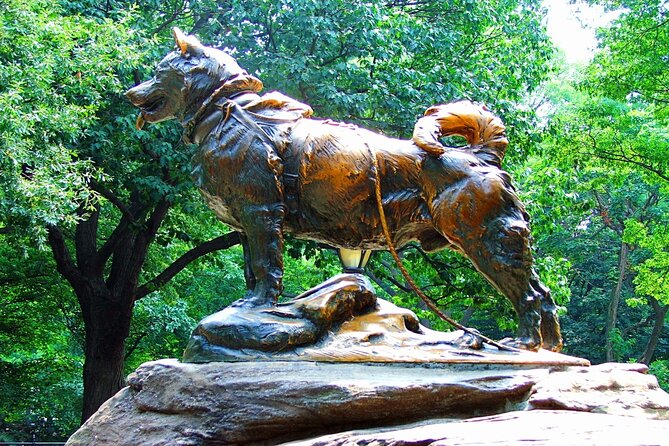
Stop 4: Balto Statue is dramatic in the best way. It honors the husky associated with lifesaving medicine deliveries in extreme Alaskan conditions, and the tour even notes that Balto attended the unveiling. It’s a reminder that Central Park isn’t only pretty—it’s also where big stories get placed.
Stop 5: The Mall and Literary Walk pulls you into the park’s more formal, statue-lined style. You’ll see figures including Shakespeare and Christopher Columbus, with audio context that explains why those names show up here.
Then Stop 6: Naumburg Bandshell brings in speakers and performances from the past and present. The tour highlights that it was built in 1923 and has hosted speeches by Martin Luther King Jr. and Fidel Castro, and that it still sees use today with free classical and jazz concerts. Even if you don’t catch a concert, this stop gives you a feel for Central Park as a civic stage.



Bethesda Terrace and Fountain: the postcard heart of the park
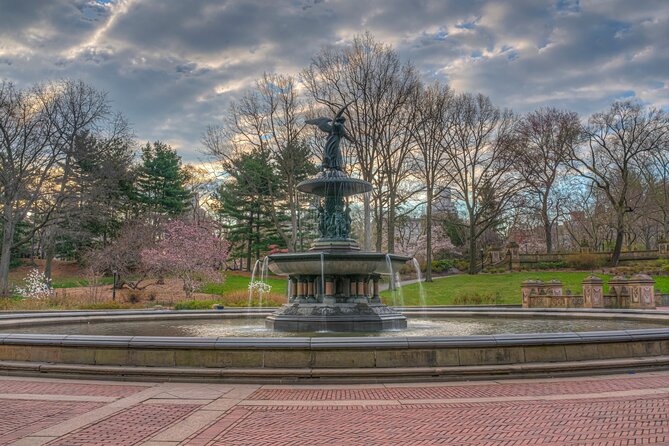
If you want the “okay, this is why people love Central Park” moment, Stop 7: Bethesda Terrace is a prime target. The audio frames it as the heart of the park’s original design, with an upper and lower layout that makes it easy to pick your favorite viewpoint.
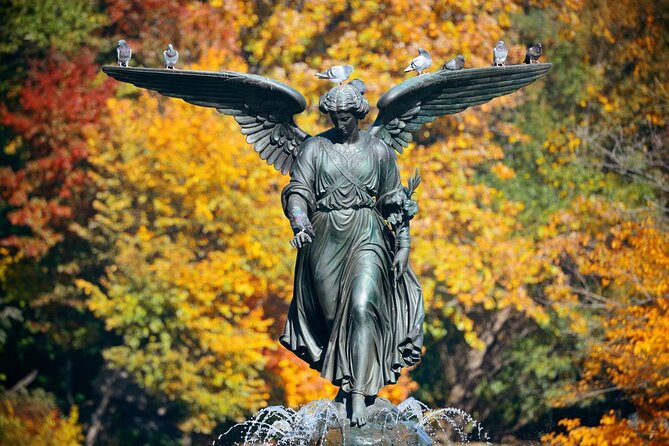
Then Stop 8: Bethesda Fountain is impossible to ignore. It’s topped by the Angel of the Waters, described as the only statue included in the original Central Park design. The fountain is also connected to Central Park’s film presence, which is a fun angle if you like recognizing famous scenes in real life.
Practical tip: this is also a great place to check your phone battery and stretch your legs, because the park can feel like one long “walk and look” until you hit this kind of natural break.
Boathouse, Andersen, and Alice: playful stops with ticket caveats
Stop 9: Central Park Boathouse / Loeb Boathouse is a mix of food, relaxation, and the working boathouse side of the park. The audio mentions it as a fine dining spot and a set location for films like When Harry Met Sally and The Manchurian Candidate. Admission is not included here, which usually means the story part is free—you just decide if you want to eat or rent a boat.
Stop 10: Hans Christian Andersen Monument connects Central Park to fairy-tale authorship. The audio also notes you might see model sailboats on the water when weather allows, which makes this a nice “linger spot” on warm days.
Stop 11: Alice in Wonderland Statue is one of the most fun things in the park for kids and adults who enjoy noticing details. The tour notes the statue was designed to be climbed on and that the polished bronze shows how well that idea worked in practice.
The Met, the Obelisk, and Hamilton: big monuments and big names
Stop 12: The Metropolitan Museum of Art is right on your walking route, and the audio gives you a quick orientation to why the Met is such a heavyweight in global art. Admission is not included, so it’s a stop for appreciating the museum presence from the park side unless you decide to go in separately.
Stop 13: The Obelisk is the “wow, that’s real” moment. The audio describes how it was moved here in 1881 and isn’t a replica. It’s also estimated to be around 3,500 years old, originally commissioned to celebrate a pharaoh’s reign.
Stop 14: Alexander Hamilton Monument rounds out this trio. The tour points out that Hamilton was a Founding Father and Washington’s right-hand man during the American Revolution—long before the Broadway-era fame.
This cluster works well because each stop changes the vibe: museum attention, ancient Egyptian scale, and then American political history.
Reservoir and Pinetum: skyline breaks and seasonal flavor
Stop 15: Jacqueline Kennedy Onassis Reservoir gives you open-space relief after so many statues and paths. The audio mentions the reservoir holds about a billion gallons of water and was once intended to supply clean water citywide. Today, it’s also about views, including a chance to admire the Manhattan skyline.
Stop 16: Arthur Ross Pinetum is all about seasonal contrast. The tour frames it as a winter solution—adding greenery when other trees lose their leaves. If you’re visiting after fall, this stop can feel extra satisfying because the park can look drab elsewhere.
These two stops are where I’d slow down. They’re scenic pauses that help you keep the tour enjoyable rather than turning it into nonstop walking.
Great Lawn to Delacorte Theater: concerts, dust memories, and theater vibes
Stop 17: The Great Lawn is a classic place to sit and reset. The audio connects it to major concerts from the past and references the nickname The Great Dustbowl when crowds churned it up. The current feel is much calmer, and it’s an easy spot for a snack break or picnic if the weather cooperates.
Stop 18: Delacorte Theater keeps the performing-arts theme alive. The tour notes this is the open-air theater for the Public Theater and that productions here are free, with visitors standing in line to get in. Even if you don’t plan to attend, the audio context helps you understand why this space matters in New York’s culture machine.
Belvedere Castle and Shakespeare Garden: viewpoint and plants tied to plays
Stop 19: Belvedere Castle is a viewpoint stop. The audio highlights that it offers unbeatable views of the park and surrounding city. It adds a fairytale touch too, which helps explain why people take photos here even when they’re not sure what else they’re doing.
Stop 20: Shakespeare Garden is the plant version of a literary tour. The audio notes the flora is drawn from William Shakespeare’s plays and poems, aiming to recreate the spirit of the English countryside tied to his life. If you’re a reader, this is a neat way to turn memory into a walking experience.
This section is especially good late in the day, when gardens and views can feel softer.
Strawberry Fields and Sheep Meadow: Lennon memory and the park’s original calm
Stop 21: Strawberry Fields is a memorial to John Lennon, and the tour explains that Yoko Ono didn’t want another statue in Central Park. Instead, the mosaic creation gives the memorial a different kind of presence.
Stop 22: Sheep Meadow is one of the park’s most honest, open-feeling spaces. The audio frames it as embodying Central Park’s early vision: a place to relax and enjoy nature away from city pressure. This is the stop where I’d consider pausing the tour, sitting for a few minutes, and letting the park do its job.
If your group is split—some want photos, some want rest—this is where you can meet everyone’s needs.
Umpire Rock and Columbus Circle: ending at the city’s edge
Stop 23: Umpire Rock is the time-travel break. The audio describes it as over 500 million years old and notes it survived when workers cleared the land for the park. It’s a good contrast to the human stories you’ve been hearing.
Stop 24: Columbus Circle is the end point, at 8th Avenue and 59th Street. The audio positions it as the boundary with a neighborhood you can explore afterward. Practically, it also makes your exit easy—you’re not stuck deep inside the park wondering how to get back.
When I finish a long walk like this, I like ending near transit and restaurants, and Columbus Circle delivers that.
When this tour shines (and when it doesn’t): who should book
This tour is best for people who like to move at their own speed. You’ll appreciate it if you want a guided structure without a group pace, and if you prefer learning through real places instead of reading plaques only.
It’s also a strong option if you plan to combine Central Park with other days in Manhattan. Since it works offline and can be started/paused, you can fit it around your schedule rather than booking a time slot for a guided group.
That said, the format depends on walking routes triggering GPS near each stop. If you’re trying to do it on electric scooters or bikes, you may find you can’t use the same paths and you’ll miss some audio points. Same idea with construction detours—if your route changes too much, the narration may lag behind your location.
One more tip: the cost can stretch further for couples. The tour info suggests that couples can share one tour by splitting headphones.
Practical tips to make it smoother on the ground
Bring headphones/earbuds so the audio is clear. Download the app while you’re on strong Wi‑Fi or cellular, because offline use depends on that download step.
If you care about hearing every story, treat this as a walking tour first. Stay on the park’s pedestrian routes so the GPS can do its job. If you do need to detour, don’t panic—pause when you’re back near the path and let the audio catch up.
Also, don’t underestimate time for photos and breaks. Even though the tour is designed to move efficiently, Central Park rewards lingering. Build in at least a few minutes for each major visual stop like Bethesda Terrace, the Fountain, or Belvedere Castle.
Finally, if you’re visiting for the first time, this kind of audio-guided walk can help you understand how all the park pieces connect. It turns a long stroll into a clear loop with story beats.
Should you book this Central Park self-guided audio tour?
Yes, if you want a low-cost, flexible way to see a lot of Central Park’s top sights without committing to a group tour schedule. It’s a good match for solo travelers, couples, and anyone who likes history told through the places themselves—while still having the freedom to pause for photos, snacks, or just to stare at the fountain a little longer.
Skip it or adjust expectations if you can’t do the walk on foot. The audio relies on you moving through the park so the GPS can trigger each stop. If you’re on scooters or bikes, plan extra time and accept that you may miss some of the story sequence.
If your goal is simple—learn what you’re looking at while you walk—this is a smart buy for $14.99, with lifetime access and offline use that makes it easy to repeat on future trips.
FAQ
How long does the NYC Central Park self-guided walking tour take?
It’s listed as about 1 to 2 hours.
Where does the tour start and end?
It starts at Doris C. Freedman Place in New York City and ends at Columbus Circle (848 Columbus Cir, New York, NY 10019).
What’s the language for the audio tour?
The tour is offered in English.
Does the tour work offline?
Yes. You’ll download the tour while you have strong Wi‑Fi or cellular, and then it works offline after that.
Do I need to buy tickets for the attractions on the route?
No attraction admissions are included. Some stops note admission is not included, so you’d need separate tickets if you want to enter.
Can I start and pause the tour whenever I want?
Yes. The app is designed so you can start, stop, and pause at your own pace.
Do I need headphones?
For the best experience, bring headphones or earbuds, since the directions and stories are audio.
Will the tour work if I’m using a scooter or bike?
This tour is designed around walking paths and location-triggered audio. If scooters or bikes can’t use the same routes, you may miss some stops because the audio triggers when you get close to each story location. The tour info also advises sticking to the tour route and speed limit.
What devices are recommended to use the tour app?
Recommended devices include an iPhone on iOS 15 or later, Android on version 9 or later, or an iPad/tablet with GPS and cellular connectivity.
What’s the cancellation policy?
You can cancel up to 24 hours in advance for a full refund. If you cancel less than 24 hours before the start time, the amount paid is not refunded.