REVIEW · NEW YORK CITY
New York City’s Financial District: A Self-Guided Audio Tour
Book on Viator →Operated by VoiceMap Audio Tours · Bookable on Viator
Wall Street gets a lot quieter with headphones. You trade random looking-around for a guided, self-paced walk through NYC’s Financial District with spot-by-spot audio. I like the start/stop flexibility and the ability to skip the stops you’re not feeling, so you can keep moving at your own pace. I also like that the audio system works offline, so you’re not stuck hunting for signal while you’re standing on a sidewalk full of tall buildings.
The main drawback to know up front: some of the content can feel surface-level if you want deep, detailed history at every corner. If you’re looking for a long, lecture-style tour, this may not satisfy—but for a quick, low-stress orientation to major Wall Street landmarks, it can be a smart use of time.
In This Review
- Key highlights worth your attention
- Why this Financial District walk works without a guide
- Getting started: VoiceMap offline, directions, and your phone reality
- The Charging Bull stop: 1989 and the surprise-install angle
- The Federal Reserve area: monetary policy plus the gold vault detail
- Museum of American Finance: what you’ll learn before you even enter
- 1842 neoclassical architecture: Parthenon and Pantheon references
- How long the route takes and how to pace your 30 minutes
- Price and value: is $8.99 a good trade in NYC?
- Who should book this Financial District audio tour?
- Should you book this self-guided Financial District audio tour?
Key highlights worth your attention
- Skip what you don’t care about and run the tour on your schedule, not on a group schedule.
- Offline audio + offline maps mean you can keep walking even with spotty mobile service.
- Charging Bull comes with the 1989 backstory, including how the statue appeared without permission.
- A gold vault detail at the Federal Reserve puts a surprising number on what’s under the street.
- Museum stop inside a landmark building completed in 1842 with classical architecture references.
- Lifetime access lets you repeat it later without paying again.
Why this Financial District walk works without a guide
NYC’s Financial District looks simple until you try to understand it. That’s where a short audio route helps. You’re walking past institutions that feel untouchable, but the tour gives you plain-English context so you’re not just taking photos of big doors and bank-name signage.
This format is especially good here because the area is dense and very walkable for a quick loop. You can pause when you spot something interesting, then continue when you’re ready. And if you decide Charging Bull is your thing but the rest isn’t, you can skip ahead instead of feeling locked into a strict script.
One more thing I appreciate: the tour is designed as a GPS-style self-guided experience, so you spend less time figuring out where to go next and more time actually looking around. That matters on Wall Street, where even getting your bearings can take longer than you expect.
You can also read our reviews of more tours and experiences in New York City.


Getting started: VoiceMap offline, directions, and your phone reality

You start at National Museum of the American Indian, 1 Bowling Green, New York, NY 10004 and the walk ends at Total Bid Data Corp, 48 Wall St, New York, NY 10005. The direction details are included, which helps a lot when you’re arriving in an area that can look maze-like at street level.
The experience uses the VoiceMap application, and you get offline access to audio, maps, and geodata. Translation: you can load your route once, then rely less on mobile data while you’re out there. That’s a big deal on Lower Manhattan, where reception can be unpredictable and you don’t want your tour to depend on bars.
Two practical points for your setup:
- Bring a charged smartphone. The smartphone itself isn’t included.
- Plan for headphones or speaker volume you can control. Being able to clearly hear narration is what turns a quick walk into a meaningful one.
Also, it’s listed as a private activity, meaning it’s set up so only your group participates. That’s a small comfort in a crowded area, because you’re not stuck trying to listen around strangers.
The Charging Bull stop: 1989 and the surprise-install angle
Most people know the Charging Bull statue by sight. The tour’s value is that it gives you the story behind why that specific bull ended up here—and why it still draws attention today.
At this stop, you hear about how the statue was installed in 1989, and the twist is that it was placed by surprise and without permission. That detail changes how you look at it. Instead of seeing it as just a photo stop, you start seeing it as a symbol with a beginning that was more chaotic than ceremonial.
Why this matters in a self-guided format: you’re free to spend a few minutes here even if the crowd noise changes. You can stand back for the photos, then step closer when the audio makes the point. If you’re the type who likes facts you can repeat, this is the kind of story you’ll remember when you’re later telling someone where the bull came from.
One caution: like any famous sculpture on Wall Street, you may be sharing space with other people. The audio helps, but you’ll still want to be patient while you find a spot where you can actually hear.
The Federal Reserve area: monetary policy plus the gold vault detail
After you move on, the audio shifts to one of the most important financial institutions in the U.S.: the Federal Reserve. You’ll hear that it sets monetary policy that guides the country’s economy, which is the big-picture anchor for the Financial District. Without that context, many nearby sites feel like they’re just labels on buildings. With it, the walk starts to make sense.
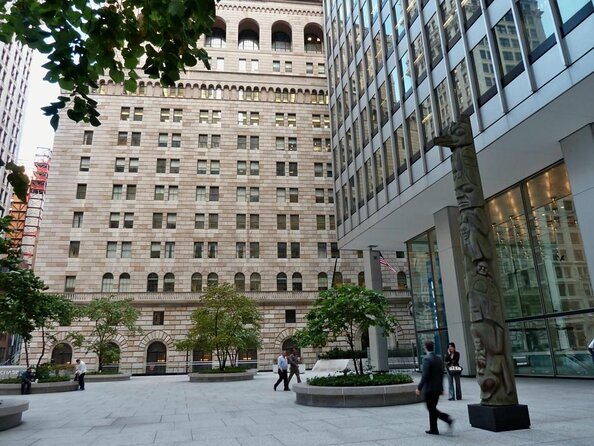
Then comes one of the most striking details: the tour notes that the Federal Reserve contains the largest reserve of gold in the world, and that the vault sits 80 feet below street level, directly on Manhattan bedrock. Even if you don’t care about gold, that number gives you a physical sense of what’s happening underground.
This is also a good moment to look at the area with a different mindset. Wall Street can feel like performance—traders, screens, headlines. The tour nudges you toward infrastructure: policy, storage, and systems that operate on a schedule that has less to do with what you see from the sidewalk.
Reality check: you’re not told you’re going inside secure areas. This is still an outdoor walk with audio context. So keep your expectations aligned with what you can actually observe.
Museum of American Finance: what you’ll learn before you even enter
Next, you get directed toward the Museum of American Finance, described as an independent institute that preserves and exhibits historical media related to American finance. It’s also listed as an affiliate of the Smithsonian Institute—which is a helpful credibility marker if you like museums with recognized institutional ties.
In the Financial District, it’s easy to assume museum stops are optional or far away. This one is positioned right where your walk already is, so it feels built into the neighborhood rather than tacked on.
What I find useful here is the framing. Instead of treating finance like pure math or just modern news, the audio points you toward media—ways people captured and explained money over time. That can make your later reading or exploring more interesting, because you start recognizing finance as a story people have been telling for centuries.
If you’re an investor or just finance-curious, this is one of the most satisfying stops. The tour doesn’t try to turn you into a banker overnight. It just gives you enough grounding to make the museum feel worth your time.






1842 neoclassical architecture: Parthenon and Pantheon references
One of the most memorable parts of this audio walk isn’t about markets at all—it’s about the building itself.
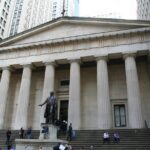
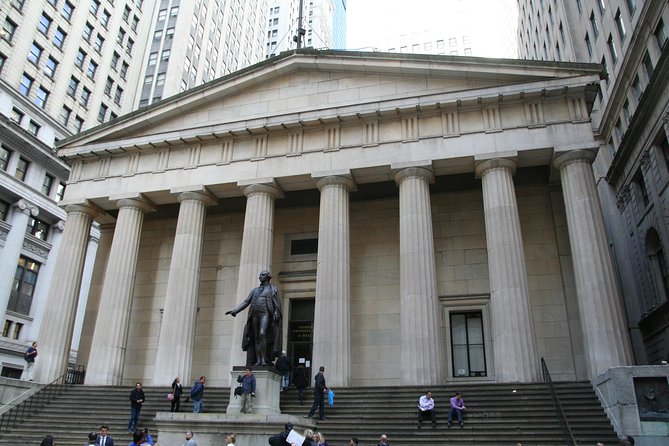
The tour highlights that the current structure was completed in 1842 and features a facade reminiscent of the Parthenon in Athens. Inside, it notes a domed interior rotunda modeled after the Pantheon in Rome. Even if you’ve seen classical architecture elsewhere, this kind of comparison helps you look with intention instead of treating the building like a generic historic shell.
Practically, this also changes where you stand. You’ll likely find yourself pausing for a better look at lines, columns, and proportions, because the audio is telling you what to notice. That makes a short tour feel longer, because you’re not rushing through a list of stops—you’re getting prompted to observe.
Potential drawback: if you’re expecting deep, minute-by-minute art history, the audio may not go that far. But as a way to connect major landmarks to recognizable architecture references, it works well. You end up with mental hooks you can carry around.
How long the route takes and how to pace your 30 minutes
The walk is designed for about 30 minutes (approx.). That time window is ideal if you want a quick orientation without turning your Lower Manhattan day into a long slog.
Here’s how I recommend pacing it:
- Plan to spend your “real time” on the stop that interests you most (Charging Bull or the museum area).
- Use the rest as context-building stops. You don’t need to linger if you’d rather keep moving.
- If the sidewalk crowd thickens, pause your attention, then let the next audio segment pull you back in.
One perk of the self-guided setup is that you can start and stop anytime. That’s not just convenience. It lets you sync the tour to your day—before lunch, after a subway hop, or during a window of good weather.
Also, the tour is listed in English. If you’re comfortable with standard English narration, you’ll likely find it easy to keep up as you walk.
Price and value: is $8.99 a good trade in NYC?
At $8.99 per person, this isn’t trying to replace a full guided tour. It’s priced like a tool: short, practical, and designed to work immediately.
So the key question is value for your needs. For me, the value is highest if you:
- Want a compact walk focused on major Financial District landmarks
- Like the idea of repeating the experience later using lifetime access
- Prefer learning through audio while you’re already on your feet in the neighborhood
Where it may disappoint is if you expect a large amount of content for the price. The tour can feel quick, and the information may land as a basic overview rather than an exhaustive education. If that’s your style, you’ll probably be happiest with this as a first pass—something you do once to get oriented, then build on later with your own reading.
A final value note: the app includes offline maps, geodata, and audio, which reduces the “hidden cost” of data roaming or dead-signal frustration. In a place like NYC, that’s not a small thing.
Who should book this Financial District audio tour?
This tour fits best if you like:
- Short walks with clear stops and no schedule stress
- Learning on the go with audio you control
- Flexibility, including skipping stops and moving at your own pace
It’s also well-suited to groups who want independent listening. One of the highlights from feedback was that a family of four could hear the narrator through a single device, which points to an easy tech setup in real life.
If you’re the type who wants maximum depth at every site, you might end up feeling slightly underfed. For that style of traveler, I’d treat this as a starter course rather than the only course.
Should you book this self-guided Financial District audio tour?
I’d book it if you want an efficient, low-friction way to connect big-name Wall Street landmarks to a few memorable facts—especially if you like flexibility and offline audio. For $8.99 and about 30 minutes, it’s the kind of add-on that can make an otherwise standard walk feel purposeful.
Skip it (or pair it with something else) if you’re chasing deep, detailed explanations and long museum-level storytelling. The route works best as a quick orientation to the Financial District’s most recognizable touchpoints.
If your plan is to spend a limited chunk of time in Lower Manhattan and you want your walk to come with context, this is a solid bet.