REVIEW · NAPLES
Pompeii from Naples: Smart Audio Guide with Travel Instructions
Book on Viator →Operated by TWD · Bookable on Viator
One app can turn Pompeii into a self-paced day. The Smart Audio Guide uses GPS to guide you from site to site on your phone, with photos and history-style explanations—so you’re not stuck waiting for a group. I like that the route is built for you, starting from Naples, and it fits the kind of day you want: calm, clear, and on your timing.
What I really liked is the flexibility: you can pause longer where you care (like frescoes and villas) and speed through parts you don’t. The one thing to plan for is phone dependence—this is a mobile app, so you need active roaming or data to keep the GPS guidance working while you’re there.
In This Review
- Key highlights
- Naples to Pompeii without the herding feeling
- Price and value: what the $24.10 really buys
- The Smart Audio Guide: how it keeps you on track
- Villa dei Misteri to Temple of Jupiter: religious Pompeii, up close
- Forum, Basilica, and Santuario di Apollo: how power worked
- Lupanar, Teatro Grande, Amphitheatre: the human side of ruins
- Villas and neighborhoods: baths, sports, rentals, and daily life
- Pompeii homes: Faun, Dioscuri, Meleagro, Vettii, Menander
- Torre di Mercurio XI and Centauro di Igor Mitoraj: past meets later art
- Timing, mobility, and what to carry (based on the experience setup)
- Should you book this Pompeii smart audio guide from Naples?
- FAQ
- How long is the Pompeii experience from Naples?
- What’s included in the price?
- What’s not included?
- Do I need mobile data or roaming on my phone?
- Is pickup available from Naples?
- Is this a private tour?
Key highlights
- GPS step-by-step directions that help you move between major Pompeii sights without guessing
- Flexible pacing so you don’t feel trapped in a slow group
- Photos + clear site info that makes ruins easier to read in the moment
- Round-trip Naples to Pompeii guidance explained inside the app
- Human help on WhatsApp available non-stop during the experience window
- A private setup so it’s just your group, not a crowd of strangers
Naples to Pompeii without the herding feeling

Pompeii can be intense. Even when you know the big names—forums, baths, theaters—the paths through the site can feel confusing if you don’t have a plan. This experience is built around a simple idea: give you a personal route and then let you follow it with a phone guide.
You start in Naples, and the day is designed as a 1-day Pompeii visit with a customized itinerary. Pickup is offered, and there’s also mention that it’s near public transportation, which matters if you’re trying to keep your day smooth without overthinking transit. Once you’re in Pompeii, you don’t have to wait for one perfect start time and one slow-moving group rhythm.
The result is a day that feels more like studying and less like rushing. And that’s a big deal at Pompeii, where you’ll be staring at stones and wall fragments that only make full sense when you know what you’re looking at.
You can also read our reviews of more tours and experiences in Naples.


Price and value: what the $24.10 really buys
At $24.10 per person, you’re mostly paying for three things: the smart audio app, the customized route, and the guidance support. You also get mobile-ticket access (per the experience details), plus travel instructions for the round trip from Naples and back.
What’s not included is the stuff you’d expect for a major site visit: entrance and public transportation tickets around €30, and food and drink. That split is important for budgeting. The app doesn’t replace the official entry ticket, but it does help you use the time you pay for more efficiently.
If you’re the type who likes to stop and read, take a second look, and move at your own speed, this is good value. If you want a full live guide leading every detail in a single spoken track, you might find an audio-first approach less satisfying. Still, for many people, the combination of GPS directions plus on-phone explanations is exactly the practical sweet spot.
The Smart Audio Guide: how it keeps you on track

This is the core of the experience, and it’s worth understanding how it helps in real time.
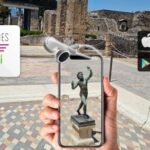
The app uses GPS to locate where you are, then guides you step by step to each attraction. That sounds basic until you’re standing inside Pompeii, where signage can be hit-or-miss and ruins don’t always scream their function from ten feet away. The audio includes site information plus pictures, so when you’re looking at a wall or a floor outline, you can connect it to what the site used to be.
Two practical points matter a lot:
- You get access to the app before the tour, which helps you get your bearings early.
- You can use one Smart Audio Guide on multiple phones at the same time (handy for couples, friends, or families).
Also, there’s an included WhatsApp channel with a human assistant available non-stop. That’s not a guarantee you’ll need help, but it’s a nice safety net if your phone battery gets low, your GPS feels stubborn, or you’re trying to confirm the next stop.
And again: make sure your phone has roaming or data, because this is a mobile app meant to work while you travel.
Villa dei Misteri to Temple of Jupiter: religious Pompeii, up close

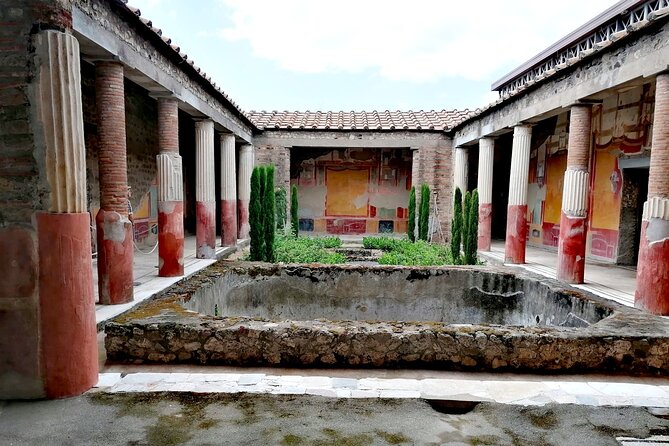
Your day kicks off with Villa dei Misteri, known for its frescoes. These aren’t random decorations; the paintings cover multiple rooms and relate to rituals and myths tied to the cult of Dionysus. The benefit of the audio guide here is obvious. Fresco scenes can look like dramatic fragments until someone explains what they’re showing and why that matters. With photos in the app, you can match the explanation to what you’re seeing in front of you.
Next is the Forum of Pompeii, a large rectangular public space around 38 by 142 meters. The forum was paved and surrounded by important civic and religious buildings, plus temples and statues. This is where the ruins become a map of daily life: the “center” of civic power and social routine. A phone guide helps you read the layout as you move, rather than just wandering through big-open stone.
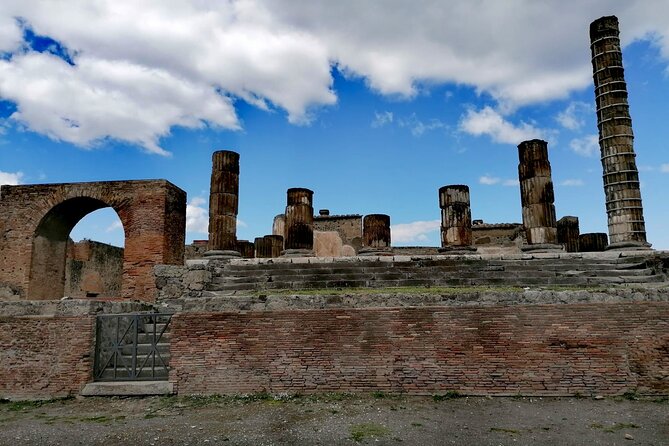
Then comes the Temple of Jupiter. The key detail here is evolution. It was originally dedicated to Jupiter, and later it became a Capitoline Triad temple—dedicated to Jupiter, Juno, and (by reference) the triad’s companion deity. For you, that means the audio guide can turn a temple foundation into a story about how belief and political identity changed over time.
Tip for pacing: at these first stops, give yourself time to look up and orient. Pompeii’s clues often sit in proportions—room sizes, open courtyards, and building relationships—not just on plaques.
Forum, Basilica, and Santuario di Apollo: how power worked

After the forum, you’ll head to the Basilica, a kind of public building in Roman cities. In Pompeii, it functioned as a gathering place for civic and commercial life—think law court and marketplace energy, not just worship. The basilica’s value to you is how it helps you understand that Pompeii wasn’t only temples and homes. It was a working city with rules, business, and crowd movement.
Then you visit Santuario di Apollo. This temple area is described as having a portico and a peristyle, creating a formal courtyard space for rituals and gatherings. The audio guide’s pictures help here because the “shape” matters. You’re not just staring at one isolated structure; you’re trying to picture how the sanctuary formed a space for processions, meetings, and ceremonies.
One small drawback to keep in mind: the experience suggests about 30 minutes per major stop on the route. If you’re a very slow reader, you might want extra time at the sites that feel most meaningful to you. The good news is the format is flexible, so you can linger where the audio is clicking for you and shorten where it doesn’t.





Lupanar, Teatro Grande, Amphitheatre: the human side of ruins

Pompeii’s shock value isn’t just the catastrophe story. It’s how human the city looks when you know what you’re seeing.
The Lupanar (Pompeii’s main brothel, also called Lupanare Grande) is one of the most famous structures in the city. It offers unique insight into Roman attitudes toward sexuality. You may feel a little awkward stepping into a building like this, but that’s part of what makes it useful. The audio guide can keep the context clear so you don’t just treat it like a photo-op.
From there, you’ll reach the Teatro Grande, which could seat roughly 5,000 to 6,000 spectators. That scale matters. Pompeii isn’t small—it’s a whole city, and entertainment wasn’t a side activity. With the audio, you’re better able to imagine events happening where you’re standing.
Then you’ll visit the Amphitheatre of Pompeii (Anfiteatro di Pompeii), described as the oldest surviving stone amphitheater in the Roman world and built around 70 BCE. If you’ve ever watched clips of Roman shows in documentaries, this is where the “Roman world” stops being abstract. You’re seeing an early version of the amphitheater form, preserved in stone enough that you can grasp its purpose.
Balanced reality check: Pompeii’s darker topics and entertainment venues are part of the story. The value of a guide format like this is you get explanations without the awkwardness of group chatter. You can listen, take in the context, and then move on.
Villas and neighborhoods: baths, sports, rentals, and daily life

Pompeii shines hardest in the domestic spaces—houses, courtyards, bath buildings—because they show how people lived when the city was whole.
One highlight is Praedia di Giulia Felice, named after its owner. The detail that really lands is the inscription found during excavations: Julia Felix’s name appears on a property rental advertisement. It’s a reminder that Pompeii wasn’t only lived-in by the wealthy. It had rentals, business arrangements, and property identity.
Then you’ll hit the Stabian Baths (Terme Stabiane). The key point here is age and continuity. They’re believed to be among the oldest baths in the Roman world, with initial construction dating back to the Samnite period—before Roman control. Over time, the baths changed, but the basic function stayed: a daily rhythm of washing, meeting, and social life.
After that, there’s the Palestra Grande, a public athletic training and exercise space with social activity baked into the architecture. This stop is a great reminder that Romans didn’t treat fitness as a hobby. It was part of public life and identity.
If you’re doing Pompeii in one long day, these stops help break up the emotional intensity. Bath space and athletic yards can feel almost refreshing compared with temples and theaters, because you get a clearer sense of routines.
Pompeii homes: Faun, Dioscuri, Meleagro, Vettii, Menander
This section is where many people get their “oh wow” moment, because Pompeii house ruins can feel surprisingly readable when you know what to look for.
- Casa del Fauno: famous for the bronze statue of a dancing faun found in the impluvium (rainwater basin) of the Tuscan atrium. The audio guide helps you link the name to the architectural feature—the basin and the atrium layout are what make the statue discovery meaningful.
- House of the Dioscuri: named for the Dioscuri, twin protectors of sailors tied to strength. Even when you’re not looking at a dramatic entrance, the naming clue gives you a reason to pay attention to where myth shows up in domestic decoration.
- Casa di Meleagro (Meleagri domus): noted for a well-preserved atrium and highly decorated walls, plus a large peristyle with a colonnaded courtyard. The peristyle is a major visual anchor. With photos in the app, you’ll know whether you should focus on the courtyard structure or the rooms around it.
- Casa dei Vettii: tied to inscriptions naming freedmen owners, Aulus Vettius Conviva and Aulus Vettius Restitutus. This makes the house feel specific, not generic. You’re looking at evidence of who owned and lived there, not just an “old house.”
- Casa del Menandro: known for finds including a treasure hoard of over 100 silver items found in a storage room. That kind of detail turns the house from a set of walls into a story about wealth, storage, and what people kept close.
A practical thought: houses can be the most time-consuming part of Pompeii because there’s so much to interpret. The good thing is the app’s structure keeps you from feeling lost. The potential drawback is you might wish you had more time because these stops are often the ones you’ll keep thinking about afterward.
Torre di Mercurio XI and Centauro di Igor Mitoraj: past meets later art
Two final stops add a slightly different flavor.
Torre di Mercurio XI is described as possibly multi-story, with upper living quarters and ground-floor commercial space like shops or workshops. Even if only parts of the structure survive, that description gives you a useful lens: Pompeii mixed living and business in the same neighborhoods.
Then there’s Centauro di Igor Mitoraj, a sculpture by the Polish artist Igor Mitoraj exhibited in Pompeii. Mitoraj’s work is described as evoking classical themes through modern interpretation. For you, this is a chance to step back from ancient stone and see how modern artists still “read” antiquity. It can feel like a breather—useful if you’ve been moving from one intense site to the next.
Timing, mobility, and what to carry (based on the experience setup)
This experience lists 8 to 10 hours total, which lines up with a Pompeii day that includes movement between the major sights and time at each stop. The itinerary’s stop durations are listed as about 30 minutes each (with a couple around 20 minutes), but your freedom to linger is a real part of the design.
The experience also flags moderate physical fitness. You should assume you’ll be walking a lot on uneven archaeological ground and navigating in an ancient layout. If your mobility is limited, plan carefully; the route is designed as a full-day, site-to-site circuit.
Since the guide is on your phone, also plan for basics:
- fully charged battery (think power bank)
- data/roaming working before you arrive
- comfortable shoes
If you run into trouble, there’s support through a human assistant on WhatsApp, non-stop during the activity—so you’re not completely stuck if your phone GPS acts up.
Should you book this Pompeii smart audio guide from Naples?
Book it if you want a self-paced Pompeii day with clear direction and strong on-phone explanations. This is especially good for couples or small groups who don’t want a crowded group tour but still want structure. The GPS step-by-step guidance reduces stress, and the photos help you interpret what you’re seeing, even when the ruins are fragmentary.
Consider skipping it (or pairing it with something else) if you’re the kind of traveler who needs a live voice all the way through, or if you’re worried you won’t be able to keep your phone connected. The mobile app approach works best when your phone can stay online and charged.
FAQ
How long is the Pompeii experience from Naples?
The total duration is listed as about 8 to 10 hours.
What’s included in the price?
You get the Smart Audio Guide (customized mobile app with GPS guidance, photos, and site information), travel instructions for the round trip from Naples and back, access to the app before the tour, and non-stop help via a human assistant on WhatsApp.
What’s not included?
Entrance and public transportation tickets are not included (estimated around €30), and food and drink are not included.
Do I need mobile data or roaming on my phone?
Yes. The guide is a mobile app, so you need active roaming or data to use it while traveling.
Is pickup available from Naples?
Pickup is offered.
Is this a private tour?
Yes. It’s a private activity, so only your group participates.
If you want, tell me your travel month and whether you prefer early mornings or late afternoons, and I’ll help you choose the best pacing plan for Pompeii using this stop order.