REVIEW · PALM SPRINGS
Death Valley National Park Self-Guided Audio Tour
Book on Viator →Operated by Shaka Guide Apps · Bookable on Viator
Death Valley reads like a movie set. This self-guided audio tour strings together the park’s top sights with offline GPS narration and road-curve warnings as you drive. One catch: the on-site commentary at each stop can be a bit brief, so you’ll want to linger if you’re the type who hates rushing.
I like that the price is built for a carload: $12.79 per group (up to 15), not per person. You also get real flexibility—you can start, pause, and skip stops—so the day works even if your group moves at different speeds.
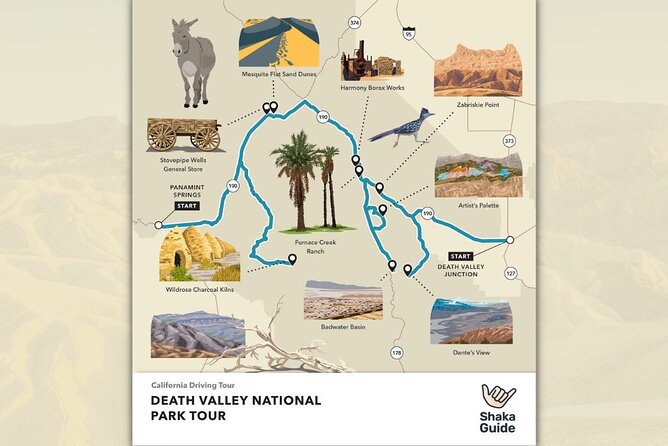
The route is designed for a long road-trip block (about 6 to 8 hours). You’re driving your own vehicle, and the tour starts back at Death Valley Junction, with an optional West Entrance start near Panamint Springs.
In This Review
- Key Highlights You’ll Feel Right Away
- Price and Value: One Low Cost for a Whole Vehicle
- Offline GPS Audio: How It Works in the Real World
- Your Self-Guided Route Through Death Valley’s Best Mix
- Emigrant Canyon Road: Journigan’s Mill, Wildrose Campground, Charcoal Kilns
- Sand Dunes and the Arrowweed Surprise: Mesquite Flat and Devils Cornfield
- Salt Creek Pupfish Boardwalk and Harmony Borax Works
- Furnace Creek Setup: Visitor Center and The Ranch for Food and Fuel
- Devil’s Golf Course, Badwater Basin, and Natural Bridge: Salt and Rocks Up Close
- Artists Drive: One-Way Twisties and Artists Palette Color
- Golden Canyon Trailhead: A Real Hike Option (Red Cathedral)
- Zabriskie Point and Dante’s View: Steep Walks to Big Payoffs
- Dirt-Road Detours: Mustard Canyon and Twenty Mule Team Canyon
- What I Think Makes This Tour Work (and for Who)
- Should You Book This Death Valley Self-Guided Audio Tour?
- FAQ
- How long is the Death Valley audio tour?
- Where does the tour start?
- Do I need cell service or Wi-Fi during the tour?
- Is the tour private for my group?
- What does the tour cost?
- What language is available?
- What is included in the audio experience?
- Are meal stops and park entrance fees included?
- Do I have to use it on one specific day?
Key Highlights You’ll Feel Right Away
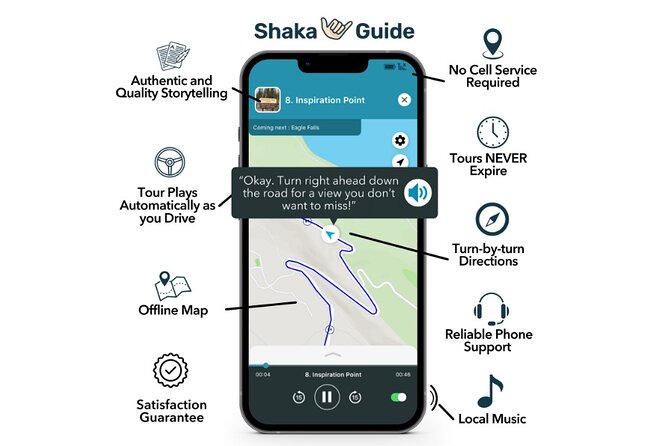
- Offline audio and offline maps so you’re not stuck hunting for service
- Turn-by-turn GPS directions that trigger narration automatically while you drive
- Free, no-pressure stop plan across classic Death Valley highlights
- Mix of quick photo stops and short walks (from boardwalks to a 3-mile canyon hike)
- Great for sunset and stargazing at Mesquite Flat Sand Dunes and Dante’s View
- Historic stops like Harmony Borax Works and the Charcoal Kilns
Price and Value: One Low Cost for a Whole Vehicle
At $12.79 per group (up to 15), this tour is unusually cost-friendly for Death Valley. Most people are paying for transportation anyway, so the logic here is simple: you get one tour per group, and your vehicle can be the “group.”
If you’re traveling with family or friends, that per-group pricing can feel like a bargain—especially on a park day where you might spend more on meals and entrance add-ons. Just note that the optional $30 per vehicle park entrance fee is not included in the tour price, along with any optional parking fees and optional meals.
You can also read our reviews of more tours and experiences in Palm Springs.


Offline GPS Audio: How It Works in the Real World
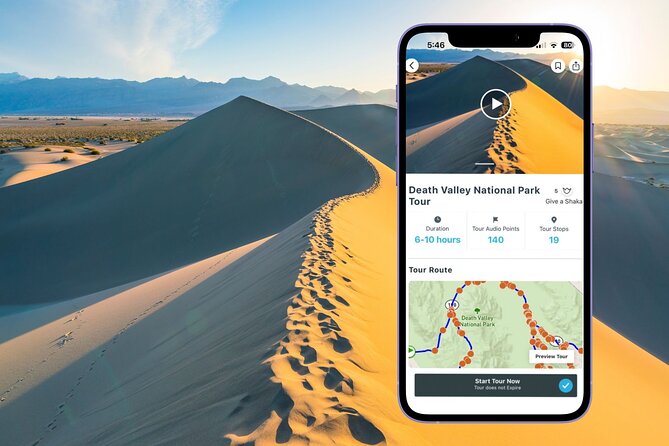
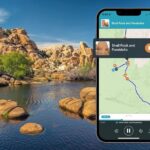
This is a mobile app-based experience (Shaka Guide Apps) with an offline audio track. You download the tour first using strong Wi‑Fi, then the narration and map are available with no continuous data or Wi‑Fi needed.
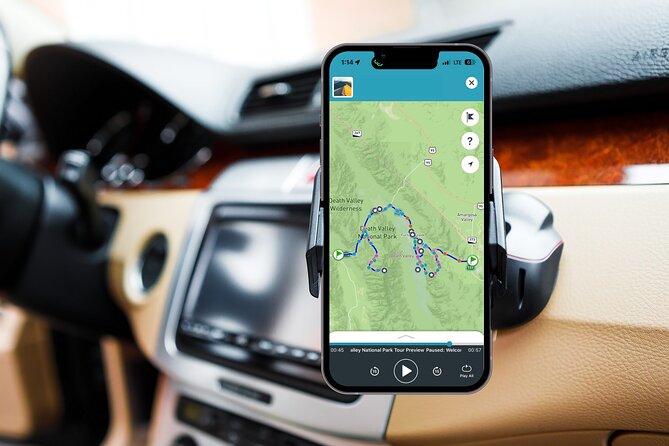
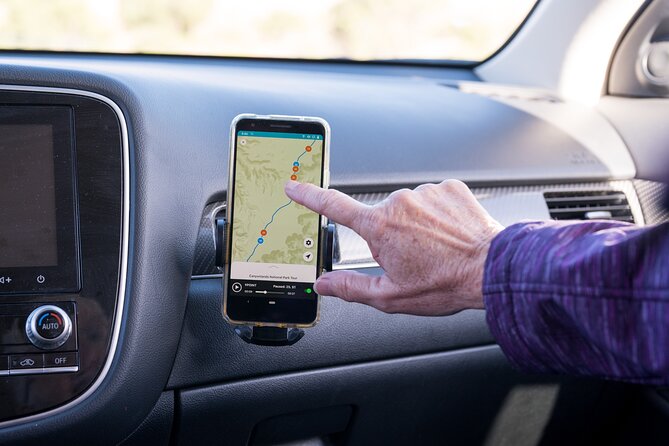
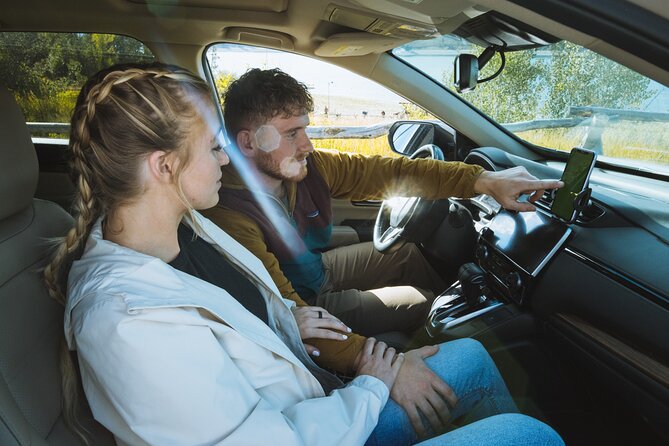
Here’s the practical part you’ll care about in Death Valley: narration plays automatically as you drive, and the app uses GPS turn-by-turn directions. You’re not trying to read a screen at 45 mph on a desert road. It also includes travel tips and music, plus warnings tied to upcoming roads and curves.
One small drawback that matters: at some sites, you may finish the audio segment quickly and want more. The good move is to use the audio as the “start signal” and then add your own time for photos and a slow look around.
Your Self-Guided Route Through Death Valley’s Best Mix
Your outing is built as a loop-style drive through classic stops: mining history, desert ecology, major viewpoints, and salt-flat icons. The timing is flexible because each stop includes a suggested window, and you can skip what doesn’t fit your day.
Typical stop lengths range from 5 minutes up to about 1 hour for the Golden Canyon hike. Plan your day like a road-trip: some stops are quick hits, some include short walks, and a few involve dirt roads where current conditions matter.
Emigrant Canyon Road: Journigan’s Mill, Wildrose Campground, Charcoal Kilns
This early stretch is ideal if you like history that’s not polished into a museum gift shop.
Stop 1: Journigan’s Mill
It’s a former processing plant with foundations, empty tanks, and relics left from the early 20th century. There’s no big modern interpretive setup here—what you’ll get is texture. If you’re a photographer, the skeletal shapes can make strong, moody images.
Stop 2: Wildrose Campground
This was a Civilian Conservation Corps campground. You’ll be able to stretch your legs and walk among remaining buildings right off the road. It’s short but it breaks the driving rhythm nicely.
Stop 3: Charcoal Kilns
Ten beehive-shaped charcoal kilns sit in a row in the Panamint Range. The audio gives you the story, and if you step inside one, you may still catch a whiff of charcoal.
Practical note: these early stops are quick, so if you want longer photo breaks, you’ll need to intentionally budget extra minutes.
Sand Dunes and the Arrowweed Surprise: Mesquite Flat and Devils Cornfield
This is the part of the route that feels most like a classic Death Valley postcard—plus it’s one of the best for light and sky time.
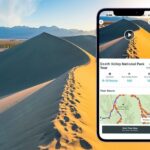
Stop 5: Mesquite Flat Sand Dunes
You can view the dunes from the parking area, but the fun starts when you walk onto the sand and wander among mesquite trees. This is a top pick on the schedule for sunset and stargazing—so if you care about evening light, build the timing around it.
Stop 6: Devils Cornfield
Not much looks normal here, and that’s the point. A patch of arrowweed grows in a way that appears like corn in a field. The parking area is small, but it keeps the look safe and contained.
If you only do one “walk for pictures” stop, this pair is a strong choice.

Salt Creek Pupfish Boardwalk and Harmony Borax Works
After the dunes, this section shifts gears: wetlands, wildlife, and mining-era industry.
Stop 7: Salt Creek Interpretive Trail
A 0.5-mile boardwalk follows the wetland area. It’s down a dirt road and reads as an easy walk, not a strenuous hike. The key detail is that Salt Creek is a critical watering hole for critters, and it’s home to the endangered Salt Creek Pupfish. Even if you don’t spot wildlife, the boardwalk format keeps the experience simple and accessible.
Stop 8: Harmony Borax Works
This is the remains of the earliest borax operation in Death Valley. You’ll see placards interpreting buildings and mechanisms, plus you can view one of the wagons pulled by the famous 20-mule teams. It’s short (about 15 minutes), but the audio context helps you understand what you’re looking at.
If you like human history—how people actually processed natural resources—this stop is a solid payoff.
Furnace Creek Setup: Visitor Center and The Ranch for Food and Fuel
Before the salt flats and big viewpoints, you’ll pass through the park’s “services hub” zone.
Stop 10: Furnace Creek Visitor Center
This is the go-to place for information, with flush toilets, a water refill station, and a museum focused on Death Valley’s natural and human history. It’s also an easy reset point if your group splits up briefly.
Stop 11: The Ranch at Death Valley
If you want a meal or gasoline inside the park, Furnace Creek is the main option. Prices here are higher, but you get an ice cream parlor, a buffet-style restaurant, and a Wild West-themed saloon. There’s also a General Store for souvenirs and a small grocery section, plus a Borax Museum option if you want more mining history.
Even if you don’t eat, this is the best place to top off water using the refill station and keep your day running smoothly.
Devil’s Golf Course, Badwater Basin, and Natural Bridge: Salt and Rocks Up Close
Now you hit the famous Death Valley wow-factor, and the route makes sure you get both views and short walking time.
Stop 12: Devil’s Golf Course
Salt flat shapes cover the ground, and there’s no established trail. You’ll want sturdy shoes if you step in, because the salt can hurt. Think of it as short-time exploration, not a long wander.
Stop 13: Badwater Basin
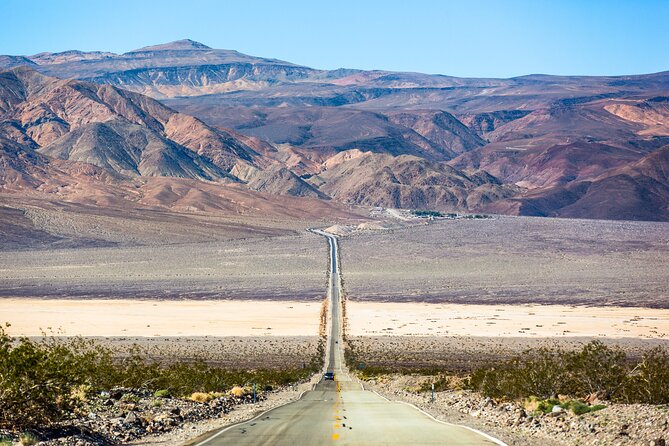
This is the lowest point in North America, and it’s the emotional peak of many Death Valley days. There’s a boardwalk by the parking lot, and you can also walk into the salt flats on the Badwater Basin trail. The audio suggests about a mile in to reach more intricate geometric shapes, which makes this a rough 2-mile round trip if you go that far.
If you only do one “walk a little deeper” moment, this is the one—because the salt formations change as you move.
Natural Bridge Trail
There’s a short hike to the natural bridge rock formation. The trail is flat, but rocky, and it’s about 1 mile round-trip.
If your group wants variety—salt shapes, a bridge formation, and a manageable walking effort—this cluster is well designed.
Artists Drive: One-Way Twisties and Artists Palette Color
Stop 15: Artists Drive is a one-way road that climbs toward the Black Mountains through a tight desert canyon. The road itself is fun, but the real reason you’re here is Artists Palette, where minerals color the rock into a colorful cliff you can explore on foot.
This is a good break between the bigger walking stops. Even if you don’t hike far, the drive and the short walk give you a strong visual reward.
Golden Canyon Trailhead: A Real Hike Option (Red Cathedral)
This is the longest active moment in the route.
Stop 16: Golden Canyon Trailhead
You’ll walk through a canyon that feels lifeless and stark, heading toward Red Cathedral, with a route of about 3 miles (5 kilometers) round-trip. The total suggested time is about 1 hour, but your group’s pace matters here.
If you want an honest-to-goodness hike rather than just viewpoints, this is the stop that delivers.
Zabriskie Point and Dante’s View: Steep Walks to Big Payoffs
These are classic overlooks, with short walks but real steepness.
Stop 17: Zabriskie Point
You’ll see rock formations and get iconic views. The walk from the parking lot to the overlook is short and paved, but it’s steep. This spot also has film history and a connection to U2’s Joshua Tree album cover.
Stop 19: Dante’s View
Dante’s View is dramatic because you’re ascending over 5,000 feet above Badwater Basin. On clear days, the audio notes you can see the Sierra Nevada and even Mt. Whitney in the far distance. It’s also a favorite for sunset and stargazing.
If your group likes “one last big vista” at the end of the day, this stop fits that role perfectly.
Dirt-Road Detours: Mustard Canyon and Twenty Mule Team Canyon
Not every part of Death Valley is paved. This route includes two detours that are worth considering, as long as you treat them like dirt roads.
Mustard Canyon (Stop 9, no official stop)
You can take a detour into a small canyon with an unusual yellow tinge. The audio specifically tells you to check current road conditions before driving. In normal circumstances the road is reasonably maintained but bumpy, and it’s not advisable for low-clearance vehicles.
Twenty Mule Team Canyon (Stop 18, no official stop)
Like Mustard Canyon, this is another dirt-road detour into a tightly curving canyon. Again, check current conditions first. It’s typically reasonably maintained but still bumpy, and not for low-clearance vehicles.
If you’re traveling with a low-clearance car, skip these detours. The main paved and boardwalk stops already cover the big hits.
What I Think Makes This Tour Work (and for Who)
This audio tour shines when you want a plan that’s structured but not controlling. You get free stops, suggested time windows, and GPS directions that reduce stress. You also get both quick hits and a couple of real walking moments, so the day doesn’t feel like nonstop staring out a windshield.
I’d strongly consider booking if:
- You like driving your own pace but want context while you do it
- Your group has mixed interests (history plus viewpoints plus a few short walks)
- You care about offline reliability, since the tour is designed to work without service once downloaded
I’d think twice if:
- You want very deep, stop-by-stop interpretation that you can linger with for long stretches
- You prefer a live guide style where every question gets answered on the spot
Should You Book This Death Valley Self-Guided Audio Tour?
Yes, if you want the best Death Valley mix in one day, without worrying about cell service or timing a guided group. The value math is strong for carloads, and the offline GPS audio setup makes the day feel calm and organized.
Skip booking only if you’re the kind of visitor who needs long, detailed explanations at each stop. For that style, you’d likely want more of a live-guided approach. But for a practical road-trip day with auto-play narration, flexibility, and iconic stops like Badwater Basin and Dante’s View, this is a smart way to do Death Valley.
FAQ
How long is the Death Valley audio tour?
It’s designed for about 6 to 8 hours, depending on how long you linger at each stop and how many you choose to explore.
Where does the tour start?
The tour starts at Death Valley Junction, CA 92328, USA, and it ends back at the same meeting point. There’s also an optional starting point at the West Entrance of Death Valley National Park near Panamint Springs.
Do I need cell service or Wi-Fi during the tour?
No. The tour is built to work offline, with no need for continuous wifi or data. You do need to download it beforehand using strong Wi‑Fi.
Is the tour private for my group?
Yes. It’s set up as a private tour/activity, so only your group participates.
What does the tour cost?
The price is $12.79 per group (up to 15). Audio narration, GPS directions, and the offline map are included.
What language is available?
The tour is offered in English.
What is included in the audio experience?
You get offline audio narration, turn-by-turn GPS directions, an offline map, music, and guidance with travel tips and activity/restaurant recommendations.
Are meal stops and park entrance fees included?
Meals and refreshment are optional and not included. The park entrance fee is optional (listed as $30 per vehicle) and is not included in the tour price. Parking fees and entrance fees may also be optional depending on the stop.
Do I have to use it on one specific day?
No. Tours never expire. Download it and choose a day that works for you.