REVIEW · PALM SPRINGS
Palm Springs Self-Guided Driving Audio Tour
Book on Viator →Operated by Adventures with Action · Bookable on Viator
Gates hide the stars, but the stories don’t. This self-guided driving audio tour strings together mid-century modern icons, Hollywood names, desert trailheads, and quirky public art with GPS-triggered narration you control as you go.
I like two things a lot: the clear driving directions and heads-up timing for pull-offs, and the value per group (up to 4 people in one car), which makes it a smart option for couples, families, or friends with limited time.
One thing to keep in mind: many “star homes” sit behind gates, hedges, and fences, so your view may be partial—and the GPS audio can feel delayed if your phone’s location is weak.
In This Review
- Key things I’d plan around
- Price and Logistics: $16.99 per car, built for your own pace
- Getting Set Up: Download with strong signal, then go offline
- Starting at the Palm Springs Visitor Center: Where you begin and what to expect
- Kaufmann and the mid-century modern lesson: The Desert House plus a quick detour
- Movie Colony drive and El Mirador memories: Hollywood in desert form
- Robolights and the Walk of the Stars: Quick stops that break up the drive
- Robolights
- Walk of the Stars Palm Springs
- Coachella Valley and the airport story: More than festival name recognition
- Sinatra gravesite and pacing advice: Worth it if you’re in the mood
- Trailheads that turn this into an outdoors day
- Willis Palm Trailhead
- Pushawalla Palms Trailhead
- Thousand Palms Oasis Preserve
- Forever Marilyn, the Rose Avenue house question, and Frey House II
- Forever Marilyn
- The Rose Avenue Marilyn claim
- Frey House II
- Palm Canyon Trail, Andreas Canyon, and Cahuilla rock details
- Palm Canyon Trail
- Andreas Canyon
- Moorten Botanical Garden and the Aerial Tramway: Payoffs for desert-people
- Moorten Botanical Garden
- Palm Springs Aerial Tramway
- Pioneertown: The movie set finale in the California desert
- Should you book this Palm Springs self-guided driving audio tour?
- FAQ
- How long is the Palm Springs self-guided driving audio tour?
- Where does the tour start and end?
- Does the audio tour work offline?
- Can I use it through my car stereo or only my phone speaker?
- What is included in the price, and are tickets required at stops?
- Are the celebrity home stops accessible from the street?
Key things I’d plan around
- Lifetime access, no expiry: download once and use it on future trips.
- Over 22 miles and 53+ audio stories: there’s a lot packed into a 2 to 3 hour loop.
- Hands-free audio that starts by location: don’t pass the marker unless you want the narration to move on.
- Some stops are walks, not just views: Willis Palm, Pushawalla Palms, Palm Canyon Trail, Andreas Canyon.
- Parking and street access vary: some neighborhoods have narrow roads—go slow and be patient.
- Tickets aren’t included: you may pay separately for places like the Aerial Tramway and some trail access.
Price and Logistics: $16.99 per car, built for your own pace
At $16.99 per group (up to 4 people), this tour is priced like a budget-friendly “do it yourself guide.” That matters in Palm Springs, where a lot of what you want to see lives behind private property.
You’re looking at roughly 2–3 hours for the main drive, covering over 22 miles with 53+ audio stories. The audio pacing is designed so you can pause for photos and short looks, but it’s not a hop-on hop-off bus. You’ll be actively driving, pulling over, and doing quick stops—plus you can add longer walks at a few trailheads.
Best part for your schedule: you can start anytime during the Visitor Center’s open hours (daily 8:00 AM–5:00 PM) and you can pause and resume whenever you want.
You can also read our reviews of more tours and experiences in Palm Springs.
Getting Set Up: Download with strong signal, then go offline
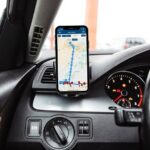
To make this tour feel smooth, do the setup right. After booking, you’ll get an email/text with a password and instructions. The key step: you must download the tour while you have strong wifi/cellular, because it’s designed to work offline after that.
On the day, bring your phone’s location services into the right mode. The narration and directions are triggered by GPS location, so if your phone can’t “pin” you accurately, you can get lag or missed prompts.
For audio, the tour is meant to be connected to your car:
- Bluetooth, USB, or AUX work
- Apple CarPlay compatibility is supported (Android Auto is described as on the way)
If you’re the one who’s driving, keep it simple: connect the audio to the car and let the guide do its job. If the car tech is finicky, it helps to have one person manage the phone while the driver focuses on the road.
Starting at the Palm Springs Visitor Center: Where you begin and what to expect
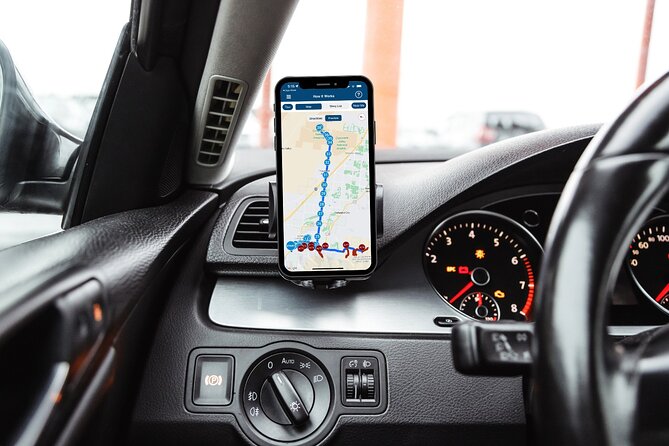
You start in the Palm Springs Visitor Center parking lot, 2901 N Palm Canyon Dr. There’s no guide standing by—this is fully self-guided—so your first job is to load the audio tour in the app and begin the first story point onsite.
Before you hit the road, set expectations: Palm Springs is full of famous homes, but many are hidden behind walls, hedges, and fences. That’s not a failure of the tour. It’s the reality of seeing private residences from a public street.
Also remember the “don’t cheat the route” rule: the tour can advance when you pass the location marker. If you want a specific story, stay near the point long enough for it to trigger.
Kaufmann and the mid-century modern lesson: The Desert House plus a quick detour
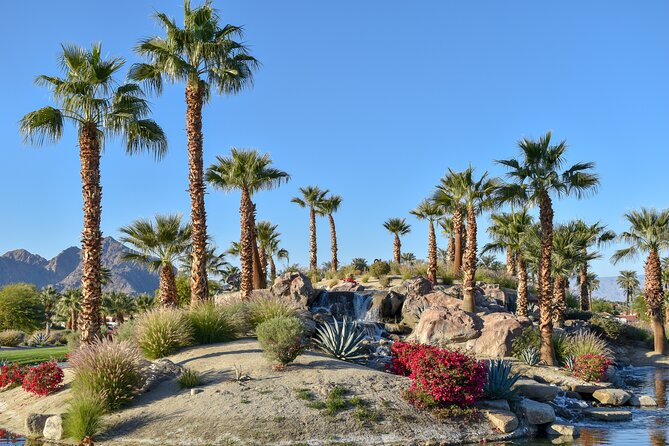
One of the first big thrills is the focus on the Kaufmann Desert House, widely treated as a top example of mid-century modern architecture in the US.
As you approach, you’ll see the house on the right beyond a white gate. The story behind it is built for architecture fans but told in plain terms:
- Edgar Kaufmann loved architecture and brought in the best
- he hired Richard Neutra
- Neutra was known for homes with open, adaptable plans and a distinctly modern look
Before you reach that section, you’ll have a chance to take a short detour to see the Kaufmann and Liberace Houses. The detour takes about five minutes, and the advice is simple: if you’re not rushing, turn right onto West Vista Chino; if you want to stay on track, continue straight.
Practical tip: because these are private properties, plan to enjoy the street-level exterior view you can see, not an inside look. The narration does a good job connecting what you’re seeing to the style and the people.
Movie Colony drive and El Mirador memories: Hollywood in desert form
Next you roll through the Movie Colony, a neighborhood tied to early Hollywood big names like Frank Sinatra, Dinah Shore, Cary Grant, David O. Selznick, Jack Benny, and Tony Curtis.
The story doesn’t just list names—it explains why this area turned into a magnet. The guide points to the El Mirador Hotel, opened in 1928, with features like an Olympic-size swimming pool and tennis courts. The hotel’s bell tower became a Palm Springs landmark, and the idea was that stars could find peace in the desert.
As permanent homes replaced weekend escapes, architects like Richard Neutra, Albert Frey, and Donald Wexler were pulled in to shape what became known as desert modernism.
How to enjoy this section: drive slow enough to look around the neighborhood design cues. Think low lines, clean geometry, and the way houses relate to outdoor space—even if walls block the full view.
Robolights and the Walk of the Stars: Quick stops that break up the drive
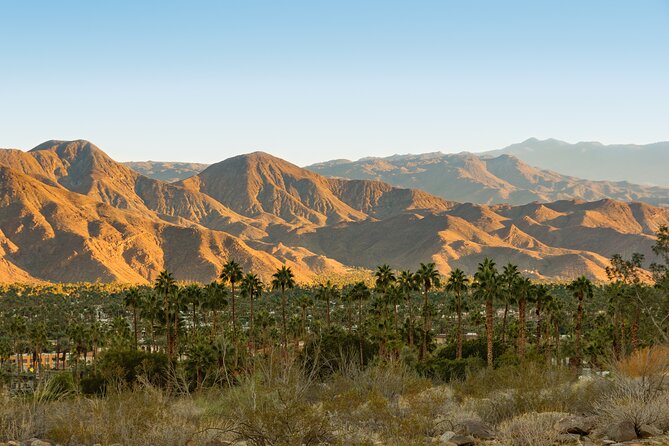
When you need a breather, these two are made for it.
Robolights
At the corner of East Granvia Valmonte and North Arquilla Road, look for the colorful Robolights sculptures peeking from behind trees. This is a “park, get out, look” stop that’s quick and easy, and it gives the tour a playful edge.
Walk of the Stars Palm Springs
Then you hit the Walk of the Stars, with 450 stars honoring major figures in Palm Springs history. It’s not only movie stars either—humanitarians, architects, artists, soldiers, athletes, and city pioneers are all included.
These stops work well if you’re traveling with kids or anyone who gets antsy when a tour is only about driving.
Coachella Valley and the airport story: More than festival name recognition
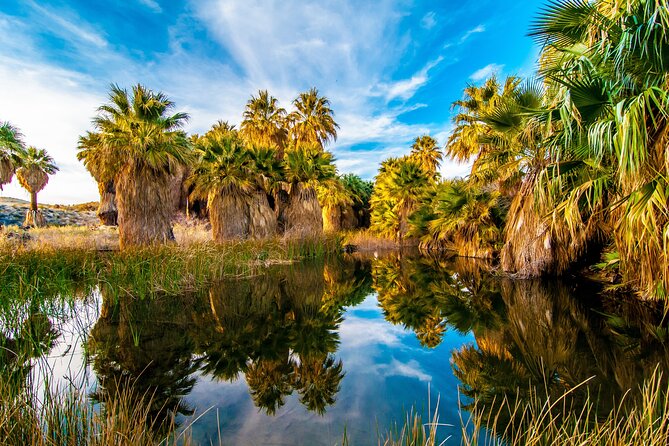
The route then widens beyond downtown. You’ll hear how Coachella Valley is tied to the world-renowned Coachella Music Festival, but the story goes further than the modern headline.
Next comes the Palm Springs International Airport origin story. In 1939, the US Corps of Engineers looked for space for an Army Air Corps landing field. The desert weather and mountainous shielding from strong winds made the location practical. After the war, it turned into a civilian airport.
If you like learning the “why here” behind places you already know, this part is satisfying because it gives Palm Springs a practical backbone.
Sinatra gravesite and pacing advice: Worth it if you’re in the mood
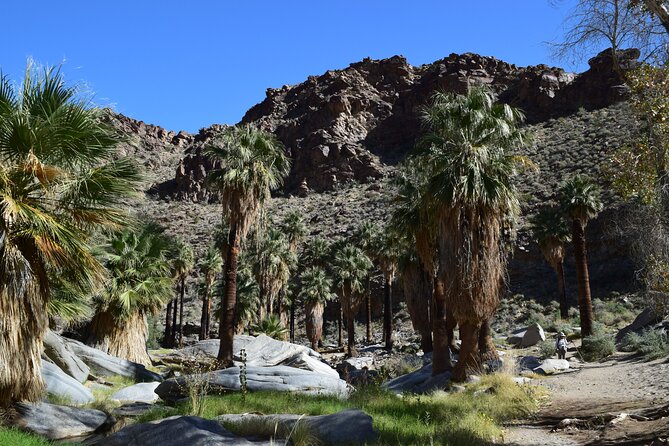
The tour includes a stop for Frank Sinatra’s gravesite. The audio lists what he was buried with: Jack Daniels whiskey, a zippo lighter, Camel cigarettes, and 10 dimes, with the dimes connected to December 1963.
Here’s the consideration: it’s a gravesite stop, so if you’re short on time, you might decide how much you care about this specific pop-culture detail. One reviewer called out that it’s far out and more of a marker than an extended experience.
My take on pacing: if you’re doing the full loop and you love Sinatra, don’t skip. If you’re time-crunched, this is the easiest place to consider skipping without losing the core drive experience.
Trailheads that turn this into an outdoors day
Not every part of this tour is a “look from the car.” A few stops set you up for actual walking.
Willis Palm Trailhead
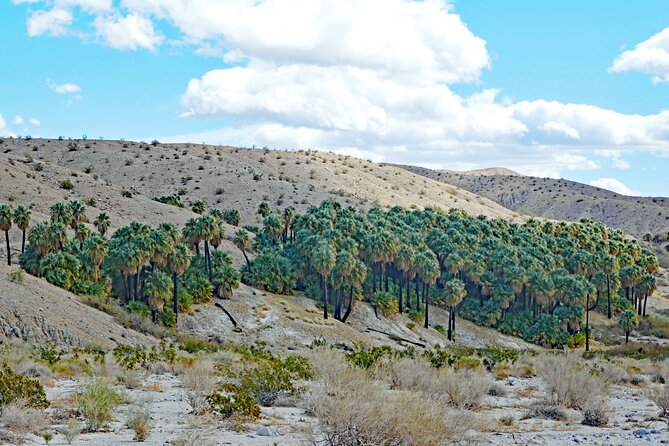
You’ll reach the Willis Palm Trailhead for a moderate 4-mile hike, about 3 hours total, with around 500 feet of elevation gain. The story also flags spring for birds and desert wildflowers.
Pushawalla Palms Trailhead
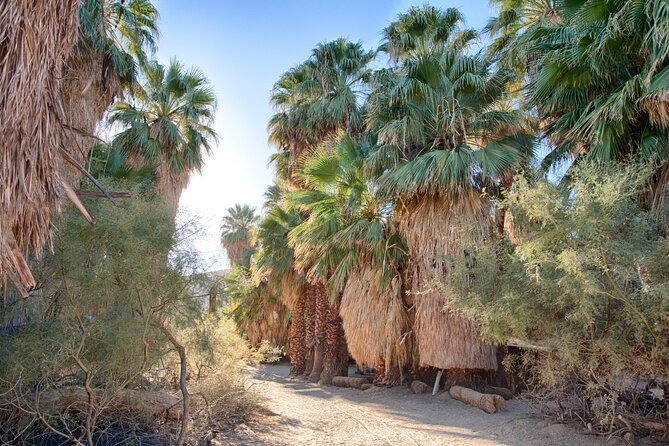
Next up is Pushawalla Palms: about 4.5 miles with roughly 700 feet of elevation gain and views from the ridge on the San Andreas Fault. You’ll hear about palm tree oases fed by water bubbling up from deep underground, plus groves of palms. The guide estimates about 3 hours.
Thousand Palms Oasis Preserve
At Thousand Palms Oasis Preserve, you’re told the visitor center is closed after storm damage, but trails are open sunrise to sunset. This is a “longer look” kind of stop where your best experience comes from choosing the walk that matches your energy.
Practical advice: these are not quick five-minute diversions. If you do them, give yourself breathing room and don’t rush back to the car just to “finish the audio.” Your timing will be better if you think of this as a half-day-style outing.
Forever Marilyn, the Rose Avenue house question, and Frey House II
Back in the realm of public art and celebrity mythology, you’ll get a few culture hits.
Forever Marilyn
You’ll stop for the huge Forever Marilyn statue, a 26-foot-tall work by sculptor Seward Johnson from 2011. The story includes a nice twist: it began in Chicago and later traveled around the world, including time in Australia.
The Rose Avenue Marilyn claim
The tour also brings up the commonly repeated rumor about a house at 1326 North Rose Avenue being Marilyn Monroe’s home. The audio notes that locals question whether it was actually hers.
This is a good reminder while you’re driving: celebrity-home stories in Palm Springs can be half folklore, half fact. The audio does a decent job nudging you to stay curious rather than certain.
Frey House II
Then there’s the Frey House II at 686 Palisades Drive. It’s not open to the public, but the Palm Springs Museum runs guided tours of the property. During this self-drive tour, think of it as an exterior spot tied to the “desert modernism” story, especially because Albert Frey is presented as the father of that style.
Palm Canyon Trail, Andreas Canyon, and Cahuilla rock details
If you like low-key walking that still feels meaningful, these are strong additions.
Palm Canyon Trail
The Palm Canyon Trail is described as an easy 2-mile out-and-back with about 200 feet of gain, usually around an hour. You also need to know this: there’s an entrance fee, and the payment point is the Trading Post building in the parking lot.
Andreas Canyon
Andreas Canyon is even lighter: a 1-mile loop with about 175 feet gain, often done in around half an hour. The audio highlights:
- more than 150 plant species within about half a mile
- palms, rock formations, and Andreas Creek
- visible rock dents tied to Cahuilla people grinding food to cook
This is where the tour feels more local and human. The desert isn’t just scenery; it’s a place with layers of use and knowledge.
Moorten Botanical Garden and the Aerial Tramway: Payoffs for desert-people
Two stops come late in the day, and they’re built for different kinds of rewards.
Moorten Botanical Garden
The guide calls Moorten Botanical Garden a must for desert plant lovers. It was created in the 1940s by Chester “Cactus Slim” Moorten and Patricia Moorten. The audio also ties the gardener’s life to film history: Chester was an actor in the 1920s and 1930s, and a stand-in for Howard Hughes. He later developed TB and found the dry desert air helped him recover.
If you enjoy seeing how people built roots in harsh places, this story adds real texture.
Palm Springs Aerial Tramway
Then you’ll hear about the Palm Springs Aerial Tramway, described as the world’s largest rotating tram car. It travels 2.5 miles along Chino Canyon, climbs up to Mount San Jacinto State Park, and rotates 360 degrees for views over the valley. The mountaintop has restaurants, a gift shop, and hiking trails.
Important reality check: admission to the Tramway is not included in the tour price, so plan on buying tickets separately.
Pioneertown: The movie set finale in the California desert
Your last stretch includes Pioneertown, a town created by Hollywood to mimic the Wild West. In 1946, investors tied to show business—Dick Curtis, Roy Rogers, Dale Evans, and others—helped transform 32,000 acres into a working movie set where people could film, vacation, and even build second homes.
It’s a fun send-off because Palm Springs isn’t just a place where famous people lived. It’s also a place where famous stories were staged.
Should you book this Palm Springs self-guided driving audio tour?
I’d book it if you want a flexible, drive-first way to understand Palm Springs. It’s a great fit when you care about celebrity lore, mid-century modern design stories, and desert landmarks—and you don’t want to pay for guided time.
Skip (or adjust expectations) if you’re expecting to see houses like you would on an interior architecture tour. Many of the star homes are partially hidden by gates and landscaping, and the tour can’t magically bypass private property.
If you do book: download the audio with strong signal, keep location services on, and give yourself extra time for any of the 3-hour hikes. One more practical tip: if navigation feels confusing, have the passenger manage the phone while the driver handles the road.
If you’re on a tight schedule, the “drive + quick stops + optional walks” structure is exactly the point. And yes, there’s free cancellation up to 24 hours before your experience start time, so you can book with less stress.
FAQ
How long is the Palm Springs self-guided driving audio tour?
The tour is listed as about 2 to 3 hours to complete. It covers over 22 miles and includes more than 53 audio stories, so your pace will depend on how many stops you walk.
Where does the tour start and end?
You start at the Palm Springs Visitor Center, 2901 N Palm Canyon Dr, Palm Springs, CA 92262. The tour ends at Thousand Palms Canyon Rd, California.
Does the audio tour work offline?
Yes. You need to download the tour while you have strong wifi/cellular, then it works offline after download. Offline maps are included for navigation.
Can I use it through my car stereo or only my phone speaker?
You’re told to connect your phone to your car using Bluetooth, USB, or AUX for the best experience. Apple CarPlay is compatible as well, with Android Auto support described as on the way.
What is included in the price, and are tickets required at stops?
The tour price includes the audio storytelling, offline maps, and hands-free playback driven by location. It does not include attraction passes, entry tickets, or reservations. The audio notes a separate entrance fee for Palm Canyon Trail (paid at the Trading Post).
Are the celebrity home stops accessible from the street?
You’ll be driving past homes and seeing what you can from public viewpoints. The tour specifically warns that star homes may be obscured or partially hidden by gates, shrubs, or private roads, and you should not violate anyone’s privacy.