REVIEW · ISTANBUL
Istanbul: Basilica Cistern Night Shift Entry and Audio Guide
Book on GetYourGuide →Operated by Cosmic Tickets & Audios · Bookable on GetYourGuide
Cisterns look different after dark. This Basilica Cistern Night Shift visit turns a famous daytime stop into a dim, watery underworld where the lighting makes everything feel older and stranger. I especially like the atmospheric night visuals—those marble columns rise from shallow water with reflections that look almost unreal—and I also like that you get a multilingual audio guide you can follow at your own pace.
The main thing to consider is value. The add-ons like skip-the-line entry and the smartphone audio guide may feel overpriced in low season (like winter), when lines and crowding are typically lighter. One more practical note: internet access on-site is limited, so you should download the audio guide instructions before you go.
In This Review
- Key highlights you’ll actually care about
- Basilica Cistern at night: what changes after dark
- Skip-the-line entry after 6 PM: why timing matters
- The underground walk: columns, shallow water, and reflections
- Medusa Heads: the moment everyone finds (and why it works)
- Byzantine engineering meets later Ottoman power
- Smartphone audio guide in 11 languages (and the offline problem)
- Photography, pacing, and what to expect from the vibe
- Price ($87) and whether this night entry is good value
- Should you book the Basilica Cistern Night Shift?
- FAQ
- What does the Basilica Cistern Night Shift ticket include?
- When will I receive my QR code ticket?
- Is there an audio guide, and how many languages are available?
- Do I need internet to use the audio guide at the cistern?
- How long is the experience?
- What can I see inside the Basilica Cistern?
- Is this entry available during daytime?
- Can I cancel for a refund?
- Where is the experience located?
Key highlights you’ll actually care about
- Night lighting changes the mood fast: columns, water, and shadows look totally different after dark
- Skip-the-line entry helps you start sooner once you arrive
- Medusa Heads are a highlight you’ll be searching for in the cistern’s deeper corners
- Smartphone audio guide in 11 languages lets you go at your own speed
- Ottoman administration context helps you connect this Byzantine engineering site to later Ottoman power
Basilica Cistern at night: what changes after dark
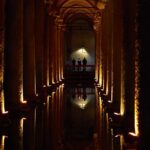
The Basilica Cistern is already unique even in daylight. It’s an underground reservoir that looks like a marble forest growing out of water—rows of columns, low ceilings, and that constant cool, damp air. At night, the experience sharpens. Instead of bright, flat museum lighting, you get softer illumination that makes the water act like a mirror. The result is a place that feels staged for atmosphere, not just sightseeing.
This matters because you’re not only looking at history—you’re reading the room. At night, you notice how the space is built to manage light and emptiness. Shadows pool between columns. Highlights bounce off wet stone. Even the scale feels different because you lose the “daylight reference points” your brain normally uses outdoors.
If you’re into photography, this is the big reason to pick night. Those reflections and darker angles can produce images that look like something between a set and a real relic. If you’re more of a history-first visitor, the darker setting also helps you slow down. The cistern is quiet enough that you’ll likely have time to stand still and listen to the audio guide narration rather than rushing through.
You can also read our reviews of more tours and experiences in Istanbul.



Skip-the-line entry after 6 PM: why timing matters
This ticket is designed for after dark, and the big operational point is the skip-the-line entry. In a busy city like Istanbul, waiting can eat up the best moments. When you’re paying for a night experience, you want your time underground to be uninterrupted and unhurried.
Also, the start time works best with how you’ll plan your evening. You’ll be aiming to arrive after 6 PM, and the ticket is set up so you can access the cistern at night rather than squeezing it between other daytime activities.
One practical thing I’d plan around: night tours can feel calmer than peak daytime hours, but they’re still popular. If you’re the kind of person who likes to move in and get oriented quickly, the skip-the-line element is most useful when you’re arriving during heavier periods.
The underground walk: columns, shallow water, and reflections
Your core experience is essentially a guided self-walk. You descend beneath Istanbul and move through the cistern’s interior at your own pace. The physical layout is the star: marble columns rising from shallow water, with long aisles that pull your eyes forward.
As you walk, focus on three things:
- The “ceiling effect.” In daylight you notice height; at night you notice depth. The lighting makes the space feel longer, and the rows of columns look almost symmetrical in perspective.
- Water as a visual tool. Because the water is shallow, it creates a thin layer of reflection instead of blocking your view. That’s why the light looks dramatic.
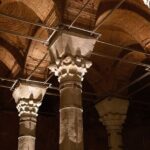
- Texture over trivia. The cistern rewards attention to material—stone, wet surfaces, and how the columns repeat. The better you look, the more the structure makes sense even before you fully absorb the history.
You’ll likely spend more time near the center areas where the lighting is strongest and reflections are cleanest. If your goal is calm exploration, night is a win. It’s easier to slow your pace without feeling like you’re holding up a group.
Medusa Heads: the moment everyone finds (and why it works)
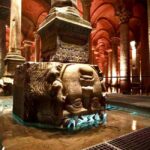
You didn’t come all this way just for a pretty room—you came for the legends. The Medusa Heads are the headline detail inside the cistern, and the reason they still catch people’s attention is simple: they’re immediately memorable once you spot them.
These are the kinds of objects that make the place feel like more than engineering. A reservoir can be impressive, but a strange sculptural detail turns it into a mystery. At night, the Medusa Heads feel even more dramatic because the lighting helps create contrast. You’ll see them as focal points rather than background ornaments.
When you’re looking for them, don’t treat it like a quick checkbox. Stop, orient yourself, and use the audio guide narration to connect what you’re seeing to why it’s famous. The audio is designed to bring history to life while you explore, so take advantage of that rather than just walking past.
Byzantine engineering meets later Ottoman power
One of the more interesting aspects of this site is that it isn’t only a Byzantine story. The cistern was built as a functional underground reservoir, but later periods treated Istanbul’s infrastructure as a living system. In this experience, you’ll connect the cistern’s engineering to its role as the administrative center of the Ottoman Empire.
That pairing—storage infrastructure with power and governance—is what makes the cistern more than a decorative landmark. You start to see it as part of how the city worked. Even though what you’re walking through is stone and water, the cistern represents real logistics: supply, stability, and survival.
This is also where the audio guide helps. The columns and water are visible; the historical meaning needs interpretation. With the narration in your language, you can follow the story without having to read your way through it.


Smartphone audio guide in 11 languages (and the offline problem)
This ticket includes a smartphone audio guide available in 11 languages: Chinese, English, French, German, Italian, Japanese, Korean, Portuguese, Romanian, Russian, Spanish, and Turkish. That’s a big deal if you want accurate context without relying on a printed brochure.
Here’s the practical challenge: internet access at the venue is limited. The good news is that you’re told to download the audio guide instructions before you arrive, and you should treat that as non-negotiable. If you arrive without downloading, you may lose the ability to listen smoothly, and you’ll end up reading less and rushing more—exactly the opposite of what you paid for.
My advice:
- Check your email ahead of time for the instructions.
- Download whatever the instructions ask for before you walk into the cistern area.
- Plan to use the audio guide as you move, not after you’ve already seen the main sights.
If you’re traveling with friends who prefer different languages, this setup is also a comfort. You can each follow your own narration rather than trying to crowd around one device.
Photography, pacing, and what to expect from the vibe
Night shifts are often chosen for mood, not just efficiency. This one delivers that in a very specific way: the underground lighting makes the whole room feel staged for atmosphere. You’ll likely notice the glow bouncing across wet surfaces and the way reflections stretch between columns.
For pacing, keep it simple:
- Give yourself time to pause in the brighter zones so you can see structure clearly.
- Then slow down in darker pockets so you can absorb the story.
- If you’re using the audio guide, sync your stops with your listening. It makes the experience feel like a guided route even though you’re exploring freely.
Who benefits most? I’d point this toward history lovers who want an evening version of a major landmark, photographers who want reflections without daytime glare, and curious travelers who like a structured story but still want flexibility.
Who might find it less ideal? If you hate walking and prefer tightly controlled group tours, this is still a walk-through experience. It’s not described as a dramatic live performance. It’s quiet, self-paced exploration under lights.
Price ($87) and whether this night entry is good value
At $87 per person, you’re paying for three things: skip-the-line entry, after-dark access, and the smartphone audio guide in 11 languages. Whether that’s a great deal depends on two factors: season and your priorities.
- In busier months, skip-the-line can save more than time. It can save your mood—less waiting means more calm, more photos, and less feeling rushed.
- In winter, when crowds are often lighter, the skip-the-line part may feel less dramatic. That’s when you’ll want to judge whether you’re mostly buying the night ambiance and the audio guide rather than convenience alone.
The audio guide is included, so if you’ll actually use it, that improves value. If you’re the kind of traveler who reads a lot before arriving and then prefers silence on-site, you might feel the price is mostly paying for night access and convenience.
My take: this is worth it if you want the cistern’s mood after dark and plan to use the multilingual audio guide. It may feel less worth it if you’re only chasing the Medusa Heads and you’re visiting in a season with light crowds.
Should you book the Basilica Cistern Night Shift?
Book it if you want:
- the after-dark lighting and reflection effect
- a self-paced visit with a story you can follow in your language
- a calmer way to experience one of Istanbul’s most famous underground spaces
Consider skipping (or adjusting) if:
- you’re visiting in a low-crowd period and you don’t care much about skip-the-line
- you might forget to download the audio guide ahead of time (limited internet is a real constraint here)
If you’re deciding based on one detail, choose the night shift for the atmosphere. The cistern is impressive in daylight, but at night it feels more like a world than a monument.
FAQ
What does the Basilica Cistern Night Shift ticket include?
It includes a Basilica Cistern skip-the-line night entry ticket and a smartphone audio guide in 11 languages.
When will I receive my QR code ticket?
You’ll receive your QR code ticket directly from the supplier Cosmic Tickets after 6 PM the day before your visit. Same-day bookings are sent immediately.
Is there an audio guide, and how many languages are available?
Yes. The audio guide is available on your smartphone in 11 languages: Chinese, English, French, German, Italian, Japanese, Korean, Portuguese, Romanian, Russian, Spanish, and Turkish.
Do I need internet to use the audio guide at the cistern?
Internet access is limited on-site, so you’re advised to download the audio guide instructions from the confirmation email before you go.
How long is the experience?
The experience is listed as 1 day.
What can I see inside the Basilica Cistern?
You’ll explore the cistern’s underground space at night, including the Medusa Heads, and you’ll learn about the palace’s role as the administrative center of the Ottoman Empire.
Is this entry available during daytime?
This is a night shift entry ticket. The ticket is accessed after 6 PM, and the experience is designed for after-dark viewing.
Can I cancel for a refund?
Yes. You can cancel up to 24 hours in advance for a full refund.
Where is the experience located?
The experience is in Istanbul, Turkey, in the Marmara Region.