REVIEW · BOSTON
Boston Record Breakers: Self-Guided Scavenger Hunt
Book on Viator →Operated by Questo · Bookable on Viator
Follow clues, walk Boston, no Wi‑Fi needed. This self-guided scavenger hunt turns major sights into a choose-your-own pace puzzle, from the Boston Public Library to the Union Oyster House. I especially like that it works offline, so you are not stuck waiting for signal, and I like the no-rush format that lets you pause when the view or the question needs your attention.
One possible drawback: a couple of locations can feel a bit guessy if you want quick answers, including Park Street Station and the Union Oyster House. Still, at $5.99 per person for about 1 hour 20 minutes of moving on foot, the value is strong if you enjoy walking and figuring things out. Just bring a phone with a decent charge, because you will rely on it for the mobile app instructions.
In This Review
- Key reasons this Boston scavenger hunt works
- Price and pacing: $5.99 for 1 hour 20 minutes of Boston
- How the offline scavenger hunt actually feels as you walk
- Starting at Boston Public Library: a classic launch point at 700 Boylston
- Copley Square and Arlington Street Church: architecture with built-in storytelling
- The Ether Monument and Public Garden corner: anesthesia in a 40-foot statue
- Beacon Hill stops: Massachusetts State House and the Shaw Memorial
- Park Street, Tremont Temple, and the route between old and new
- Bell, the Tavern, and what Boston did with printers and inventors
- Ending at the Union Oyster House: your payoff stop on the Freedom Trail
- Who should book this self-guided Boston scavenger hunt
- The bottom line: should you book Boston Record Breakers?
- FAQ
- How long is the Boston Record Breakers scavenger hunt?
- Can I play this Boston scavenger hunt without an internet connection?
- Do I need a physical tour guide?
- Where does the scavenger hunt start?
- Where does the scavenger hunt end?
- What language is the experience offered in?
- What are the opening hours?
- Can I start at any time during the day?
- Is this experience private?
- What is the cancellation policy?
Key reasons this Boston scavenger hunt works
- Offline play means you can keep going even if your phone service gets moody.
- No guide in the group keeps it private and avoids the awkward “when do we start?” moments.
- Start anytime, take breaks so the timing fits your day, not the other way around.
- Landmark-to-landmark route guides you through a classic Boston slice, from Back Bay to Beacon Hill.
- Freedom Trail area payoff lands you at the Union Oyster House for food after the last clue.
- Good value math: one low price for a timed puzzle walk through multiple big-name stops.
Price and pacing: $5.99 for 1 hour 20 minutes of Boston
For $5.99 per person, you are basically buying an on-phone game that choreographs a short walking route of key downtown neighborhoods. It is not a guided narration service where you pay for a person’s time; instead, you pay for the structure—clues that push you to look closely at each stop and move to the next.
The stated duration is about 1 hour 20 minutes, but that is a helpful average, not a prison sentence. If you move quickly, you will finish sooner. If you like to slow down at each location, read what you can, and take photos, you might stretch it a bit—yet it still stays short enough to fit before dinner or between other plans.
Your biggest “pacing lever” is the ability to take a break and resume later. That matters in a city where sidewalks and crowds can change your plan fast. The game’s structure gives you momentum, while the format gives you control.
You can also read our reviews of more tours and experiences in Boston.

How the offline scavenger hunt actually feels as you walk
You start at the Boston Public Library (Central Library) on Boylston Street, then follow the in-app instructions to the next location. The premise is simple: you explore each landmark and find the answer to the challenge, which advances you to the next stop.
What makes this work well in real life is that it turns sightseeing into a series of small missions. Instead of wandering with a vague sense of, I’m seeing a historic building, you get a reason to slow down and look for details. You are also not forced to keep a group together, since it is private—your group is the only one playing.
Offline play is the practical detail that changes everything. If you have ever tried to use maps or apps in a crowded city center, you know how quickly things can get annoying. Here, you are explicitly set up to play without needing an internet connection, which keeps the experience calmer and more reliable.
Two practical tips from how this kind of game works:
- Give yourself a few seconds to scan the app instructions before you enter each main area.
- Keep expectations realistic: you are solving location-based clues, so you will do some reading and some visual searching.
Starting at Boston Public Library: a classic launch point at 700 Boylston
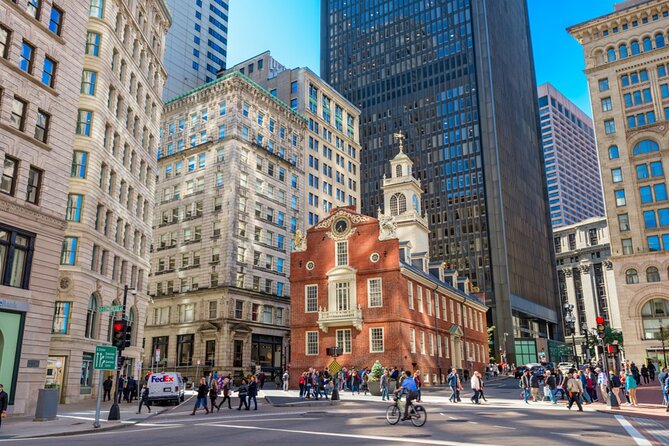
The Boston Public Library is a strong first stop because it is not just pretty—it is a serious institution with major firsts. The game points you toward its role as a pioneer of public library service in America, including claims like the first large free municipal library, the first public library to lend books, and the first to have a children’s room. It also notes that the library includes a central library and multiple neighborhood branches, with millions of yearly visitors.
Why this opening works: it gives you instant context. You are not starting with a random statue. You start with a place that shaped everyday life in the U.S. and still draws huge crowds, so it is easy to see why Boston people care about it.
What you are doing during the clue step is straightforward: look around to find the answer to the challenge and move on. The “look around” requirement is key. Even if you know the library already, the scavenger hunt pushes you to approach it like a detective, not just a tourist.
Potential snag to plan for: busy interior areas can make it feel like you are hunting in public. If you are the type who hates rushing for small details, consider arriving a little before you want to start, so you can focus without feeling on top of other people.
Copley Square and Arlington Street Church: architecture with built-in storytelling
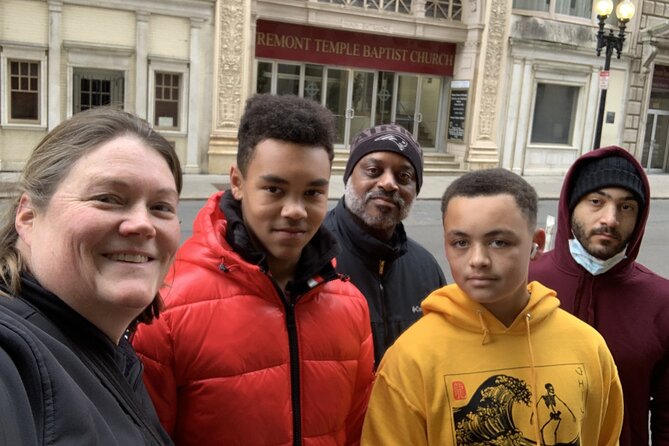
After the library, the route heads to Copley Square in the Back Bay. The clue focus here is on the square’s naming and cultural identity. You are told it is named for painter John Singleton Copley and that, before 1883, it was known as Art Square for the many cultural institutions nearby. The game also mentions that it was proposed as a Boston Landmark.
Copley Square can be easy to walk past because it is a public space, not a single building you naturally stop in front of. The scavenger hunt fixes that. It forces you to take a moment in a place that might otherwise become a short crossing.
Next comes Arlington Street Church, positioned across from the Public Garden. This stop has more specific historical anchors: it is a Unitarian Universalist church, completed in 1861, designed by Arthur Gilman and Gridley James Fox Bryant, and modeled to resemble James Gibbs’ St. Martin-in-the-Fields in London. The “across from the Public Garden” detail matters too, because it frames your walk with greenery and a major landmark corridor.
In practical terms, this is a good “middle of the hunt” section. You are still moving, but the buildings give you enough visual cues to make the clue hunt feel fair. You are not stuck scanning a blank wall; you have clear architectural features and a location that is easy to find and describe.
The Ether Monument and Public Garden corner: anesthesia in a 40-foot statue
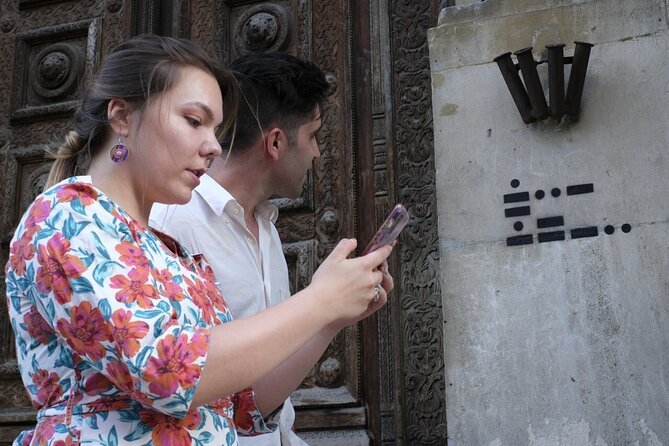
The Ether Monument, also known as The Good Samaritan, is where the game gets delightfully specific. It is a statue and fountain near the northwest corner of the Public Garden, near the intersection of Arlington Street and Marlborough Street. The clue context ties the monument to the use of ether in anesthesia.
This stop also gives you real scale: it is 40 feet tall and is described as the oldest monument in the public garden. The information credits possible design attributions to Boston architect William Robert Ware and sculptor John Quincy Adams Ward.
Why I like this part: it takes you from “big city sights” into a story you probably did not already know. A monument about anesthesia is exactly the kind of detail that makes a short scavenger hunt feel more than just a walk between postcard backdrops.
What to expect as you play: you will look around to find the answer to the challenge to advance again. Since the monument is prominent, you should be able to orient yourself quickly. Still, water features and busy pedestrian flows can distract you, so aim to spend a minute focusing before you start searching for the exact clue.






Beacon Hill stops: Massachusetts State House and the Shaw Memorial
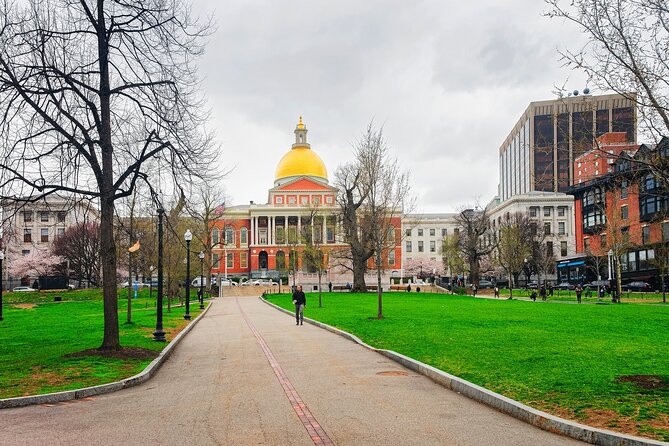
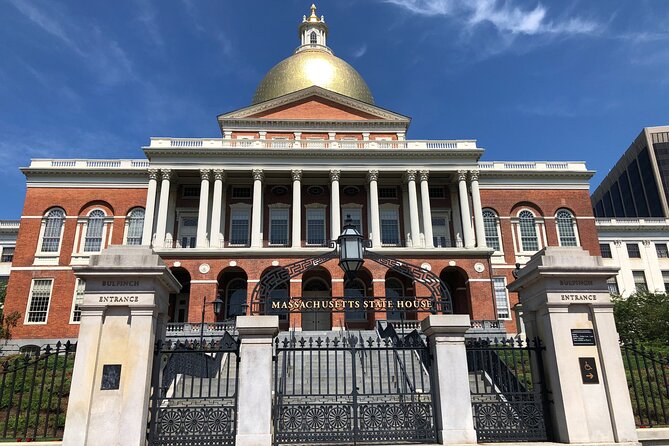
Then the hunt shifts into Beacon Hill territory with the Massachusetts State House, located in the neighborhood and described as the state capitol and seat of government for Massachusetts. You are given the design name—Charles Bulfinch—and a completion date of January 1798. The game even includes the cost detail: $133,333, noted as more than five times the budget. It also mentions that the building has been enlarged repeatedly since.
This is one of those stops where a clue-based format helps. Even if you just walk past the State House in normal sightseeing mode, it can feel like you are seeing a big building. With the game, you are pushed to engage with details and look for the answer that unlocks the next step.
The route then heads to the Memorial to Robert Gould Shaw and the Massachusetts Fifty-Fourth Regiment. The game description is very specific: a bronze relief sculpture by Augustus Saint-Gaudens opposite 24 Beacon Street at the edge of Boston Common. It depicts Colonel Robert Gould Shaw leading members of the 54th Regiment as they marched down Beacon Street on May 28, 1863 to depart the city to fight in the South. It notes the unveiling date as May 31, 1897 and calls it the first civic monument to pay homage to African American soldiers.
If you only have an hour and a bit, this is a meaningful use of time. It ensures the hunt includes not just architecture and famous names, but a story tied directly to American history and the people who fought in it.
Park Street, Tremont Temple, and the route between old and new
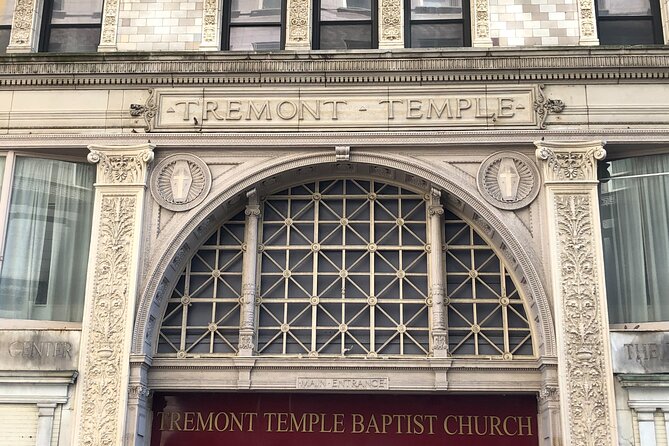
The next segments move through Park Street and Tremont. Park Street is described as laid out in 1804, originally as Park Place, replacing Sentry Street. The game also points out that, in the 1880s, the Woman’s Journal was published on Park Street, and that Houghton Mifflin was headquartered there beginning in the late 19th century.
That publishing and business context is useful because it expands the idea of a “walk through Boston” into a walk through communications—printing, publishing, and the people who shaped public opinion.
Then you reach the Tremont Temple at 88 Tremont Street. This stop is a Baptist church affiliated with American Baptist Churches, USA. The game notes that the multi-storey structure was designed by Clarence Blackall and opened in May 1896, replacing a smaller 1827 structure that had repeatedly suffered fire damage.
This is a good moment to remember what kind of scavenger hunt this is. You are not doing an arts-and-crafts craft fair. You are doing a “details in public space” game. Temples, squares, and state buildings tend to give clear references you can search for.
Bell, the Tavern, and what Boston did with printers and inventors
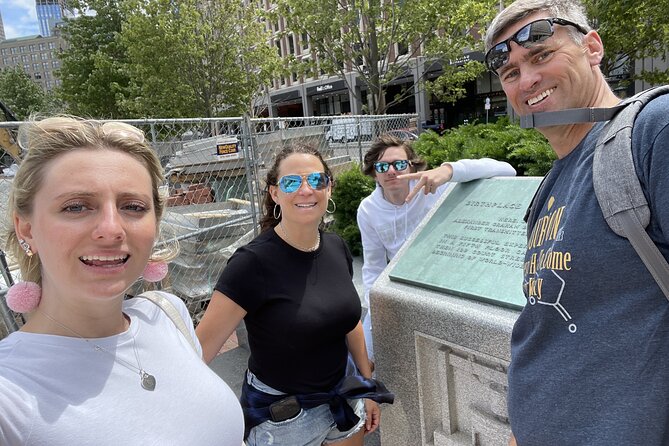
The hunt then connects three themes that belong together in Boston: invention, printing, and politics—at least in the places the game chooses to highlight.
First is Alexander Graham Bell, described here as a BU professor from 1874 to 1879. The game says he invented the telephone in 1876 after research on transmitting speech, funded by BU. It also notes that his connection shows up again in 1916 at a BU reception marking the 40th anniversary of his invention.
Then comes the Tavern, said to have been around since 1795. The game paints it as a meeting place for printers and politicians, plus sailors and students—then adds that it became the most famous alehouse in the city.
I like this pairing because it turns your walk into a quick tour of Boston’s working life. It is easy to treat historic buildings like museum pieces. Here, the game nudges you toward the idea that these were active social spaces and practical hubs.
Ending at the Union Oyster House: your payoff stop on the Freedom Trail
The final landing spot is the Union Oyster House, located on the Freedom Trail near Faneuil Hall. The game describes it as America’s oldest restaurant, housed in a building dating back to pre-Revolutionary days and serving food since 1826. It also highlights that the oyster bar and stalls have remained in their original positions.
There is one more detail that is pure Boston texture: Daniel Webster was described as a constant customer. After your last clue, you arrive at a place where it is easy to turn the end of the hunt into a real meal.
Practical note: one of the limited downside points from a user comment was that the clue step around the Union Oyster House felt guessy. That does not mean it will be frustrating for you, but it does tell me to recommend one thing: do not let yourself feel rushed in the final stop. Give yourself a minute to scan and read what you can before you panic and start guessing.
If you do want to keep this low stress, plan to end at Union Oyster House with an extra buffer. Even if you finish the clue quickly, you will still benefit from time to decide what you want to eat.
Who should book this self-guided Boston scavenger hunt
This is a great fit if you:
- Want an offline Boston walking activity that does not depend on cell coverage.
- Like clue hunts where you get information by looking closely at what is in front of you.
- Prefer private experiences and dislike crowd-managed group schedules.
- Have about 1–2 hours and want to cover multiple major landmarks without adding another guided tour to your day.
It may be less ideal if you:
- Hate puzzle ambiguity and want everything to feel instantly solvable.
- Have trouble reading small text on your phone while walking.
- Want a traditional guided experience with a person explaining every detail in real time.
The bottom line: should you book Boston Record Breakers?
If you are paying $5.99 for something that is short, offline, and centered on big Boston landmarks, this kind of scavenger hunt is a smart way to get variety without committing to a long tour. The route covers major names—Boston Public Library, Copley Square, Arlington Street Church, Massachusetts State House, the Shaw Memorial, and the Union Oyster House—so you get both architecture and history beats without a bus ride.
I would book it if you enjoy walking with a mission and want a flexible way to explore. I would hesitate only if you strongly dislike clue formats where you might occasionally need to think longer than expected—especially around Park Street Station and the Union Oyster House.
FAQ
How long is the Boston Record Breakers scavenger hunt?
It takes about 1 hour 20 minutes (approx.).
Can I play this Boston scavenger hunt without an internet connection?
Yes. You do not need internet access to play.
Do I need a physical tour guide?
No. There is no physical guide included.
Where does the scavenger hunt start?
Start at Boston Public Library – Central Library, 700 Boylston St, Boston, MA 02116, USA.
Where does the scavenger hunt end?
It ends at the Union Oyster House, 41 Union St, Boston, MA 02108, USA.
What language is the experience offered in?
It is offered in English.
What are the opening hours?
The listed hours are Monday to Sunday, 5:00 AM to 9:00 PM, for 11/13/2020 to 02/07/2027.
Can I start at any time during the day?
Yes. You can start at any hour.
Is this experience private?
Yes. It is a private tour/activity, and only your group will participate.
What is the cancellation policy?
You can cancel for free up to 24 hours in advance for a full refund. If you cancel less than 24 hours before the experience’s start time, the amount paid is not refunded.