REVIEW · SAN FRANCISCO
Food, History, and Resistance: A Self-Guided Audio Tour
Book on Viator →Operated by VoiceMap Audio Tours · Bookable on Viator
Food can be a doorway, not just a meal. This self-guided VoiceMap tour uses Japantown’s flavors and street corners to tell stories about community, survival, and how resistance shows up in everyday life.
I especially like how the tour balances three angles: Japanese food traditions, neighborhood history you would miss on your own, and a stop that connects this area to major jazz names. I also love the way it’s built for real pacing, with time to pause and look closer instead of rushing you through.
One thing to consider: it’s self-guided with offline access, so you’ll want a charged phone and headphones ready, and you should plan for about 50 minutes to an hour of walking.
In This Review
- Key highlights before you go
- How Food Turns Into Resistance in Japantown
- Price and Time: The Value of 50 to 60 Minutes
- Your Route: Starting at Osakaya Restaurant, Ending Near 1010 Geary
- Stop 1: Seeing Japantown Beyond Ramen and Sushi
- Stop 2: Benkyodo and the Last Traditional Manju Makers
- Stop 3: Bop City on Fillmore Street and Jazz After Hours
- What VoiceMap Gives You: Offline Audio, Maps, and Geodata
- When History Gets Personal: Internment and Community Stories
- Comfort, Pace, and Who This Tour Fits Best
- Should You Book This Japantown Audio Tour?
- FAQ
- How much does the Food, History, and Resistance in Japantown audio tour cost?
- How long is the tour?
- Is the tour self-guided, and what language is it in?
- Where do I start and end the tour?
- Is offline access included?
- Do I need tickets or museum entrances to complete the stops?
- Are food and drinks included?
- Is the tour near public transportation, and are service animals allowed?
- What’s the cancellation policy?
Key highlights before you go
- Benkyodo’s manju legacy: one of only three traditional manju makers still operating in the US
- A menu of history, not just restaurants: the tour pushes past ramen and sushi into community stories
- Bop City’s jazz powerhouse lineup: John Coltrane, Billie Holiday, Miles Davis, and Duke Ellington are part of the story
- Fillmore Street’s Harlem of the West: you’ll hear why this neighborhood had an outsized music impact
- Offline audio and geodata: you can keep going even when signal gets spotty
How Food Turns Into Resistance in Japantown
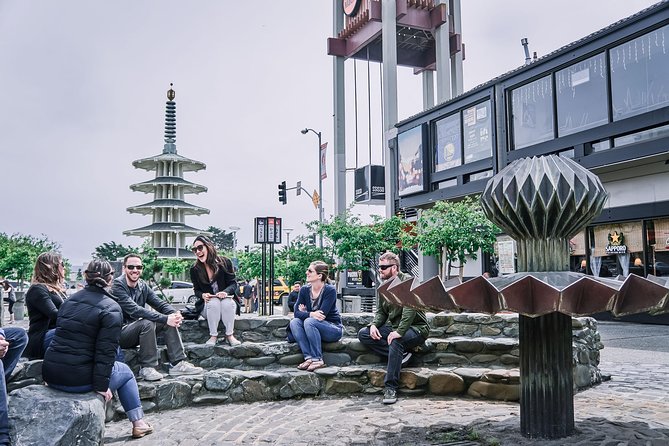
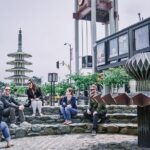
Japantown in San Francisco is easy to experience as a place to eat. But this tour nudges you to see it as something sturdier: a community that had to hold on through hard times, and a neighborhood where culture traveled across generations.
What makes this experience work is the mix. You’re not only learning dates and facts. You’re also learning what people valued enough to keep making, singing, performing, and defending—even when the world around them was changing fast.
You can also read our reviews of more tours and experiences in San Francisco.
Price and Time: The Value of 50 to 60 Minutes
At $11.99 per person for a 50 minutes to 1 hour walk, you’re paying for focus and convenience more than for a guided lecture. The big value is that you get a structured route plus offline audio, so you don’t have to guess what to look at or when to look.
You also get lifetime access to the tour, which matters in a city like San Francisco. If you’re the type who wants to revisit neighborhoods as your interests sharpen, this price is easier to justify than a one-and-done experience.
Your Route: Starting at Osakaya Restaurant, Ending Near 1010 Geary
The tour starts at Osakaya Restaurant, 1737 Post St and ends at 1010 Geary Blvd. That’s a useful detail because it helps you plan the rest of your day. You won’t be stuck back at your starting point, and you can pair this with other Japantown stops afterward.
Service is listed as available daily, essentially all day (hours shown run 12:00 AM to 11:59 PM). That means you can pick a time that fits your energy level, whether that’s a quiet morning or an afternoon you want to stretch into evening.
It’s also offered in English, and the experience has a maximum of 10 travelers. For an audio tour, that small cap still helps keep things feeling organized rather than chaotic.
Stop 1: Seeing Japantown Beyond Ramen and Sushi
The first stop frames the whole experience. Yes, you’ll see why people come for food—but the audio pushes you to ask a better question: what else is happening in these streets that never makes it into casual dining conversations?
This is where the tour earns its theme. You start looking at Japantown as a place with stories carried by people, not just storefronts. You’ll get the sense that the neighborhood has always been more than what outsiders notice on a first pass.
Practical tip: start slow. Stand where the audio tells you to stand, then take ten steps in either direction to see what the speaker is connecting. When you do that, the neighborhood starts clicking into place faster than if you keep walking through it on autopilot.
Stop 2: Benkyodo and the Last Traditional Manju Makers
Benkyodo is the heart-of-the-tradition stop. The audio explains that Benkyodo is one of only three traditional Japanese manju makers remaining in the US, with the other two in the other remaining Japantowns in Los Angeles and San Jose.
Manju itself is described in a way that makes you understand why people treat it like more than dessert. Traditionally it’s sweet bean paste in the center, wrapped in mochi—glutinous rice that gets pounded into a sticky, gooey mass. The point isn’t just ingredients. The point is craft, repetition, and continuity.
What I like about this stop is the way it turns food into evidence. When a tradition like manju-making survives, it says something about the community behind it: people kept knowledge alive long enough for it to outlast waves of disruption.
If you enjoy food history, this is the moment that makes the tour feel grounded. If you just like snacking, it still works—because you’ll know what you’re looking at, and why it matters.

Stop 3: Bop City on Fillmore Street and Jazz After Hours
Then the tour shifts gears, and that shift is smart. At 1712 Fillmore Street, the audio tells you about Bop City, a place that became known for playing after hours.
The names listed are big enough to stop you in your tracks: John Coltrane, Billie Holiday, Miles Davis, and Duke Ellington. When you hear that lineup connected to a specific street corner in San Francisco, it stops being trivia and starts feeling like real geography—music history you can literally stand next to.
The story also explains why Fillmore Street earned the nickname Harlem of the West in the 1940s as the black community grew. That matters for how you understand the neighborhood around Japantown. This isn’t history in isolation. It’s history moving between communities, sharing space, and shaping culture across the city.
Practical tip: take a breath here. This stop is the one where you’ll want to look up and around before you move on. The audio connects the music legacy to place, and that works best when you let your eyes catch up.
What VoiceMap Gives You: Offline Audio, Maps, and Geodata
This tour runs through the VoiceMap application. You get lifetime access to the tour, plus offline access to audio, maps, and geodata. That’s a real advantage in San Francisco, where connectivity can be patchy in pockets.
Offline access also means you can focus. You’re not constantly checking screens or worrying about buffering. You follow the route the app sets up, and the audio stays with you.
One small consideration: the tour explicitly says a smartphone isn’t included. So treat this like a normal walking day with one extra step—you’ll need your phone, and it should be charged. Bring a power bank if you tend to eat battery life fast.
When History Gets Personal: Internment and Community Stories
This tour includes resistance and wartime history, and the emotional impact depends on your own background. In one of the accounts tied to this experience, someone connected their family history to incarceration sites such as Tanforan horse track and Topaz, Utah. That same person described how a gate near the Japanese Language School helped them think about how reporting for internment happened.
Even if you don’t carry that family connection, this is still where the tour can hit hard. The way it links a neighborhood landmark to a wider story can make history feel less abstract. You’re not just hearing about what happened. You’re standing where the community lived before everything was torn apart.
A tip for handling stops like this: don’t rush past the discomfort. Pause, listen to the full message, then give yourself a minute of silence after the audio ends. It’s the kind of tour moment that sticks.
Comfort, Pace, and Who This Tour Fits Best
The tour is designed for most travelers. It also allows service animals, and it’s listed as near public transportation. That combination makes it easier to slot into a typical SF day without needing a car.
The pace is another plus. One of the best things about audio tours is that you can control your speed, and this one is built to let you pause and take in what you want. If you’re the type who reads signage, stops for photos, or wants to step closer to a storefront detail, you’ll appreciate that flexibility.
Who it suits most:
- You like walking tours but want freedom instead of a group schedule
- You care about food history and want it tied to real places
- You want a short experience that still covers more than surface-level sights
- You’re interested in cultural intersections, like the way jazz history connects to Fillmore Street
Should You Book This Japantown Audio Tour?
I think you should book it if you want Japantown to feel like a story, not a checklist. For $11.99, you get a structured walk, offline support, and three very different stops—traditional manju-making, wartime community context, and Bop City jazz lore—that together make the neighborhood feel bigger than its most famous meals.
Skip it if you want a museum-style explanation with a live guide, or if you hate walking for about an hour. Also, if you’d rather not rely on your phone at all, this won’t be your best match since a smartphone is required.
If you’re curious, go for it. This is the kind of tour that turns your casual afternoon into something you’ll remember, because it changes how you look at the same streets.
FAQ
How much does the Food, History, and Resistance in Japantown audio tour cost?
It costs $11.99 per person.
How long is the tour?
The tour duration is about 50 minutes to 1 hour.
Is the tour self-guided, and what language is it in?
Yes, it’s a self-guided audio tour. It’s offered in English.
Where do I start and end the tour?
Start: Osakaya Restaurant, 1737 Post St, San Francisco, CA 94115. End: 1010 Geary Blvd, San Francisco, CA 94109.
Is offline access included?
Yes. You get offline access to audio, maps, and geodata through the VoiceMap application.
Do I need tickets or museum entrances to complete the stops?
No. Tickets or entrance fees to museums or other attractions en route are not included.
Are food and drinks included?
No. Food and drinks are not included.
Is the tour near public transportation, and are service animals allowed?
Yes. It’s near public transportation, and service animals are allowed.
What’s the cancellation policy?
The experience is non-refundable and cannot be changed for any reason.