REVIEW · ROME
Castel Sant’Angelo E-Ticket & Multilingual Audio Guide
Book on Viator →Operated by Clio Muse Tours · Bookable on Viator
Castel Sant’Angelo hits you fast, then keeps giving. This self-guided, offline audio tour pairs an entry ticket with step-by-step narration at the sites that shaped the fortress, from imperial tomb to papal residence. I like that you can explore on your own pace without hunting for Wi‑Fi, because the audio and maps are designed to work offline.
What also works well is the convenience of a phone e-ticket tied to a specific date/time slot, so you’re not starting from zero at the ticket desk. The one thing to watch: the castle can have changing visitor routes, and some audio users report that directions and exhibit numbering don’t always match perfectly once you’re inside.
In This Review
- Quick hits to know before you visit
- What you’re really buying: e-ticket + offline audio, no live guide
- Booking and time slots: why arrival timing matters
- The “how to enter” part: phone ticket reality check
- Stop 1: The execution courtyard story by the river Tiber
- Stop 2: Hadrian’s mausoleum ramp and the imperial urns
- Stop 3: Sala Paolina frescoes and papal glamour
- Stop 4: Sant’Angelo terrace views over the Tiber (and Tosca vibes)
- Audio guide workflow: how to make it smooth (and where it can stumble)
- Accessibility and physical pace: stairs and slopes are part of the deal
- Price and value: when $34.94 makes sense
- Who this tour fits best
- Should you book this Castel Sant’Angelo E-ticket and audio guide?
- FAQ
- Is there a live guide with this Castel Sant’Angelo experience?
- Do I need an internet connection to use the audio?
- What time should I arrive at Castel Sant’Angelo?
- What kind of smartphone do I need?
- Can I use a printed ticket or only a phone ticket?
- What’s included in the price?
- Is this tour refundable if I cancel?
Quick hits to know before you visit

- Offline audio plus an interactive map so you can keep moving even with no signal on-site
- E-ticket delivery by email lets you plan ahead and show your entry on your phone or printout
- Four major stops built around Castel Sant’Angelo’s toughest-to-miss stories and rooms
- Terrace views at the top where the Tiber and Rome feel framed rather than just seen
- Plan for security time: arrive about 30 minutes early for the check-in process
- Audio needs your phone setup (storage, headphones, and compatibility with your device)
What you’re really buying: e-ticket + offline audio, no live guide
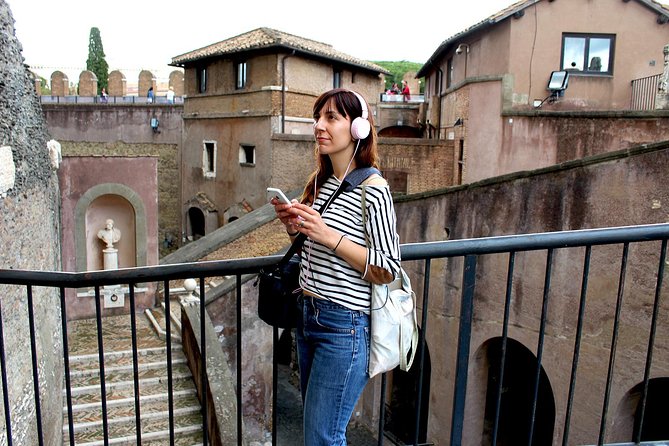
This experience is a combo: your adult admission e-ticket to Castel Sant’Angelo and a self-guided smartphone audio tour (Android and iOS). Total time is about 1 hour 30 minutes, though your pace will decide the real length.
There’s no live guide and no meeting point. That matters because your “tour” experience is really two parts working together:
1) getting inside the fortress with your ticket, and
2) following the audio’s prompts through the route.
The big practical win is offline use. You’re specifically told to download the ticket and audio while on Wi‑Fi before you go, because you shouldn’t expect Wi‑Fi or 4G once you’re inside. The audio download is also not tiny: you’ll need roughly 100–150 MB of space.
You can also read our reviews of more tours and experiences in Rome.



Booking and time slots: why arrival timing matters
The tour offers choice of dates and times, which is what you want in Rome. Even with advance tickets, Castel Sant’Angelo is still a guarded, ticketed monument with security.
Your best move is arriving about 30 minutes early to go through the security check-in. Late arrivals won’t be accommodated. If you’re traveling in warmer months, also give yourself buffer time; you may not be forced to stand in a long line for hours, but you can still feel the pace slow down before you even reach the first rooms.
Also keep in mind: large backpacks and bulky bags/luggage aren’t allowed. If you’re coming straight from a train or airport bag situation, plan to travel light.
The “how to enter” part: phone ticket reality check

Your entry ticket is an e-ticket on your phone (or a printed copy). You’ll receive an email from the local supplier with ticket and audio instructions.
A small gotcha: your ticket may show your experience purchase under a different legal name, and that can look odd at a glance. It’s still meant to be usable, and you shouldn’t need to panic.
One more key point: a Viator voucher is not your entry ticket and isn’t accepted at the entrance. If you have a voucher screen open, make sure you also have the actual ticket ready.
If something goes wrong, there’s an easy escalation route: use the support email listed for the provider ([email protected]) and reference your booking number. Some users reported that support sorted out missing ticket emails quickly when contacted.
Stop 1: The execution courtyard story by the river Tiber

Your route begins at the main entrance on the bank of the Tiber, and you’ll be guided toward the large open space that once served as the executions courtyard.
This is where Castel Sant’Angelo’s darker reputation gets specific. You’ll hear stories connected to the Roman Inquisition, including the case of Giordano Bruno. It’s the kind of narration that makes the stone feel less like a backdrop and more like an actual place where power was applied in public.
Admission time here is about 15 minutes in the fortress plan. The rooms are not just “interesting,” they’re emotionally different from the calmer, later sections of the visit.
Practical tip: even though you’re self-guided, I’d still move slowly at this first stop. The open spaces can be louder and visually confusing, and you’ll want your bearings before the route tightens.
Stop 2: Hadrian’s mausoleum ramp and the imperial urns

Next you’ll step into the castle’s early history, built around Hadrian’s cylindrical tomb. This part is a physical history lesson: the architecture is the story.
You’ll spend around 30 minutes exploring what’s described as a ramp leading up to the area where the cinerary urns of the Imperial family once stood. The route you’re given involves going up an original 2nd-century brick-walled ramp—and yes, this is a “wear comfortable shoes” moment.
This is also one of the stops where the site’s structure can affect your audio experience. Some people find that the audio prompts can feel less precise once you’re surrounded by multiple corridors or room entrances. If you’re the type who likes to follow “sign by sign,” you might want to keep your phone screen glance-ready.






Stop 3: Sala Paolina frescoes and papal glamour

Then you shift from the imperial world to the papal one. Paolina Hall is described as being covered in intricate frescoes, and it’s tied to the luxurious Sala Paolina where Pope Paul III welcomed honored guests.
This is about power, wealth, and propaganda-by-decoration. You’ll also be guided toward the work of Perino Del Vaga, whose decorative complex is part of what makes this section feel like a stage set.
Time here is about 30 minutes, and this stop usually plays well with couples and first-time visitors because it offers contrast. You don’t have to be a history nerd to appreciate the difference between “tomb architecture” and “church political theater.”
One small consideration: fresco rooms can be visually busy, so if you’re sensitive to crowds and lines of sight, pace yourself. Let the narration set the context, then use a few quiet breaths to take in what’s actually in front of you.
Stop 4: Sant’Angelo terrace views over the Tiber (and Tosca vibes)

The final highlight is the Sant’Angelo terrace with panoramic views across the Tiber and Rome. The audio connects the mood to the dramatic ending associated with Tosca, where the singer Floria Tosca is linked with throwing herself over the edge.
Even if you don’t care about opera, this is where Castel Sant’Angelo becomes more than a museum stop. From the top, you start to see how the river bends through the city and how this fortress functions as a lookout point.
This section is about 15 minutes in the visit plan, but it’s the kind of stop you can easily stretch if you enjoy photos and scanning the horizon. If you’re short on time, still try to catch the terrace light even for a few minutes—this is the “Rome postcard” payoff built into the itinerary.
Audio guide workflow: how to make it smooth (and where it can stumble)
The audio is designed to be self-guided with offline content including text, narration, and maps. You’ll use your own smartphone and your own earphones.
Here’s how to set yourself up for success:
- Download before you leave Wi‑Fi. The guidance says there’s no Wi‑Fi/4G on-site.
- Charge your phone fully. Low battery inside the fortress can turn the experience into a guessing game.
- Bring earphones. The experience doesn’t include them.
- Check compatibility. The audio is not compatible with Windows phones, and iOS devices older than certain models are excluded (examples listed include iPhone 5/5C and older, iPod Touch 5th gen or older, iPad 4th gen or older, and iPad Mini 1st gen).
Now for the balanced part: a recurring theme in user feedback is that the audio route can be less clear than it should be once you’re inside. Specific complaints include:
- narration that doesn’t perfectly match numbering on exhibits,
- maps and paths that don’t follow the current visitor flow, especially during restoration changes, and
- prompts that aren’t always perfectly timed for when to press play/pause.
I’d treat the audio as a strong context guide, not as a GPS replacement. If you’re patient and you’re comfortable walking back a few steps if needed, you’ll probably find it worth the money and effort. If you want turn-by-turn certainty, you might prefer a live guide or a different self-guided system with more explicit landmark matching.
Accessibility and physical pace: stairs and slopes are part of the deal
Castel Sant’Angelo involves ramps and upward pathways. Some users specifically noted it can be tough if you have limited endurance or walking issues because you’ll be moving uphill through sections of the fortress.
Since this experience is self-guided and does not offer live assistance, you’ll want to judge your comfort with:
- slopes and stair-heavy pathways, and
- taking breaks on your own schedule.
If stairs are difficult for you or your group, consider planning a shorter overall visit and prioritizing the terrace and the Paolina Hall section first.
Price and value: when $34.94 makes sense
At $34.94 per person for an entry ticket plus an offline audio guide, the value depends on how you like to tour.
This is a good deal if you:
- want to avoid roaming charges by using offline maps and audio,
- prefer flexible pacing over waiting for a group, and
- enjoy learning context while you look at art and architecture up close.
It might feel less great if you:
- rely heavily on precise signage matching and don’t want to problem-solve at all, or
- plan to visit without downloading first and expect everything to work on-site.
My take: for most visitors who arrive prepared with downloaded audio and a charged phone, it’s strong value because you’re not paying extra for a live guide, yet you’re getting a structured route with key stories built in.
Who this tour fits best
This self-guided setup is especially suitable for:
- couples and friends who want to split off for photos and regroup,
- solo travelers who like to learn as they go, and
- history-curious visitors who want a narrative thread through the tomb, papal rooms, and terrace.
It’s less ideal for you if:
- you want constant “this door, then this hallway” directions,
- your phone battery is usually a problem, or
- you don’t have earphones and don’t plan to borrow.
Should you book this Castel Sant’Angelo E-ticket and audio guide?
Yes, I think you should book it if you can do the basics right: download on Wi‑Fi, bring earphones, charge your phone, and arrive early enough for security. The terrace views and the way the audio ties imperial, religious, and dramatic stories together make the experience feel organized.
Skip this one (or switch to a different format) if you want high-precision navigation that never changes with renovations or crowd patterns. In a fortress with evolving routes, audio that depends on numbers matching the floor can be frustrating if you hate backtracking.
If you’re on the fence, here’s the simple checklist I’d use: prepare your phone, show up early, wear good shoes, and treat the audio as guided context. Do that, and Castel Sant’Angelo is likely to feel like a memorable afternoon rather than a stressful tech setup.
FAQ
Is there a live guide with this Castel Sant’Angelo experience?
No. This is a self-guided audio tour. You’ll use the smartphone audio instructions on your own, along with your entry ticket.
Do I need an internet connection to use the audio?
No internet is required for the audio content because the tour includes offline materials (text, audio narration, and maps). You should download everything while on Wi‑Fi before your visit.
What time should I arrive at Castel Sant’Angelo?
You should arrive about 30 minutes in advance for security check-in. Late arrivals won’t be accommodated.
What kind of smartphone do I need?
You need an Android (version 5.0 and later) or an iOS smartphone. The audio tour is not compatible with Windows phones, and certain older Apple devices are not supported.
Can I use a printed ticket or only a phone ticket?
Both are accepted. Your ticket can be shown digitally on your phone or printed.
What’s included in the price?
Your price includes the Castel Sant’Angelo admission ticket plus the E-ticket and the downloadable self-guided audio tour for your smartphone. Offline content includes narration and maps.
Is this tour refundable if I cancel?
No. The experience is non-refundable and cannot be changed for any reason.