REVIEW · BOLOGNA
Bologna Murder Mystery: Self-Guided City Quest
Book on Viator →Operated by Questo · Bookable on Viator
Bologna turns into a crime-scene walk. This self-guided Bologna Murder Mystery city quest uses the Questo app to turn famous squares and streets into a puzzle trail, with no internet needed once you start. You’ll follow a mystery storyline made of real-world clues, complete 11 challenge stops, and then finish at Piazza Rossini.
I like two things right away: the price-to-walking ratio and the way it nudges you past the usual checklist. At $6 per person for about an hour, you get an organized route and built-in reasons to look at details you might otherwise skip. You also get 11 puzzle challenges, so the time feels like a game instead of a slow sightseeing march.
One thing to keep in mind: there’s no physical tour guide. If the story doesn’t fully click for you, you’re still expected to solve each next clue by reading what’s around you and following the app—fun, but it can also mean you rely on your phone when you’d rather have a person to ask.
In This Review
- Key points at a glance
- How this Bologna Murder Mystery quest actually works
- Price and value: $6 for a guided-in-your-pocket walk
- Where you start and where you finish in Bologna
- Your Bologna loop: 11 puzzle stops you’ll solve on foot
- Porta Galliera and Bologna’s ornate wall gate clues
- Piazza VIII Agosto and the Piazzola market angle (Fri/Sat)
- Arena del Sole: theatre details with a reopening story
- The Fountain of Neptune: bronze, dates, and Giambologna’s model
- Oratory details under an old city wall door
- Piazza Maggiore and the unfinished facade of San Petronio
- A Baroque church with an elliptical plan and 1905 facade
- Two Towers: Asinelli and Garisenda and their family names
- Bologna’s oldest university story, from homes to public spaces
- Park of Montagnola: Napoleonic planning in 1805
- Bologna Cathedral and a 17th-century focus
- Archiginnasio: built fast in 1562 and inaugurated in October
- Palazzo dei Banchi and the facade hiding the rear market
- What to do if you get lost or the story feels fuzzy
- Who this Bologna Murder Mystery is best for
- Should you book the Bologna Murder Mystery self-guided quest?
- FAQ
- How long is the Bologna Murder Mystery self-guided city quest?
- Do I need an internet connection to play?
- Is the experience available in English?
- Where do I start and where do I end?
- Is there a physical tour guide during the quest?
- Can I cancel for free?
Key points at a glance
- Offline-friendly play so you can explore without burning mobile data
- Start and stop on your own schedule within the app’s open hours
- 11 puzzle challenges that push you to notice small, specific details at each stop
- English language support for the storyline and prompts
- Private group experience so only your group plays the quest
- Family- and friend-friendly pacing built around a short, about 1-hour walk
How this Bologna Murder Mystery quest actually works
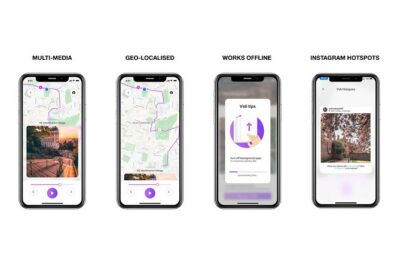
This is a city quest built for walking. You’ll use a mobile access code and the Questo app for step-by-step directions, with a storyline that ties the route together. The app is designed to be flexible: you can pause and resume, and you can choose your own beginning and end time rather than being locked into one tour departure.
The big practical win is that you don’t need an internet connection to play. That matters in Bologna, where signal can vary block to block, and it matters anywhere if you’re trying to control data use. The app experience also includes a mobile ticket, so you’re not dealing with printouts while you’re on the move.
You’ll also want to set expectations: the quest is structured around finding answers to each challenge at each location. That means you’ll spend real time looking around—sometimes up, sometimes across a square—rather than just passing through and snapping a photo.
You can also read our reviews of more tours and experiences in Bologna.

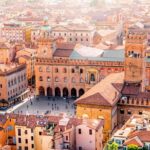
Price and value: $6 for a guided-in-your-pocket walk
At $6 per person, this quest is priced like a low-commitment activity. You’re not paying for a guide’s labor per hour or for a transport component. Instead, you’re paying for a route plan, a mystery storyline, and 11 puzzle prompts that keep you moving toward specific spots.
That value makes sense if you’re the type who enjoys learning by doing. You’ll get quick “reasons to stop” at each major point on the route: you’re not just sightseeing, you’re solving. It also makes the activity easy to fit into a day in Bologna, since the duration is about 1 hour.
The trade-off is that you don’t have a human on standby. If you’re someone who loves asking questions mid-walk, you might miss that. Still, for the cost, the structure is strong: you get a self-guided format that stays organized.
Where you start and where you finish in Bologna
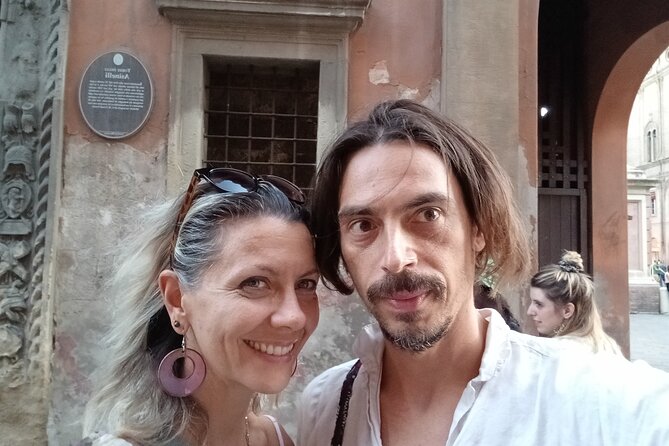
You’ll meet at Piazza XX Settembre, 15 in Bologna. Your quest then leads you step by step to Piazza Rossini, 1, which is where you’ll finish. The app instructions are set up so you can follow them without guessing where the route is headed.
The experience runs all day in the given opening window (listed as Monday–Sunday, 12:00 AM to 11:59 PM), so you can time it for the part of your day that works best. It’s also near public transportation, which is handy if you want to plug this into a larger Bologna itinerary without adding extra transit planning.
Your Bologna loop: 11 puzzle stops you’ll solve on foot
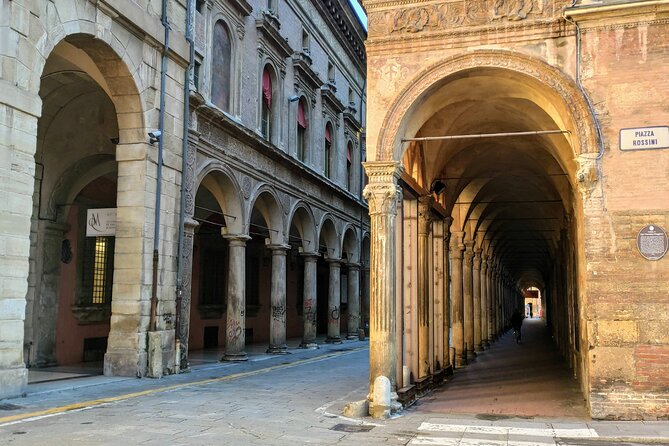
The route is a chain of locations, each tied to a clue. At every stop, the app gives you a challenge, and you’ll need to look around to find the answer and move to the next place.
Here’s what you can expect as you progress through the quest:
Porta Galliera and Bologna’s ornate wall gate clues
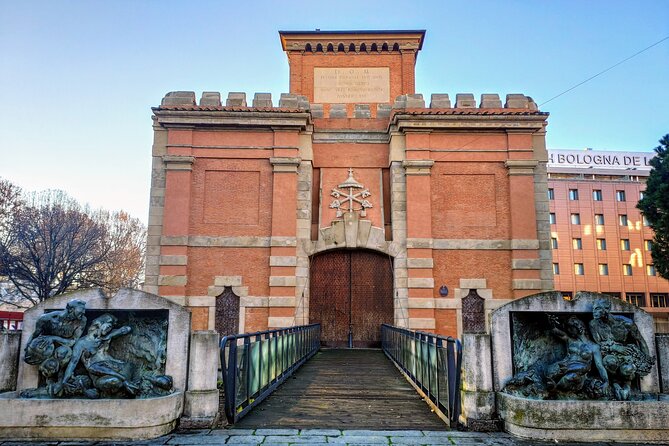
You’ll start by heading to Porta Galliera, one of the remaining gates from Bologna’s former outer medieval walls. This gate is noted as the most ornamented of the remaining gates, built during 1659–1661 using designs by Bartolomeo Provaglia.
The puzzle here is simple in concept: you’re meant to look around and find the clue tied to Porta Galliera’s story. Since this is an “observe and answer” moment, it’s a good early stop if you want to get your bearings fast and get into the game.
Piazza VIII Agosto and the Piazzola market angle (Fri/Sat)
Next, the quest places you at Piazza VIII Agosto, where on Friday and Saturday the traditional “Piazzola market” runs with over 400 street stalls. The app’s challenge at this stop is another look-around task, aimed at turning what could be a quick glance into a moment of attention.
If you play on a Friday or Saturday, you may feel like the square is “in motion.” If not, you’ll still get the same puzzle structure, just without that market energy.
Arena del Sole: theatre details with a reopening story
Then you’ll reach Arena del Sole, a historic theatre area in Bologna. Its origins are listed as 1810, and it reopened in 1995 after eight years of reconstruction.
This stop is a classic quest-builder: it’s specific. The app wants you to connect the theatre’s timeline to the clue you’ll find around you. If you enjoy facts that have dates attached, this is the kind of stop that can feel satisfying.
The Fountain of Neptune: bronze, dates, and Giambologna’s model
A major visual anchor in the route is the Fountain tied to Neptune. The fountain was completed in 1565, and the over-life-size bronze figure of the god Neptune was completed and fixed around 1567.
The clue focus includes names and commission history: the statue is described as an early design by Giambologna, who had submitted a model for the Fountain of Neptune in Florence but lost the commission to Baccio Bandinelli. If you like art history details you wouldn’t normally seek out, this stop is one of the strongest.
Oratory details under an old city wall door
The quest then moves to an oratory built between 1481 and 1497. It was created when the celestine fathers of the nearby church of San Giovanni Battista decided to build a small church in an area below which was the structure of a door of the circle early medieval walls.
The clue ties into the religious art placed there: an ancient image of the Madonna was protected by a simple tabernacle. This stop is more “story-finding” than “landmark-checking,” since the attraction is partly about what’s beneath and alongside what you see.
Piazza Maggiore and the unfinished facade of San Petronio
Next is the monumental basilica in Piazza Maggiore, dedicated to Bologna’s patron saint, Saint Petronius, who is listed as bishop of Bologna in the fifth century. Construction began in 1390, and the main facade is described as unfinished since.
This is another puzzle where you’re meant to look carefully. Instead of a broad “walk and admire,” the game structure makes you focus on one answer point connected to the basilica’s stated story.
A Baroque church with an elliptical plan and 1905 facade
The route continues to a Baroque church whose construction began in 1687–1690, designed by Giovanni Battista Bergonzoni. It includes an elliptical plan with a dome designed by Giuseppe Tubertini, completed in 1787, with the facade added later in 1905.
The sanctuary houses a specific work: Sorrow over Dead Christ (1463) by Niccolò dell’Arca. For puzzle-solvers, this stop gives the app something to work with: a tangible set of dates and names to connect the clue to what’s around you.
Two Towers: Asinelli and Garisenda and their family names
You’ll hit Bologna’s famous pair of leaning towers: the taller one is Asinelli, and the smaller leaning one is Garisenda. Their names are described as coming from families traditionally credited with having been constructed between 1109 and 1119.
This is a great “easy-to-locate” stop in the sense that towers are hard to miss. The challenge still matters, though: you’ll be looking around for the puzzle answer, not just standing and taking a photo.
Bologna’s oldest university story, from homes to public spaces
Another stop pulls you into the education thread around Bologna. The quest describes how the oldest university in Europe didn’t have a base until well into the Renaissance. Before then, classes were held in professors’ homes (many lived around here) or in public spaces like the one you’re standing in.
This is a clever clue approach because it asks you to imagine how things worked before the institution got a dedicated physical home. It’s not just dates for the sake of dates; it’s about how people used the streets and neighborhoods as classrooms.
Park of Montagnola: Napoleonic planning in 1805
Then you’ll reach Park of Montagnola, described as a public park in Bologna. Its original construction is listed as 1805, commissioned under Napoleonic rule from Giovanni Battista Martinetti.
In quest form, parks can be tricky because they’re spread out. Here, the app’s challenge turns that into a focused mission: you’re not wandering aimlessly; you’re searching for the specific clue that unlocks the next step.
Bologna Cathedral and a 17th-century focus
The next major landmark is Bologna Cathedral, dedicated to Saint Peter. The provided details say most of the present building dates from the 17th century, with a few parts from the late 16th century, and it’s described as the seat and metropolitan cathedral of the Archbishop of Bologna.
The puzzle prompt at the cathedral helps you slow down and read the place rather than just pass through. It’s a nice change of pace when earlier stops leaned heavily on gates, towers, and art.
Archiginnasio: built fast in 1562 and inaugurated in October
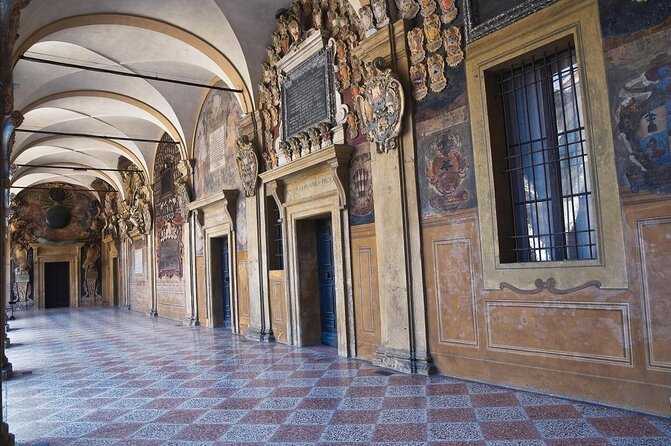
Your route then includes Archiginnasio, described as beginning at the end of February 1562, built very quickly, and inaugurated on October 21, 1563. The building of the new Schools was named Archiginnasio after a classical term used to designate the Studium, with the Studium being the original name of the University of Bologna.
This is one of the stops where the dates feel like part of the satisfaction. The clue design likely plays on those named details and helps you connect the place to its schooling identity.
Palazzo dei Banchi and the facade hiding the rear market
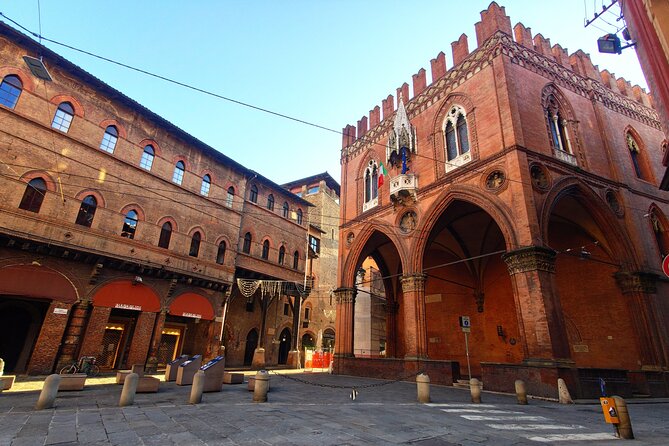
Finally, you’ll arrive at Palazzo dei Banchi. It’s described as the last building erected in Piazza Maggiore, designed by Vignola in the 16th century, with a spectacular facade intended to hide the alleys of the rear market. The name is also explained: it comes from the ancient presence of currency exchange “banks.”
This end-area clue is a strong way to close the loop. By the time you reach it, you’ve been practicing puzzle attention across multiple types of architecture, so the facade story becomes the kind of detail you can appreciate and remember.
What to do if you get lost or the story feels fuzzy
This quest is built to be independent, and that’s part of the fun. Still, if you feel turned around, don’t panic. The experience uses step-by-step app guidance to move you toward Piazza Rossini, so your job is to keep following the next instruction rather than trying to fix your whole route in your head.
One more consideration: the mystery storyline is part of the package, but it may not feel perfectly clear while you’re walking. If the story is confusing, focus on the clue mechanics: look around, find the answer, and advance. The practical value here is the guided walk between real places, not a dramatic plot you have to fully decode.
Who this Bologna Murder Mystery is best for
This is ideal for people who like walking and learning through small prompts. Families can like it because the duration is short (about an hour) and each stop has a clear task. Groups of friends also tend to enjoy it because you can compare notes on what you’re seeing and who spotted the key detail first.
English language support helps make it accessible if you don’t want to rely on Italian-only explanations. It’s also budget-friendly, which makes it a good match for travelers who want a structured experience without committing to a pricey guided tour.
If you’re the type who needs a human guide to keep you on track or to explain the story’s big picture, you might prefer a traditional tour. But if you enjoy self-directed discovery, this app quest is built for you.
Should you book the Bologna Murder Mystery self-guided quest?
I’d book it if you want a low-cost, about-one-hour Bologna walk that forces you to pay attention. The strongest reason to choose it is the mix of offline puzzle play, 11 challenge stops, and a route that touches major landmarks and specific architectural stories. At $6 per person, it’s hard to beat as a “fill the day with something purposeful” option.
Skip it if you hate walking without a guide or if you need every part of the storyline to make perfect sense as you go. In that case, the lack of a physical tour guide might feel limiting.
FAQ
How long is the Bologna Murder Mystery self-guided city quest?
The experience lasts about 1 hour.
Do I need an internet connection to play?
No internet connection is needed to play the quest.
Is the experience available in English?
Yes, it’s offered in English.
Where do I start and where do I end?
Start at Piazza XX Settembre, 15, 40121 Bologna BO, Italy, and end at Piazza Rossini, 1, 40126 Bologna BO, Italy.
Is there a physical tour guide during the quest?
No. This is self-guided with the app, so there’s no physical tour guide.
Can I cancel for free?
Yes, you can cancel for a full refund if you cancel at least 24 hours in advance.