REVIEW · BOLOGNA
Bologna’s Ancient and Recent History: A Self-Guided Audio Tour
Book on Viator →Bookable on Viator
Bologna rewards slow listening. This self-guided audio walk lets you wander the city’s ancient and more recent landmarks with VoiceMap GPS and no tour-group pressure. I like that it costs just $7.99 and you get lifetime access in English or Italian, plus offline audio and maps when you’re out on the streets.
One possible drawback: the narration may feel short on facts at some stops, and you can end up listening while you wait—so go in expecting a guided stroll, not a lecture. If you want museum-style depth at every single site, you might need to pair this with a ticketed visit on your own.
In This Review
- Key highlights to look for
- A self-guided Bologna walk with VoiceMap, not a group schedule
- Starting at Neptune Fountain and timing your 90-minute route
- Piazza Maggiore to San Petronio Basilica’s largest sundial
- Roxy Bar and Vasco Rossi’s Vita Spericolata detour
- Two Towers, Dante’s Inferno mention, and the UNESCO porticos (2021)
- Santo Stefano’s Seven Churches and a pass-by of Santa Maria della Vita
- The University of Bologna origin story and Piazza Galvani’s electrified frogs
- Price and value: what $7.99 really buys you
- What to bring (and how to walk this route well)
- Should you book this Bologna ancient-to-science audio walk?
- FAQ
- How long does the Bologna Ancient and Recent History self-guided audio tour take?
- Where do I start and where does the tour end?
- What app do I need, and does it work offline?
- Is the tour offered in English and Italian?
- Do I need tickets for museums or attractions mentioned on the route?
- What do I need to bring with me?
Key highlights to look for
- Neptune Fountain start point that makes it easy to get your bearings fast in the center
- San Petronio Basilica’s world’s largest sundial sight built into a walk through Piazza Maggiore
- Two Towers plus Dante’s shadow, with stops that connect literature to stone
- UNESCO porticos (2021), explained as more than pretty arches you can walk under
- Santo Stefano’s Seven Churches as a quieter spiritual detour within the route
- Piazza Galvani and the electrified frogs story, for when Bologna turns scientific
A self-guided Bologna walk with VoiceMap, not a group schedule
What makes this experience work in Bologna is that it’s built for wandering. You’re not stuck with a rigid lineup, and you can pause as long as you want at a plaza, a façade, or a moment where the light hits right under the porticos.
After booking, you get a ticket with instructions and a unique code. Then you install the VoiceMap app, enter your code, and let it handle the flow with automatic GPS playback and turn-by-turn directions. This is a big deal on foot because Bologna’s center can feel like a maze until you’re moving with guidance.
You also get offline support: audio, maps, and geodata can all work without a signal. That means you’re not spending your walk hunting for bars just to hear the next stop. And you can use it not only before your booking date, but also after, since access is lifetime.
Two more practical points: you’ll need your own smartphone and headphones. And the experience is private in the sense that it’s for your group only, not mixed into a larger guided party—though the experience still stays self-led.
Finally, keep expectations straight about what’s included. You won’t be guided through any museums or ticketed attractions along the way. If you choose to go in, you pay on your own time and budget.
You can also read our reviews of more tours and experiences in Bologna.


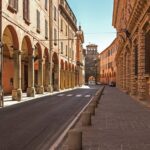
Starting at Neptune Fountain and timing your 90-minute route
You begin at Neptune’s Fountain in Piazza del Nettuno, so your “walk start” feels central and obvious. From there, the route threads through the historic core at a pace suited to a 1 to 1.5 hour outing.
This length is perfect if you want Bologna to feel connected without turning your whole day into a checklist. You can do it as a first afternoon orientation, or as a focused loop when you already know the basics and want the story behind what you’re seeing.
Because it’s GPS-guided, you’ll want to be ready to move when the app prompts you. Porticos can slow things down in a good way, but they can also confuse phone GPS if you’re deep under long arcade stretches. If the route seems to stall, step out slightly into a brighter square, then let it re-sync.
You’ll be back at the meeting area when you finish—your ending point is described as returning to the route area near Via d’Azeglio. In real life, that usually means you end in the same neighborhood you started and can keep exploring with food, espresso, and more wandering.
Piazza Maggiore to San Petronio Basilica’s largest sundial
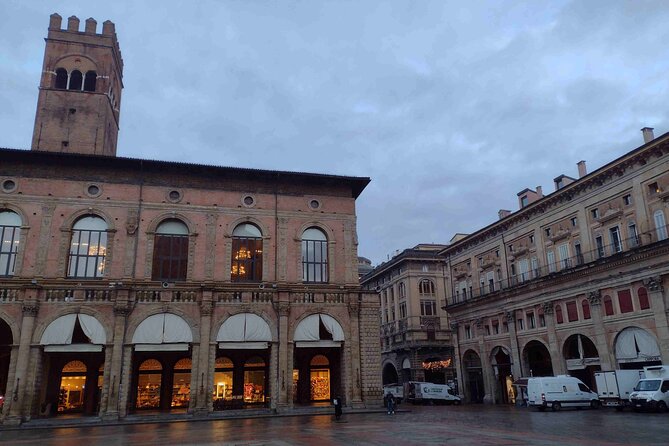
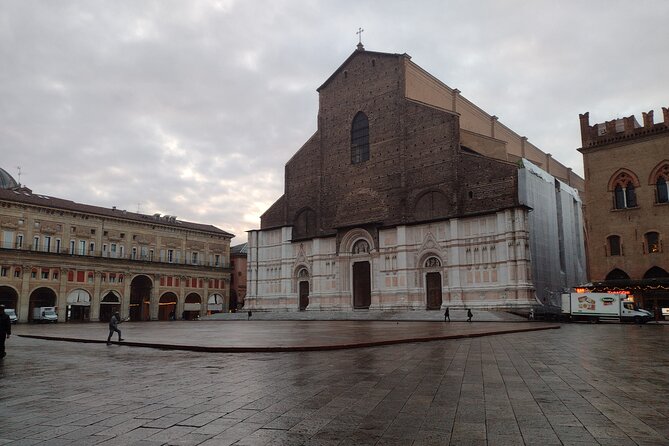
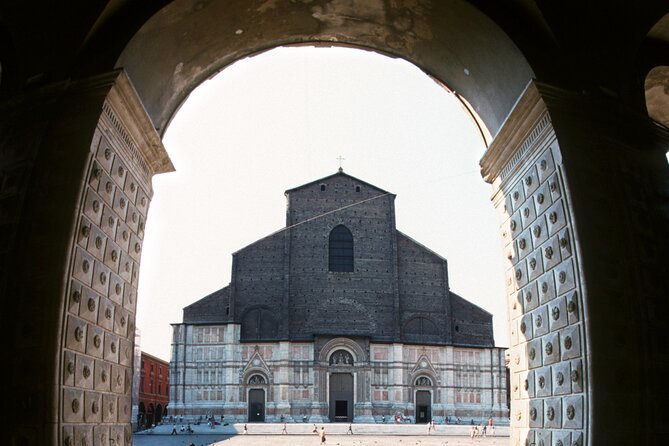
The walk builds toward one of Bologna’s biggest “stop and look up” moments. After getting underway from the fountain, you move through Piazza Maggiore and head to San Petronio Basilica.
San Petronio is famous for its scale, but the standout item on this audio route is the world’s largest sundial you’ll see at the basilica. This is one of those sights that feels instantly special because it’s not just decorative. It’s a tool—part architecture, part timekeeping—and it connects everyday life to the way earlier generations measured the world.
What I like about placing this early is pacing. You start with a big central space, then you get a building that rewards close attention. You can keep it quick if you’re short on time, or linger if you like reading façades and noticing how the city’s ideas show up in stone.
Roxy Bar and Vasco Rossi’s Vita Spericolata detour
Not every Bologna walking route gives you pop culture. This one gives you a stop for the Roxy Bar, linked to Italian superstar Vasco Rossi through his song Vita Spericolata (The Reckless Life).
That small musical detail changes the vibe of the day. It’s a reminder that the city isn’t only medieval towers and university founders; it also has modern street-level identity. If you enjoy the idea of tracing how art and music “claim” places, this stop will feel like a fun wink in the middle of the historical scenery.
You likely won’t spend long at this kind of spot. It’s more about recognizing it and letting the story land, then moving on.
Two Towers, Dante’s Inferno mention, and the UNESCO porticos (2021)
Next come the Two Towers—Bologna’s most recognizable silhouette. The audio route points out that one of them gets a mention in Dante’s Inferno, which is a great way to make literature feel physical instead of abstract.
Then you get the part that makes Bologna so different from many Italian cities: the porticos. These walkways earned UNESCO World Heritage status in 2021, and this route doesn’t treat them like wallpaper. You’ll see and learn about how the porticos work as a street system—covering routes, shaping movement, and changing the way weather and crowds feel.
This section is where you’ll likely do the most “walk-with-your-head-up” moments. The arches are practical when the sun hits, they soften rain, and they slow you down just enough to enjoy façades you might otherwise miss.
If you’re the kind of traveler who wants a deeper lesson, you might still want extra reading later. But even if you don’t, this part is visually rewarding on its own.




Santo Stefano’s Seven Churches and a pass-by of Santa Maria della Vita
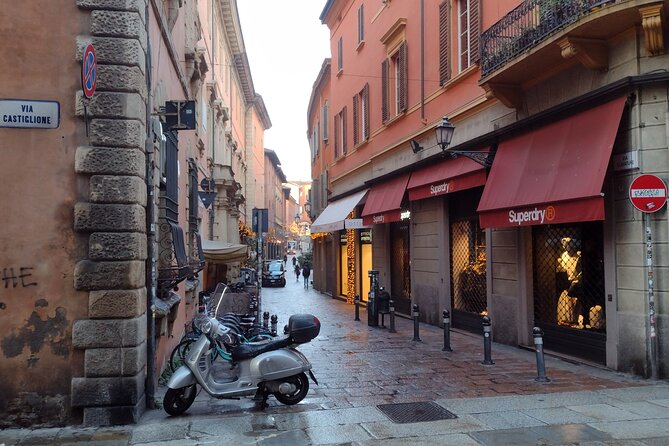
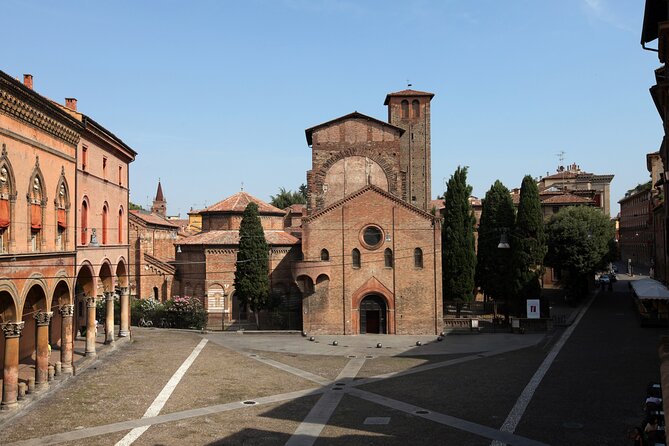
One of the route’s more atmospheric stops is Santo Stefano, often linked to the idea of the “Seven Churches” experience. Instead of one big highlight, it’s a collection, and that format rewards curiosity at walking speed.
This is also a good spot to take a breath. A collection of religious spaces usually means you’ll slow down, stand still for a moment, and notice details like how the architecture changes as you move between adjacent areas. Even if you don’t go inside anywhere you’ll just appreciate the layout.
Along the way, you also pass Santa Maria della Vita. You may not spend much time there unless you choose to stop for a photo or a closer look. But it adds variety—another face of Bologna’s church architecture without turning your day into a museum crawl.
The University of Bologna origin story and Piazza Galvani’s electrified frogs
Bologna has an unusually strong claim to being a place where ideas spread. This audio walk includes a moment about how the world’s oldest university got its start—a reminder that universities are not just buildings. They’re social engines that shape scholarship, careers, and city life for centuries.
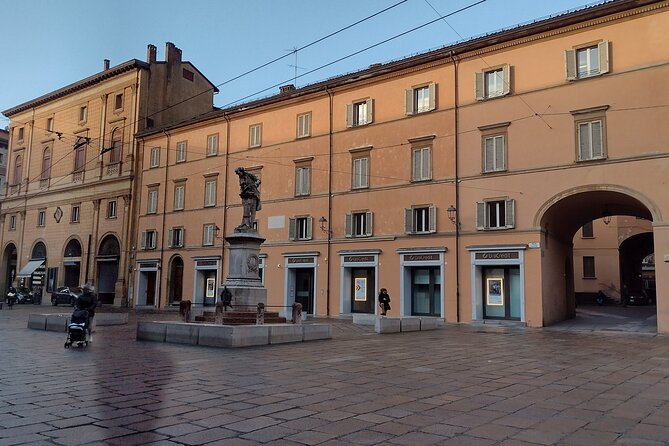
Later, you move toward Piazza Galvani. Here, the story turns scientific: you’ll hear about experiments involving electrified frogs before heading back toward where you started.
That’s a clever pairing because it puts Bologna’s academic legacy next to a famous experiment story. It helps you feel the city as more than a postcard. You’re seeing a place that turned thinking into something concrete—right where you’re walking.
Price and value: what $7.99 really buys you
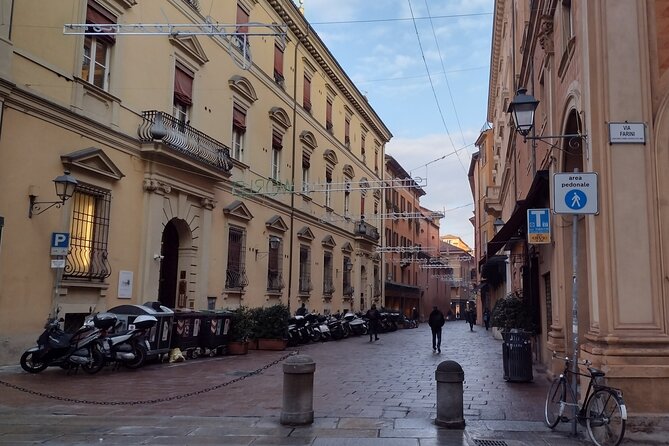
At $7.99 per person, this is priced like a budget-friendly add-on, not a premium guided tour. The big reason it can still be worth it is the lifetime access model. You’re not paying again if you want to repeat the walk later, do it in a different season, or share it with someone traveling at a future date.
Offline use is also part of the value math. If you’ve ever been stuck watching a spinning loading icon in the middle of an Italian center, you already know how much that matters. Here, your maps and audio are designed to keep working.
Still, you should calibrate expectations for that price. This isn’t a guided museum day. It’s a self-guided walking narrative. That means you get a story and direction at the right moments, but you still choose when to enter buildings and how much time to spend in each place.
What to bring (and how to walk this route well)
Bring comfortable shoes. The route is short by time, but it’s still a walking loop through central Bologna, and you’ll likely spend extra moments at the basilica and the towers.
Use headphones that fit well. Since the VoiceMap audio is GPS-triggered, you’ll miss key lines if the sound is spotty. If you’re traveling in a noisy time of day, consider noise-isolating or in-ear options.
Before you start, make sure you can access the VoiceMap app and that your code is ready. Then, if possible, load the offline content while you have a stable connection. This isn’t listed as a step you must do, but it’s the easiest way to avoid any last-minute surprises.
Also: be flexible with timing. If you want to really enjoy the sundial, take your time at San Petronio. If you want the route to feel snappy, keep moving and treat each stop as a quick “look + listen” moment. The beauty here is control.
Should you book this Bologna ancient-to-science audio walk?
Book it if you want a budget way to connect Bologna’s big landmarks—Neptune Fountain, Piazza Maggiore, San Petronio, the Two Towers, UNESCO porticos, Santo Stefano, the oldest university origin story, and Piazza Galvani—into one walk. It’s also a smart pick if you like independence: start when you want, linger when something grabs you, and keep going without waiting for a group.
Think twice if you’re craving long, detailed explanations at every single stop. There can be moments where the narration feels more personal or light on factual depth, and that may not satisfy if you’re the type who reads every plaque and wants deep scholarship in your headphones.
If you land somewhere in the middle—curious, but also wanting time to simply enjoy Bologna—this is an efficient, low-cost way to make your stroll feel guided without feeling scheduled.
FAQ
How long does the Bologna Ancient and Recent History self-guided audio tour take?
The duration is approximately 1 hour to 1 hour 30 minutes, depending on how long you stop at different sights.
Where do I start and where does the tour end?
The tour starts at Neptune’s Fountain in Piazza del Nettuno. The experience ends back at the meeting point area, with the route described as looping back near Via d’Azeglio.
What app do I need, and does it work offline?
You use the VoiceMap app on Android or iOS. The tour includes offline access to audio, maps, and geodata.
Is the tour offered in English and Italian?
Yes. The tour includes lifetime access in English or Italian.
Do I need tickets for museums or attractions mentioned on the route?
No museum walkthrough is included. If you choose to enter any museums or attractions mentioned along the way, you’ll need to pay for them separately.
What do I need to bring with me?
You’ll need your own smartphone and headphones. Transportation and food and drink are not included.