REVIEW · PARIS
Best of the Left Bank: Self-Guided Tour of the Latin Quarter
Book on Viator →Operated by VoiceMap Audio Tours · Bookable on Viator
A stroll through Paris written in audio is a smart move. You follow the Latin Quarter at your pace, with offline access so you are not hunting Wi-Fi every five minutes, and you hit big names like the Sorbonne and the Panthéon without feeling rushed. I especially like how the offline maps and geodata help you keep your bearings, and how the story spots literary history right at the start. One drawback to plan for: the app can be picky about where it thinks you are, so you may need a moment to re-sync when the route gets confusing.
This tour shines for two reasons: it keeps things low-stress and it covers a lot of ground in a compact area. You can walk slowly, stop for photos, or linger near Rue Mouffetard for snacks without feeling like you are falling behind a group.
For the audio, you’ll want to treat your phone like it is on duty. If your device audio cuts out or refuses to resume, it can throw you off, so I’d come with the audio downloaded and a backup plan like saved maps.
In This Review
- Key highlights that make this one worth your time
- First steps in the Latin Quarter: Shakespeare and Company to the theatrical side streets
- A practical tip before you hit play
- Le Théâtre de la Huchette: small theater energy, big continuity
- Eglise Saint-Severin: why the pillars look the way they do
- Cluny Museum pass-by: residence, Roman baths, and medieval art in one spot
- Sorbonne: how a king’s chaplain connects to today’s campus
- Panthéon: French heroes in one long line
- Saint-Étienne du Mont and Sainte Geneviève: protection, burial, and legend
- Rue Mouffetard: the oldest market street for real street energy
- Jardin des Plantes section: King’s Garden origins near your route
- Ending at Arènes de Lutèce: a Roman amphitheater that still feels real
- Price and value: why $14.99 can work (if you use it right)
- App reality check: how to avoid the common frustrations
- Who this tour fits best
- Should you book this self-guided Latin Quarter audio walk?
- FAQ
- How long is the Latin Quarter self-guided audio tour?
- How much does the tour cost?
- Is the tour offered in English?
- Does it work offline?
- Where does the tour start and end?
- What app do I use for the audio tour?
- Is museum entry included for any stops?
- What do I need to bring?
- Does the tour require group participation?
Key highlights that make this one worth your time

- Offline audio, maps, and geodata mean fewer Wi-Fi problems on busy streets.
- Lifetime access gives you more than one trip for your money.
- You start right by Shakespeare and Company, with a literary link to Hemingway, Gertrude Stein, and Ezra Pound.
- You pass landmarks tied to big French names, from the Sorbonne to the Panthéon.
- The route mixes famous sights with street-level texture like Rue Mouffetard and the Jardin des Plantes area.
- You finish at Arènes de Lutèce, a Roman amphitheater that is about as old as it gets in central Paris.
First steps in the Latin Quarter: Shakespeare and Company to the theatrical side streets
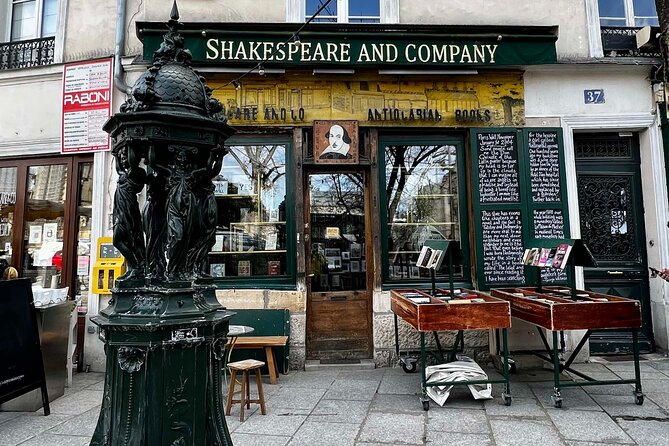
The tour starts in front of Shakespeare and Company at 37 Rue de la Bûcherie (Paris 75005). This matters more than it sounds. That corner sets the tone: the Latin Quarter is where you come to see Paris as ideas as much as architecture, and the audio immediately leans into the neighborhood’s literary energy.
The opening story points to Hemingway, Gertrude Stein, and Ezra Pound as people who used to shop there. Even if you only know their names, it gives you a reason to look up and notice what’s around you instead of treating the streets like a blur between major monuments.
From the start, you also get that old-Paris rhythm: small blocks, turning corners, and then suddenly a recognizable façade. The beauty of a self-guided format is that you control your speed. If you want to pause before moving on, you do it. If you want to keep moving because your feet are fresh, you do that instead.
You can also read our reviews of more tours and experiences in Paris.



A practical tip before you hit play
Make sure you have your headphones ready and your audio downloaded before you start. The tour includes offline access through the VoiceMap app, but the device still needs a clean session to play smoothly. If the app tries to reconnect while you’re walking, that’s when confusion can happen.
Le Théâtre de la Huchette: small theater energy, big continuity
As you work your way along the route, you pass Le Théâtre de la Huchette. The audio calls out something specific and very “Paris”: it has been playing the same short plays since 1957—The Bald Soprano and The Lesson by Ionesco.
This kind of detail is why audio tours work better than a random walking loop. It nudges you to see continuity in the city. Paris is not just a highlight reel. It’s also places that keep doing the same thing for decades, even as everything around them changes.
If you like theater, you’ll probably enjoy slowing down here. Even without going inside (tickets are not included), the stop gives the walk a living feel.
Eglise Saint-Severin: why the pillars look the way they do

Next up is Eglise Saint-Severin. The audio explanation focuses on a construction choice that gives the church a visual quirk: it began with just the central nave. Then the builders enlarged it by pushing the walls outward, which is why you see different rows of pillars.
That’s the kind of fact that helps you “read” a building. Instead of thinking, It looks old, you understand why it looks that way. And once you have that key, you’ll notice the building becomes more than a stop on your list. It turns into a real structure with decisions behind it.
This is also where you start to feel the value of a self-guided layout. You are not paying for entry, but you are getting context. You can stand, listen, and then keep walking when you’re ready.
Cluny Museum pass-by: residence, Roman baths, and medieval art in one spot

You’ll pass the Cluny Museum area, and the audio ties together three worlds in one place: the lavish residence of the Abbot of Cluny, the city’s ancient Roman Baths, and Alexandre du Sommerard’s collection of medieval art.
Even though the tour does not include museum tickets, this stop is still useful. It’s a reminder that the Latin Quarter layers eras so tightly that you can miss it if you are just scanning for big-ticket sights.
If you’re the kind of traveler who likes to choose on the fly, this is a good moment to make a decision. The audio sets expectations for what you might want to see later if you decide to buy tickets on a separate day.






Sorbonne: how a king’s chaplain connects to today’s campus
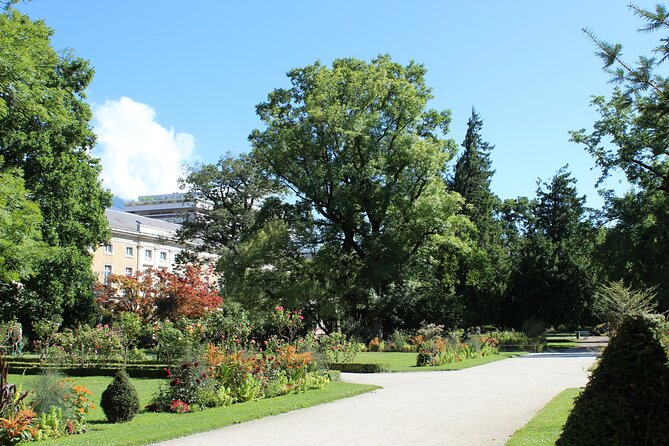
The route continues to the Sorbonne. The audio gives you the origin story: Robert de Sorbon, who served as chaplain to King Saint Louis, started it.
That single detail helps you see the Sorbonne not just as a name on a street sign, but as an institution with roots in medieval power and religion. And because the tour keeps moving, you don’t get stuck waiting for a museum schedule. You absorb the context while you walk.
One nice side effect of this kind of stop is that it breaks up the “big monument” feeling. Instead of only looking at buildings as objects, you start thinking of them as systems—education, religion, civic life—stuff that shaped how people lived here.
Panthéon: French heroes in one long line
The audio then brings you to the Panthéon, described as a shrine to French national heroes. It lists people you’ll recognize across art, politics, science, and literature: Marie Curie, Voltaire, Victor Hugo, Rousseau, Alexandre Dumas, André Malraux, and Josephine Baker.
This stop works because the tour frames it as a collective memory. You’re not just looking for a famous dome. You’re listening for what the city chose to honor, and that makes your walk more meaningful.
If you’re someone who tends to rush through monuments, slow down just a little here. Even a short pause helps you connect the names to what you see in front of you. And since the tour is self-guided, you can spend as long as you want without checking a schedule.
Saint-Étienne du Mont and Sainte Geneviève: protection, burial, and legend
After that, you pass Saint Étienne du Mont, described as the burial place of Sainte Geneviève. The audio adds a legend-adjacent detail: she protected the city from Atilla the Hun.
This is a good example of how the tour mixes facts and stories. You walk away with a clearer sense of why certain saints matter in Paris. The Latin Quarter has always been a place where myth, faith, and civic identity overlap, and this stop shows that overlap in plain language.
It’s also a nice change of pace from the more explicitly academic stops like the Sorbonne. You get a more human, story-based angle on the same neighborhood.
Rue Mouffetard: the oldest market street for real street energy
Next you go down part of Rue Mouffetard, called the city’s oldest market street. This is one of the stops that makes the walk feel like Paris, not just Paris on postcards.
The tour doesn’t include food, but it gives you permission to plan for it. One of the best practical tips here is to set aside time to sample as you pass shops and stalls. If you try to treat the whole walk like a race, you lose the point of coming to a market street in the first place.
If you like simple pleasures—bread, cheese, a small pastry, or a drink that you can hold while you keep walking—this is where you’ll feel the most payoff.
Jardin des Plantes section: King’s Garden origins near your route
You also pass through a section of Jardin des Plantes. The audio notes it was first created in 1635 and was called the King’s Garden.
This is a valuable pause even if you do not enter the gardens deeply. It helps you transition from the dense street life into a more open, calmer pocket. The Latin Quarter can be busy, and even a short breath of greenery makes the rest of the walk more enjoyable.
Ending at Arènes de Lutèce: a Roman amphitheater that still feels real
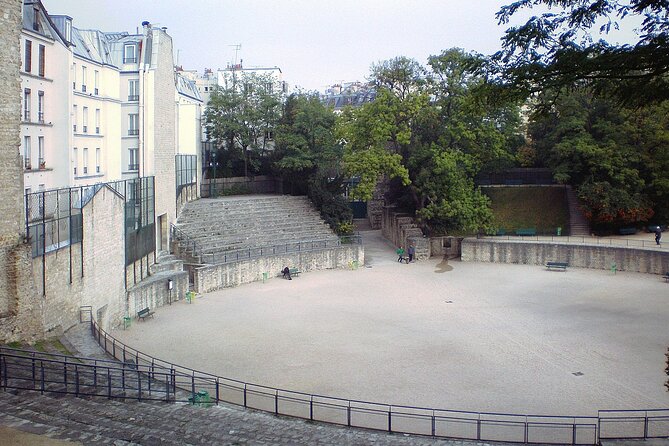
The tour ends at Arènes de Lutèce on 49 Rue Monge. The audio highlights it as a 2,000-year-old Roman amphitheater. Ending here is smart because it gives you a strong “time jump” finish. You start with literary references tied to the 1900s and modern icons, then you land in ancient Rome—inside walking distance.
You don’t need museum tickets to enjoy the impact of this finale. It’s an outdoor, recognizable structure that makes the whole route feel like a guided tour of layers: Roman, medieval, early modern, and modern Paris all stacked close together.
When your walk ends, you’re also in a location with easy continuation options for food or a longer wander. Even if you do nothing else, finishing at a Roman amphitheater gives the experience a complete arc.
Price and value: why $14.99 can work (if you use it right)
At $14.99 per person for 2 to 2.5 hours, the value is mainly in the lifetime access plus the convenience of offline audio and maps. You’re not paying for museum entry or transportation. You’re paying to get context while you walk, and to do it on your schedule.
This price makes the most sense if:
- you like self-paced sightseeing
- you are comfortable walking 2 hours and want structure
- you want to learn without adding ticket lines
It costs little compared with many guided experiences, but it still covers a lot: major landmarks and neighborhood texture, plus built-in wayfinding via the VoiceMap app.
App reality check: how to avoid the common frustrations
Two issues show up in the experience pattern. First, the app instructions on which way to go next can get confusing at times. Second, audio can cut out or fail to resume on some devices.
You can reduce the odds of both problems with a simple strategy:
- Start with the offline content downloaded
- Bring headphones that work reliably
- Keep your screen brightness on and do not put the phone into power-saving modes that might interrupt audio
- If you feel lost, pause, check your position, and then press play again once you’re confident you’re aligned
The good news: most of what the tour does is helpful and clear when everything is functioning. Offline access is a real win on crowded streets.
Who this tour fits best
This self-guided Latin Quarter tour is best for you if you want:
- an easy plan for a half-afternoon or evening walk on the Left Bank
- a structured route that still gives you freedom
- audio explanations for the major stops and the “why this building looks like that” moments
It’s also a solid choice for couples and small groups because it’s listed as a private activity for your group. You’re not sharing attention with strangers, even though the experience is self-paced.
Should you book this self-guided Latin Quarter audio walk?
Yes, if you want an affordable way to connect the dots across the Left Bank. The combination of offline audio and a route that hits everything from Shakespeare and Company to Arènes de Lutèce is a strong value play, especially when you can control your stops for food along Rue Mouffetard.
Hold off or go in with eyes open if you dislike app-based wayfinding. The route depends on the VoiceMap app understanding where you are, and that’s where problems can happen if the device or GPS is acting up.
If you’re the type who likes to learn while walking, and you’re okay troubleshooting a device once in a while, this is a smart way to spend part of your Paris time.
FAQ
How long is the Latin Quarter self-guided audio tour?
The walk typically takes about 2 hours to 2 hours 30 minutes.
How much does the tour cost?
It costs $14.99 per person.
Is the tour offered in English?
Yes, the tour is available in English.
Does it work offline?
Yes. It includes offline access to audio, maps, and geodata through the VoiceMap app.
Where does the tour start and end?
It starts in front of Shakespeare and Company at 37 Rue de la Bûcherie, 75005 Paris, and ends at Arènes de Lutèce at 49 Rue Monge, 75005 Paris.
What app do I use for the audio tour?
You use the VoiceMap app for Android and iOS.
Is museum entry included for any stops?
No. Tickets or entrance fees for museums or other attractions along the way are not included.
What do I need to bring?
You’ll need a smartphone and headphones, since they are not included.
Does the tour require group participation?
It’s a private tour/activity, meaning only your group will participate. It is self-guided, so you set your own pace.
If you want, tell me what day/time you’re planning to do this walk, and whether you prefer museums or street food stops. I can suggest a simple pacing plan that fits the 2–2.5 hour window.