REVIEW · BAR HARBOR
Ultimate Acadia National Park Self-Guided Driving Audio Tour
Book on Viator →Operated by Travel with Action · Bookable on Viator
Acadia gets a lot easier with a car audio guide. This self-guided drive strings together major stops across Mount Desert Island, with hands-free narration that cues you by location as you go.
What I really like is the value per vehicle: one $16.99 purchase covers up to 4 people, so it can feel cheap next to any bus day. Second, the app is built for the reality of Acadia—download once, listen offline, even when cell service disappears.
One thing to consider: the audio timing can feel off if you don’t match the suggested driving pace, and some stops have limited pull-offs for larger vehicles.
In This Review
- Key takeaways before you drive
- Why Acadia’s Park Loop Road feels less stressful with audio
- Price and value: what you’re really paying for
- Getting set up: offline GPS, password access, and audio that actually works
- Route overview: from Hulls Cove to the Cadillac payoff
- Hull’s Cove Visitor Center: the smart place to begin
- Sieur de Monts Spring: an Acadia “birthplace” story stop
- East-coast lookouts: Precipice and the choice between hard and gentle
- Schooner Head Overlook and the stand-in viewpoint strategy
- Sandy Beach, Old Soaker, Thunder Hole, Monument Cove: the ocean does the work
- Gorham Mountain and the “false summit” feeling
- Egg-shaped stones and Otter Cliff: big drops and big rock shapes
- Cobblestone beaches and a quick note on “parking reality”
- Rockefeller Jr.’s carriage roads at Aunt Betty Pond
- Jordan Pond and Bubble Pond: glaciers write the landscape (literally)
- Eagle Lake: the water source and bird food role
- Cadillac Mountain Summit Trail: the final climb and view payoff
- Beaver Dam Pond: the quiet closer after the big views
- So who is this best for?
- Final call: book this or skip it?
- FAQ
- FAQ
- Do I need cellular or Wi‑Fi during the drive?
- How much does the Acadia audio tour cost?
- How long does the tour take?
- Is the National Park entrance fee included?
- Is Cadillac Mountain summit access included?
- What are the main places the tour covers?
- What if I want an easier walk than Precipice?
- Can I play the audio through my car stereo?
- Does this tour expire?
- Are winter closures a problem for this tour?
Key takeaways before you drive
- Offline-first setup means you’re not stuck hunting for signal once you’re in the park.
- Per-car pricing (up to 4) makes it one of the simplest Acadia “budget add-ons.”
- Location-triggered audio helps you know what’s coming before you miss the turn.
- Multiple hiking options (like Precipice vs. Ocean Path) let you adjust for your comfort level.
- Cadillac Mountain needs extra planning since summit access isn’t included in the audio tour.
- Parking space is tight in places, so plan for short stops and get your timing right.
Why Acadia’s Park Loop Road feels less stressful with audio

Acadia can be a full-body experience. You’re juggling cliff views, ocean noise, parking lots that fill fast, and the feeling that you’ll miss a “must-see” if you blink.
This format helps because the stories are designed around the drive itself. You get story prompts that match where you are, so you’re not relying on stopping to read signs or guessing what a turnout is actually telling you. That matters in a place where many of the best moments come from quick decisions: pull in now, or keep rolling.
It also keeps you flexible. If you want to stay in place for photos, snack, or a short walk, you can. If you don’t care about one stop, you can skip it and not feel like you’re “falling behind” a group.
You can also read our reviews of more tours and experiences in Bar Harbor.


Price and value: what you’re really paying for

The price is $16.99 per group, up to 4 people. That’s the first big value lever: you’re not paying per head, and you’re not paying for a live guide.
The second value lever is time. You’re looking at about 2–3 hours for the full loop-style experience (over 22 miles). In practice, that means you can cover a lot of Acadia highlights without booking multiple paid tours or spending extra time trying to piece together what to see next.
The one cost to keep in mind is that park admission is not included. You still need to plan the National Park entrance fee ($35.00 per booking) and any required Cadillac Mountain summit reservation/access, since those aren’t part of the audio tour.
Getting set up: offline GPS, password access, and audio that actually works
This tour uses a separate app (Action’s Tour Guide App). After booking, you’ll receive a password via email and text. Then you download the tour app and enter the password.
Two practical rules make or break the day:
- Download while you’re on strong Wi‑Fi/cellular. Once you’re in Acadia, you may not have reliable internet.
- Use a GPS-enabled device so location-based auto-play can trigger the stories at the right time.
Once you arrive, no one meets you. You go to the starting point for your chosen direction and launch the tour in the app. The audio should start automatically at the first story point.
To hear it in the car, you can connect your phone to your car stereo using Bluetooth, USB, or AUX. CarPlay support is mentioned as compatible for playback, but a few people report the audio cutting out at the start/end of stops depending on how they route sound. If you’ve got a setup that tends to interrupt audio, test it before you roll out.
Route overview: from Hulls Cove to the Cadillac payoff

The drive starts at Hull’s Cove Visitor Center, where the narration sets the scene with the forests and why the park’s seasonal colors can be so striking. Then you’ll work your way into the Park Loop Road, which acts like a backbone for the big overlooks and coastal stops.
A key idea here: this isn’t only about sitting in your car. The audio tour includes story cues for both quick pull-offs and optional short hikes/walks. You can treat it like a guided drive, or like a flexible checklist with built-in context.
Your end point is the Cadillac Mountain summit area in the “crown jewel” payoff, followed by a few more stops before the drive finishes back at the meeting point.
Hull’s Cove Visitor Center: the smart place to begin
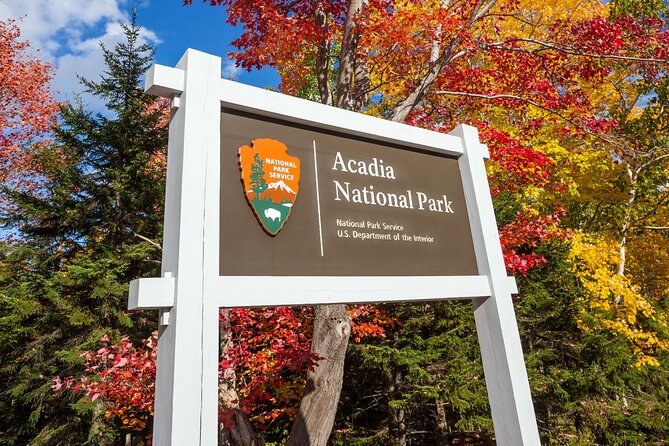
Starting at Hull’s Cove is a good move. It gives you a first block of context before you hit the road’s scenic intensity.
You’ll hear about the forests and how the park’s environment supports those dramatic seasonal shifts—especially in the fall. Even if you’re mostly there for coastline views, this early grounding makes later stops easier to understand. When the narration talks about rocks, water, and time, it helps to have that first mental map of the terrain.
If you arrive early, you can also use the time to get your bearings before crowds build. That’s especially useful because parking and traffic can turn chaotic fast around popular stops.


Sieur de Monts Spring: an Acadia “birthplace” story stop

As you continue, the tour passes Sieur de Monts Spring. The narration frames it as a symbolic spot tied to the idea of Acadia National Park starting more than a century ago.
This is the kind of stop that’s easy to drive past without meaning. Hearing a short story attached to it changes the experience. You’re not just watching water—you’re watching a living reminder of how people connected to the place long ago.
East-coast lookouts: Precipice and the choice between hard and gentle

The audio tour calls out one of Acadia’s most famous hiking routes: the Precipice Trail. It’s listed as about 1 hour, and it’s described as the most challenging and well-known hiking trail in Acadia.
That means: if you’re not comfortable with exposure or steep terrain, you’ll want to skip it. The tour gives you a built-in alternative route option: the Ocean Path Trail. This is framed as a gentle, winding walk compared to Precipice.
Here’s how to use this choice well:
- If you want big effort and dramatic payoff, Precipice is part of the package.
- If you want a calmer walk while still enjoying the coastal mood, Ocean Path keeps you in the game without the stress.
Also note a practical timing issue: some story cues play while you’re driving and asking you to get ready for the next stop. If you tend to stop late (or you’re moving faster than the app expects), you might feel like the audio is “behind” your location. Slow down and follow the speed prompts to keep the timing synced.
Schooner Head Overlook and the stand-in viewpoint strategy

A key mid-route stop is Schooner Head Overlook. It’s listed as about 20 minutes and can be reached from Bar Harbor without entering deeper into the park via Schooner Head Road, or via Park Loop Road just prior to the Sand Beach area.
This is useful if you want a viewpoint without committing to a longer walk. It’s also helpful as a “stand-in” when crowds or parking frustrations hit—because it’s close enough that you can still keep your day moving.
Sandy Beach, Old Soaker, Thunder Hole, Monument Cove: the ocean does the work
This stretch is pure coastal theatre. The tour points you to several short stops where the geology and wave action do the entertaining.
At Sandy Beach, it’s small—about 290 yards long—but the narration adds a fun natural-history detail: a slight greenish tint in the sand is linked to sea urchins. It’s exactly the kind of micro-detail that makes a stop feel more than just scenic.
Near there you’ll hear about Old Soaker, where waves crash against a vertical rock face and shoot water up. Then there’s Thunder Hole, a natural rock inlet where the wave boom can be dramatic.
Finally, Monument Cove is described as a twenty-foot tall pillar shaped by water and time, looking like a sculpture. These are the stops where you might spend less time walking and more time watching. Plan to stand where you can get a safe view, then let the waves do their part.
Practical note: don’t count on every wave to act the same way. The coast is weather-and-tide dependent, even if the story is always ready to play.
Gorham Mountain and the “false summit” feeling
Next up is Gorham Mountain, where the narration mentions a false summit—it looks like you’ve reached an end point before the trail continues higher.
This is the kind of detail that changes how you hike it. If you already know you might feel “done” too early, you’ll be less likely to question yourself mid-approach.
Even if you don’t hike it, the story works as a mental cue for understanding what you’re seeing in the surrounding area. Acadia’s views often come from understanding how the terrain tricks your eye.
Egg-shaped stones and Otter Cliff: big drops and big rock shapes
The tour highlights a beach with large, egg-shaped stones, smoothed by rough waves into bowling-ball sized rocks. It’s a great stop for anyone who likes geology, and it’s also just fun for the brain: you’ll look at rocks differently afterward.
Then comes Otter Cliff and Otter Cove. Otter Cliff is described as having a steep 110-foot drop to the chilly Atlantic. This is another place where the audio context matters, because without it you might miss how steep and exposed the viewpoint relationship is.
If you have limited time, prioritize the viewpoint first. You can decide on any small walking opportunities after you’ve taken in the main view.
Cobblestone beaches and a quick note on “parking reality”
The audio tour also includes a prompt about doing a hike to Mount Desert Island’s cobblestone beaches. It’s presented as a classic Acadia experience, even if you only have time for a short stretch.
One practical drawback: parking and pull-offs can be limited. Some stops are more friendly for standard cars than larger vehicles. If you’re in a campervan or anything long, plan extra time to find an acceptable place to stop and don’t assume you can park right at the story point.
Rockefeller Jr.’s carriage roads at Aunt Betty Pond
This is a big shift from ocean cliffs to a calmer, green-leaning Acadia experience.
The tour includes Aunt Betty Pond Carriage Road, tied to the larger system of Rockefeller Jr. carriage roads. The story describes:
- over 45 miles of carriage roads built between 1913 and 1940
- designed as a way to help city visitors escape into nature
- use by bikers, hikers, and even horse-drawn carriage riders
- 16 stone bridges, each described as a unique work of art
If you like “walkable history,” this section is worth the time. It also helps you pace the day: after cliff-and-ocean intensity, the carriage roads feel like a gentler rhythm.
And there’s a built-in game here: try to spot more than one bridge and connect the bridge story to what you’re seeing in real life.
Jordan Pond and Bubble Pond: glaciers write the landscape (literally)
The tour then moves to Jordan Pond, with a strong suggestion to pause for views and the restaurant. The narration explains Jordan Pond was carved out by a massive glacier about twenty thousand years ago.
Right after that is Bubble Pond, also framed as a glacial remnant. The story says it was hollowed out by a massive ice sheet descending on the island from the Arctic.
If you’re the type who usually skips geology talk, this is a place where it pays off. You’ll see the water as the final product of something that happened long before anyone drove a Park Loop Road.
Eagle Lake: the water source and bird food role
As you keep driving, the tour passes Eagle Lake, explained as a water source for Bar Harbor and a food source for local birds.
This is a good reminder that Acadia is not just scenery. It’s also a functional ecosystem that supports nearby communities and wildlife.
Cadillac Mountain Summit Trail: the final climb and view payoff
Finally, you reach the section that most people come for: Cadillac Mountain and the Cadillac Mountain Summit Trail story.
The narration frames the summit views as unmatched, and earlier in the day the tour mentions catching sunrise from Cadillac Mountain. If you’re aiming for sunrise, you’ll want to check timing and access needs in advance because summit access isn’t included in the audio tour itself.
This is also where you’ll want to be extra aware of your plan. Some days are busy, and the summit is the part most likely to require reservations or specific access rules. The audio tour can guide you to the right context, but you still need the official access plan.
Beaver Dam Pond: the quiet closer after the big views
At the end of the route, the narration points you to Beaver Dam Pond, described as a secret spot along one of the nicer wooded stretches of Park Loop Road.
This is the kind of stop that works well right after the summit. The big views can leave you buzzing; Beaver Dam Pond is a chance to slow down and let your eyes adjust back to trees and water instead of cliffs.
It’s also a reminder that Acadia isn’t only “one moment.” The whole loop can feel like one long highlight, but the finishing stop helps you remember why you came in the first place: the park’s quiet pockets.
So who is this best for?
This audio tour is a strong fit for you if:
- you want to see major Acadia highlights without adding a guided group schedule
- you’ll appreciate stories about history and geology while you drive
- you’re traveling as a group of up to 4 and want one purchase per vehicle
- you like the idea of optional hikes (Precipice vs. Ocean Path) instead of a single fixed plan
It’s less ideal if:
- you need a “hands-on” guide who will manage every stop for you
- you can’t handle smartphone setup and GPS-triggered audio
- you have a large vehicle and need guaranteed curbside parking at each story point
- you’re counting on it to include park entrance or Cadillac summit access (it doesn’t)
Final call: book this or skip it?
Book it if you want an organized, flexible way to experience Acadia’s big hits in a single 2–3 hour driving loop. For the price-per-car setup and the offline GPS audio, it’s one of the easiest ways to turn a self-drive day into a story-filled day.
Skip it if you already have your stops nailed down with a solid itinerary map, or if you’re not interested in optional hikes and would rather rely purely on signage. Also skip if you know you won’t be able to download the app properly in advance or you’re likely to struggle with auto-triggered audio.
If you do book, set yourself up for success: download before you arrive, follow the speed prompts for the best timing, and plan your Cadillac summit access separately.
FAQ
FAQ
Do I need cellular or Wi‑Fi during the drive?
No. The tour is designed to work offline after you download it before you get to the park.
How much does the Acadia audio tour cost?
It’s $16.99 per group, up to 4 people.
How long does the tour take?
About 2–3 hours for the full route (over 22 miles).
Is the National Park entrance fee included?
No. The park entrance fee is not included. The listed national park entrance fee is $35.00 per booking.
Is Cadillac Mountain summit access included?
No. Cadillac summit access is not included, so you’ll need to arrange any summit access or reservation separately.
What are the main places the tour covers?
It starts at Hull’s Cove Visitor Center and follows the Park Loop Road, with major stops that include coastal areas and the Cadillac Mountain summit area.
What if I want an easier walk than Precipice?
The tour includes an Ocean Path walking option as an alternative to the more challenging Precipice Trail.
Can I play the audio through my car stereo?
Yes. The tour notes audio playback can work via Bluetooth, USB, or AUX.
Does this tour expire?
No. It’s lifetime access with no expiry.
Are winter closures a problem for this tour?
Yes. The Park Loop Road has seasonal closures, including from December to mid-April, with limited vehicle access. You should check official NPS updates before you go.