REVIEW · BARCELONA
Barcelona: Mies van der Rohe Pavilion Ticket and Audio Guide
Book on GetYourGuide →Operated by Fundació Mies van der Rohe · Bookable on GetYourGuide
Modern architecture, minus the noise.
The Mies van der Rohe Pavilion is one of those rare places where simple lines do most of the talking, and the included audio guide helps you read what you’re seeing instead of just staring at it. If you’re the kind of traveler who likes your sights quiet and intentional, this fits.
What I like most is how the pavilion’s design strips everything back to essentials, and how the visit stays calm even in a busy city. I also love that you get a guided way to connect the space to its story, including the fact that it was dismantled after the 1929 exhibition and then rebuilt and reopened on-site in 1986.
One consideration: at about $10 per person, it’s not a free stop, and a few people feel the entry price should be lower. Also, the pavilion can look slightly different at times because of occasional artistic interventions, so don’t expect every visit to be photo-identical.
In This Review
- Key things to know before you go
- Why this pavilion feels like a pause button in Barcelona
- Ticket and audio guide: what you’re really buying
- How to pace your visit inside a minimalist space
- The pavilion layout: the story is in the geometry
- The 1929 exhibition, the dismantling, and the 1986 return
- Materials up close: where the beauty is in the contrasts
- What can change during your visit: interventions and photo culture
- Who this fits best (and who might want a different plan)
- Price and value: is $10 worth it?
- Should you book the Mies van der Rohe Pavilion ticket with audio guide?
- FAQ
- What’s included with this ticket?
- What languages is the audio guide available in?
- How long is the experience?
- Will I be able to skip the ticket line?
- Where does the pavilion fit in the story of modern architecture?
- What restrictions should I know before entering?
- Is the pavilion wheelchair accessible?
- Are opening hours guaranteed?
- Can the pavilion look different from one visit to another?
Key things to know before you go
- A calm modernist masterpiece you can experience at a slow pace
- 5-language audio guide (Spanish, Catalan, English, French, German) built for independent wandering
- Designed by Mies van der Rohe and Lily Reich, tied to the 1929 Barcelona International Exhibition
- Reconstruction story is part of the payoff, with the pavilion reopened in 1986
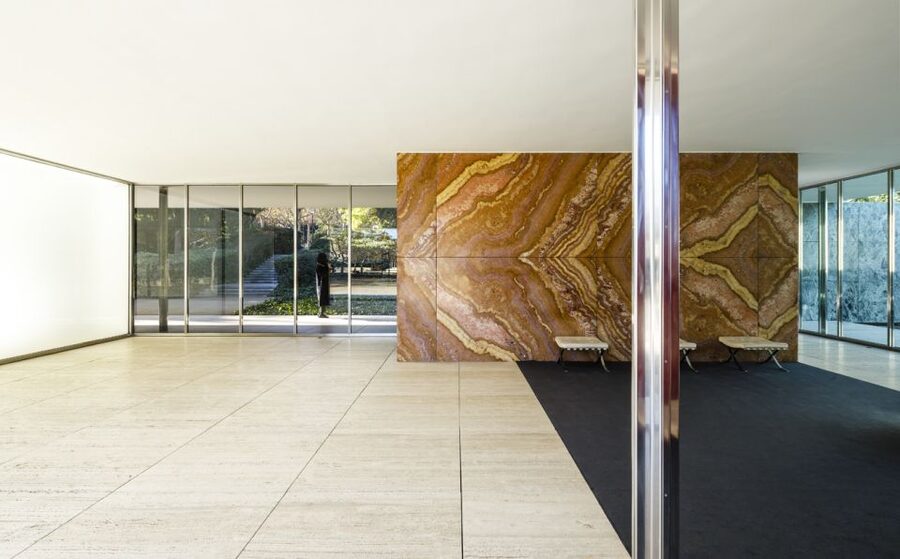
- Materials matter here: you’ll notice contrasting surfaces tied to sources like the Alps, Tivoli, Atlas, and Tinos
- Photography is common, but you’ll be without tripods
Why this pavilion feels like a pause button in Barcelona
The Mies van der Rohe Pavilion works because it doesn’t beg for attention. It’s pared down to the basics: planes, edges, reflections, and carefully chosen materials. In a city where many famous sights are designed to impress from far away, this one invites you to get close and pay attention to how the space behaves.
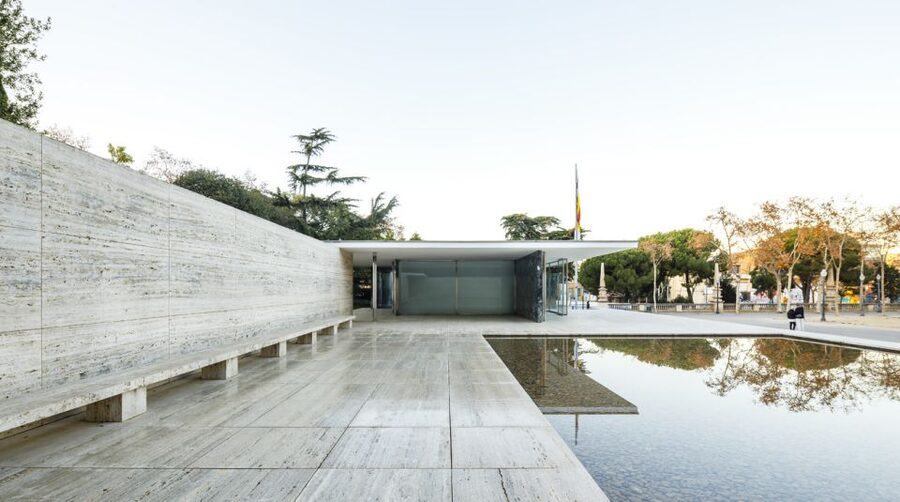
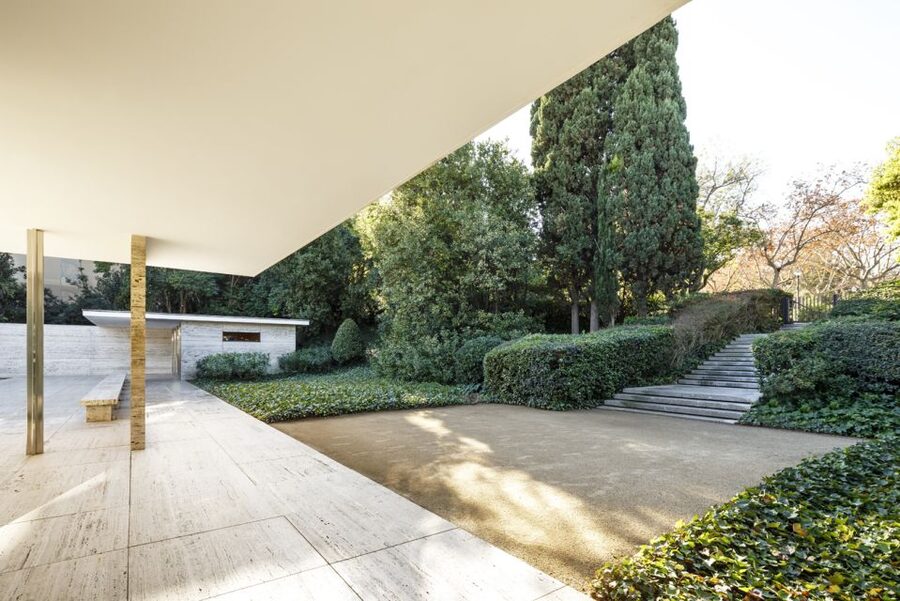
You’ll notice the pavilion’s approach right away: the design creates a strong relationship between inside and outside. Standing in one spot, you can feel how the boundaries shift with your position. Walk a few steps and the same wall or floor becomes something different, because reflections and openings change what you perceive.
This is also why the visit tends to feel calm. The pavilion is small enough that you can actually slow down, not sprint. And even when you’re sharing the space with photographers or models, the setting doesn’t turn into a chaotic crowd scene. That balance is part of the magic.
You can also read our reviews of more tours and experiences in Barcelona.


Ticket and audio guide: what you’re really buying
This experience is straightforward: you get entrance to the pavilion plus an audio guide included in Spanish, Catalan, English, French, and German. It’s sold with the promise of skipping the ticket line, which matters here because the site is compact. If you lose time at the start, you feel it.
The ticket is described as valid for 1 day, with starting times available based on availability. That’s a clue to how the site is managed: plan to arrive around your time slot rather than drifting late. One practical hint from experience notes is simple—arrive when you’re supposed to, so you can settle before the space fills up around you.
Also, you should treat the audio guide as part of the experience, not an optional add-on. Without it, the pavilion can still be beautiful, but the design choices can blur together. With it, you get a clearer read on what the architect was trying to achieve.
How to pace your visit inside a minimalist space
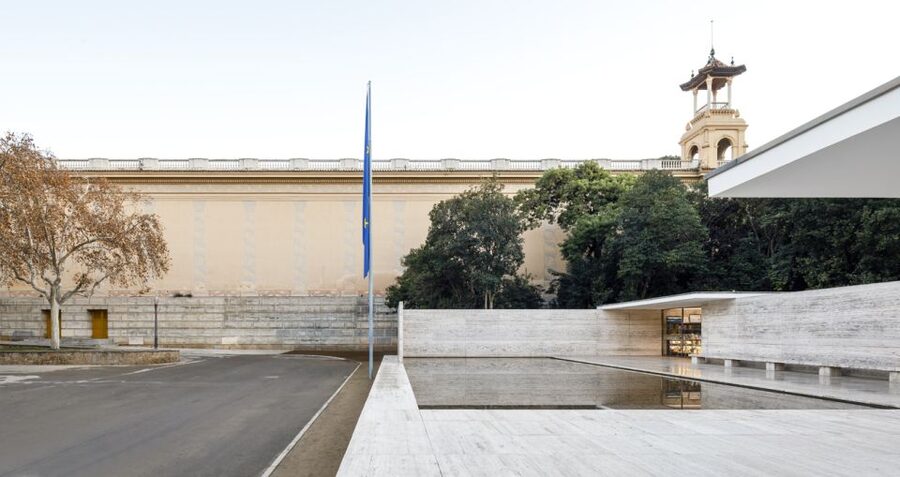
Because the pavilion is about precision, your pace is the whole game. Don’t rush to tick off corners. Instead, give yourself time to stand still and look—not once, but twice. The first look is for composition (lines, openings, surfaces). The second look is for how the space affects you as you move.
Here’s a simple way to use the audio guide without making it feel like homework:
- Start it early so you know what to watch for.
- Pause at key viewpoints (especially where the interior/exterior relationship becomes obvious).
- When you finish a section of the story, take a short walk before you press play again.
If you’re photographing (or just enjoy watching others do it), keep in mind the rules: tripods aren’t allowed, and there’s no smoking or food and drinks permitted. That shapes the mood. It stays cleaner, quieter, and more respectful to the site.
The pavilion layout: the story is in the geometry
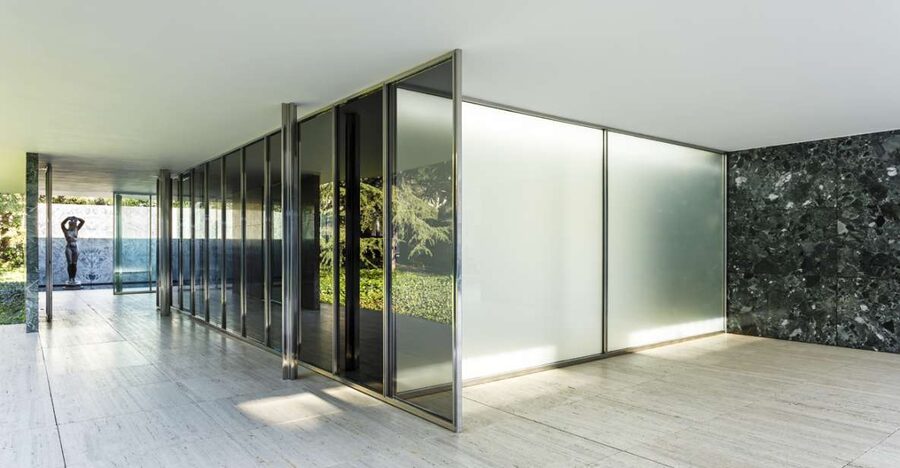
What makes this place click is the way Mies van der Rohe shapes movement. The pavilion isn’t just a box of rooms. It’s closer to a sequence of frames. The structure guides your eyes through contrasts—light against shadow, solid against open, and materials against materials.
One of the design ideas described for this pavilion is the linear interplay between interiors and exteriors. Practically, that means you should look for edges and transitions: places where a surface feels like it continues, even when the view changes. If you do this, the pavilion stops being “a building” and starts being “a set of controlled moments.”
The palette also matters. The pavilion uses material contrasts that are described as being brought from different regions—the Alps, Tivoli, Atlas, and Tinos. Even if you don’t catch every material name, you can still see the intention: different textures and tones are placed to create balance, not decoration.
And yes, people do turn up to work here. During some visits, photographers and models may be using the space, and they end up becoming part of the scene. That doesn’t ruin the experience if you’re open to it. If you want total solitude, you might still find the space calming, but it may not be empty.
The 1929 exhibition, the dismantling, and the 1986 return
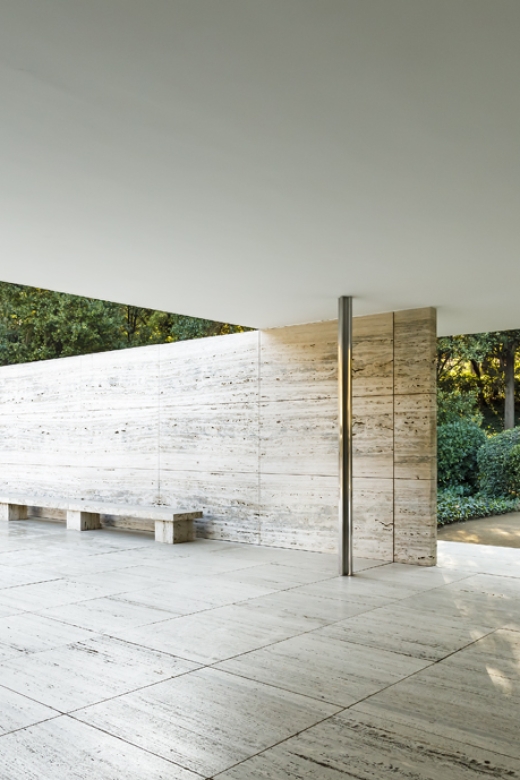
The pavilion’s story is not a background detail—it’s part of why the building feels so deliberate. It was originally the German national pavilion for the 1929 Barcelona International Exhibition. After the event ended, the pavilion was dismantled.
That would have been the end for most famous structures. Here, it wasn’t. Because the pavilion was seen as significant for what it represented in modern design, it was later reconstructed and reopened on its original site in 1986.
What you’ll get from knowing this is a shift in how you look at the building. You start to see it as a careful re-creation of an idea, not just a random historic artifact. That matters for your appreciation. It also makes the visit feel more like a living architectural lesson than a typical museum stop.
The pavilion is described as a benchmark for generations of architects and artists. In other words: it’s not just famous. It influenced how modern architecture learned to speak.






Materials up close: where the beauty is in the contrasts
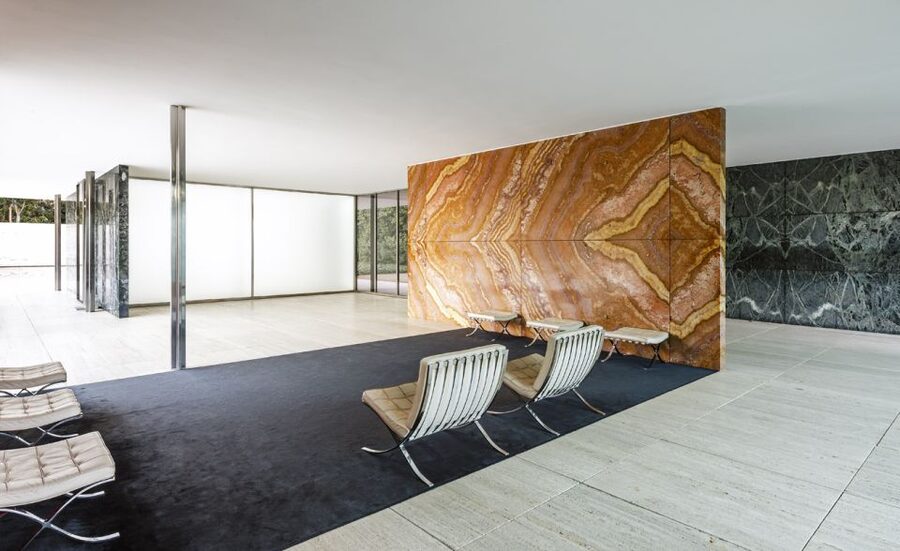
The pavilion’s materials aren’t just there to be pretty. They’re part of the design logic, used to create precise contrasts. That’s why the pavilion is worth lingering over even if you’re not an architecture nerd.
Here’s what to do while you’re there:
- Look at how light sits on surfaces at different angles.
- Pay attention to how the floor and walls help define space without heavy ornament.
- Notice how materials change the feel of the room: some surfaces read cooler or more reflective; others feel calmer and more solid.
The descriptions associated with the pavilion also point out that materials were brought from places including the Alps, Tivoli, Atlas, and Tinos. You don’t need to become a geographer to enjoy that. The practical takeaway is that the architects were choosing materials deliberately, for balance and effect—like they were composing an image you can walk through.
What can change during your visit: interventions and photo culture
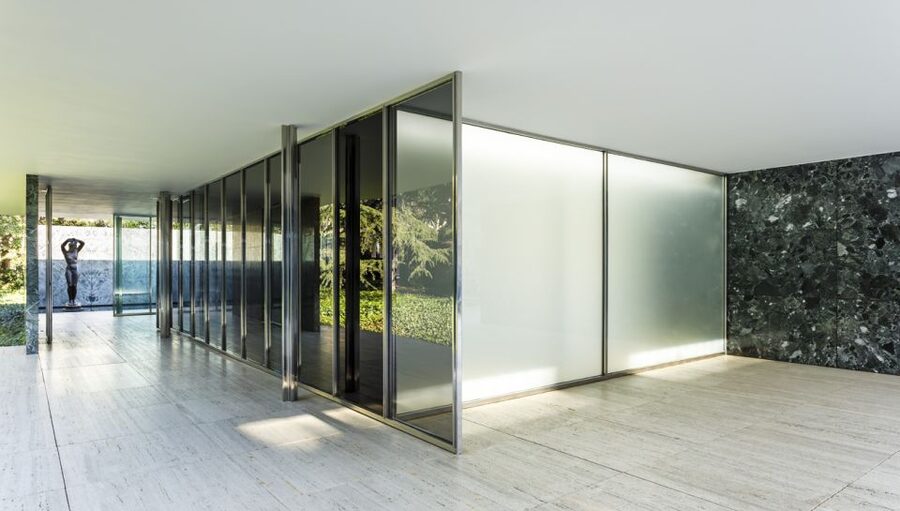
There’s one thing to keep your expectations grounded: the pavilion can occasionally host artistic interventions. That means the appearance may be altered, even if the core design stays the same. If you’re planning your visit for a specific photo you’ve seen online, it’s smart to remember that reality may be slightly different.
Also, the space is sometimes used by professionals for photography and modeling. When that happens, the pavilion’s minimalist style actually supports it—clean lines and reflections can become part of the visual work. But it can also make the site feel a bit more occupied at certain times.
Your best protection here is mindset plus timing. Arrive around your scheduled slot, use the audio guide in order, and don’t feel like you have to get the perfect shot to enjoy the place.
Who this fits best (and who might want a different plan)
This ticket is a great fit if you:
- love modern architecture and want to understand it beyond surface photos
- prefer quieter, smaller sites where you can take your time
- like using an audio guide to connect design to context
- enjoy design details like materials, proportions, and how spaces transition
You might think twice if you:
- want a big, busy, high-energy landmark experience
- don’t care much about architectural history or design interpretation
- only have a very short attention span for calm spaces
The pavilion is small, so it won’t replace a full day of classic sightseeing. Instead, it works like a focused chapter in your Barcelona reading.
Price and value: is $10 worth it?
At roughly $10 per person, the value comes down to what you want out of the visit. If you’re the kind of traveler who enjoys architecture and wants a structured way to understand it, the entry + audio guide combination is a solid deal. You’re paying not just for a doorway, but for an explanation system in five languages that helps you read the pavilion in a deeper way.
If you’re more of a casual looker, the value may feel harder to justify. A few comments connected to this experience suggest some visitors think it should be free or priced lower. That’s a fair reaction if you’re expecting something more like a public square. But for people who care about the design and the reconstruction story—why it was dismantled, then rebuilt and reopened in 1986—this price can feel reasonable.
My advice: if modernist architecture excites you even a little, this is worth prioritizing. If it doesn’t, you might still enjoy it visually, but you’ll likely feel the fee more.
Should you book the Mies van der Rohe Pavilion ticket with audio guide?
I’d book it if you want a calm, design-focused stop with built-in context. The pavilion rewards slower looking, and the audio guide does the work of turning minimalism into something you can actually understand—especially the design intent and the reconstruction story tied to 1929 and the 1986 reopening.
Skip it if you’re chasing spectacle or you know you won’t use the audio guide. This is not the kind of site where you can count on sheer chaos to entertain you. It’s about clarity, materials, and how the space behaves.
If you do book, go in with a plan: start the guide early, don’t rush the views, and remember that artistic interventions and photo work may shape what you see on a given day.
FAQ
What’s included with this ticket?
You get entrance to the Mies van der Rohe Pavilion and an audio guide.
What languages is the audio guide available in?
The audio guide is available in Spanish, Catalan, English, French, and German.
How long is the experience?
It’s listed as a 1-day activity.
Will I be able to skip the ticket line?
Yes, skip-the-ticket-line access is included.
Where does the pavilion fit in the story of modern architecture?
The pavilion was originally the German national pavilion for the 1929 Barcelona International Exhibition, and it was later dismantled and then reconstructed and reopened on its original site in 1986.
What restrictions should I know before entering?
Smoking, food and drinks, and tripods are not allowed. Pets are not allowed (assistance dogs are allowed).
Is the pavilion wheelchair accessible?
Yes, wheelchair access is included.
Are opening hours guaranteed?
Opening hours may change, so it’s smart to check before you go.
Can the pavilion look different from one visit to another?
Yes. Occasionally, artistic interventions can alter the pavilion’s appearance.