REVIEW · ROME
Rome Self-Guided City Experience
Book on Viator →Operated by Vox City International Ltd · Bookable on Viator
Rome’s best idea: you control the pace. This Vox City self-guided tour uses a mobile app with GPS guidance, offline navigation, and recorded narration to help you hit major landmarks without needing a live guide. You get an itinerary of big hitters like the Pantheon, St. Peter’s Basilica, Trevi, and several other top sights, with most stops designed as short, on-the-spot check-ins.
What I like most is the setup for flexibility: you can go when you want, stop when you want, and skip ahead if your day changes. Second, it’s built around learning while you wander—local-expert style stories and curiosities delivered in your language—so you’re not just taking photos in autopilot. One thing to consider before you buy: a handful of reviews reported app problems in Rome (map not loading, purchase not recognized, or the app freezing), so your real-world success depends on your phone and your ability to get the app working ahead of time.
If you’ve got a decent mobile data plan as backup and you’re willing to do a bit of pre-trip tech setup, this can be great value. But if you hate tech that can fail, you may want a different option.
In This Review
- Why This App-Led Rome Tour Feels Like a Guide (Without the Group)
- Key Stops and How the Route Really Works
- 1) Pantheon (Free Admission Listed)
- 2) Vatican Museums (Admission Not Included)
- 3) St. Peter’s Basilica (Free Admission Listed)
- 4) Piazza Navona (Free Admission Listed)
- 5) Piazza di Spagna (Free Admission Listed)
- 6) Fontana di Trevi (Free Admission Listed)
- 7) Piazza Cavour (Free Admission Listed)
- 8) Piazza del Popolo (Free Admission Listed)
- 9) Via della Conciliazione (Free Admission Listed)
- 10) Museo Nazionale di Castel Sant’Angelo (Free Admission Listed)
- 11) Villa Borghese (Free Admission Listed)
- 12) Piazza della Repubblica (Free Admission Listed)
- 13) Via Nazionale (Free Admission Listed)
- 14) Abbazia di San Paolo Fuori Le Mura (Free Admission Listed)
- 15) Piazza Venezia (Free Admission Listed)
- 16) Via dei Fori Imperiali (Free Admission Listed)
- 17) Via Del Corso (Free Admission Listed)
- 18) Circo Massimo (Free Admission Listed)
- 19) Bocca della Verità (Free Admission Listed)
- 20) Insula dell’Ara Coeli (Free Admission Listed)
- Price: What $11.58 Buys You (and What It Doesn’t)
- Offline Maps, Geo-Tagging, and the Real-Day “Don’t Get Lost” Factor
- Where the Experience Can Go Wrong: App Performance and Phone Setup
- Who This Works Best For (and Who Should Skip)
- Quick Practical Tips Before You Start
- Should You Book This Rome Self-Guided App Tour?
- FAQ
- FAQ
- How long is the Rome self-guided experience?
- Is the tour app usable offline?
- What’s included in the price?
- Are entry tickets included for attractions?
- Do I need earphones?
- Will I use public transportation?
- What device do I need?
- Is it refundable if plans change?
- What are the operating hours?
Why This App-Led Rome Tour Feels Like a Guide (Without the Group)

This is not a bus tour. It’s more like a guided walk that lives in your pocket. The app handles the “where do I go next?” part with geo-tagging, and it guides you through an on-foot or public-transport route using built-in itineraries.
Instead of a human guide telling you the same story at the same time, you get recorded narration tied to stops. That matters in Rome, where you can easily lose time waiting in lines, detouring for a cappuccino, or getting pulled into a side street. With this, the tour is designed to fit your day—not the other way around.
Also, the price is striking for what you’re getting. At $11.58 per person, you’re paying for a guided experience via phone, not paid entry to attractions or a staffed service. If you’ll use the audio and the navigation, it can feel like a bargain. If the app struggles, that value disappears fast—so treat app-readiness as part of the trip.
Key Stops and How the Route Really Works

The itinerary is built around quick stops—each one is listed at about 3 minutes for your experience at that location. In practice, that means you’ll likely spend your time doing three things: following the app to the next geo-point, checking the main sight area, and listening to the narration in short segments.
There are 20 named stops and 130+ points of interest total in the city. Many stops are marked with admission as free. Vatican Museums is specifically listed as admission not included. And the overall experience notes that entry to attractions isn’t included, so plan on paying museum admission where it applies.
One more reality check: the list mixes major districts. That’s fine because the app is designed to work on foot and via public transportation, but public transportation tickets aren’t included. So you’ll still need to pay for transit yourself if the route tells you to hop on a bus or metro.
Here’s what the sequence sets you up to do:
You can also read our reviews of more tours and experiences in Rome.



1) Pantheon (Free Admission Listed)
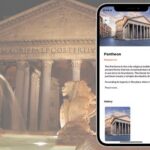
Start with one of Rome’s most recognizable landmarks. The tour positions Pantheon first, and the app gives you narration while you orient yourself in the area. Even if you’ve seen photos before, it helps to have a guided audio cue while you’re standing there.
What to expect: quick arrival, audio facts, and time for a couple of photos before moving on.
Watch-out: this is a compact area, so crowds can change how long you’ll want to stay. Since the tour is timed in short segments, you may want to pause the audio if you’d rather linger.
2) Vatican Museums (Admission Not Included)
Next up is the Vatican Museums. Since admission isn’t included, you’re not buying a museum ticket through this experience. But the audio/narration component can still be useful if you plan your own entry and want context while you’re in the broader Vatican area.
What to expect: you’ll be guided to the area and provided narration, but you’ll handle admission separately.
3) St. Peter’s Basilica (Free Admission Listed)
Then the app points you to St. Peter’s Basilica. With free admission listed here, this is the kind of stop where you can get a lot for your time. You also tend to get a “wow” factor just from being in the space, even before you go looking for details.
What to expect: navigation to the key spot plus narrated storytelling while you look around.
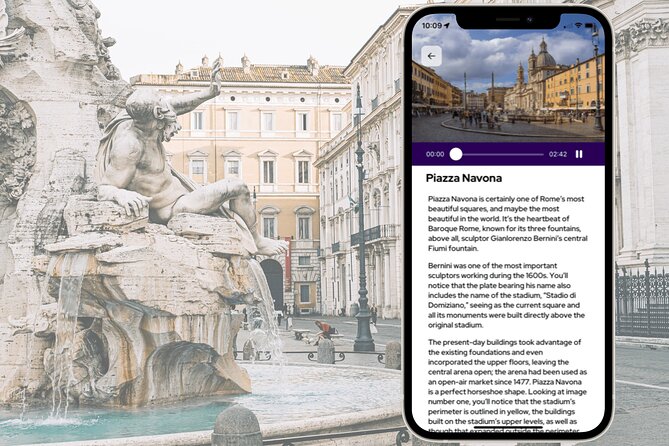
4) Piazza Navona (Free Admission Listed)
After the Vatican zone, you land in classic central-Rome square life. Piazza Navona is a strong contrast—open space, street energy, and plenty of vantage points.
What to expect: the tour works well here because you can keep moving while listening to the next audio cue.






5) Piazza di Spagna (Free Admission Listed)
The app shifts you to another postcard Rome location. This kind of stop is great for slow walking, and it’s perfect for stopping at a viewpoint while the narration runs.
What to expect: a short, guided orientation with time for a quick look.
6) Fontana di Trevi (Free Admission Listed)
Trevi is usually the “must” on any list. Here, the app gives you the context while you stand at the fountain and decide your best angle.
What to expect: short listening time and photo-making before the route continues.
7) Piazza Cavour (Free Admission Listed)
This is a smaller-feeling addition in the list, which can be a nice change of pace. You’re still in the Rome sights zone, but you’re not only stuck in the most famous crowds.
What to expect: a quicker stop that still comes with narration.
8) Piazza del Popolo (Free Admission Listed)
Then you’re back to a big square. This is one of those places where you can hear the tour and still take your time judging the angles.
What to expect: a guided stop that’s easy to combine with a coffee break nearby.
9) Via della Conciliazione (Free Admission Listed)
A long street section can sound boring in theory, but it helps if the narration keeps you informed while you walk. This part can also help you connect the Vatican-area energy to the next cluster of sights.
What to expect: an audio walkthrough while you cover distance.
10) Museo Nazionale di Castel Sant’Angelo (Free Admission Listed)
Now the route includes Castel Sant’Angelo. Admission is listed as free for this stop on the app’s itinerary details, but always treat museum entry as something you should verify once you arrive.
What to expect: audio cues plus a landmark exterior moment.
11) Villa Borghese (Free Admission Listed)
Villa Borghese is a nice breather on a packed list. Even if your “tour time” is short here, being in green space (compared to dense streets) can reset your legs and your mind.
What to expect: guided context while you enjoy a change in scenery.
12) Piazza della Repubblica (Free Admission Listed)
Another central square stop. These are useful because they’re natural pause points for navigation.
What to expect: a short listen and a good place to check your next direction.
13) Via Nazionale (Free Admission Listed)
Long streets are where self-guided tours can shine. The narration gives you structure, and the route helps you keep moving without thinking too hard.
What to expect: walking segments that feel less chaotic because the app does the next-step planning.
14) Abbazia di San Paolo Fuori Le Mura (Free Admission Listed)
This stop adds a different kind of landmark—an abbey setting outside the tight center vibe. The audio helps you understand what you’re looking at even if you didn’t memorize Roman religious sites before your trip.
What to expect: a guided moment that breaks up the more typical fountain-and-square rhythm.
15) Piazza Venezia (Free Admission Listed)
A major square again, good for orientation and photos. Piazza Venezia is also a spot where you might want to stand back a bit to take in the whole surrounding layout before you move.
What to expect: quick context and a clean place to regroup.
16) Via dei Fori Imperiali (Free Admission Listed)
This is a corridor-style stop. Think “walk and listen.” The route makes it easier to cover a straight stretch without missing the narration tied to the route.
What to expect: movement with story-based audio.
17) Via Del Corso (Free Admission Listed)
Shopping streets are tricky on a tour because you can get distracted. Having narration can keep your focus on why you’re there.
What to expect: a walking stop that feels more meaningful when you’re not just browsing stores.
18) Circo Massimo (Free Admission Listed)
A big open-area sight can be great for self-guided touring because you’re not trapped by lines at every corner. Even with short stop timing, you can get the main impression and move on.
What to expect: open-space viewing plus audio facts.
19) Bocca della Verità (Free Admission Listed)
This is one of the more playful Rome landmarks. The audio context can make it more fun than treating it as a quick photo stop.
What to expect: a short narrated stop in a spot people usually crowd around.
20) Insula dell’Ara Coeli (Free Admission Listed)
The route ends with a landmark stop tied to the city’s layers. This late-stage stop can feel like a closer on the self-guided theme: many Rome sights are more about the story and setting than a single photo.
What to expect: final guided narration before you return to the start point.
At the end, the tour says it finishes back at the meeting point.
Price: What $11.58 Buys You (and What It Doesn’t)

For $11.58, you’re buying three practical things:
1) A mobile app with navigation and narrated stops
2) Walking itineraries across major areas
3) A plan with offline capability, so you aren’t stuck searching your way through Rome
What you’re not buying: attraction entry by default, public transit tickets, earphones, or a staffed guide. The app can guide you to Vatican Museums, but admission there is marked as not included.
In value terms, this is best when you treat it like a self-guided lesson plan. Use the audio while you walk. Let the navigation do the heavy lifting. If you only want a map, there are cheaper options. If you want a guided-style experience at a bargain price, this one fits.
Also, the booking timing suggests demand—on average it’s booked 13 days in advance. That’s not a guarantee of quality, but it does hint that people like the concept and the price.
Offline Maps, Geo-Tagging, and the Real-Day “Don’t Get Lost” Factor
This experience leans hard on avoiding the classic self-guided problem: wandering off-route and losing time. The app is designed so you can use it without data or internet, which is huge in cities where roaming can get pricey.
It also says you are always geo-tagged, so you’re not guessing where you are. That’s a big deal when you’re trying to connect stops quickly—especially when your day includes both walking and potential transit.
A second helpful detail: it includes free Wi-Fi spots. That won’t replace offline mode, but it can help you get setup done when your phone first boots the app in Rome.
If you’re the type who likes to keep your screen off and just follow directions, geo-tagging is the whole point. If your phone battery is weak, bring a charger—nothing in the description says it helps with battery management.
Where the Experience Can Go Wrong: App Performance and Phone Setup
Here’s the blunt part. The concept is strong, but the success rate depends on app reliability.
Some experiences show:
- Cases where the app didn’t work properly after purchase (the purchase wasn’t recognized)
- Cases where the app froze, including missing direction cues and locking up the phone until restart
- Cases where downloading the map failed, leaving someone with no map after calls and troubleshooting
That doesn’t mean the tour is always bad. It means you should plan for the possibility that you’ll need to troubleshoot tech at the start of your day.
Practical fixes that fit what’s described:
- Install and test before you leave
- Make sure your phone accepts the app and loads it
- Try to get your route working while you still have time to pivot
- Bring your own earphones if you like clear audio (the experience lists earphones as not included)
If you can’t stand last-minute tech stress, consider pairing this with a second plan: a simple “top sights” order you could follow even without the app.
Who This Works Best For (and Who Should Skip)

This is a great fit if you:
- Like self-guided travel but still want recorded narration to keep you engaged
- Want to control timing across a shortlist of major Rome sights
- Have a phone you trust and you’re comfortable using navigation
- Prefer offline capability so you can roam without data worries
It’s less ideal if you:
- Hate app troubleshooting
- Don’t want to rely on a mobile ticket system
- Expect a human guide style experience (there isn’t one)
The experience caps group size at a maximum of 30 travelers, but since it’s app-led, that number won’t feel like a big factor the way it would on a guided group bus tour.
Quick Practical Tips Before You Start
A few things help this feel smooth:
- Keep your phone charged before you begin. Navigation plus audio can drain battery fast.
- Use your own earphones if you want the narration without nearby street noise.
- If the route includes public transport, budget for transit tickets separately since they’re not included.
- Download or prepare the offline portion early. The whole pitch is avoiding roaming costs and keeping access stable.
And one more tip: Rome is Rome. If you spot something you want to spend extra time on, pause the schedule. The tour is designed for independent pacing, so treat it as guidance, not a strict script.
Should You Book This Rome Self-Guided App Tour?
Yes, if you want a low-cost, narrated Rome “greatest hits” plan and you’re willing to do basic phone prep. At $11.58, it’s hard to beat the value when the app loads correctly and you actually use the offline navigation and audio.
No, if you depend on tech to work perfectly and you don’t want any chance of map download or purchase-recognition problems. For travelers who want zero fiddling, a different kind of tour may suit better.
My take: this can be a smart, modern Rome move—just don’t treat it like a guaranteed plug-and-play device.
FAQ
FAQ
How long is the Rome self-guided experience?
It’s listed as about 2 to 3 hours.
Is the tour app usable offline?
Yes. The app can operate offline, which helps you avoid roaming charges.
What’s included in the price?
The experience includes the mobile app, 130+ points of interest, walking itineraries, and free Wi-Fi spots.
Are entry tickets included for attractions?
No. Entry to attractions is not included. Vatican Museums is specifically listed with admission not included, while several other stops are marked as free admission in the itinerary details.
Do I need earphones?
Earphones are not included, so if you want better audio, plan to bring your own.
Will I use public transportation?
The tour can be done on foot or using public transportation, but public transportation tickets are not included.
What device do I need?
You can use it on Android or Apple mobile devices.
Is it refundable if plans change?
No. The experience is non-refundable and cannot be changed for any reason.
What are the operating hours?
It lists Monday through Sunday from 12:00 AM to 11:59 PM.