REVIEW · QUEBEC CITY
Old Town Quebec Secrets: Private Exploration Game and Tour
Book on Viator →Operated by Questo · Bookable on Viator
Old Quebec becomes a puzzle route. I like the way this offline game turns famous streets into a series of small, solvable challenges, and I also like the history clues that point you toward sites you might otherwise rush past.
One thing to consider: a few clues may feel awkward or outdated, so if you hate uncertainty or want a perfectly smooth script, expect you might need hints along the way.
In This Review
- Quick takeaways
- A private puzzle walk through Old Quebec’s big names and odd corners
- Offline play in Quebec City: why it’s more than a gimmick
- Meeting point to Place Royale: what your route feels like
- Tourny Fountain: sculptor Mathurin Moreau and a question that makes you search
- Saint-Louis Gate: French defenses and British control of movement
- The Rue Saint-Louis elm and the cannonball-in-roots story
- Couvent des Ursulines: education for women and Montcalm’s burial place
- The Cathedral of the Holy Trinity: Anglican Canada’s first outside-Britain church
- Grande Place, Place de l’Hôtel-de-Ville, and the way city centers keep changing names
- Séminaire de Québec: François de Laval and an institution built for training and outreach
- A monument from Paul Chevré: honoring the founder of Québec City
- Jean-Paul Lemieux: when Old Quebec connects to twentieth-century art
- Place Royale and Samuel de Champlain’s first permanent settlement: 1608 in one spot
- Parlement Building (Hôtel du Parlement): a civic building with layers underneath
- Notre-Dame-de-Québec: a parish that survived shelling, fires, and rebuilding
- Price and value: why $9.29 can feel like a bargain
- Who this private game walk suits best
- Should you book Old Town Quebec Secrets in Quebec City?
- FAQ
- Do I need internet access to play the game?
- How long is the Old Town Quebec Secrets experience?
- Is the tour offered in English?
- Is there a physical tour guide included?
- Can I start and pause the game whenever I want?
- Is it free for kids, and can large groups book it?
Quick takeaways
- Offline by design: you can play without internet, so your plan won’t collapse if your phone service stinks.
- Your pace, your timing: you can start, pause, and continue whenever it fits your day.
- Private group walk: it’s just your group, and there’s no physical tour guide following you around.
- Old Quebec highlights, with side streets: you’ll hit major landmarks like Place Royale and Notre-Dame-de-Québec, plus a few odd corners.
- Value matters here: at $9.29 per person and free for kids, it’s a low-cost way to turn sightseeing into an activity.
A private puzzle walk through Old Quebec’s big names and odd corners
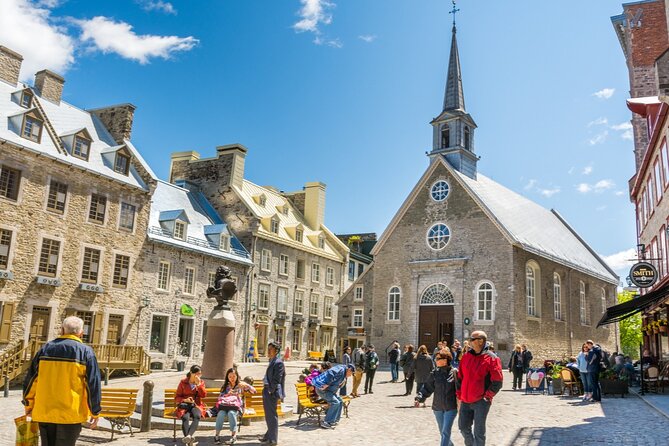
Old Quebec is easy to love. It’s scenic, walkable, and full of stories. The trick is making sure you don’t just collect photos and move on. This experience does that job for you by turning the walk into an offline game in the Questo app.
You’re guided step by step to a route that lands at Place Royale, with the game ending at Rue des Pains Bénits. Along the way, you stop at places that cover a wide slice of the city: French-era defenses, early education for women, key religious institutions, Anglican history, civic buildings, and even a local art connection. You don’t need a guide’s voice in your ear. Instead, you scan the area, read what you’re asked to find, and then use your eyes to move forward.
I like experiences like this when I’m traveling with mixed interests. The architecture people get stops worth looking at. The history fans get enough names and dates to feel grounded. The puzzle types get something to do with their hands and attention. And because it’s private, you don’t feel rushed by strangers or stuck waiting for a slow group.
The biggest practical payoff is simple: the game forces you to slow down at each location just long enough to notice details. You’ll stand where you normally might pass by. You’ll look up, scan doorways, and read the surroundings like they matter. In Old Quebec, they do.
Offline play in Quebec City: why it’s more than a gimmick
This game is built to work offline. That means you don’t need mobile data to play, which is a real advantage in a place where signal can be spotty in older streets and stone corridors.
What you do need is a phone you can comfortably handle outdoors: enough battery to last about 1 hour 30 minutes, and enough brightness so you can read the prompts. The app also acts as your planner. You can play anytime after booking without rescheduling, and the service is open daily from 12:00 AM to 11:30 PM. So you’re not boxed into a single time slot, which is great if your day in Quebec City is already crowded with dinner, museums, or a winter walk.
Another smart detail: you can begin and pause whenever it suits you. That matters in real travel life. You might want to pause for a hot drink, take a longer look at a church facade, or reset after a steep bit of walking. The game won’t punish you for life happening.
This is also a mobile-ticket experience. Once you’re set, your phone becomes your ticket and your guide, step by step, for the route. If you’re the type who likes a plan but hates rigid tours, this format is a good match.
Meeting point to Place Royale: what your route feels like

Your start point is 3004 Av. Honoré-Mercier, Québec, QC G1A 1A2, Canada. From there, you’re guided step by step to Place Royale. The game ends at Rue des Pains Bénits, Québec, QC G1K.
The route is designed for walking and for frequent “look around” moments. Expect to stop repeatedly rather than just cruise through Old Quebec like a long line of postcards. That’s the whole point. Each location comes with a challenge that makes you scan the details at human pace.
Because you’ll be stopping at multiple sites, think of this less like a museum loop and more like a guided scavenger hunt—except the answers are tied to real places with names, dates, and changing roles over time. You don’t need to be a history expert. You do need curiosity and patience for reading clues carefully.
Tourny Fountain: sculptor Mathurin Moreau and a question that makes you search
Your first big stop features the Tourny Fountain. Even though it’s only been installed in Québec City recently, it has an older story behind it: six copies of this work were designed by French sculptor Mathurin Moreau in 1853, and it was exhibited at the 1855 World’s Fair in Paris.
The game prompt here is practical. You’re not just told to admire it and move on. You have to look around to find the answer and then advance to the new location. That kind of task changes how you experience fountains and monuments. You start treating them like clues, not decorations.
How this helps your trip: Quebec City can be visually loud, even when you’re trying to focus. A clue-based start helps you get attention settled fast. You learn the rhythm of the game early—scan, read, search—then keep that momentum through the rest of the route.
Saint-Louis Gate: French defenses and British control of movement
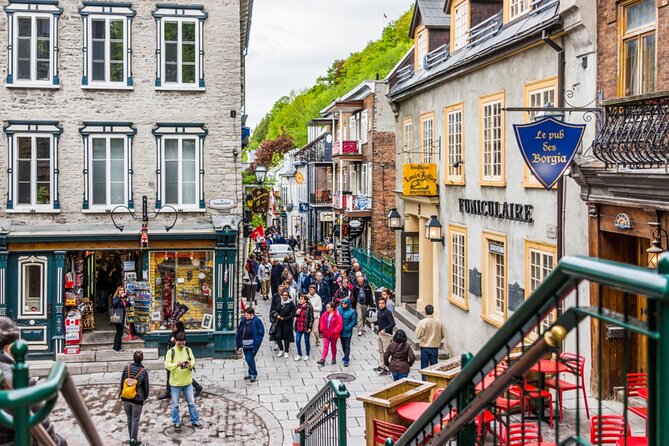
Next comes the first Saint-Louis Gate. Under the French Regime, it dates to the late 17th century at its present location. During the British Regime, the gate doors were closed at night to restrict travel between the city and outlying areas. That policy disrupted trade and slowed the city’s development.
This is the kind of stop that benefits from walking slowly. You can’t fully absorb the “movement and control” idea from one quick glance. The game nudges you to hunt for the story’s answer right where the gate’s significance sits in the streetscape.
Drawback to keep in mind: gate locations and nearby street changes are common in older cities. If your clue feels like it doesn’t match what you see right now, that can be frustrating. The upside is that even when the puzzle doesn’t land perfectly, the historical framing is solid. You’ll still come away understanding how something as simple as a gate could shape daily life.
The Rue Saint-Louis elm and the cannonball-in-roots story
Old Quebec has a few landmarks that feel like urban legends. One of them is on Rue Saint-Louis at the corner of Rue du Corps-de-Garde: a tall old elm tree with what looks like a large cannonball trapped in its gnarly roots. Calèche drivers slow their horses so passengers can point it out, and people stop to stare and try to figure out how the cannonball got there and when.
This stop is fun because it’s visual. You can’t ignore it. The game adds structure by turning your curiosity into a challenge: look around, answer the puzzle, and move on.
Here’s why I think this part works so well: Quebec City’s greatest strength is that it’s full of real physical reminders. Trees, stones, street corners—things that still exist. This is one of those places where your brain wants the story, and the game gives you a reason to look carefully instead of guessing wildly.
Couvent des Ursulines: education for women and Montcalm’s burial place
The Couvent des Ursulines stop hits hard in a good way. It was founded in 1639 and is described as the oldest institution of learning for women in North America. Its chapel is also tied to Louis-Joseph Montcalm: after his death in the 1759 battle that decided the fate of New France, he was buried there.
This isn’t just a name-drop stop. It connects two big themes: early education and a turning point in Canadian history. The game’s prompt keeps you attentive and gives you something to do with your feet while you absorb the setting.
Practical note: because this is a major historic site with religious and institutional meaning, be respectful with noise and movement. The game format helps here because it naturally builds short, focused visits rather than long, aimless wandering.
The Cathedral of the Holy Trinity: Anglican Canada’s first outside-Britain church
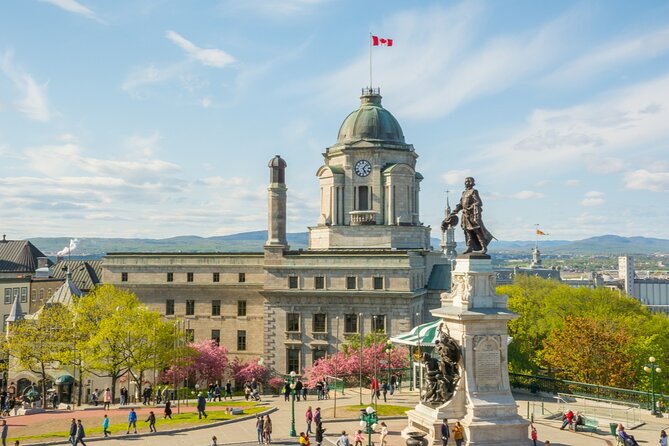
Next up is the Cathedral of the Holy Trinity. In 1804, it was the first Anglican church built outside Britain. It’s also a National Historic Site of Canada (noted as 1989). Architecturally, it’s described as neoclassic Palladian style, modeled after St Martin-in-the-field Church in Trafalgar.
Why this stop matters for your sightseeing: Old Quebec is often read through a French Catholic lens. This church adds another layer: the Anglican presence came later, and you can see it in the design and the story of how and where it was built.
The game wants you to look around for the answer. That’s a good method here because the details (style cues, references, and setting) are easier to notice when you’re not rushing. You get to connect architectural language to local history, instead of just staring at something pretty.
Grande Place, Place de l’Hôtel-de-Ville, and the way city centers keep changing names
A public square stop shifts the focus to civic life and how spaces get renamed over time. The square has been known as Grande Place, Grande Place de la Haute Ville, and Place du Marché. In 1900, it was renamed Place de l’Hôtel-de-Ville after the construction of city hall. It was also known as place Notre-Dame and place de la Basilique until the middle of the 20th century.
This is a clever kind of puzzle stop because it rewards close reading and awareness of place. A square isn’t just a square in a city like this. It’s a hub that carries different meanings as power structures and institutions change.
When I do a walking game like this, I try to pause and look at the whole space once the clue is done. You’ll likely start seeing why the square matters: where people gather, where institutions sit, and how the city’s identity shifts without fully leaving anything behind.
Séminaire de Québec: François de Laval and an institution built for training and outreach
Then you reach the Séminaire de Québec, tied to François de Laval. It’s described as a society of Catholic priests founded in 1663 by Laval, who became the first bishop of Québec. The society’s mission included training priests, evangelizing Aboriginals, and administering the parishes of the colony.
This stop is one of those “big ideas at street level” moments. In one location you get education, religion, administration, and outreach. The game’s challenge keeps you from skimming past the significance.
If you’re into historical cause-and-effect, this is a useful stop. It’s not just about what a building is. It’s about what kind of system it represented in its era.
A monument from Paul Chevré: honoring the founder of Québec City
Another highlight is a monument created in honor of the founder of Québec City, a work by Paul Chevré, inaugurated in 1898. The game task again asks you to look around and find the answer before moving to the next spot.
This is a good reminder that monuments can be more than background. In older cities, monuments function like wayfinding for history. They point you toward the identity a city chose to highlight.
If you like stopping for photos, this is one of the places where you can do that without losing the story. Treat the monument as the game’s “pause moment,” then walk on with renewed understanding of who the city wants you to remember.
Jean-Paul Lemieux: when Old Quebec connects to twentieth-century art
Mid-route, the game includes Jean-Paul Lemieux, a twentieth-century painter. He’s described as one of Canada’s foremost painters, with work in several styles represented by five artistic periods.
This stop breaks the typical Old Quebec rhythm. It’s not purely about early settlement or religious architecture. It’s about how cultural identity keeps evolving, even while the streets stay old.
If you like art but don’t want to plan an extra museum stop, this kind of insertion is worth it. It gives you a quick art hit that still fits the theme: Quebec City isn’t frozen in time.
Place Royale and Samuel de Champlain’s first permanent settlement: 1608 in one spot
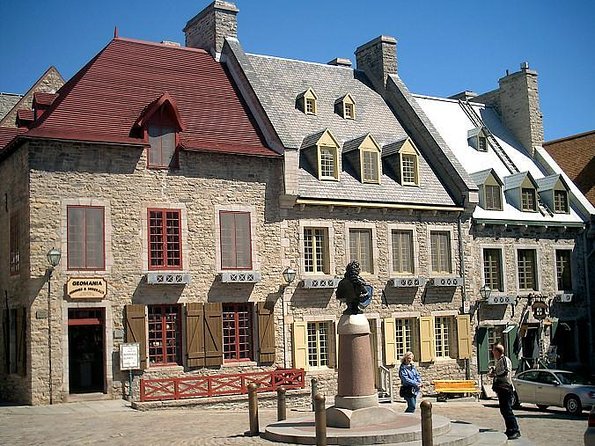
One of the most important stops is the precise location where Samuel de Champlain built the first permanent French settlement in the Americas. It dates to 1608 and is described as an abitation that included a fort, store, trading post, and residence all in one. That’s why Place Royale is considered the cradle of French North America.
This is the moment where the entire route clicks into focus. You started with fountains and gates. You learned about institutions and churches. Then you arrive at the cradle of the French settlement narrative. The game’s look-around question style forces you to treat Place Royale like more than a scenic square. It becomes the anchor.
If you only have one “big story” stop in your Old Quebec day, this is the one. Even if you don’t solve everything perfectly, you still get to stand at a foundational point in early French North America.
Parlement Building (Hôtel du Parlement): a civic building with layers underneath
The itinerary includes the Parliament Building, the Hôtel du Parlement. It’s described as an eight-floor building and home to the Parliament of Québec, composed of the Lieutenant-Governor and the National Assembly. The building was designed by architect Eugène-Étienne Taché and constructed from 1877 to 1886.
It was inaugurated on September 15, 1896, in the Old Quebec neighborhood. The building slopes downward because it’s built on a hill. The description also notes it was once home to the Jesuit College, known as the Jesuit Barracks, from the 1730s to 1878. The city hall was designated a National Historic Site of Canada in 1984.
This is a big stop for understanding Quebec City’s layering. One site can shift functions over centuries: from religious education spaces to civic government buildings. The game gives you a reason to inspect the structure and then connect it to the broader story.
If you’re hoping for a stop that feels especially “alive,” this one can do it. Parliament is government, and government feels present. Even if you’re outside and moving on, you get that sense of official power built into the stone.
Notre-Dame-de-Québec: a parish that survived shelling, fires, and rebuilding
The final major historic anchor is Notre-Dame-de-Québec. The parish has served as the first Catholic parish in North America since 1664. It acquired cathedral status in 1674 when it became the seat of the Diocese of Québec, and later it became a basilica 200 years after that. Its history is marked by shelling, fires, and multiple reconstructions and renovations.
This stop is emotional even when you’re not trying to be dramatic about it. The game’s approach still works: you look around, find the answer, and then you’re leaving with an understanding of why the building matters.
For me, this kind of ending is perfect for a puzzle walk. It ties together the religious institutions you’ve met earlier (like the Couvent des Ursulines) and shows resilience through change. You finish the route understanding that Old Quebec’s landmarks aren’t just old. They survived.
Price and value: why $9.29 can feel like a bargain
At $9.29 per person, this experience is priced like an activity, not a full guided tour. For that money, you get a 1 hour 30 minute walk, a private game format, and access to a route with multiple major stops.
The value gets even better if you’re traveling as a family. Kids are free. And if you have a larger group, you don’t hit a hard wall: if your group is larger than 15, you simply make multiple bookings.
The practical trade-off is that you are the tour guide for your group. There’s no physical tour guide included. Also, the experience depends on clue quality and on your willingness to solve puzzles outdoors.
So I think of it like this: if you enjoy being active and curious while you walk, the cost feels fair. If you want a smooth, scripted explanation with zero awkward moments, you may feel underwhelmed. This isn’t a lecture. It’s a quest.
Who this private game walk suits best
This works best if you:
- Like walking with a reason to stop
- Enjoy solving puzzles more than listening to a lecture
- Want an affordable activity that still hits major Old Quebec landmarks
- Have a group with mixed interests who can share the same phone-based prompts
It might be less ideal if:
- You hate any uncertainty in wording or clue placement
- You want someone in person to explain everything without you searching
- You prefer a classic guided tour structure where answers are immediate and narration-heavy
Should you book Old Town Quebec Secrets in Quebec City?
Yes, if you want an easy way to turn Old Quebec into an active day. The offline format keeps it stress-free. The route covers major historic anchors like Place Royale and Notre-Dame-de-Québec, and it adds those memorable oddball moments like the elm tree and cannonball story.
I’d book it if you’re the kind of traveler who likes looking closely and moving at your own pace. With a little patience, it can be a fun match of sightseeing and problem-solving without spending much.
I wouldn’t rush to book if you need a flawlessly updated, perfectly worded script every time. The experience is still worth considering, but plan to be flexible. If you’re okay using hints when you get stuck, you’ll likely have a good time.
FAQ
Do I need internet access to play the game?
No. The game is designed to be played offline, so you do not need an internet connection to continue playing.
How long is the Old Town Quebec Secrets experience?
It lasts about 1 hour 30 minutes.
Is the tour offered in English?
Yes, it is offered in English.
Is there a physical tour guide included?
No. This is played through the Questo app, and there is no physical tour guide included.
Can I start and pause the game whenever I want?
Yes. You can begin and pause the game whenever it suits you, and it can be played anytime after booking without rescheduling.
Is it free for kids, and can large groups book it?
Kids are free. If your group is larger than 15 people, you can make multiple bookings so everyone can participate privately.