REVIEW · PARIS
Montmartre Self-Guided Audio Tour: More Than Meets the Eye
Book on Viator →Operated by VoiceMap Audio Tours · Bookable on Viator
Montmartre sounds like a story in motion. This self-guided audio walk uses location-aware cues and offline maps to turn hilltop streets into a timeline. You’re not herded along; you move at your speed, with narration timed to what you’re seeing.
I love the GPS tracking that helps you know where to go next, and I love the lifetime access so you can replay the walk later. The English audio is easy to follow, and the tone feels like a guide who knows when to be funny and when to slow down.
The main catch is physical: Montmartre is steep, with lots of steps. Bring comfortable shoes, and keep your phone charged, since the tour relies on your device.
In This Review
- Quick picks before you press play
- The big idea: Montmartre without a group schedule
- Starting at Rue des Abbesses: where the tour begins to make sense
- Mur des je t’aime and an 885-year church thread
- Picasso-era workshops and the artist-saturated streets
- Place Émile-Goudeau to Picasso First Studio: where the neighborhood breathes
- Moulin de la Galette windmill and the art behind the facade
- Le Passe-Muraille and Saint-Denis statues: small marks with big meaning
- Rue de l’Abreuvoir to Maison Rose: why a pink house became a magnet
- The tiny vineyard, Lapin Agile cabaret, and Place du Tertre
- Rue climbs, statues, and a Sacré-Cœur peek at the end
- Timing, stairs, and phone battery: how to avoid a rough finish
- Price and value: is $14.99 worth it for Montmartre?
- Should you book this Montmartre audio tour?
- FAQ
- What is the price of the Montmartre Self-Guided Audio Tour?
- How long does the audio tour take?
- Is the tour available in English?
- Where does the tour start and end?
- What’s included in the price?
- What do I need to bring?
- What is not included?
- Does the tour work offline?
- Is the route too hilly or stair-heavy?
- Is it private to my group?
Quick picks before you press play
- Offline audio, maps, and geodata, so you’re not stuck if service drops
- Mur des je t’aime and its 311 tile ways to say I love you in 250 languages
- Picasso connections up close, including a studio/workshop period from 1904 to 1909
- Moulin de la Galette on a real windmill history circuit, plus links to Renoir and Van Gogh
- Cabaret history at Lapin Agile, including André Gill and the rabbit drawing in 1880
- Self-paced navigation, with on-track reminders and support for speeding up the narration
The big idea: Montmartre without a group schedule
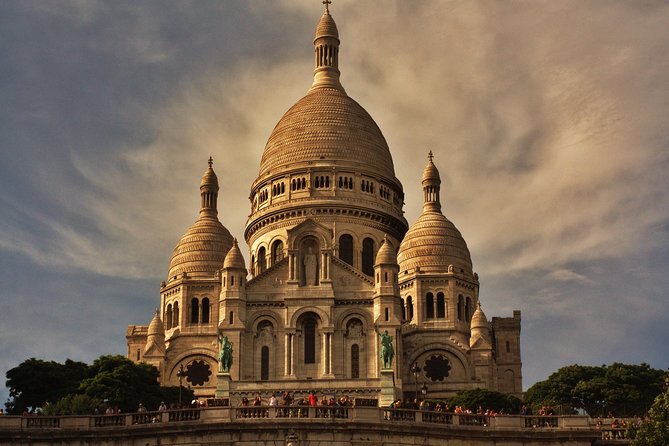
This is built for independent travel. You start at 22 Rue des Abbesses and follow an audio route that moves you through the neighborhood in a logical order, ending near Basilique du Sacré-Cœur.
What makes this type of tour work well is the balance between freedom and structure. You’re not wandering randomly trying to connect dots, but you also don’t have to listen to a scripted lecture at someone else’s pace.
The audio guide feels designed to keep you oriented. Several stops are tied to street-level landmarks (statues, small squares, and building fronts), not just big tourist signage. That’s how you get that I’m-walking-with-a-local feeling without committing to a guided group.
You can also read our reviews of more tours and experiences in Paris.



Starting at Rue des Abbesses: where the tour begins to make sense
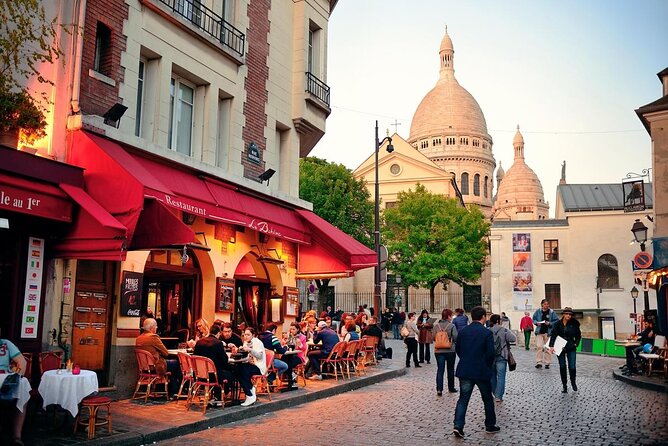
Your walk kicks off near Rue des Abbesses, a practical place to start because it’s well connected to public transit. From there, the route quickly sets a theme: Montmartre as an art district, but also as a real residential neighborhood with layers of faith, work, and nightlife.
Early on, the narration helps you keep your bearings. This matters in Montmartre because street layouts can confuse you even on a clear day. The GPS-based guidance is intended to reduce that stress, so you can focus on what’s in front of you.
Tip: if you’re arriving on foot, take a minute to get your bearings before you start the audio. A quick glance at your map will save time later when you’re climbing.
Mur des je t’aime and an 885-year church thread
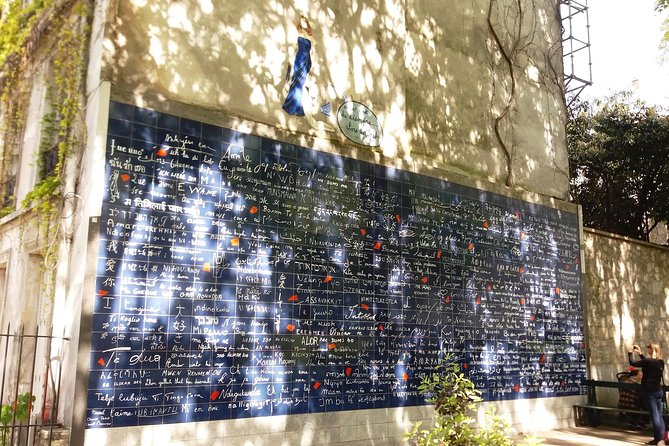
One of the first memorable moments is the Mur des je t’aime. This Wall of Love is made of tiles featuring 311 ways to say I love you in 250 languages. It was created in 2000 by Frédéric Baron and Claire Kito.
It’s a very Montmartre kind of stop: modern, playful, and community-forward. Even if you’ve seen famous Paris love stories before, this one feels different because it’s multilingual and built into the street scene.
Right after, the route shifts to a church with recorded roots back to 885, which makes it among the oldest Christian sites in Paris. That contrast is the point. You’re not only looking at art and cafés; you’re also walking through a place where the spiritual and the artistic have existed side by side for centuries.
How it helps your visit: it prevents Montmartre from turning into a set of disconnected postcards. Instead, it becomes a neighborhood with continuity—people worshipped here long before the artists arrived.
Picasso-era workshops and the artist-saturated streets
The tour’s most satisfying payoff comes from how it places major names into specific street corners. You’ll pass by the workshop where Picasso lived between 1904 and 1909. The narration also ties in Modigliani, who lived and worked there, and links the area to Renoir, Juan Gris, Max Jacob, and le Douanier Rousseau.
Even if you’re not a deep art-nerd, the practical benefit is simple: you’ll stop treating these painters as “museum labels.” You’ll see that they were drawn to particular blocks, buildings, and working spaces.
You also get street-level stops tied to artist history, including place Émile-Goudeau and Picasso First Studio, plus La maison de Dalida. These names matter because Montmartre’s fame comes from the feeling that creativity spilled out onto the streets.
One drawback to keep in mind: this route is story-heavy, so the best experience comes when you pause now and then instead of speed-walking straight through. If you skip the pauses, you’ll walk by the places without letting the context land.
Place Émile-Goudeau to Picasso First Studio: where the neighborhood breathes
Streets like place Émile-Goudeau can look small at first glance, but that’s exactly why they’re worth including. Big Paris sights can swallow you with scale. Montmartre’s charm is more human-sized: corners where conversation and daily life happen.
The audio keeps you from missing the “in-between” parts. For example, when the tour mentions connections to the Picasso story, it’s not just name-dropping. It encourages you to look at the street fabric and think about why someone would settle here: proximity, atmosphere, and the workable mix of quiet and energy.
If you’re a solo traveler, this part shines. You can lean into the pace that feels right—stop for a photo, step into shade, and then press play again when you’re ready.






Moulin de la Galette windmill and the art behind the facade
Later, you’ll reach the windmill that’s one of only two windmills left in Montmartre. This one specialized in grinding wheat and has long operated as a restaurant. Artists like Renoir, Van Gogh, and Pissarro frequented it and painted it, making it an icon of the hill.
Here’s the kind of detail that turns a sight into a story: Renoir’s Bal au Moulin de la Galette doesn’t show the windmill itself. It captures the party taking place behind that famous facade. And Van Gogh painted several versions of the windmill because his brother Theo lived nearby and he knew the area well.
This is one of the stops where you’ll probably look around more than you expected to. The buildings and the slope affect sightlines, so even a simple “look at the windmill” moment becomes part of understanding how artists saw Montmartre.
Practical note: the area around famous facades tends to be crowded at peak times. If you want photos without too much hassle, consider starting your walk earlier in the day or taking a brief pause when the crowd shifts.
Le Passe-Muraille and Saint-Denis statues: small marks with big meaning
The route includes Le Passe-Muraille and a Statue of Saint-Denis. These are the kinds of landmarks that many people walk past without a reason to stop.
The audio helps by giving you a way to read the street art and sculpture. You’re not only looking at a statue; you’re learning how Montmartre built identity through memorable characters and recognizable forms.
If you like walking tours for context, this is where you’ll feel it most. If you mainly want scenic views, you may find these stops slightly less dramatic than the windmill or Sacré-Cœur. But they do break up the walk with meaning.
Rue de l’Abreuvoir to Maison Rose: why a pink house became a magnet
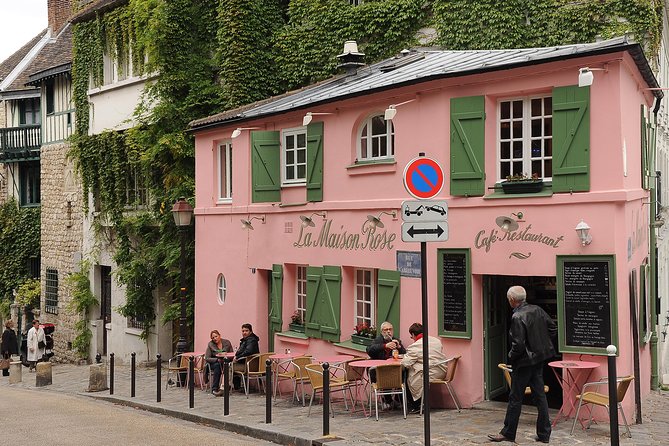
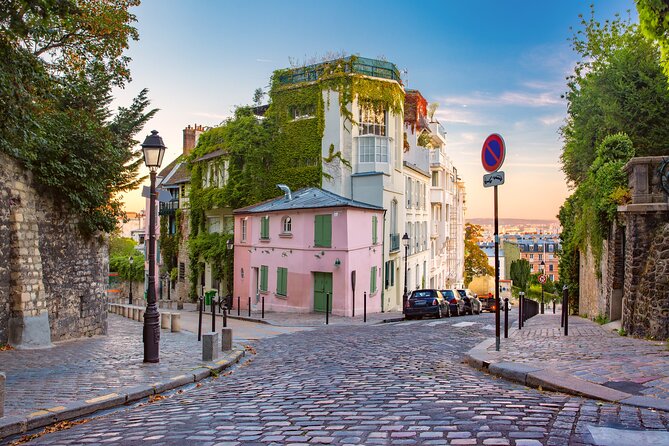
As the route heads down Rue de l’Abreuvoir, you reach the second Maison Rose, the pink house that became iconic through local painter Utrillo.
Then the story widens beyond painting. The house was bought by someone with connections to famous singers, so performers including Édith Piaf, Charles Aznavour, and Jacques Brel often visited. Before them, writer Albert Camus was also a fan.
This is where the audio tour earns its keep. It shows Montmartre as a creative district spanning art, writing, and performance—not only visual artists.
Quick consideration: if you’re pressed for time, this section is easy to skim because it’s visually straightforward. Slow down here for a minute. The pink house becomes more than a photo when you know why it was a gathering spot.
The tiny vineyard, Lapin Agile cabaret, and Place du Tertre
The tour then takes you through a small vineyard—one of the few still left in Paris. It’s so small that one person tends it, keeping it pretty for visitors, tour guides, the mayor, and TV crews.
That detail tells you something important about Montmartre: it’s not frozen in time. The neighborhood still functions, and small traditions keep going even as the area becomes famous.
After the vineyard, you’ll hit Le Lapin Agile. It first opened in 1795 as a cabaret and drinking establishment, initially named the Rendez-vous of Thieves, then Cabaret of the Assassins. In 1880, caricaturist André Gill created the new look and introduced the rabbit drawing.
Later comes Place du Tertre, the classic artist square atmosphere. This is also where you’ll encounter the restaurant whose name means simple and without ceremony. A restaurant has existed on the site since the 1500s, and it’s been rebuilt and renamed multiple times.
The story around the food stops matters because it explains why Montmartre became a “scene.” Painters and poets came for drinks and meals, including Degas, Renoir, Monet, Cézanne, Sisley, Toulouse-Lautrec, and others. In 1886, Van Gogh painted La Guinguette à Montmartre here.
If you’re food-focused, don’t expect a ticketed meal included in the tour. But you will get enough context to choose whether you want to sit down, order something, and watch the neighborhood move.
Rue climbs, statues, and a Sacré-Cœur peek at the end
The closing stretch includes the Statue du Chevalier de la Barre (the tour mentions a second one) and takes you toward Sacré-Cœur. Along the way, you keep getting those “read the hill” moments—statues and street changes that remind you the neighborhood’s slope affects everything.
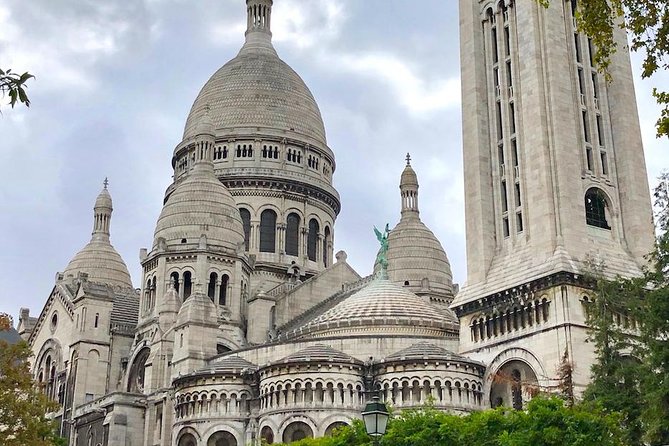
The final moment is a peep inside Basilique du Sacré-Cœur. This is a good place to finish because the architecture gives you a payoff: after street-level art stories, you step into a major Paris landmark with a different scale and light.
If you go inside, keep it simple: don’t rush. Even a short visit helps you reset your eyes after looking at façades, signs, and street details for an hour or more.
Timing, stairs, and phone battery: how to avoid a rough finish
The tour is listed at about 1 to 2 hours, but Montmartre can stretch time quickly. The area is hilly, and there are lots of stairs, so your pace really matters.
A real-life planning approach: if you want photos, take breaks, and stop when music or cafés catch your attention, plan for a longer walk—think several hours rather than rushing through.
Phone battery is the other make-or-break issue. The tour relies on the VoiceMap app and uses GPS location. If you’re the type who always runs your phone at 20% at the end of the day, this isn’t the moment to test that habit. Bring a portable charger if you have one.
Also, don’t be surprised if GPS feels less reliable in thick-walled spaces like churches. When that happens, the audio guidance may pause or behave differently. Staying patient and watching for the next clear location cue will keep things smooth.
Price and value: is $14.99 worth it for Montmartre?
At $14.99 per person, this tour is priced like a practical tool rather than a full guided day. You’re paying for narration, routing, and offline access—plus lifetime access to the content.
That lifetime access changes the math. If you’re doing a fast trip and you only get one chance to understand Montmartre, this can act like a first-time orientation. And if you come back later (even within the same trip), you can replay sections you didn’t fully absorb.
Value is also about what you avoid. You don’t need to buy museum tickets to get a meaningful art-and-history walk. You do pay for something that saves effort: not getting lost, not guessing which streets matter, and not missing the “why this matters” parts that make Montmartre worth your time.
The one downside to price-value comparisons is that it doesn’t replace a guided experience if you want live Q&A or deep museum-style analysis. Still, for a neighborhood walk, this is a strong use of your time and money.
Should you book this Montmartre audio tour?
Book it if you want Montmartre at your own pace with offline narration and GPS-style guidance. I’d especially recommend it if you’re traveling solo, hate the awkward pace-matching of group tours, or you like learning why famous places matter while you’re standing right in front of them.
Skip it (or think twice) if you don’t handle steep walking well. This route is physically demanding in a hilly neighborhood, and the audio relies on your phone, so battery anxiety can turn into stress fast.
If you’re the kind of traveler who enjoys street-level stories—Picasso-era sites, the vineyard, cabaret history at Lapin Agile, and the finishing note of Sacré-Cœur—this is a solid way to experience Montmartre without overpaying for a crowded schedule.
FAQ
What is the price of the Montmartre Self-Guided Audio Tour?
The tour costs $14.99 per person.
How long does the audio tour take?
It’s listed at about 1 to 2 hours, depending on how you walk and pause.
Is the tour available in English?
Yes, the audio tour is offered in English.
Where does the tour start and end?
It starts at 22 Rue des Abbesses, 75018 Paris, France and ends in front of Basilique du Sacré-Cœur at 35 Rue du Chevalier de la Barre, 75018 Paris, France.
What’s included in the price?
You get lifetime access to the tour in English, plus the VoiceMap app for Android and iOS, with offline access to audio, maps, and geodata.
What do I need to bring?
You’ll need your smartphone and headphones.
What is not included?
Transportation, food and drink, and any tickets or entrance fees to museums or attractions en route are not included.
Does the tour work offline?
Yes. The tour includes offline access to audio, maps, and geodata.
Is the route too hilly or stair-heavy?
Montmartre is a hilly area, so expect steep walking and stairs. The tour is listed as suitable for most travelers, but if stairs are a challenge for you, this may be tough.
Is it private to my group?
It’s listed as a private tour/activity, so only your group participates.