REVIEW · PARIS
Louvre Museum Timed Entry Ticket with Audio Guide in 4 languages
Book on Viator →Operated by 1Day Tickets · Bookable on Viator
Huge museums can overwhelm you. With timed entry and a phone audio guide, you get into the Louvre faster and learn as you go. The catch is that this experience depends on your ticket access and the audio link working smoothly, so it pays to check everything before you arrive.
What I like most is the freedom: you control the pace for 1 to 3 hours, and you’re not forced to sprint between highlights. You also get a museum map to help you pick a route instead of zigzagging randomly through 35,000+ exhibits.
For support, you have phone/WhatsApp help during business hours (9 am to 5 pm Paris time), plus the option to reschedule before departure (subject to availability). Just bring your own headphones, because the audio is delivered digitally—not as a rental device.
In This Review
- Key things to know before you go
- Timed Entry at the Louvre: the real value is time control
- A practical way to use your time slot
- Phone Audio Guide (4 languages): how it actually works
- Bring headphones, and test the link early
- Which language should you choose?
- The Louvre Map Approach: you can’t see it all, so route smart
- Think in zones, not checklists
- Mona Lisa and the crowds: how to manage the bottleneck
- Give yourself a buffer for navigation
- Self-guided pacing (1 to 3 hours): why this format works for real schedules
- A small truth about the Louvre
- Language options: using the guide to get more from famous works
- Service and rescheduling: when timing gets weird in Paris
- Do yourself a favor: keep your confirmation handy
- Logistics that matter: meeting point, getting there, and group size
- Who this Louvre ticket is best for
- Who might want something else
- Should you book this Louvre Museum timed-entry audio ticket?
- FAQ
- How long is the Louvre Museum timed entry experience?
- Which languages are available for the audio guide?
- Do I need to bring headphones?
- Is the Louvre Museum admission included?
- Is there phone/WhatsApp support if I need help?
- Can I reschedule my time if my plans change?
- Is pick-up or transfer included?
Key things to know before you go
- Timed entry slot: choose a start time that fits your day, instead of waiting around
- Audio guide in 4 languages: English, French, German, Spanish with art history content
- Use your own headphones: plan on pairing your phone with wired or Bluetooth headphones
- You get a museum map: helpful for navigating a palace that’s basically designed to overwhelm
- Rescheduling support: if the museum’s hours change, you have a path to adjust (when available)
- Max 100 travelers: even though it’s self-guided, the experience stays relatively contained
Timed Entry at the Louvre: the real value is time control

The Louvre isn’t just a museum. It’s a giant palace-turned-culture machine spread across roughly 60,000 square meters. If you show up late in the day, you don’t just lose time. You lose momentum. Lines and crowds can turn a simple “see the highlights” plan into a long detour quest.
That’s where timed entry matters. Rather than arriving and hoping for the best, you lock in a time window so you can plan your day around it. This is especially useful if you’ve got other Paris stops lined up—Versailles, a Seine cruise, or even just dinner plans you don’t want to sacrifice.
This ticket is also priced at $58.48 per person. On paper, that can look steep for a “self-guided” setup. But the value is that you’re paying for the included admission plus a way to reduce the most annoying part of a big attraction: waiting. If you’d otherwise spend that time in a ticket line, you’re buying back hours of your vacation.
You can also read our reviews of more tours and experiences in Paris.



A practical way to use your time slot
I’d treat your timed entry as your anchor. Arrive with enough buffer to get inside before you feel rushed. Then pick one “must-see” and one “nice-to-see.” If you try to do everything, you’ll do nothing well—inside, you’ll end up drifting and second-guessing.
Phone Audio Guide (4 languages): how it actually works

The audio guide is one of the main selling points. You get digital audio in English, French, German, and Spanish, with art history coverage tied to the museum experience.
Here’s the part that makes or breaks the day: this audio is designed for your own phone, using a link. One important caution that comes through clearly is that you should not expect a classic “rental audio machine” included in your ticket. If you arrive looking for a separate device, you can end up frustrated.
Bring headphones, and test the link early
The experience clearly asks you to bring your own headphones. Don’t show up with no plan. If you can, test your setup before you’re fully inside—just so you’re not debugging your phone while the crowd noise makes everything harder.
Also, when it’s time to access the guide, you should use the access link connected to your ticket. The audio should play on your phone with your headphones. If your audio machine is broken in the real world, that’s not something you can control. But you can control whether you’re using the correct audio access method.
Which language should you choose?
If your French is rusty, don’t force it. You’ll enjoy the art more when you can follow the story. Pick your comfort language. If you want the best comprehension, go with English or Spanish (assuming those are easiest for you). The point of the guide isn’t to show off. It’s to help you understand why people care about each piece.






The Louvre Map Approach: you can’t see it all, so route smart
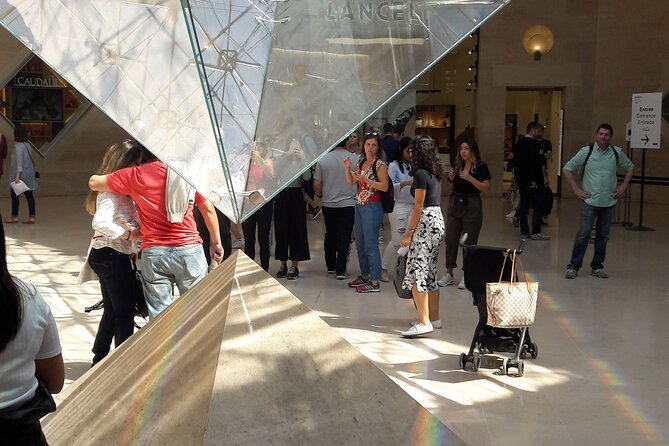
The Louvre map is included, and it’s not just a souvenir. It’s your best tool for turning chaos into choices.
The museum holds 35,000 exhibits across an enormous floor area. Even if you’re a fast walker, you’ll run out of time before you run out of paintings. So the map’s job is simple: help you select a route that matches your interests.
Think in zones, not checklists
Instead of trying to hit every wing, pick a zone and stay there long enough to actually look. You’ll get more out of one thoughtful lap than three rushed ones where you barely register what you saw.
A smart plan looks like this:
- Choose one absolute priority (for most people, that’s Mona Lisa)
- Choose one related “if we have time” interest (you can still find famous pieces like Venus de Milo)
- Give yourself breathing room for detours when something grabs your attention
Mona Lisa and the crowds: how to manage the bottleneck
Mona Lisa is part of the standard Louvre story. It’s also a crowd magnet. One lesson that comes through from real-world experiences is that the Mona Lisa area can feel intensely crowded, so your patience matters.
If Mona Lisa is a must, aim to see it earlier in your visit rather than late. Late visits tend to turn the crowd around the painting into a slow-moving shuffle. And when you’re stuck waiting to get a look, you also lose time trying to find your way to the exit or to other pieces.
Give yourself a buffer for navigation
The Louvre can make you feel turned around fast. Even with a map, the scale is huge and signs may not always help when you’re tired. Build in a buffer at the end of your visit so you don’t end your trip in a stress-walk.
This is also why your ticket’s self-guided nature is a plus: you can adjust. If one room is jammed, you can pivot. If another room is manageable, you can linger. That control is the whole point.
Self-guided pacing (1 to 3 hours): why this format works for real schedules

The experience is designed for a 1 to 3 hour visit. That time range is realistic. It’s long enough to do more than “photo stop, done,” but short enough to fit into an active Paris day.
This pacing works best if you:
- prefer to linger where you want
- don’t want to be pulled away from a painting just because a group moved on
- like building your own route using your map and your audio guide
It’s less ideal if you want a step-by-step guided narrative with guaranteed logistics handled for you. This is self-guided, so you are responsible for following your timed entry and using the audio access method.
A small truth about the Louvre
You’ll remember the Louvre better if you slow down. The museum’s size is intimidating, but it’s also an excuse to focus. Let the audio guide point you toward what’s worth noticing, then let your eyes decide what deserves extra time.
Language options: using the guide to get more from famous works

The audio guide offers four languages, which means it can serve different travelers without forcing compromise. If you’re traveling as a pair, each person can pick their own language and still share a common moment: you can talk about the art after you hear the explanation.
If you’re visiting with friends who speak different languages, this format helps avoid the awkward one-person-behind-the-rest problem. Everyone can follow at their own level.
One more point: art history content tends to work best when you can follow the story without mental translation. The faster you understand, the faster you start noticing details—symbols, composition choices, and historical context.
Service and rescheduling: when timing gets weird in Paris

Paris does not always follow your plan. Museum closures, special days, and timing shifts can happen. What I appreciate here is that support is available by phone/WhatsApp during business hours, and there’s a reschedule possibility before departure (subject to availability).
In practice, that means if something changes—like the museum closing earlier than expected—you may have a chance to adjust your visit instead of losing your day entirely.
Do yourself a favor: keep your confirmation handy
A downside that showed up in negative experiences is that ticket delivery or communication can fail. In a self-guided experience, you need your ticket info to enter and your audio access to work.
So I’d do these basics:
- save your booking confirmation on your phone
- double-check any email or message updates (including spam/junk folders)
- have a way to contact the support channel listed for the experience
It sounds obvious. It’s also the difference between a smooth Louvre morning and a wasted ride.
Logistics that matter: meeting point, getting there, and group size

Your start point is Louvre Museum, 75001 Paris and the activity ends back at the meeting point. It’s also noted as near public transportation, which matters because you don’t want to burn energy traveling when you could be using it to look at art.
The maximum is 100 travelers. Since it’s self-guided, that number isn’t the same as a classic guided group. Still, a smaller ceiling can help keep the experience from turning into a full-scale stampede.
The duration is listed as 1 to 3 hours, so don’t schedule your next activity too tightly right after your timed window. Add buffer time for navigation, rest breaks, and the reality that crowds can shift your walking pace.
Who this Louvre ticket is best for

This experience is a strong fit if you want:
- timed entry to reduce waiting
- a 4-language audio guide that you control
- the ability to choose what you see within a realistic visit window
- museum time that doesn’t feel like you’re on a conveyor belt
It’s also a good option if you’re traveling with kids or adults who want freedom rather than constant group management—because you can pause, regroup, and move on whenever you want.
Who might want something else
If you need hands-on guidance for finding your way quickly, this self-guided format might feel like too much on your own. Also, if you’re worried about phone audio setup, battery life, or link access, you’ll want a backup plan (extra battery, offline notes if allowed, or a willingness to adapt).
Should you book this Louvre Museum timed-entry audio ticket?
I’d book it if your priority is to spend your time inside, not in lines, and you’re comfortable steering yourself using a map and a phone-based audio guide. At $58.48, you’re paying for admission plus convenience plus multi-language narration. For many visitors, that’s a good trade.
I’d hesitate only if you know you’ll struggle with ticket access, message delivery, or phone audio setup on the day. The experience depends on you having the right access method and using your own headphones. If you tend to have phone problems while traveling, plan extra time and keep support contact info ready.
If you want a Louvre day that feels flexible, timed, and easier to manage, this is a solid way to go. Just treat the audio link and confirmation like they’re part of the sightseeing. Because, in a way, they are.
FAQ
How long is the Louvre Museum timed entry experience?
It’s listed as approximately 1 to 3 hours, depending on how much you choose to see and how long you linger.
Which languages are available for the audio guide?
You get digital audio guides in English, French, German, and Spanish.
Do I need to bring headphones?
Yes. You’re instructed to bring your own headphones with you.
Is the Louvre Museum admission included?
Yes. The entrance ticket is included in the price.
Is there phone/WhatsApp support if I need help?
Yes. Priority support is available by phone/WhatsApp chat during business hours (9 am to 5 pm Paris time).
Can I reschedule my time if my plans change?
Yes. Rescheduling is possible any time prior to departure, subject to availability.
Is pick-up or transfer included?
No. Pick Up / Transfer is not included, and the activity ends back at the meeting point.