REVIEW · ROME
The Roman Jewish Ghetto: A Self-Guided Audio Tour
Book on Viator →Operated by VoiceMap Audio Tours · Bookable on Viator
A short walk with big stories. This self-guided audio tour lets you explore Rome’s Jewish quarter on your schedule, starting, pausing, or restarting whenever you want. I especially like that once you download it, the tour works offline—no cell signal needed in the middle of the streets. One thing to watch: if the audio doesn’t fully download or you start the tour the wrong way, you can miss parts of the route.
For $8.99, you’re not just buying a one-off lesson. You get lifetime access to the VoiceMap content, in English, and the app uses GPS so it can trigger playback as you walk. If you’re the kind of traveler who hates managing apps on a phone, this may feel like work—but for most people, it’s a smooth way to see the area fast.
In This Review
- Key highlights I’d plan around
- A self-guided Jewish Ghetto walk that fits Rome’s pace
- Price and value: what $8.99 buys you
- Offline-first audio: how to make sure it works on the street
- Where you start matters: Via di S. Maria del Pianto to Portico d’Ottavia
- Piazza delle Cinque Scole: why the name survived
- The 1904 synagogue: the new temple for daily worship
- Portico d’Ottavia: Augustus, Octavia, and old temple space
- Timing, walking plan, and how to pair it with dinner
- Who this tour suits—and who might not love it
- Should you book the Roman Jewish Ghetto self-guided audio tour?
- FAQ
- How long is the Roman Jewish Ghetto self-guided audio tour?
- How much does the tour cost?
- What language is the tour available in?
- Does the tour work without cell phone reception?
- Where does the tour start and end?
- Are tickets or entrance fees included?
- Is this tour private?
Key highlights I’d plan around

- Offline audio, maps, and geodata after downloading once
- GPS-guided playback so you don’t have to stare at your screen
- Lifetime access to the tour content for the price of one evening out
- A tight ~30-minute route through major sites in the Jewish quarter
- Clear start and end points (so you can finish without backtracking)
A self-guided Jewish Ghetto walk that fits Rome’s pace

Rome rewards smart time use. This tour is built for that reality: you get an experience that takes about 30 minutes, so you can fit it between museum lines, gelato breaks, or dinner plans without blowing your whole day.
I like that it’s not an all-day commitment. You can start when you’re ready, stop when your feet complain, and restart later if you step away. That freedom matters in the Jewish Ghetto, where streets can feel like a maze if you’re trying to map everything at once.
The tone also helps. The audio focuses on what you’re seeing and what those places used to mean. You’re not stuck with a long script that ignores the street in front of you—you’re getting a guided story while you actually walk it.
You can also read our reviews of more tours and experiences in Rome.



Price and value: what $8.99 buys you
At $8.99 per person, you’re paying for convenience plus accuracy, not for a ticketed attraction. There are no museum entries included here, so don’t expect this price to cover special exhibits or ticketed sights along the way.
What you do get is worth sizing up: lifetime access to the tour content and an offline download that includes audio, maps, and geodata. For a first-time self-guided audio experience, that lowers the risk—if you come back to Rome later, you don’t have to pay again.
The other value angle is time. Thirty minutes in Rome is a real chunk of walking and learning. If you’ve got a tight itinerary, this is a good way to add depth without waiting for guided groups.
Offline-first audio: how to make sure it works on the street
The single biggest “make or break” factor with audio tours is downloads. This one is designed so that once you download, it works without cell phone reception—including the audio and the supporting map data.
My practical advice is simple:
- Download the tour while you’re on reliable Wi-Fi.
- Don’t switch networks or start the download on a shaky hotspot.
- Give it enough time to finish before you walk away.
A small caution: some people end up missing recordings when files didn’t fully download. If that happens to you, you’ll want to confirm you tapped the download step and let it complete on your device.
When everything’s ready, the experience is pleasantly low-stress. You can focus on the streets rather than hunting for bars.
Where you start matters: Via di S. Maria del Pianto to Portico d’Ottavia
This is a point-to-point route. You start at Via di S. Maria del Pianto, 22, 00186 Roma RM, Italy and end at Via del Portico d’Ottavia, 39, 00186 Roma RM, Italy. That structure is great because you’re not doing the awkward loop-of-doom where you circle the same block trying to find the next stop.
Before you hit play, take one minute to orient yourself at the start spot. Use the app’s Start Tour function (not manual wandering), and let GPS place you on the route. If you start in the wrong mode, it can become confusing fast—especially in an area where streets curve and names can change.
Also plan for walking. This is near public transportation, but the tour itself is meant for on-foot exploration. Wear shoes you can trust for short, stop-and-go strolling.
Piazza delle Cinque Scole: why the name survived
One of the most interesting parts of the story happens before the building you see was fully there. Your audio begins with Scola, the word for synagogue, and the significance of Piazza delle Cinque Scole.
You’ll learn that this piazza was tied to the Temple and multiple synagogues often linked with different traditions—listed here as the New, Castilian, Catalan, and Sicilian Scole. After the emancipation of the Ghetto, the complex was torn down, but the name remained. That detail matters. Place names can preserve memory even when the structures change.
When you stand in the area, try to think of it like a breadcrumb trail through time. You’re not just looking at a square—you’re seeing how language and local identity keep holding onto history when buildings don’t survive.
A practical tip: take 30 seconds to pause and look around before you move on. The audio is short, and this is the kind of stop where the meaning clicks when you give your brain a moment to register the space.






The 1904 synagogue: the new temple for daily worship
The next stop focuses on the community’s decision to build again. In 1901, the community commissioned two architects: Osvaldo Armanni and Vincenzo Costa. Four years later, in 1904, the new synagogue opened and has served as the main place of worship in Rome ever since.
This is where the tour shifts from “what was” to “what continued.” I like that the story doesn’t treat the synagogue as a static monument. It’s framed as a living center—something that kept functioning even after major political and social shifts.
As you listen, keep an eye out for the architectural cues the audio points you toward. Even if you’re not an architecture person, it helps to think in terms of design choices tied to a real community need: a place to gather, pray, and endure.
One consideration: since this stop is about an operational religious site, be respectful with your pacing and volume. If you arrive while something is underway, you may want to step back and let others move naturally.
Portico d’Ottavia: Augustus, Octavia, and old temple space
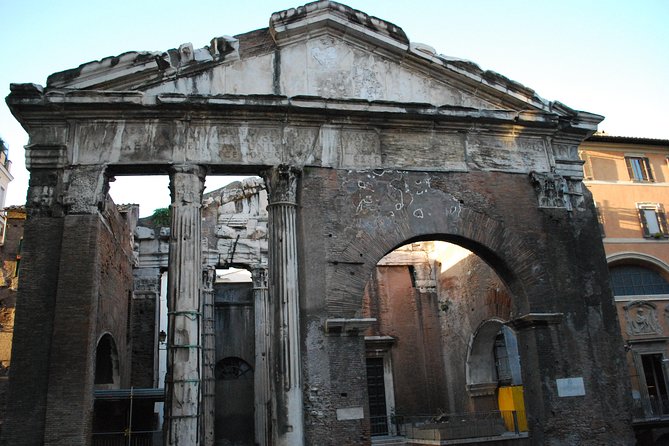
Your route ends at the area of Portico d’Ottavia, a site with deep Roman roots. The audio explains that it was built by Augustus, the first Roman emperor, to honor his sister Octavia.
You’ll hear that the complex includes a monumental arch and facade, then an internal portico that originally held two temples. This is a great stop for closing the loop between eras. You started in a Jewish quarter context shaped by centuries of community life. Here, you’re reading Rome’s imperial layer—where power and architecture announce themselves.
End-stop positioning is useful here. Because your tour finishes at Via del Portico d’Ottavia, 39, you can treat this as your “walk-off” point. You’ve got a clear location to stop, check your phone, and decide what’s next.
If you want the most out of the ending, linger just a bit. The structures here are visually strong, and the story makes more sense when you connect the architecture to what the audio says it held originally.
Timing, walking plan, and how to pair it with dinner
The tour is about 30 minutes, so think of it as a focused sprint rather than a slow meander. That makes it ideal when the rest of Rome is demanding your attention with crowds, lines, and transport schedules.
Because you’re going to the Jewish Ghetto area, it’s also a good time to plan food afterward. One of the best ways to make this kind of history walk stick is to add a real-world anchor: a meal nearby turns the stories into something you can taste, not just read.
If you’re pairing this with other sites, give yourself a buffer at the start. Taking a minute to confirm you’re at the right start point reduces the chances of route confusion later.
Best mindset: treat this as a “taste of context.” You’re learning the place names and major turning points quickly, then you move on with better questions in your head.
Who this tour suits—and who might not love it
This works well for:
- First-time users of self-guided audio, because the route has a start and end and the app handles playback logic.
- People who want history without joining a large group.
- Travelers with limited time who still want meaningful context.
It may frustrate you if:
- You don’t want to manage downloads and device settings. Offline audio depends on your phone cooperating.
- You tend to start activities in a “wing it” way. This route really does reward starting at the correct location and using the tour controls.
Also note the tour is offered in English and is set up as a private activity for your group only. If you’re traveling with friends, that can feel more relaxed than joining a noisy pack.
Should you book the Roman Jewish Ghetto self-guided audio tour?
I’d book it if you want a short, organized walk through the Jewish quarter that gives you names, dates, and real place meaning—without demanding hours of your day. The lifetime access and offline design make it a low-cost way to return to the content later, and the GPS-triggered playback helps you focus on what’s around you.
Skip it or approach with caution if you’re the type who hates troubleshooting phone apps or you’re likely to start before confirming the full download. In that case, one technical hiccup can turn a smooth route into confusion.
If you’re on the fence, here’s the deciding question: do you have 30 minutes to walk, plus the patience to download once on Wi-Fi? If yes, this tour is a solid value way to understand the Ghetto’s layers.
FAQ
How long is the Roman Jewish Ghetto self-guided audio tour?
It’s approximately 30 minutes.
How much does the tour cost?
The price is $8.99 per person.
What language is the tour available in?
The tour is offered in English.
Does the tour work without cell phone reception?
Yes. Once downloaded, it works without cell phone reception and includes offline access to audio, maps, and geodata.
Where does the tour start and end?
It starts at Via di S. Maria del Pianto, 22, 00186 Roma RM and ends at Via del Portico d’Ottavia, 39, 00186 Roma RM.
Are tickets or entrance fees included?
No. Tickets or entrance fees to museums or attractions en route are not included.
Is this tour private?
Yes. It’s listed as a private tour/activity, so only your group participates.