Trastevere turns into a clue trail. This self-guided puzzle quest has you walking between famous sights in the Trastevere area while your phone gives clues tied to local legends and a story featuring Luisa’s mystery. I like that it’s genuinely flexible: you start when you want, and the route is built for stopping often, not rushing. I also like that it includes 15 real-world puzzle challenges and works solo or as a group, so you can set the pace.
The main thing to consider is tech dependence. If your phone can’t connect well enough to load the app instructions, the game can stall, and one past experience flagged support as slow or hard to reach. If you’re prone to spotty service, I’d plan to switch to Wi‑Fi when possible before you begin, and keep an eye on offline loading inside the app.
In This Review
- Key Things to Know Before You Go
- A Puzzle Quest That Still Feels Like Rome
- Price and Value: Why $8.09 Can Feel Like a Deal
- How the App Experience Works (and What to Watch For)
- Your Stop-by-Stop Walk in Trastevere
- Stop 1: Ponte Fabricio
- Stop 2: Piazza in Piscinula
- Stop 3: Vicolo dell’Atleta
- Stop 4: Piazza di Santa Cecilia
- Stop 5: Vicolo del Buco, 60
- Stop 6: Excubitorium della VII Coorte
- Stop 7: In Trastevere House
- Stop 8: Vicolo di Santa Maria in Trastevere
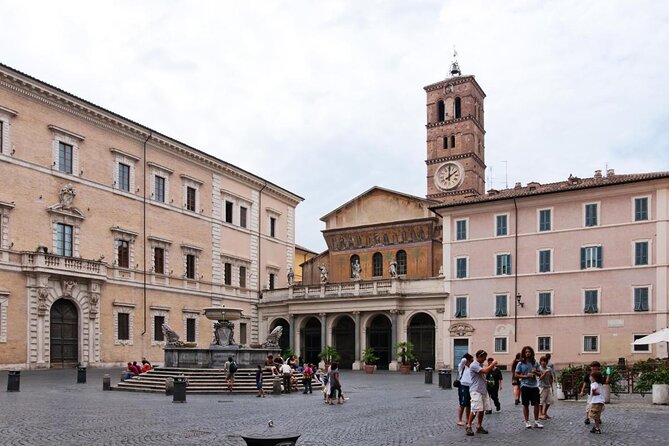
- Stop 9: Basilica of Santa Maria in Trastevere
- Stop 10: Porta Settimiana
- Stop 11: Via di Santa Dorotea
- Stop 12: Piazza Trilussa (Finish)
- What Kind of Travelers This Suits Best
- Pacing, Time on Your Feet, and Break-Friendly Design
- Languages, Solo vs. Group, and How to Plan with Others
- Should You Book This Puzzle Quest?
- FAQ
- Where does the experience start and finish?
- How long does the Rome: Hidden Treasures of Trastevere puzzle quest take?
- Is there a fixed time slot for starting?
- Do I need tickets to enter the attractions?
- Is it available for solo travelers?
- What device types are supported?
- What languages is the experience offered in?
- Is there a guide with you?
Key Things to Know Before You Go
- Flexible start time, no time slots: you can begin at any point during the long daily opening window.
- Works solo or with a group: same route, different pacing.
- 15 puzzles plus a story: Luisa’s mystery and Trastevere legends keep the walk from feeling like random sightseeing.
- Short stop structure: many segments feel like mini-missions (with time to linger if you want).
- Free entry for this experience: you don’t need paid attraction tickets to complete it.
- Multiple languages including English: helpful if not everyone in your group speaks Italian.
A Puzzle Quest That Still Feels Like Rome

This isn’t a guided tour where someone talks at you for an hour. It’s closer to a self-guided walking game that uses real streets, squares, and monuments as the backdrop. You’ll follow directions from stop to stop and answer clue prompts right there in the real world. That small shift changes how you see the neighborhood: you’re not just passing through. You’re actively noticing.
What makes it work well for Trastevere is the variety. The route bounces from a major bridge to small lanes and tiny squares, then to a major church and back to street-level viewpoints. Even if you’re traveling with kids, it gives them a reason to look up, not just wander.
The “story” side matters, too. There’s a Luisa’s mystery thread running through the challenges, plus Trastevere legends. That gives the walk a narrative line, so the experience feels more connected than a typical checklist of sights.
You can also read our reviews of more tours and experiences in Rome.



Price and Value: Why $8.09 Can Feel Like a Deal

At $8.09 per person, this is priced like a budget-friendly activity, not a premium guided tour. For that money, you get a full walking mission: a mobile access code, a set of 15 puzzle challenges, and story content that keeps you moving between 12 named stops.
The value angle is the “made for pause” pacing. Each stop is designed as a short segment, and the experience explicitly lets you stop as long as you like at multiple points. So if you’re tired, you can breathe. If you want photos, you can take them without feeling like you’re falling behind a group schedule.
Also, it’s marked as not requiring admission tickets to attractions to complete the route. That’s a practical plus in Rome, where the difference between paid entry and free viewing can be the difference between an easy day and an expensive one.
How the App Experience Works (and What to Watch For)
You download the app, use your phone for the instructions, and solve puzzles at each stop. The “mobile ticket” concept here is simple: you’re not hunting for printed vouchers. You follow the prompts and continue to the next scene.
A couple of practical tips help the experience run smoothly:
- Start with your battery topped up. A long game plus lots of map use can drain your phone.
- Check audio and screen brightness. If clues are text or image-based, you’ll want legibility.
- Stay close at each stop. Some clue prompts are best solved right on the exact spot rather than from a distance.
- Keep your phone handy, not buried. If you pull it out only at the end of a lane, you’ll lose time.
One key caution comes from a reported problem: not being able to connect and then struggling to get real-time help. I can’t promise you’ll see that issue, but the smart move is to test your connection right before you start. If you can, use stable Wi‑Fi near your meeting area, then head out.
If you do hit a wall, there’s a direct support email listed in the response I saw: [email protected]. Save it in your contacts so you’re not scrambling while troubleshooting.
Your Stop-by-Stop Walk in Trastevere
The route is built as a sequence of named stops, each with a short “mission” feel. Even when each segment is described as around 5 minutes, the experience is designed so you can linger. That flexibility is a real benefit in Rome, where a sudden view, a coffee line, or a photogenic corner can steal time.
Stop 1: Ponte Fabricio
You begin at Ponte Fabricio, and the first clue gives you the story kick-off plus directions to the next stop. Starting on a bridge is smart. You get a big-sky sense of direction, and it’s usually easier to find your bearing here than inside a maze of alleys.
Tip: take a minute before you start scanning the clue. Orient yourself so the first move feels confident, not chaotic.






Stop 2: Piazza in Piscinula
Next is Piazza in Piscinula. You solve the next clue on-site to move forward in the storyline and receive your next set of directions. Squares like this are good “reset points,” because you can step out of foot traffic and focus on the puzzle without weaving through crowds.
Potential drawback: if the area is busy when you arrive, you may feel slightly rushed while trying to read and solve.
Stop 3: Vicolo dell’Atleta
At Vicolo dell’Atleta, the game keeps you in the smaller street rhythm. You’ll study the clue and proceed when you’re ready. These lane stops are great for “slow Rome” pacing. You’ll naturally look at stone textures, doorways, and the way streets curve.
If you’re with kids, lane-style segments help because they’re contained. The space encourages “search and spot” behavior instead of a long open wander.
Stop 4: Piazza di Santa Cecilia
Piazza di Santa Cecilia is another square-based challenge. This is where the puzzle walk starts to feel like a guided rhythm: clue, short walk, clue, short walk. You’ll solve the prompt to continue the story and get the route forward.
A practical advantage: squares are easier for restroom breaks and quick snack pauses than narrow lanes.
Stop 5: Vicolo del Buco, 60
Next is Vicolo del Buco, 60. You look up your clue here, then move on with the correct directions. This stop sounds like the kind of Rome address that makes you smile: it has that playful street feel that fits a puzzle quest.
Note to self: slow down at this stop if you’re trying to match the exact location. Small street numbering can be confusing when you’re standing on a corner with multiple entrances.
Stop 6: Excubitorium della VII Coorte
At Excubitorium della VII Coorte, you get a new clue and then you’re allowed to stop as long as you like before continuing. This is one of the places where the experience stops being purely “game” and becomes “real exploration.”
If you like history but don’t want a lecturer, this stop style is a nice compromise. You can read the clue, solve it, then simply look around at the site at your own speed.
Stop 7: In Trastevere House
Your next scene is at In Trastevere House, where you receive the next clue. Again, you can take your time. This kind of stop works well because it breaks the walking cycle with a more relaxed pause.
Stop 8: Vicolo di Santa Maria in Trastevere
Now you’re on Vicolo di Santa Maria in Trastevere. Enjoy the view, then continue exploring at your own pace. Lane viewpoints are where this type of game really shines, because you’re not just looking—you’re also solving.
Photo tip: take photos of the street perspective before you start reading the next clue. Otherwise you’ll end up juggling phone screens and camera framing.
Stop 9: Basilica of Santa Maria in Trastevere
At the Basilica of Santa Maria in Trastevere, you explore while admiring the basilica around you. The puzzle structure suggests a focused stop, but you still keep control over how long you stay.
This is a good moment for a short sit, especially if you’ve been walking for a while. Even if you don’t go deep into anything ticketed, you can still enjoy the atmosphere of a major church setting.
Stop 10: Porta Settimiana
Next up is Porta Settimiana. You solve the next clue tied to the next scene and directions onward. “Gate” locations tend to have a strong visual pull, so even if the puzzle takes a minute, the stop itself often feels rewarding.
Stop 11: Via di Santa Dorotea
At Via di Santa Dorotea, you’ll see the street and get your next clue. This stop likely feels like a “connective tissue” segment, helping you transition from monument energy back to a more ordinary street-walk feel.
Stop 12: Piazza Trilussa (Finish)
You finish at Piazza Trilussa. This is where both the story and the exploration games end. Ending at a public square is a smart design choice: it’s easy to regroup, snack, and decide what to do next without needing to hunt for an exact departure point.
What Kind of Travelers This Suits Best
This experience is a strong fit if you like structure but not a lecture. It’s also ideal when you want to see Trastevere at street level, not just from the edges.
You’ll likely enjoy it most if:
- you’re traveling with kids who need a task to stay engaged
- you want something lighter than a full guided tour
- you’re comfortable using your phone for directions and clue prompts
- you prefer flexible pacing over a strict schedule
If you’re the type who hates tech dependence, or you expect your phone signal to be unreliable all day, this might be stressful. In that case, you could still enjoy Trastevere on your own—but this format only works if you can access the app content.
Pacing, Time on Your Feet, and Break-Friendly Design
The duration is listed as about 1 hour 15 minutes to 1 hour 45 minutes, which is a realistic “Rome afternoon chunk.” The tour stops are laid out so each segment feels short, often around 5 minutes for the clue action. But the experience also gives you permission to stretch the time at certain stops.
That flexibility matters. Trastevere has lots of reasons to slow down: a quiet corner, a storefront worth a glance, a gelato break that turns into a conversation. With this game, you’re not betraying the plan by taking a detour for a minute or two.
If you’re planning this as part of a bigger day, I’d schedule it earlier rather than later, when your energy is higher and your phone battery is less likely to be on fumes.
Languages, Solo vs. Group, and How to Plan with Others
The experience is available on Android and iPhones, and it’s offered in multiple languages including English. That’s practical if you’re mixing ages or language levels in your group.
It’s also designed for solo play or group play. In practice, group play can work two ways:
- everyone solves their own clues and you compare results
- one person drives the reading while others help spot locations
Either way, the route gives you shared moments. That’s a nice contrast to classic sightseeing where each person drifts and then meets back up.
Should You Book This Puzzle Quest?

Yes—with a couple of smart conditions.
Book it if you want a fun, low-cost way to see Trastevere’s streets, squares, and major landmark areas while solving real-world challenges. At $8.09, it’s the kind of activity that can turn an ordinary walking day into something memorable without demanding tickets or a paid guide.
Think twice if you’re worried about connectivity. A reported issue involved the app failing to connect and a lack of helpful support at the time. If you’re relying on mobile data only, test your setup before you commit, and keep the support email [email protected] handy.
If your phone is reliable and you’re open to a playful walk, this is a great value way to experience Trastevere with your own pace in control.
FAQ
Where does the experience start and finish?
It starts in Rome at 00186 and finishes at Piazza Trilussa, 42, 00153 Roma.
How long does the Rome: Hidden Treasures of Trastevere puzzle quest take?
It takes about 1 hour 15 minutes to 1 hour 45 minutes.
Is there a fixed time slot for starting?
No. You can enjoy a flexible start time with no time slot required.
Do I need tickets to enter the attractions?
No. The experience is described as having free admission ticket stops and does not require entry tickets to attractions to complete the tour.
Is it available for solo travelers?
Yes. You can complete it solo or with a group.
What device types are supported?
It’s available on Android and iPhones.
What languages is the experience offered in?
It’s offered in multiple languages, including English.
Is there a guide with you?
No. A tour guide is not included; it’s self-guided through the mobile app.