REVIEW · YORK
Private York Self-Guided Tour
Book on Viator →Operated by Pandemic Tours · Bookable on Viator
York’s past is close enough to touch. This private self-guided route strings together Roman, medieval, and Viking York in one walk with audio narration.
I like that the app gives you a clear route with GPS directions and stop-by-stop storytelling, so you’re not guessing where to go next. I also like the pacing: each segment is short, and you can linger when a place catches your eye. One caution: this is phone-first, so if you hate checking screens while walking, you’ll need to manage it (or be ready to switch to your own map).
The tour also has a smart practical edge. Once downloaded, the app stays available for three weeks, letting you redo sections or re-listen when you want context later. It’s in English and designed for a tight 2–3 hour loop, so it works great for a quick visit. The main drawback is that the navigation and audio experience depends on the app working smoothly on your device.
In This Review
- Key Things to Know Before You Start
- A Self-Guided York Route That Actually Works on Foot
- Who this suits best
- York Minster: Start With the Big Story at 6 Minster Yard
- Roman York and the Roman Column: What Eboracum Meant
- St Peter’s Liberty: A Medieval City Inside a City
- St. Michael le Belfrey and Guy Fawkes: History With a Shock of Drama
- High Petergate, Bootham Bar, and the Roman-to-Georgian Street Story
- York City Walls and the Multangular Tower: Walk the Defenses
- Museum Gardens and St Mary’s Abbey: A Green Pause With Roman Anchors
- St Mary’s Abbey Remains: Alan Rufus to the Monks
- The Shambles and Saint Margaret Clitherow: Street Theatre That’s Still Real
- Jórvík (Danish York): Vikings, Ragnar, and a City Name You’ll Remember
- Clifford’s Tower: The Grand Finish and What to Do Next
- Price and Value: Why $12.33 Can Be a Great Deal in York
- My take on the “app vs bus vs guide” choice
- Practical Tips for Getting the Most From the App
- Should You Book This York Self-Guided Tour?
- FAQ
- How long is the York self-guided tour?
- Where do I start and end?
- What does the tour include?
- Are attraction entrance tickets included?
- Is there an in-person guide?
- What language is the tour available in?
- Is the booking refundable if I cancel?
- Is it only for my group?
Key Things to Know Before You Start
- A walkable 2–3 hour route: York Minster to Clifford’s Tower, with time at each stop.
- Audio guided by Jenny: no computer-style voice, just narration you can follow at street level.
- Three-week app access: download once and use it again during your stay.
- Short stop audio files: built to keep you moving and reduce battery drain worries.
- Most stops are free: only a couple of places mention admission fees.
- Private-by-design: it’s set up for only your group, with no in-person guide walking with you.
A Self-Guided York Route That Actually Works on Foot
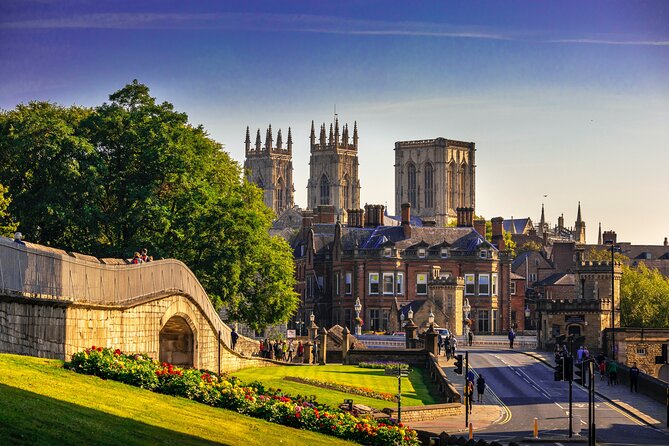
York can feel like a puzzle at first. Too many lanes, too many signs, and every corner seems to hide another layer of history. This experience gives you a straightforward answer: follow the app, hit the key landmarks, and connect the story across time periods without needing a formal tour group.
You start at 6 Minster Yard, York (YO1 7JD) near York Minster. You end at Clifford’s Tower, Tower St, York (YO1 9SA). That matters because you’re walking in a logical direction through the city’s most famous areas, instead of crisscrossing and losing time.
The route is built for a 2–3 hour visit, with individual stop times ranging from about 5 minutes up to 20 minutes. That time framing is useful: it keeps the day from stretching into a half-marathon, but it still gives you breathing room, especially around the walls and the gardens.
You can also read our reviews of more tours and experiences in York.



Who this suits best
This is a strong fit if you:
- want freedom (your pace, your stops)
- like history that explains what you’re looking at, not just dates
- don’t want to pay for entry tickets just to “justify” a tour
- are comfortable using a phone while walking
If you want zero screen time, you might find the phone dependency annoying. In that case, you could still use it at the start, then rely on your own navigation for the rest—but it’s designed to be followed.
York Minster: Start With the Big Story at 6 Minster Yard
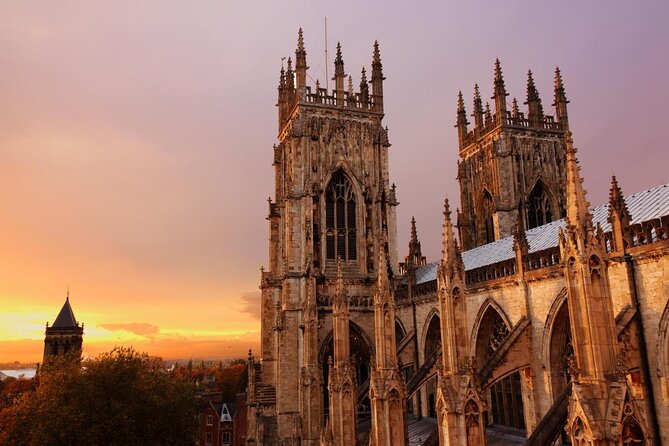
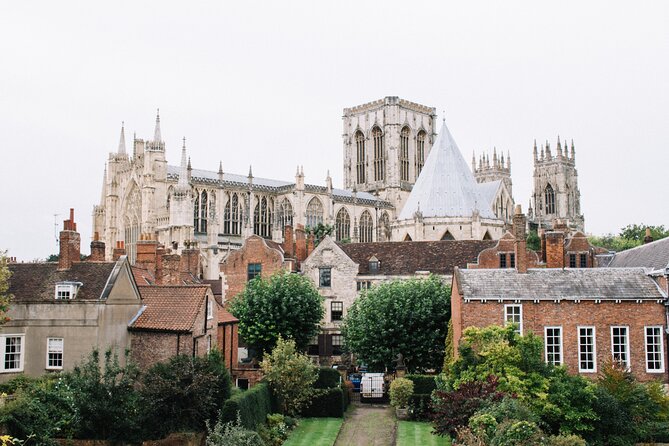
Your first stop is York Minster, starting at The Cathedral and Metropolitical Church of Saint Peter in York. York Minster isn’t just impressive—it’s the centerpiece of the city’s spiritual and civic identity.
The narration frames it clearly: York Minster is one of the largest cathedrals of its kind in Northern Europe, and it’s the seat of the Archbishop of York, described as the third-highest office of the Church of England. That context helps you see the building as more than architecture. It’s a living institution with authority and history wrapped into the stone.
The stop is about 10 minutes, and admission is not included. So think of this first segment as orientation. You’ll understand what to look for, even if you decide not to pay for interior access.
Why it’s a good start: it anchors everything else. When you reach later stops tied to St Peter or medieval “quarters,” you’ll already know the role Minster plays in the city’s map and meaning.
Possible drawback: if you were hoping the tour would include the main cathedral entry, it doesn’t. You’ll need to decide in advance whether you want to pay for York Minster’s interior.
Roman York and the Roman Column: What Eboracum Meant
Then you pivot into Roman York with The Roman Column. York’s Roman-era identity is easy to overlook, especially if you’re focused on medieval streets. This stop pulls you back to the city as Eboracum, a Roman fort founded in 71 AD by Roman General Quintus Petillius Cerialis of the Ninth Legion.
The narration explains the placement: the fort was built on flat ground above the River Ouse near its junction with the River Foss. That kind of detail is valuable because it turns a “point of interest” into a mental map of how Romans used rivers and roads.
This stop is also about 10 minutes, and it’s free (no admission ticket required here). You get the Roman context without needing to add another entrance fee.
My practical takeaway: if you only do one Roman-themed moment, this is a good one. It’s quick, outside, and it sets up later explanations of Roman street alignments and fort edges.
St Peter’s Liberty: A Medieval City Inside a City
Next comes the medieval layer tied to the idea of boundaries around St Peter’s church. The tour explains that this area functioned like a city-within-a-city and wasn’t under the Mayor’s authority. That special jurisdiction is called the Liberty of St Peter.
This stop is easy to miss if you’re only looking at buildings. But the story changes how you interpret the streets around Minster. When you understand that certain spaces were governed differently, you start noticing why certain areas became influential, and how residents’ lives could be shaped by where authority sat.
Time on this stop: the app includes it as a segment within the route, described as about learning what happened inside that liberty and the social repercussions of St Peter’s monks across the city.
Why I like this kind of stop: it turns York into a system, not just a set of photos. You start understanding why certain neighborhoods developed different roles.
Consideration: because this is more about jurisdiction and social life than a single landmark you can admire from one angle, it helps to pay attention to the audio rather than treating it like background noise.
St. Michael le Belfrey and Guy Fawkes: History With a Shock of Drama
At St. Michael le Belfrey Church, the tour shifts into a famous name: Guy Fawkes.
This church is described as the only remaining sixteenth-century church in York and the largest pre-Reformation parish church in the city. Those labels matter because they tell you why the building survived when so much else changed after the Reformation.
The big story point is that Guy Fawkes was baptised on 16 April 1570 here. That fact instantly makes the place feel personal and specific. It’s not just “old church.” It’s a recorded moment tied to a figure who still echoes through British culture every November 5th.
Admission is free for this stop. The planned time is about 10 minutes—enough to absorb the context without making you sit still too long.
Practical advice: this is a good place to slow down your walking pace slightly. Even if you can’t access everything inside, the narration gives you what you need to appreciate what you’re seeing.
High Petergate, Bootham Bar, and the Roman-to-Georgian Street Story
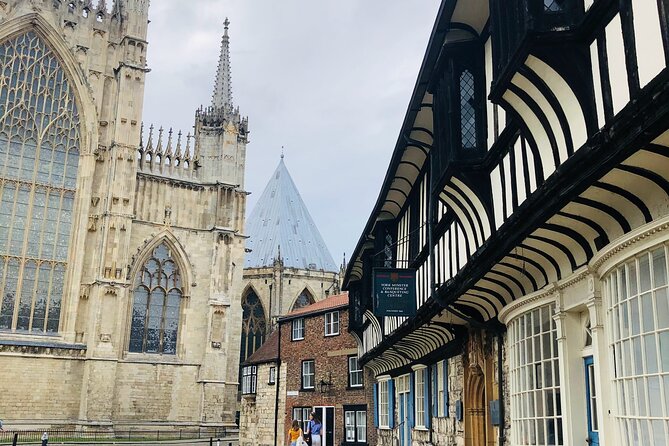
Now you move onto High Petergate, which the tour frames as a corridor through time.
Petergate Street sits on the line of the Roman Via Principalis, the first-century main east-west route through the Roman fortress. So you’re walking a street that tracks how York’s major movement corridors evolved. The name itself is tied to proximity to York Minster, which is dedicated to St Peter.
The tour describes High Petergate as a medieval route into York from the north, running from Bootham Bar to Stonegate. It also points out that some medieval buildings still stand—an “eclectic mix” with Georgian-era architecture.
Then the narration expands with Petergate House, a Grade II listed building once home to Sir Thomas Herbert, described as a historian and groom of the bedchamber to Charles I. The tour even includes a story about a haunted house in the area, which is a nice change of pace if you like the spooky side of local lore.
At the north end, you reach Bootham Bar—one of the four main entrances to the Roman fortress about 2,000 years ago—and the app explains why it’s preserved.
Time: about 15 minutes across this section, plus extra micro-stops as you walk.
The value here: this is where your eyes learn to read the city. After this, York stops being random. You start seeing alignment, entrances, and how modern streets map onto old roads.
York City Walls and the Multangular Tower: Walk the Defenses
Next is York City Walls, one of the city’s most distinctive assets. The narration highlights that York has more miles of intact wall than any other city in England. It also notes the different names you might hear: York City Walls, Bar Walls, and Roman walls.
This stop is where you get active. The app provides recommendations on where to hop onto the walls and gives you the liberty to walk through for as long as you like. That flexibility is part of the tour’s whole logic: it gives you structure, then lets you choose your effort level.
You’ll spend about 15 minutes at this stop on the plan, but with walls it’s easy to extend—so keep an eye on time if you want to finish everything.
Then you get a short segment at the Multangular Tower, a western corner tower of the Roman fortress, standing about 9 metres high. The tour notes it contains stonework from both Roman and medieval periods, which is a neat way to connect the eras without needing a museum ticket.
Why this section is a highlight: walls are the rare York feature that lets you see the city’s shape. Even if you don’t go far, the perspective changes how you understand where everything sits.
Museum Gardens and St Mary’s Abbey: A Green Pause With Roman Anchors

After the stones and edges of the walls, you step into Museum Gardens, described as a ten-acre botanical space surrounding the Yorkshire Museum.
The tour explains that the gardens cover the grounds of the former medieval St Mary’s Abbey. It also ties the design to the early 19th century: established by the Yorkshire Philosophical Society and designed by landscape architect Sir John Murray Naysmith.
This part is around 20 minutes, and it’s free. You’ll also learn what makes it special seasonally: collections of trees, shrubs, perennials, and bulbs.
The narration points out historic buildings within the gardens, including remains of the west corner of the Roman fort of Eboracum and St Mary’s Abbey.
That Roman-to-monastery layering is the theme of the whole route, just expressed in a softer way: a walk through greenery that still connects to old fort walls and abbey precincts.
St Mary’s Abbey Remains: Alan Rufus to the Monks
St Mary’s Abbey is the related stop where the story gets specific.
The tour describes it as a Benedictine foundation with origins dating back to 1086, when Alan Rufus (a distant cousin of William the Conqueror, and described as Count of Brittany) granted it to a monk named Stephen of Whitby.
It also notes the remains of the Roman Anglian Tower. That kind of detail can sound abstract, but it’s helpful: it tells you that York’s “layers” weren’t replaced cleanly. They overlapped.
This stop is about 15 minutes and free.
What I’d do if I had extra time: linger here and listen twice. The Abbey story has a lot of names, and the gardens let you take the information without feeling rushed.
The Shambles and Saint Margaret Clitherow: Street Theatre That’s Still Real
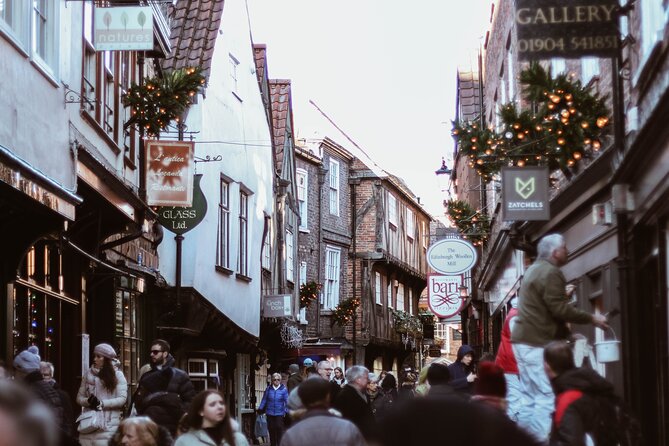
Now comes one of York’s most famous lanes: the Shambles.
The tour describes it as an old street with overhanging timber-framed buildings, with some structures dating back as far as the 14th century. It’s also described historically as the Great Flesh Shambles, where butcheries displayed meat shelves.
The narration leans into the pop-culture angle without losing the real-world thread. It discusses what’s myth and what’s real about the connection people often make between this street and the Harry Potter world, plus the broader idea of real-life events.
This segment is about 15 minutes and free.
Then you add a very specific stop inside the Shambles story: the Shrine of Saint Margaret Clitherow. The tour explains she was an English saint and martyr of the Roman Catholic Church, married to a butcher who owned and lived in a shop on this street. Her home is thought to be No. 10 Shambles.
This stop is about 10 minutes. Admission is not included for this one, so treat it as optional if you don’t want to pay.
Why this combination works: Shambles gives you the atmosphere. Margaret Clitherow gives you the human-scale story underneath the atmosphere.
Jórvík (Danish York): Vikings, Ragnar, and a City Name You’ll Remember
After the medieval streets, the app switches to Jórvík, also called Danish York—a term historians use for south Northumbria during the late 9th and early 10th centuries when Vikings dominated.
The narration frames it in time: Vikings established themselves here more than a thousand years ago. It’s a quick shot of identity, but it helps you understand why York can feel both medieval and ancient-Roman in the same day.
This stop includes bonus stories of three famous Vikings who visited the city, and yes, Ragnar is among them.
You’ll spend about 10 minutes here, and it’s free.
What to expect: this is more narrative than architecture. If you’re the kind of traveler who likes names, relationships, and cause-and-effect, you’ll probably enjoy this segment more than you expect.
Clifford’s Tower: The Grand Finish and What to Do Next
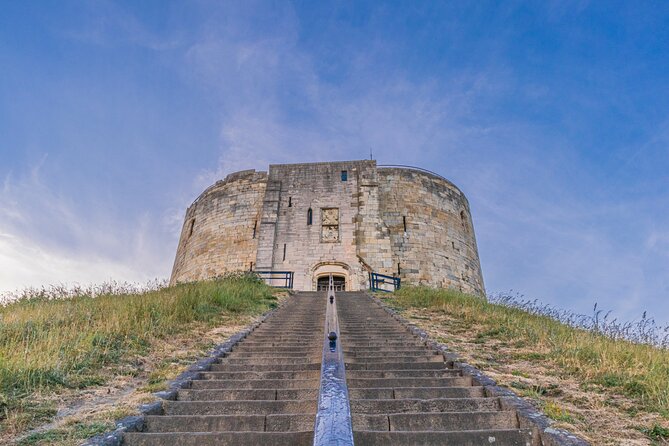
Finally you end at Clifford’s Tower, one of York’s best-loved landmarks.
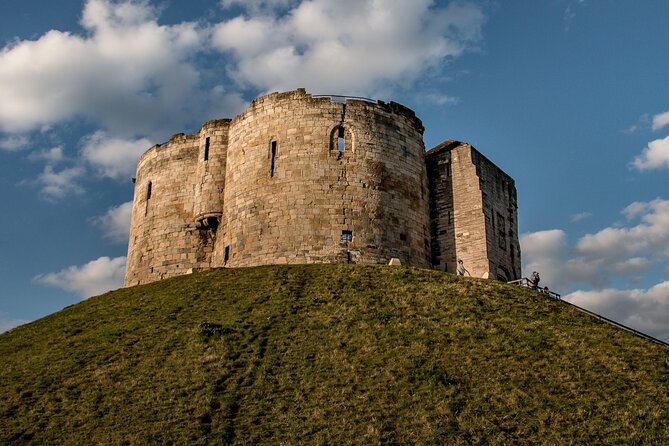
The narration explains that Clifford’s Tower is the largest remaining part of York Castle, once the centre of government for the north of England. It also ties the castle to the people of York, not just the building.
This finish matters for two reasons:
- It’s a visual payoff after all the gates, walls, churches, and abbey grounds.
- The app includes recommendations for where to eat and what to do next, which helps you turn the visit into an actual plan rather than a wandering walk.
This last stop is about 15 minutes. It’s free per the tour data.
Price and Value: Why $12.33 Can Be a Great Deal in York
At $12.33 per person, this is priced like a budget-friendly way to get a curated walking route. The math works best if you already plan to do a lot of York on foot and you care about context.
Here’s why it can feel good value:
- You get three weeks of unlimited access to the app, so it isn’t a one-and-done purchase.
- The app includes maps, directions, GPS route, and stop structure—you’re paying for reduced stress.
- Several major stops are free (Roman Column, St Michael le Belfrey, High Petergate segments, walls, Multangular Tower, Museum Gardens, St Mary’s Abbey, Shambles, Viking York, Clifford’s Tower).
- You get audio narration by Jenny, with pictures, videos, and recommendations built in.
Where the value shifts down:
- You’ll still have to pay any admission where it’s not included (York Minster and the shrine stop are listed as not included).
- Your enjoyment depends on how much you like phone-based navigation.
My take on the “app vs bus vs guide” choice
If you hate staring at your phone, a standard hop-on hop-off bus might be easier. But if you’re a walker and you like explanations as you go, this route can beat the bus in both cost and satisfaction.
Practical Tips for Getting the Most From the App
A few things will help you make this smoother on the ground.
First, download and activate it early. The tour says you’ll get an email with instructions, and the booking reference is not the activation code. That detail matters because it’s common to waste time hunting for the wrong number.
Second, expect the pace to be adjustable. The app gives stop times, but the walls segment explicitly offers the option to walk through as long as you like. Start a little earlier than you think you need if you want to extend here.
Third, pay attention to audio length. The experience is designed around short audio files at each stop, which is a direct response to battery and screen-time concerns.
Finally, be ready for the occasional tech wobble. There are signs the provider has fixed app bugs and supported people when audio didn’t play as expected, including cases where support refunded money when the app failed. Still, the experience itself is listed as non-refundable, so your best protection is to test the app before you commit your whole walk to it.
Should You Book This York Self-Guided Tour?
Book it if you want a structured walking route through York’s most important eras, and you’re okay using your phone for navigation and audio. It’s especially good for first-timers who want to see a lot without paying for multiple guided tours.
Skip it (or adjust expectations) if you:
- don’t like screen time while walking
- want everything to be included, especially entry fees at York Minster and the shrine stop
- hate learning any app interface at all
Overall, I’d call it a smart, affordable way to make York feel understandable. You finish with a mental map: Minster’s authority, Roman street lines, the logic of medieval boundaries, the drama of Guy Fawkes’s baptism location, and the Viking layer named Jórvík.
FAQ
How long is the York self-guided tour?
It’s designed to take about 2 to 3 hours, with stop times ranging from about 5 to 20 minutes.
Where do I start and end?
Start: 6 Minster Yard, York YO1 7JD, UK.
End: Clifford’s Tower, York Tower St, York YO1 9SA, UK.
What does the tour include?
You get 3 weeks of unlimited access to the self-guided smartphone tour app, plus map, directions, GPS route and stops, and an audio guide with pictures, videos, and recommendations.
Are attraction entrance tickets included?
No. Admission tickets for the attractions mentioned during the tour are not included, including York Minster and the Shrine of Saint Margaret Clitherow.
Is there an in-person guide?
No. This is self-guided. The audio guide is provided by Jenny.
What language is the tour available in?
The tour is offered in English.
Is the booking refundable if I cancel?
This experience is listed as non-refundable and cannot be changed for any reason.
Is it only for my group?
Yes. It’s a private tour/activity, so only your group participates.