REVIEW · MALLORCA
Palma’s Alternative History: A Self-Guided Audio Walk
Book on Viator →Operated by VoiceMap Audio Tours · Bookable on Viator
Palma is best when you can pause. This self-guided audio walk uses Sandra’s local stories to stitch together big landmarks like the Parc de la Mar and the Catedral de Palma, with the freedom to start and stop when your feet need a break. The big upside is that you don’t have to book a timed group tour to learn the city’s twists; the one drawback is that the whole experience runs through the VoiceMap app, and you’ll want your phone battery ready.
What I like most is how offline audio and maps let you move at street pace, not schedule pace, for about 1 to 1.5 hours. It’s also good value: lifetime access for $9.99 means you can repeat the walk whenever you return to Palma. Just plan on bringing your own smartphone, and ideally headphones, because those aren’t included.
In This Review
- Key highlights worth your attention
- Why Palma’s alternative history format works
- Starting at Parc de la Mar: where the tour sets its tone
- Art Nouveau and a 17th-century house break for your feet
- Santa Eulalia Church: old royal moments and a free interior
- Sa Riera’s torrent: street history you can feel underfoot
- Plaça Major and Plaça de Cort: your Mile Zero finish
- Cathedral of Light (Seu): the big milestone stop
- Almudaina Palace: from an Arabic king to the modern king’s residence
- The former maritime stock exchange: free admission, big meaning
- Price and value: $9.99 for a walk you can repeat
- VoiceMap logistics: how to make it smooth (and avoid frustration)
- Fit for your trip: who this Palma walk is best for
- Should you book this self-guided Palma audio walk?
- FAQ
- How long is the audio walk?
- Where does the tour start and end?
- What language is available?
- Can I use it offline?
- Do I need tickets for the stops?
- Do I need a smartphone and headphones?
- Is this tour private?
Key highlights worth your attention
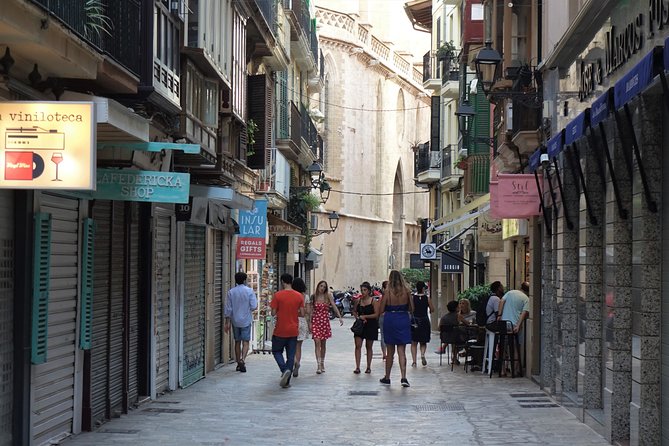
- At your pace: Start, pause, and resume your walk whenever you want
- Local narration by Sandra: A longtime resident connects landmarks with stories
- Offline-ready with VoiceMap: Download for audio, maps, and geodata before you go
- Landmarks plus stops in-between: You hit major sights and useful context
- Finish in the center: You wrap near Plaça de Cort and Palma town hall
Why Palma’s alternative history format works
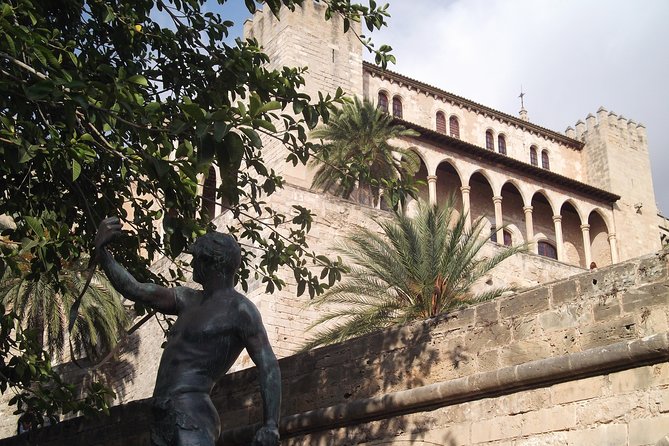
Palma’s old center is made for walking, but it’s also easy to miss the plot. This audio route tackles that problem by steering you through a simple idea: Palma’s history isn’t one straight line. It’s layers—ancient Talayotic culture, later rule and religion, and then the elegant city you recognize today.
Because it’s self-guided, you can slow down at the points that matter to you. If you’re into architecture, you’ll get plenty to chew on. If you’d rather grab a drink and catch your breath, the route still keeps you moving without feeling like you’re behind. You’re not stuck with a fixed pace or a guide speaking over street noise.
Also, the route is short. At about an hour to an hour and a half, you can fit it into a first-visit day, even if you’re also touring the cathedral, wandering along the waterfront, or doing a separate museum. And because you get lifetime access, the cost is mostly paid once.
You can also read our reviews of more tours and experiences in Mallorca.

Starting at Parc de la Mar: where the tour sets its tone
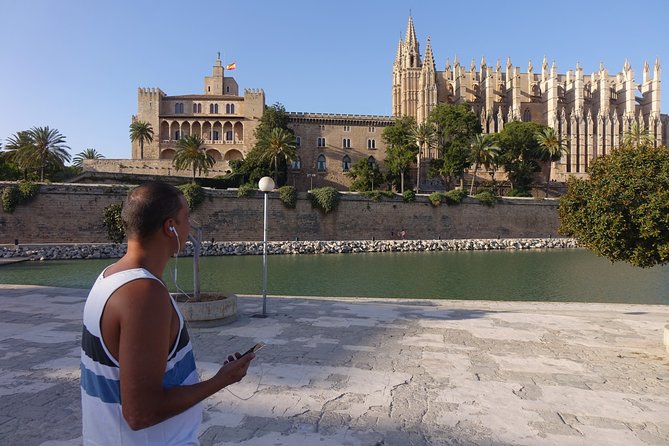
The walk begins at Parc de la Mar, a charming square that faces the Catedral and the Almudaina Palace. The setting is dramatic because you’re basically standing in the middle of Palma’s “view corridors.” You can look straight toward the cathedral, and you can feel how the old city layout pulls your eyes forward.
The narration gives you one of those smart city details that changes how you see the place: the square was built over the sea in the 1960s during Mallorca’s tourism boom. That matters, because it frames Palma as a living city. Not just ancient ruins, not just postcard charm—actual development, actually modern planning layered over older space.
Right here, you also get a useful practical benefit: you’re starting from a spot that makes the rest of the route make sense visually. The cathedral and palace aren’t just random stops; they become reference points.
Art Nouveau and a 17th-century house break for your feet
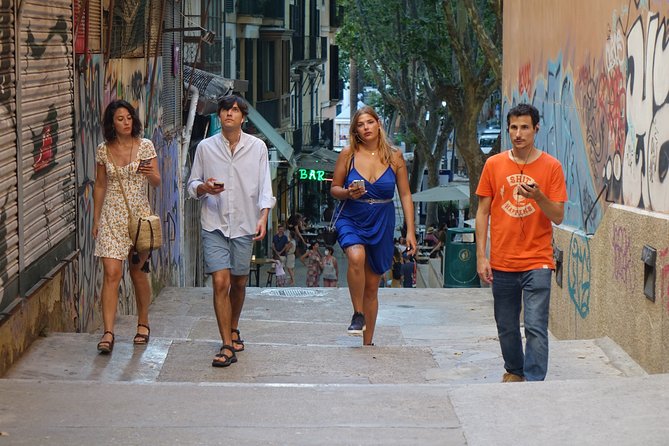
After the waterfront square, the route moves you to a splendorous Art Nouveau monument originally built in the early 1900s. If you tend to walk past these styles without catching the differences, an audio guide helps you notice the shapes and intent—what the building was trying to do for the city at the time.
Next comes a very Palma kind of stop: a typical noble Majorcan house built in the seventeenth century (listed as Can Marcel). Today it hosts a lounge bar with a rustic, authentic design, and it’s an easy place to pause the audio and reset.
This is where the self-guided format shines. You’re not required to listen straight through. You can stop for water, use the restroom, or simply sit for a few minutes and let Palma’s atmosphere land. And since the tour includes no food or drink, this is a good moment to plan a small break rather than improvising later.
Santa Eulalia Church: old royal moments and a free interior
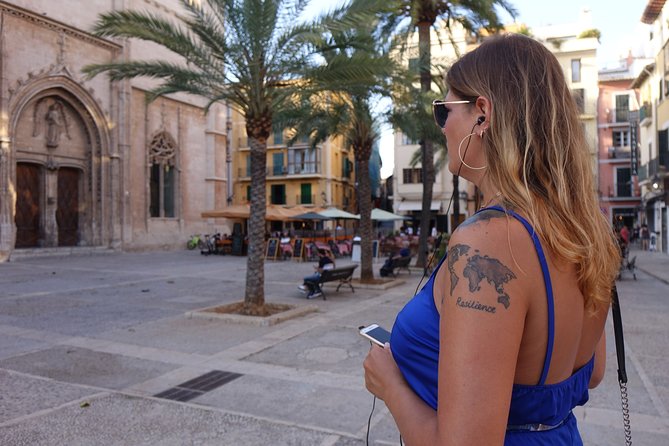
One of the most solid “value stops” on the route is Santa Eulalia Church, described as one of the oldest churches in Mallorca, built in the thirteenth century. The interior is said to be richly decorated in a baroque style, and the best part for your wallet is that it’s free to visit.
The narration adds extra context that makes the building more than a quick photo stop. Before the cathedral was completed in 1601, the first kings of Majorca were crowned in Santa Eulalia Church. So when you look at this church, you’re not only seeing religious art—you’re also standing inside a site tied to political ceremony.
If you want one stop that makes your whole walk feel worth it, this is it. It gives you a tight mix of age, art, and meaning.
Sa Riera’s torrent: street history you can feel underfoot
As the route continues, you get a story that’s easy to forget until you hear it: in the past, the torrent of Sa Riera flowed through this street, dividing the city in two parts. That physical feature becomes a historical divider—where people moved, where power concentrated, and where the city’s rhythm changed.
The narration also ties this location to entertainment and power: knights’ tournaments were organized along this torrent. It’s the kind of detail that makes you understand how the city used public space for spectacle, not just daily life.
When you’re walking through modern streets, it’s tempting to think nothing has changed beneath you. Stops like this help you see that street lines are often the fossil record of older geography.
Plaça Major and Plaça de Cort: your Mile Zero finish
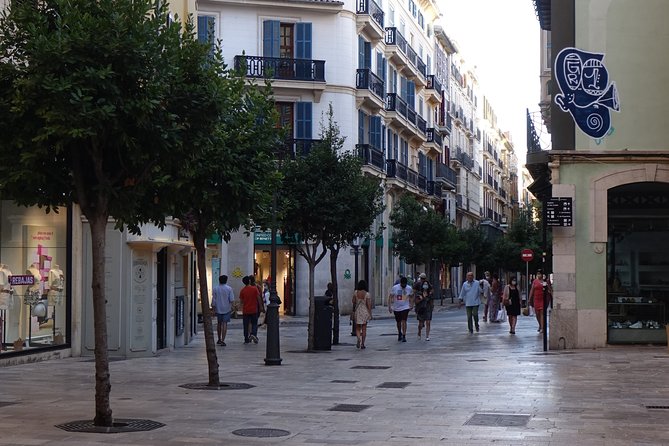
The tour reaches Plaça Major, described as Palma’s Mile Zero. It’s a great finishing point because it’s central and historic at the same time. You end up in a place that feels like a hub—useful if you’re meeting someone, grabbing dinner, or heading to another attraction.
The route also includes time at a square built in the middle of the nineteenth century, where the annual feast day of Saint Sebastian takes place on January 19. The narration frames it as a key celebration for Palma and the patron saint of the city. Even if you’re not there in January, knowing this makes the square feel less random.
Then you wrap up near Plaça de Cort, roughly an hour later, close to Palma town hall. The whole walk’s arc lands you back in the administrative and cultural core, which is exactly where you want to be when you’re planning the next step of your day.
Cathedral of Light (Seu): the big milestone stop
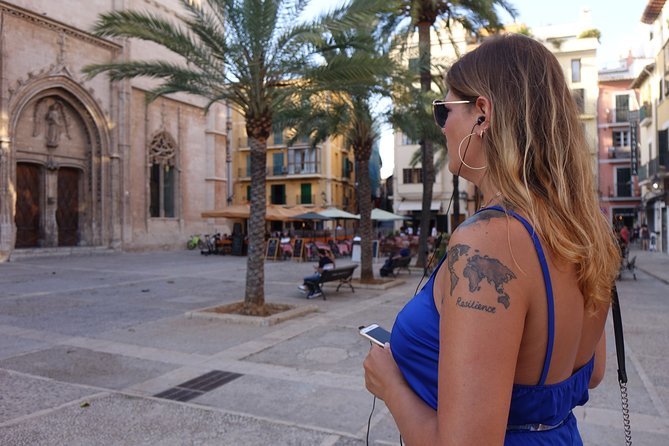
No Palma walk is complete without the Cathedral of Palma, also known as the Cathedral of Light and called the Seu. The narration gives you the timeline that turns the building into a real project, not a finished object.
Construction started in 1230 and was completed 371 years later in 1601. That huge span matters because it hints at change over time—styles, priorities, and the sheer persistence it took to finish. Standing near it, you’re looking at a monument shaped by generations.
The cathedral is also described as the crown jewel and a source of pride for Majorcans. You’ll feel that pride in how locals talk about the building and how the city organizes space around it.
If you’re doing this audio walk on a first trip, treat the cathedral as your anchor. Use it to orient yourself, and let the narration explain why it ended up here, taking centuries to reach completion.
Almudaina Palace: from an Arabic king to the modern king’s residence
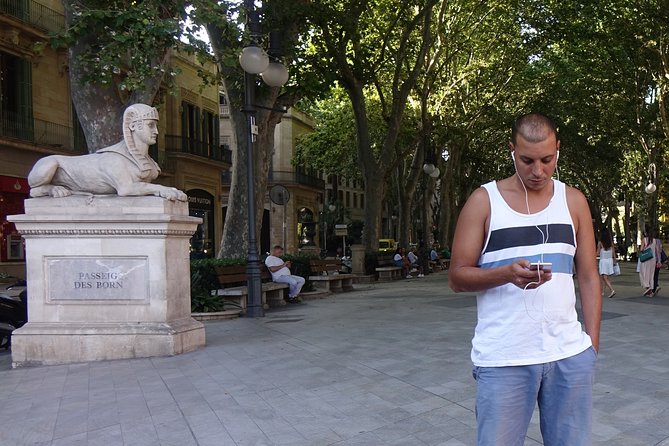
Next comes Almudaina Palace, described as an Arabic king palace built in the tenth century and identified as the oldest monument of Palma. Even if your main interest is medieval Europe, the narration helps you understand that Palma’s story includes multiple cultural layers—not just one.
Today, the palace is described as the official King Residence, where King Philip VI receives official visitors such as presidents from other countries. The palace also operates as a museum and a military building.
That mix—historic residence, museum functions, military association—is exactly why palace stops are so effective on an audio route. You hear the continuity and the change. It’s not just “a building from X century.” It’s still part of state life in some form, which makes the history feel current rather than locked behind glass.
The former maritime stock exchange: free admission, big meaning
Another standout practical stop is a beautiful Gothic building built in 1428, described as the former maritime stock exchange. It’s listed as open to the public, and admission is stated as free.
Maritime Palma is one of the city’s true engines, and a stock exchange building is a useful clue. It signals that the wealth of the sea wasn’t only about ships—it was also about trading, finance, and decision-making. If you’re interested in how cities grew, this stop connects the dots.
It also helps that it’s free. Since the audio tour includes no tickets for museums or attractions, you’ll appreciate encountering at least one site you can enter without paying extra.
Price and value: $9.99 for a walk you can repeat
At $9.99 per person, this audio tour is priced like a quick impulse buy, but the product is more durable than most day passes. You get lifetime access, which means you can do the route again without paying again when you return to Palma.
Duration is also part of the value equation: about 1 to 1.5 hours. That’s long enough to feel like you learned something, but short enough not to hijack your entire day.
What you don’t get matters too. This isn’t a ticketed museum route. Tickets or entrance fees aren’t included, and food, drink, transportation, and a smartphone/headphones are not included either. So the “value” here is knowledge, routing, and context—not guaranteed paid attractions.
For me, the best bargain is the combination of major landmarks plus smaller context stops, all without needing to line up with anyone or match a group schedule.
VoiceMap logistics: how to make it smooth (and avoid frustration)
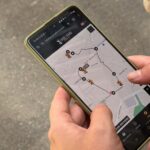
You’ll need the VoiceMap app on Android or iOS, and you’ll want headphones (not included). The good news is that offline access is part of the package: audio, maps, and geodata can be downloaded.
Here’s the practical trick: download before you walk. If your signal is spotty or you plan to move through side streets and squares, offline matters. It also protects you from battery drain caused by constant reloading.
One more reality check: the whole tour depends on the app working properly. The experience concept is strong, but at least one user reported app instability, including needing to reopen it and manually mark the point, plus fast battery use. That doesn’t mean it will happen to you, but it does mean you should prepare:
- Bring a charged phone
- Consider a power bank if you know your battery drops fast
- Download offline content before you start
If the app does misbehave, you may lose a bit of momentum because the route timing is guided by the phone.
Fit for your trip: who this Palma walk is best for
This is a smart pick if you’re:
- Visiting Palma for the first time and want a history storyline without a live guide schedule
- Short on time but want more than photo stops
- Traveling at a comfortable walking pace and like learning while you wander
- Comfortable using an app for navigation and audio playback
It may be less ideal if you dislike phone-based tours or you’ve had bad luck with apps in the past. In that case, you’d want a backup plan (like offline notes or a map you can follow without audio).
Should you book this self-guided Palma audio walk?
Book it if you want a focused, first-visit history route that moves you from Parc de la Mar toward Plaça Major and ends near Plaça de Cort, and if the idea of listening at your pace sounds right for your day. The lifetime access and offline support make it easier to justify than many paid walking tours.
Skip or rethink if you’re likely to struggle with smartphone battery, or if app reliability would ruin your trip. The narration and stop selection are strong, but the experience is only as smooth as the VoiceMap app on your device.
If you land in the middle—curious, short on time, and willing to charge your phone—this walk is a great way to turn Palma’s streets into a readable story.
FAQ
How long is the audio walk?
It’s designed to take about 1 hour to 1 hour 30 minutes.
Where does the tour start and end?
It starts at Parque del Mar in Palma and ends at Plaça de Cort in Palma, near the town hall area.
What language is available?
The audio tour is offered in English.
Can I use it offline?
Yes. The package includes offline access to audio, maps, and geodata through the VoiceMap app.
Do I need tickets for the stops?
Tickets or entrance fees for museums or attractions en route are not included. The information provided notes that some places on the route are free to visit, but you should still expect you won’t have paid entries covered.
Do I need a smartphone and headphones?
Yes. A smartphone and headphones are not included, and you’ll use the VoiceMap app.
Is this tour private?
Yes. It’s described as a private activity, with only your group participating.