REVIEW · LAS VEGAS
Las Vegas Strip Self-Guided Walking Audio Tour
Book on Viator →Operated by Adventures with Action · Bookable on Viator
Las Vegas moves fast, and this tour matches your pace. You’ll get offline maps so you can navigate without data, plus auto-play audio that starts when you reach each story point. It’s a smart way to see the neon, but also understand what you’re looking at.
What I like most is the sheer amount of storytelling packed into a walk—think 4+ miles and 35+ audio segments over about 1–2 hours. The other big win is control: you can pause for photos, step into lobbies, and skip anything that doesn’t grab you. One thing to keep in mind: the audio is location-triggered, so if you start far from the designed route, you may lose some audio timing or context.
In This Review
- Key things to know before you go
- How the Las Vegas Strip self-guided audio format really works
- Downloading and audio setup: do this once, do it right
- Price and value: $14.99 for a lifetime-access Strip history loop
- The walk itself: 4+ miles, 35+ stories, about 1–2 hours
- Stop-by-stop: from Leo the Lion to the Mandalay Bay finale
- Leo the Lion at the MGM Grand: the history of a roaring logo
- The Las Vegas Strip fact check: Paradise, not the city
- MGM Grand’s scale: how big “grand” really is
- Planet Hollywood and the Aladdin site: the Strip remixes itself
- Paris Las Vegas: a themed Europe with a Hollywood origin story
- Horseshoe Las Vegas: a rebrand with older roots
- Flamingo: the oldest continuously operating resort
- Harrah’s: a long-running Strip fixture
- Venetian and The Mirage: Sinatra-era nostalgia to Wynn-era reinvention
- Caesars Palace: the Teamsters connection
- Bellagio: how a Lake Como vacation turned into an icon
- ARIA and CityCenter: the tech-forward side of the Strip
- Park MGM and the smoke-free promise
- New York-New York: copycat landmarks and a real-world scandal
- Excalibur, Luxor, and Mandalay Bay: the themed final stretch
- Headphones, audio quirks, and how to handle it when weather hits
- Who should book this Strip audio tour (and who might skip it)
- Should you book this Las Vegas Strip self-guided audio tour?
- FAQ
- FAQ
- How much does the Las Vegas Strip self-guided walking audio tour cost?
- How long does the tour take?
- Does it work offline?
- What app do I need to use?
- How do I start the tour once I arrive?
- Do I need data or Wi‑Fi during the walk?
- Where is the meeting point?
- What language is the tour offered in?
- Can I cancel and get a refund?
Key things to know before you go
- Offline-first setup: Download the tour on strong Wi‑Fi/cellular, then use it offline on the Strip.
- Hands-free, location-based audio: Stories play automatically as you reach each destination.
- Big walking route: Expect 4+ miles and 35+ stories, best done in comfortable shoes.
- Long-lasting access: New, lifetime access with no expiry lets you reuse it on future trips.
- Flexible but route-aware: Start near the first story point to avoid audio confusion.
How the Las Vegas Strip self-guided audio format really works
This is a self-guided walking tour built around your phone’s GPS. After you set up, you don’t tap through menus constantly. You go to the first story location, and the audio begins on its own, then continues as you move along the route.
For me, the best part is not having to “keep up” with a group. You can linger by the MGM lion, walk ahead for quick photo stops, or slow down when you want a breather from the sun or crowds.
The flip side of self-guided is that you need a reliable phone setup. The tour recommends iPhone (iOS 15+), Android (9+), or an iPad/tablet with GPS and cellular connectivity, mainly so navigation cues work smoothly.
You can also read our reviews of more tours and experiences in Las Vegas.



Downloading and audio setup: do this once, do it right
The tour setup comes in two parts. First, you get an email/text with a password and instructions. Then you download the separate app (Action’s Tour Guide App), enter the password, and start the correct tour when you’re onsite.
Here’s the one step that matters most: you must download the tour while you’re on strong Wi‑Fi/cellular. After that, the route is designed to work offline, which is a big deal on the Strip where signal can be spotty and expensive.
Also, bring headphones/earbuds for the best experience. The tour is hands-free while you walk, but you’ll still want clear audio so you can catch names, dates, and those little “wait, that’s interesting” facts.
Price and value: $14.99 for a lifetime-access Strip history loop
At $14.99 per person, it sounds like a small ticket for a full walking experience. The math improves even more because it comes with new, lifetime access—no expiry date—so you can replay the same route later when you return to Las Vegas.
There’s also a value angle in how it’s purchased. The tour information notes it’s purchased per car, not per person, which can make it cheaper if you’re traveling as a couple and can share one phone/headset experience.
One more practical value point: this beats “one-and-done” sightseeing. You can start, pause, and restart whenever you want, then revisit stories later on another day of your trip.
The walk itself: 4+ miles, 35+ stories, about 1–2 hours
This route is built for a brisk but manageable pace. The tour length is over 4 miles with more than 35 audio stories, and most people complete it in about 1–2 hours.
I’d plan on more than that if you like taking photos at every major hotel and you don’t want to cut corners at busy intersections. The Strip has plenty of places to slow down—just watch your walking speed and follow the sidewalk rules.
If you’re thinking about doing it in one go, wear shoes you’d happily walk 4+ miles in. Some segments put you outside longer than others, and comfort makes the whole experience better.
Stop-by-stop: from Leo the Lion to the Mandalay Bay finale
Below is what you’ll experience as you move from the MGM lion area through the classic (and sometimes surprisingly clever) themed landscape of the Strip.





Leo the Lion at the MGM Grand: the history of a roaring logo
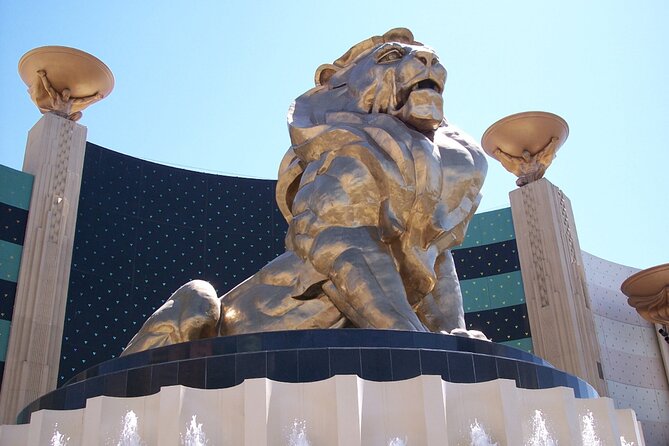
You start by admiring Leo the Lion, the huge golden bronze sculpture by the MGM Grand. It’s 45 feet tall and weighs about 50 tons—so yeah, you’ll notice it before you even mean to.
The audio story connects that statue to the MGM logo: Leo roared from MGM film openings from 1957 until 2021. The logo may be CGI now, but it keeps Leo’s iconic look and that famous roar, which is a neat reminder that Vegas branding often comes from Hollywood.
This stop is also a great warm-up. You get your bearings for the route and start hearing the tone of the tour—short, story-driven, and focused on what you’re seeing right in front of you.
The Las Vegas Strip fact check: Paradise, not the city
Then the tour pivots into orientation. You’ll hear the surprising detail that the Strip isn’t technically in Las Vegas—it’s in an unincorporated area called Paradise.
The story explains that this land stayed unincorporated until 1950. It’s the kind of detail that helps you understand why the Strip feels like its own place, almost like a separate world layered beside the real city.
Even if you already knew it, it’s worth paying attention while you’re walking. It changes how you think about everything else you’re passing.
MGM Grand’s scale: how big “grand” really is
From there, you’ll roll past the MGM Grand casino and hear what “grand” meant during its modern-era reopening. The casino debuted its new location in 1993, during a boom of development on the Strip.
You also get the hotel size perspective: the MGM Grand has 6,852 rooms, listed as the third largest in the world. It’s a useful fact because it explains why you can feel like you’re in a small city when you’re near the property.
Planet Hollywood and the Aladdin site: the Strip remixes itself
Next comes Planet Hollywood Resort and Casino, in operation since 2007. The story also notes this location used to be the Aladdin casino, running from 1966 until 1997.
This is the Strip’s pattern in miniature: buildings and brands cycle, but the foot traffic keeps flowing. If you listen closely, the tour helps you see that Vegas is constantly rewriting the same space.
Paris Las Vegas: a themed Europe with a Hollywood origin story
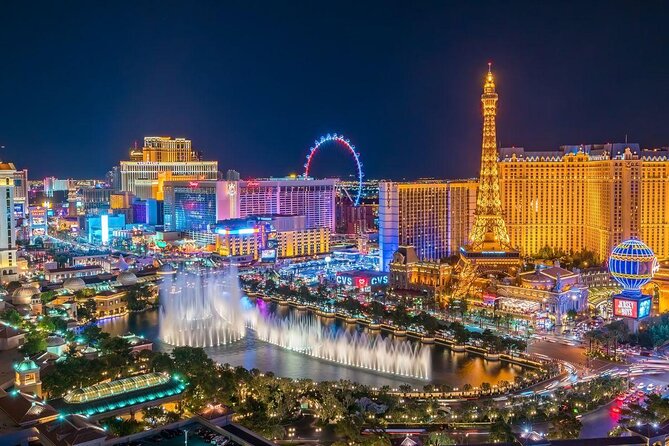
At Paris, Las Vegas, you’ll see replicas like the Eiffel Tower, Arc de Triomphe, and La Fontaine des Mers. The audio ties the design to a mashup of ideas from major Paris landmarks, and it even includes a creative origin note tied to French cinema icon Catherine Deneuve.
Paris opened in 1999, and the story frames it as a deliberate pop-culture take on Europe. When you’re standing there, it makes the façade feel less random and more like a carefully engineered illusion.
Horseshoe Las Vegas: a rebrand with older roots
You’ll pass Horseshoe Las Vegas, a newer opening (2023) on a site that held multiple identities before. The audio explains the name honors Binion’s Horseshoe on Fremont Street, known as Glitter Gulch, and connects the legacy to Benny Binion.
This stop is a reminder that the Strip isn’t only about new construction. It’s also about branding continuity—Vegas often recycles the same symbols in fresh packaging.
Flamingo: the oldest continuously operating resort
One of the most interesting stops is Flamingo Hotel and Casino. It opened in 1946 and is described as the oldest continuously operating resort on the Strip.
The story points out the Art Deco design influence (tied to Miami Beach) and gives a flavor of the era when the Flamingo set a model for high-end Vegas. Even small details like the dealer dress code and requests about removing hats in the casino help you picture what “classic Vegas” used to feel like.
This is where the tour does its best job making the buildings more than backdrops. You’ll actually understand why people talk about “then and now.”
Harrah’s: a long-running Strip fixture
Then you’ll move by Harrah’s Las Vegas, located on the Strip since 1992. The audio notes that before that, the site held the Holiday Inn and Casino, including the historical point that it was one of the few casinos run by a woman.
It’s a compact story, but it adds depth to a modern property. You start seeing these spots as chapters, not just storefronts.
Venetian and The Mirage: Sinatra-era nostalgia to Wynn-era reinvention
The tour continues with the Venetian, noting it was previously the Sand Resort. It also drops the Rat Pack connection, mentioning Frank Sinatra as a favorite.
Then you’ll reach The Mirage, tied to Steve Wynn’s era of shaping the modern Strip. The story includes the funding twist: Michael Milken was involved in financing construction, then was indicted on 98 counts of racketeering and securities fraud shortly before opening.
It also includes Steve Wynn crediting Milken for changing things, even with the legal mess. That contrast is very Vegas: big dreams, big names, and messy real life.
Caesars Palace: the Teamsters connection
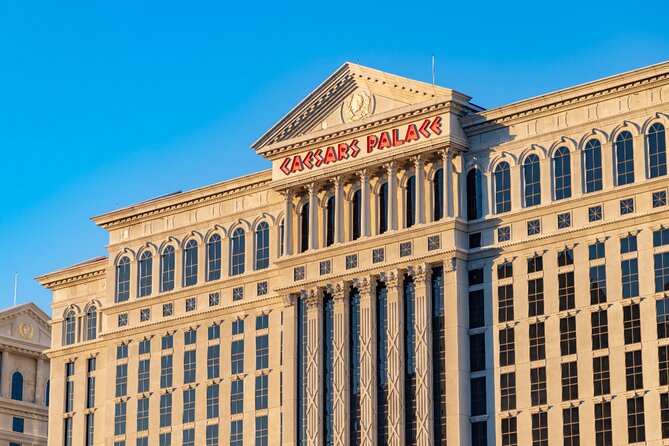
At Caesars Palace, you get the long timeline since 1966. The audio also mentions the grand opening featured Jimmy Hoffa, described as president of the Teamsters, and that Hoffa helped fund the resort.
This is another stop where the tour adds useful context. You’re not just looking at columns and fountains—you’re seeing how money and power shaped the destination.
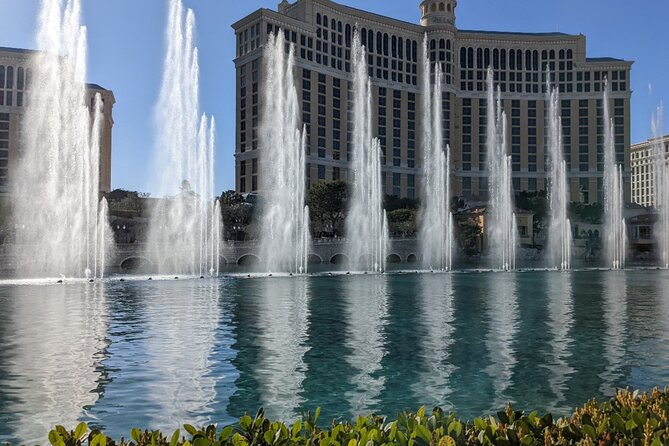
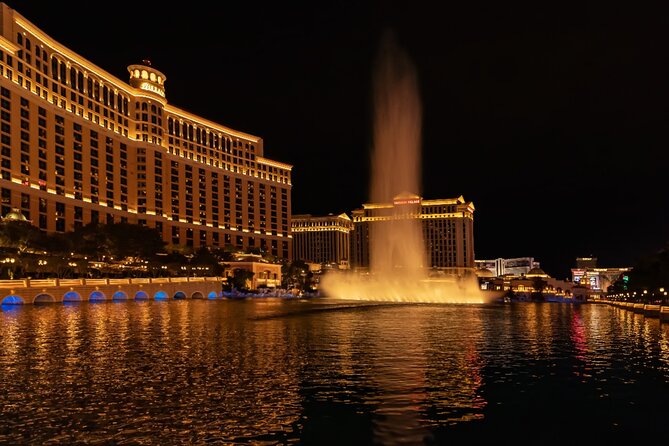
Bellagio: how a Lake Como vacation turned into an icon
Next is Bellagio, which opened in 1998. The story explains the name comes from a village on Lake Como in northern Italy.
It also tells you that Wynn initially proposed building a 50-acre lake on the property, with an island in the middle and a French-Alpine themed resort. A vacation to Lake Como shifted the idea, and Beau Rivage became Bellagio.
If you’re a visual person, this stop is where listening while watching really pays off. You can connect the landscaping and overall vibe to the story behind the concept.
ARIA and CityCenter: the tech-forward side of the Strip
At ARIA Resort and Casino, the audio focuses on automation and high-tech touches. It says hotel rooms respond when you enter—curtains open, TV and lights turn on, music plays, and climate controls start—without you touching switches.
It also describes how the room shuts itself down when a guest leaves to conserve power. In a city known for older glamour, this feels like a different kind of Vegas pitch.
You’ll also pass CityCenter, often called the ARIA Campus, which includes multiple hotels, condominiums, and major shopping areas like The Shops at Crystals. This stop is good for understanding the “mixed-use” direction Vegas went in recent decades.
Park MGM and the smoke-free promise
You’ll then see Park MGM, described as the only totally smoke-free casino on the Strip. The tour frames it as a bigger and more modern MGM resort, with less history than the MGM Grand.
It’s a practical detail if smoke is an issue for you. Knowing this early helps you plan which casinos you’ll actually want to spend time inside.
New York-New York: copycat landmarks and a real-world scandal
Next is New York-New York, with façades designed to mimic Manhattan highpoints. The audio lists many elements in the replica skyline view and includes extra detail about fiberglass replicas linked to NYC landmarks.
It also mentions a major stamp scandal back in 2010, tying the story to something that went wrong beyond design.
This stop is perfect for a “look and listen” moment. You’ll see why the property got attention, and you’ll also understand that themed places aren’t just entertainment—they can become real-life news.
Excalibur, Luxor, and Mandalay Bay: the themed final stretch
The tour closes with classic fantasy and ancient-styled Las Vegas.
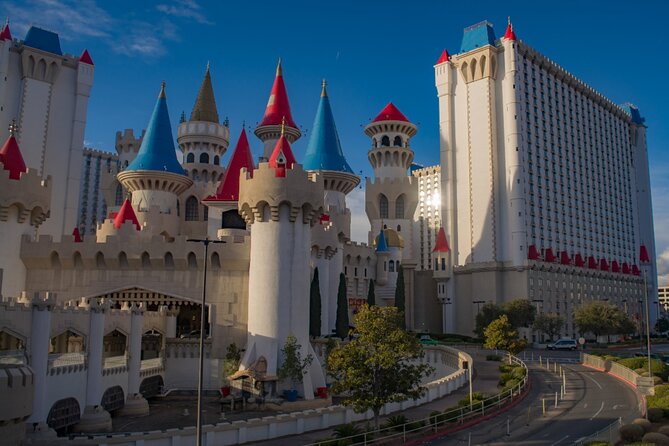
You’ll pass Excalibur, with its cartoonish castle façade inspired by King Arthur’s sword. The audio adds a note about rumors of it being torn down in recent years, though it confirms it’s still there.
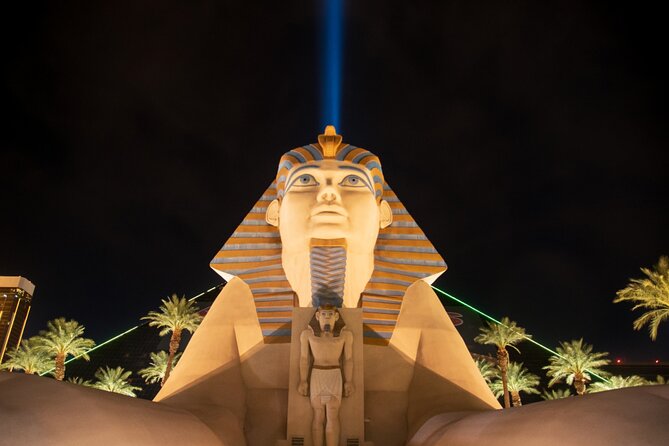
Then comes Luxor, named for an ancient Egyptian city. The big standout mentioned is the Luxor Sky Beam, which shoots from the pyramid peak and can be seen across the Las Vegas Valley.
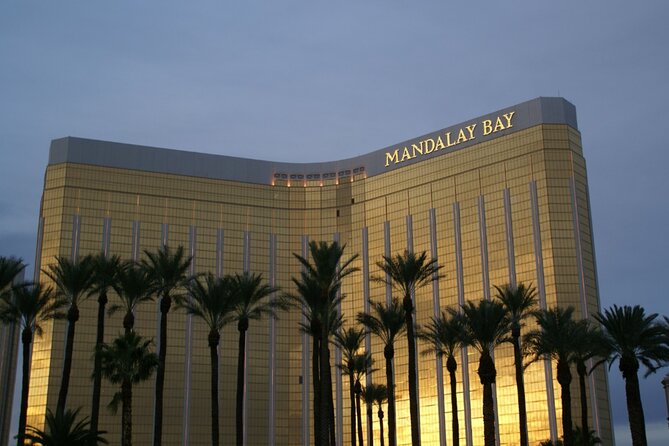
Finally, you’ll reach Mandalay Bay. The audio notes that Mandalay is the second largest city in Myanmar, located on the Irrawaddy River, and it’s hundreds of miles from the nearest bay—yet the resort still uses the name Mandalay Bay. The story gives you the origin logic so the name doesn’t feel random.
Headphones, audio quirks, and how to handle it when weather hits
The tour works best with headphones/earbuds. If you’ve ever tried to listen to audio in a noisy place without them, you already know the difference it makes.
Audio can also get finicky if you start away from the intended route. If you ignore the starting location and begin where you’re staying, you may end up reading text instead of listening, because story triggers may not line up with where you are.
Weather doesn’t fully stop the plan. Even in rainy conditions, there are chances to duck into nearby casino entrances and keep moving at your own speed—another reason the self-guided format is handy.
Who should book this Strip audio tour (and who might skip it)
This tour is a strong fit if you want flexibility more than a guided lecture. I’d recommend it to couples, solo walkers, and anyone who likes learning while moving but doesn’t want to be stuck on a set schedule.
It’s also a good choice if you hate dependence on mobile data. Offline maps plus offline story audio means you can wander without sweating your signal.
I’d hesitate if you’re expecting a lot of deep “secret investigation” style content. The format is more about sight-to-story connections—what you see, why it matters, and quick context you can digest while walking.
Should you book this Las Vegas Strip self-guided audio tour?
Book it if you want a low-cost, lifetime-access way to understand the Strip while you walk. The offline maps, automatic story playback, and 4+ mile route make it a practical alternative to a bus tour, especially if you like stopping for photos and taking breaks.
Skip it if you prefer a traditional guide who can answer questions in real time, or if you’re worried about phone GPS working perfectly. In that case, you might prefer a guided walking option instead.
FAQ
FAQ
How much does the Las Vegas Strip self-guided walking audio tour cost?
The tour is priced at $14.99 per person.
How long does the tour take?
It takes about 1 to 2 hours to complete, and the route is over 4 miles with more than 35 audio stories.
Does it work offline?
Yes. You download maps so you can navigate offline, and the tour is designed to work without cellular or Wi‑Fi after download.
What app do I need to use?
You use Action’s Tour Guide App, which you download separately from the booking information.
How do I start the tour once I arrive?
Open the Action’s Tour Guide App onsite, launch the correct tour version if needed, then go to the first story point. The audio begins automatically at that location.
Do I need data or Wi‑Fi during the walk?
You should not rely on data during the walk. The instructions say you must download the tour while in strong Wi‑Fi/cellular, and it works offline afterward.
Where is the meeting point?
Start at Tropicana Las Vegas – a DoubleTree by Hilton Hotel at 3801 Las Vegas Blvd S, Las Vegas, NV 89109. The tour ends back at the meeting point.
What language is the tour offered in?
The tour is offered in English.
Can I cancel and get a refund?
Yes. You can cancel for a full refund if you cancel at least 24 hours before the experience’s start time. If you cancel within 24 hours, the amount paid is not refunded.