REVIEW · GLASGOW
Glasgow Private Self-Guided Tour
Book on Viator →Operated by Pandemic Tours · Bookable on Viator
Murals and medieval stone meet on one walk. This Glasgow private self-guided tour strings together Cathedral history, big cemetery views, and street art, all explained by Alex through an audio guide. The route is built for your pace: you can linger at the places that catch your eye and move on when you’re ready.
I especially like two things: the mural focus (including Smug’s work and St Enoch details) and the way the audio turns plain landmarks into stories you can picture. The stops are spread across the city center, so you’re not hunting around blindly with a single “must-see” photo in mind.
One drawback to plan for: you’re guiding yourself with an app, so the phone needs to behave. If the app navigation or audio feels glitchy, you’ll have to pause, check the map, and restart the moment you’re at.
In This Review
- Key highlights you’ll actually use
- How the self-guided format fits Glasgow’s streets
- Start at Glasgow Cathedral and time-travel for 800 years
- Necropolis: Glasgow’s cemetery that feels like an outdoor viewpoint
- Provand’s Lordship (and the many jobs of one old building)
- Glasgow murals: the city explains itself on walls
- Strathclyde University and the art-friendly architecture around it
- St Enoch cradling St Mungo: a mural you should pause for
- Tron Theatre area: St Thenew’s Gait and the Enoch connection
- Glasgow’s police history museum: civic power, 1800 to 1975
- Merchant City stops: Mercury, City Chambers, George Square
- A gallery and a Mackintosh-inspired tea break
- Buchanan Street to The Lighthouse: finishing near St Enoch
- Price and real-world value for money
- Practical tips so the phone doesn’t ruin your day
- Should you book the Glasgow Private Self-Guided Tour?
- FAQ
- How long is the Glasgow Private Self-Guided Tour?
- What is the price for this tour?
- What’s included with the tour purchase?
- Do I need a live guide?
- Who provides the audio guide?
- Where do I start and where does it end?
- Do I need the Pandemic Tours app, and how long do I get access?
- Can I get a refund if I cancel?
- Are service animals allowed?
Key highlights you’ll actually use
- Audio by Alex with real human narration to keep you oriented without a live guide
- A mural trail built around Glasgow street art, including Smug works and St Enoch themed art
- Landmarks with scale like the Necropolis stretching 37 acres (about 15 soccer fields)
- A clean city-center route that starts at Glasgow Cathedral and ends near St Enoch Subway Station
- Many stops with Admission Ticket Free listings, which helps value for money
How the self-guided format fits Glasgow’s streets
This is a private, self-guided walk, meaning your group does it on its own schedule—no waiting for a tour group to gather. The “guide” is Alex, delivered through an audio track (not a robotic computer voice), plus maps, directions, GPS route, and supporting images and videos inside the Pandemic Tours app.
In practice, this matters for Glasgow because the best parts are often the bits between the big buildings: gable ends with murals, alley views, and the way one street leads you into the next story. With this tour, you don’t have to constantly decide what’s next. You can also slow down when you want photos—especially with the mural stops, where the details are the point.
The other big factor is time. The tour is listed as about 2 to 3 hours, but it’s clearly designed for city walking and stopping. One of the nicest things about a self-guided city loop is that you can take longer without feeling like you’re “behind.” If you enjoy drifting, plan to stretch it.
You can also read our reviews of more tours and experiences in Glasgow.

Start at Glasgow Cathedral and time-travel for 800 years
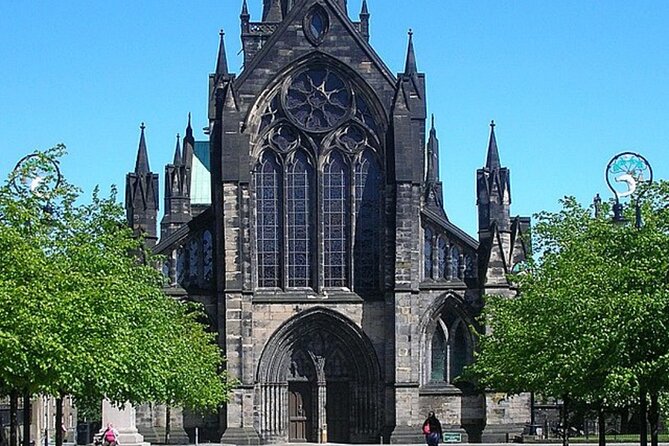
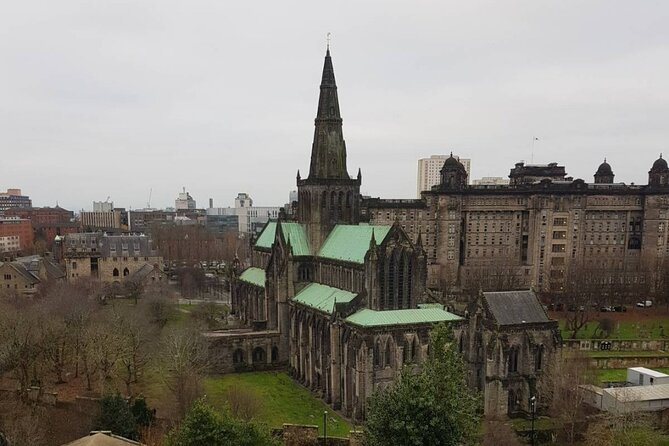
Your walk begins at Glasgow Cathedral on Castle Street. This cathedral story is both dramatic and surprisingly steady. After an earlier cathedral was destroyed by fire just after it was built in 1136, the version you can experience dates to 1197. The key line here is that worship has continued inside these walls for more than 800 years, and that continuity changes how you read the stone around you.
Set aside around 30 minutes here. Even if you’re not a history fanatic, you’ll appreciate the rhythm: stand back to take in the overall shape, then look closer for the emblems and details Alex points out in the audio. The tour also frames the cathedral as one of Glasgow’s emblems—useful if you’re trying to understand what locals mean when they talk about “identity” in this city.
Also note the practical win: the cathedral stop is listed as Admission Ticket Free. That doesn’t mean every stop is free, but it does help you start strong without committing to a ticket.
Necropolis: Glasgow’s cemetery that feels like an outdoor viewpoint
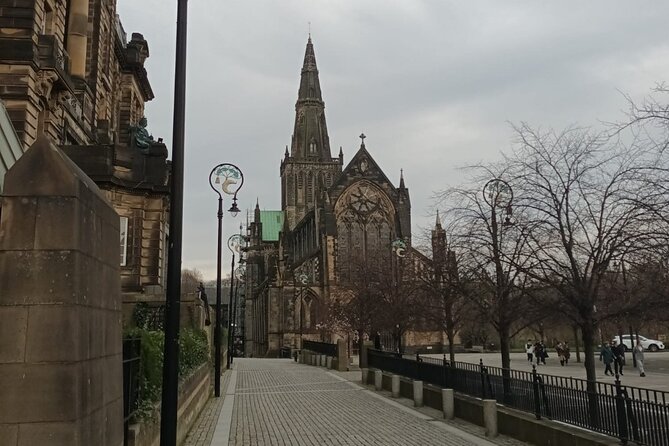
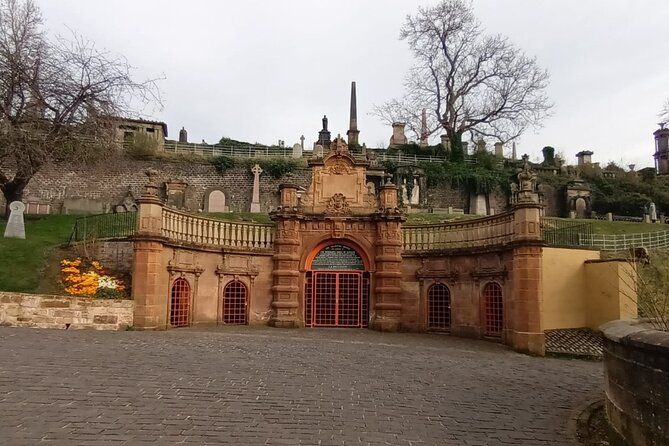
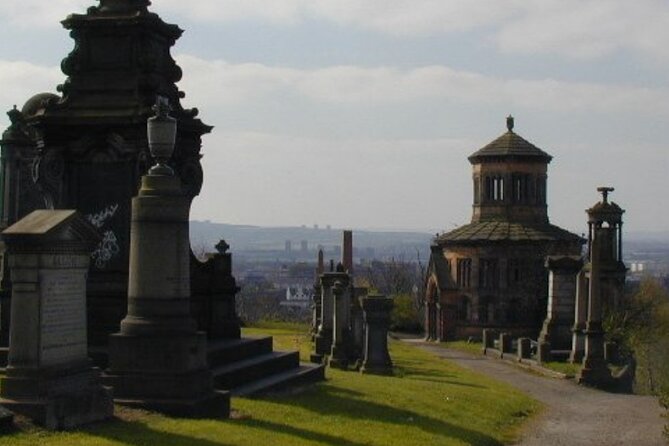
Next you head to The Glasgow Necropolis, Glasgow’s most famous graveyard. It was established in 1831, taking cues from Père Lachaise in Paris, but the vibe is unmistakably Glasgow—confident, grand, and built to impress.
Alex has you think about why it was made that way. In the early 1800s, wealthy Glaswegians wanted to present themselves properly even after death. That attitude shapes the entire layout. It’s not just “a cemetery you walk through.” It’s an enormous project spread across 37 acres—about the size of 15 soccer fields or roughly 150,000 m².
The tour gives you about 15 minutes. You’ll likely want more if you like viewpoints, stonework, and slow reading of places. Even in 15 minutes, you can get the main idea: scale, setting, and why people were drawn to burial here after it became the fashionable alternative to older sites.
Provand’s Lordship (and the many jobs of one old building)
One stop in this route takes you to a stone building often called Provand’s Lordship—formerly known as the Hospital of St Nicholas. The history here has layers: the earliest background is described as going back to the fifteenth century, but the first official record is from 1626. Over time, the building served many roles: town clerk’s office, justice court, town council offices, and even a jail at the top level for security reasons.
What I like about putting this kind of building on a self-guided route is that it rewards your pace. You’re not rushed. You can stand and look at how a place changes in meaning as the years pile up. And you can also connect it to the rest of the walk, because Glasgow in this area isn’t a single “theme.” It’s civic power, justice, faith, commerce—stacked on top of each other.
If you’re used to tours that point and move, this stop is a nice break. It’s also a reminder that “heritage” isn’t always a museum—it can be a structure that once did everyday jobs for the city.
Glasgow murals: the city explains itself on walls
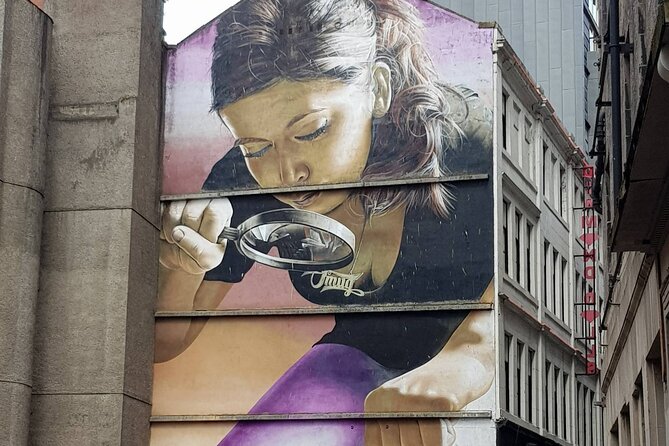
Glasgow is known for murals, and this tour uses that fact as a guiding principle. Instead of treating street art as random decoration, the audio frames the mural wave as a response to neglected walls and gable ends, and also as an attempt to change perceptions about street art.
That’s more useful than it sounds. When you understand the why behind the art, you start noticing things you’d otherwise ignore: composition, themes, community cues, and how a mural fits the building it lives on.
You’ll see murals in multiple parts of the route, not just in one “street art zone.” In this city, that’s the advantage of doing it self-guided. Your eyes adjust as you go, and you learn how the murals “talk” to the streets around them.
Strathclyde University and the art-friendly architecture around it
The next highlighted stop is University of Strathclyde. The tour notes it as one of Glasgow’s three major universities. It’s a practical stop too: this is where the scenery starts mixing older civic character with more modern institutional architecture.
You get around 15 minutes, so treat it like a walk-through moment rather than a full campus visit. Look for architecture details that make photos interesting, but also listen to what Alex points out—because this stop is included as part of the mural-and-city-story thread.
This is where the tour’s design starts making sense. It’s not only about famous sites. It’s about how Glasgow’s institutions sit inside everyday streets, and how art shows up near where people study and work.
St Enoch cradling St Mungo: a mural you should pause for
At a shorter 5-minute stop, you’ll find the St Enoch cradling St Mungo mural. The key detail is emotional and unusual: it shows a mother lovingly cradling a baby, and it’s described as a futuristic representation of St. Mungo.
Because the stop is brief, you’ll want to do two things fast:
1) Get your bearings quickly (stand far enough back to take in the whole work)
2) Then move closer for the specifics Alex highlights
This is one of those murals where you’ll feel the “story” more than the technique. The point isn’t just that it looks good. It’s that the art ties religious history to Glasgow’s own streets in a way that feels current.
Tron Theatre area: St Thenew’s Gait and the Enoch connection
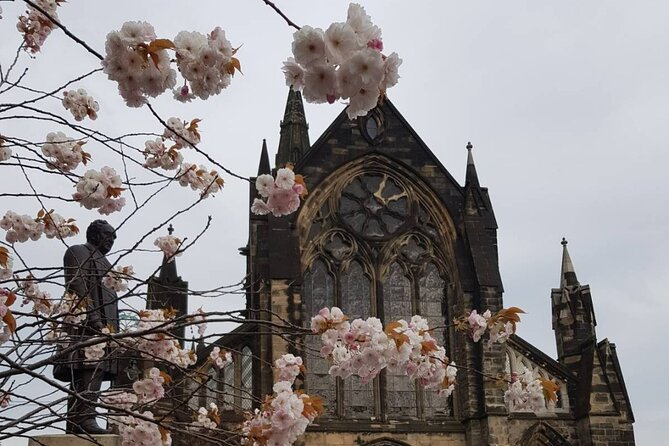
The route then leans into word history and local geography with the area around Tron church, which today is Tron Theatre, and the street called Trongate.
Here’s the connection Alex emphasizes: Tron church sits along a route originally known as Saint Thenew’s Gait, tied to the supposed site of Thenew’s burial. Thenew is connected to Saint Enoch, who is described as the mother of Saint Mungo.
Why does this matter? Because it shows you how Glasgow keeps its history in place names and street logic. You don’t need to be religious to enjoy it. You just need to pay attention to how stories stick to cities.
Glasgow’s police history museum: civic power, 1800 to 1975
Another stop is devoted to a museum that tells the story of the first police force in Great Britain. The audio frames the span from 1800 to 1975, focusing on how the force was founded, developed, and shaped by people and events.
This one is valuable if you like learning how cities work when you’re not just looking at buildings. It turns “the police” from a background fact into a civic story with time markers.
The tour doesn’t list a specific ticket time here, but plan for a short indoor break if you want the full context. If you’re sensitive to museum-style pacing, you might skim—this stop is more about the big picture than deep paperwork.
Merchant City stops: Mercury, City Chambers, George Square
As the route moves through the Merchant City area, it layers in symbolism and formal civic landmarks.
You’ll hit 98 Ingram St, tied to the Ramshorn cemetery story. The church originally built there dates to 1824, designed by English architect Thomas Rickman in the gothic revival style. On the graveyard, you’ll find graves of tobacco merchants Andrew Buchanan and John Glassford. The audio also notes that the older Ramshorn cemetery (now partly covered by Ingram Street) was considered the more expensive burial place before the Necropolis became the new fashionable option.
Then comes a very “Glasgow” kind of sculpture stop: a statue of Mercury, the Roman god linked with financial gain, commerce, eloquence, poetry, travellers, boundaries, luck, trickery, and thieves. Mercury stands on a marble plinth and is one of two Mercury sculptures by Alexander Sandy Stoddart, representing the Italian quarter of Merchant City.
If you want a smooth photo moment, do it in order:
- First photo from a distance that shows the plinth in context
- Then a second close-up for the details Alex points out
After that, you’ll pass major civic architecture:
- Glasgow City Chambers, completed in 1888 and inaugurated by Queen Victoria (there’s a statue of her at the opposite end of George Square)
- George Square, named after King George III, laid out as early as 1781 in a Georgian-style grid plan, then developed about 20 years later
These are the stops that make the city feel “official.” They help you connect murals and street art back to the older power structures that shaped the streets you’re walking today.
A gallery and a Mackintosh-inspired tea break
The route includes what’s described as a must-visit gallery, plus a separate establishment from 1983 with interiors inspired by Charles Rennie Mackintosh. The tea room itself is described as modeled on Kate Cranston’s Ingram Street tea rooms from the early 1900s.
This is one of the best “value” moments in the walk because it’s optional in the right way. You can keep walking, or you can take a proper break and turn the tour into something that feels like a day, not a checklist.
If you like architecture, this is a solid stop even without going super deep. If you like tea breaks, even better. Either way, it gives your legs a reset before you head toward the more modern shopping-and-streetscape zone.
Buchanan Street to The Lighthouse: finishing near St Enoch
The tour shifts into a more modern Glasgow feel at Buchanan Street. The audio frames the route as a time run: from the medieval Cathedral, to tobacco merchants, to the shenanigans of the 1990s, and now to today’s center.
From there you pass The Lighthouse, described as a visitor centre, exhibition space, and event venue in the heart of Glasgow. Even if you don’t step inside, it’s a good waypoint to break up the walk and orient yourself for the last stretch.
The final big mural moment is another Smug work: Honey, I shrunk the Kids, described as photo-realistic street art. Since it’s the last mural listed, give yourself the energy to look carefully. This is where Glasgow street art hits its strongest “wow” factor on the route.
The tour ends close to St Enoch Subway Station, which the description connects to the Roman Fort area, bringing you back to a transportation hub that makes it easy to leave and keep exploring.
Price and real-world value for money
At $12.37 per person, this tour is built for budget travelers who still want depth. The reason it’s good value isn’t just that it’s cheap—it’s that you’re buying structure.
You get:
- 3 weeks unlimited access to the tour in the app
- Maps, directions, GPS route, and stop-by-stop content
- Audio guidance by Alex, using human narration
- Photos/videos and recommendations tied to the route
That “unlimited access” part is quietly helpful. If you stop and go slowly, you can replay segments without paying again. If you get interrupted, you can restart and keep moving.
One more value angle: many of the listed stops are Admission Ticket Free, including the Cathedral and Necropolis. Just keep in mind the overall experience notes that any entrance fees are not included, so always check any places that might charge once you’re standing at the door.
Practical tips so the phone doesn’t ruin your day
- Charge your phone first. You’re walking, using GPS, and relying on audio.
- Bring earbuds or keep speaker volume ready. If audio feels low, you’ll lose the point of having Alex’s narration.
- Plan for a little extra time. The tour is listed 2 to 3 hours, but if you stop for photos, tea, or extra mural watching, it can stretch.
- Wear walking shoes. This is a city-center route with multiple stops, including large cemetery terrain.
- Start early enough for daylight photos. Murals look better with clear light, and Necropolis viewpoints are more rewarding when you can see details.
Should you book the Glasgow Private Self-Guided Tour?
Yes, if you want a Glasgow walk that mixes big historic landmarks with street art you can actually look at, not just glance at while someone talks over you. This works especially well for couples, solo travelers, and anyone who likes controlling their own pace.
I wouldn’t pick it as your first Glasgow activity if you need constant human Q&A or if you know your phone-based navigation tends to frustrate you. In that case, you might find the app format harder than it sounds on paper.
If you can manage your phone battery and you enjoy planning your own pace, this is a strong way to get oriented fast—Cathedral to Necropolis to murals to modern Glasgow, all in one connected loop that ends where you can easily move on.
FAQ
How long is the Glasgow Private Self-Guided Tour?
It’s listed as about 2 to 3 hours.
What is the price for this tour?
The price is $12.37 per person.
What’s included with the tour purchase?
You get 3 weeks unlimited access in the Pandemic Tours app, plus maps, directions, GPS route and stops, and an audio guide with videos, pictures, and recommendations.
Do I need a live guide?
No. It’s a self-guided audio tour. Alex provides the guidance through the app.
Who provides the audio guide?
The audio guide is described as being guided by Alex, and it uses a non–computer-generated voice.
Where do I start and where does it end?
Start: Glasgow Cathedral, Castle St, Glasgow G4 0QZ.
End: St. Enoch, Glasgow G1 4BW (near the Roman Fort).
Do I need the Pandemic Tours app, and how long do I get access?
Yes. You must download the Pandemic Tours app once your booking is confirmed, and you get 3 weeks of unlimited access to the tour in the app.
Can I get a refund if I cancel?
No. This experience is non-refundable and cannot be changed for any reason.
Are service animals allowed?
Yes, service animals are allowed.