REVIEW · TOULOUSE
Toulouse: City Sightseeing Tour by Bus with Audio Guide
Book on GetYourGuide →Operated by Toulouse Welcome - CityTour · Bookable on GetYourGuide
Toulouse looks different from a bus window. In about an hour, you get open-top views of the Ville Rose, plus an audio guide in 8 languages that explains what you’re seeing as you pass the big names of central Toulouse. I like that it’s built for short stays: you cover a lot without spending hours getting lost in side streets.
One thing to keep in mind: the narration isn’t always perfectly matched to the view outside the window, so you may want to glance twice when a stop is coming up.
If you’re using Toulouse as a base for food, architecture, and canal walks, this kind of quick circuit is the fast lane. The starting point is right by the Capitole, so you can hop off and start exploring immediately.
In This Review
- Key things I’d watch for
- Where you board: Toulouse Welcome at Rue du Poids de l’Huile, by the Capitole
- The open-top ride: Ville Rose views without the walking tax
- Saint-Étienne Cathedral and Saint-Sernin Basilica: the landmarks you can place on a map
- Hôtel d’Assézat and the Bemberg Foundation: architecture you can recognize later
- Along the Garonne and Canal du Midi: why Toulouse matters between oceans
- Audio guide and language options: how to get clear value from the narration
- Timing and what you should do after the 75 minutes
- Value for $19: when this bus tour makes sense
- Who should book this Toulouse CityTour bus
- Should you book the Toulouse Welcome CityTour by bus?
- FAQ
- How long is the Toulouse CitySightseeing bus tour?
- Where do I meet the bus?
- What languages are available for the audio guide?
- Is there a live guide or is it only audio?
- Is the bus open-top?
- Are there any rules during the tour?
- What’s the minimum number of passengers for the tour to run?
- Can I get a refund if plans change?
- Check-in times vary?
Key things I’d watch for
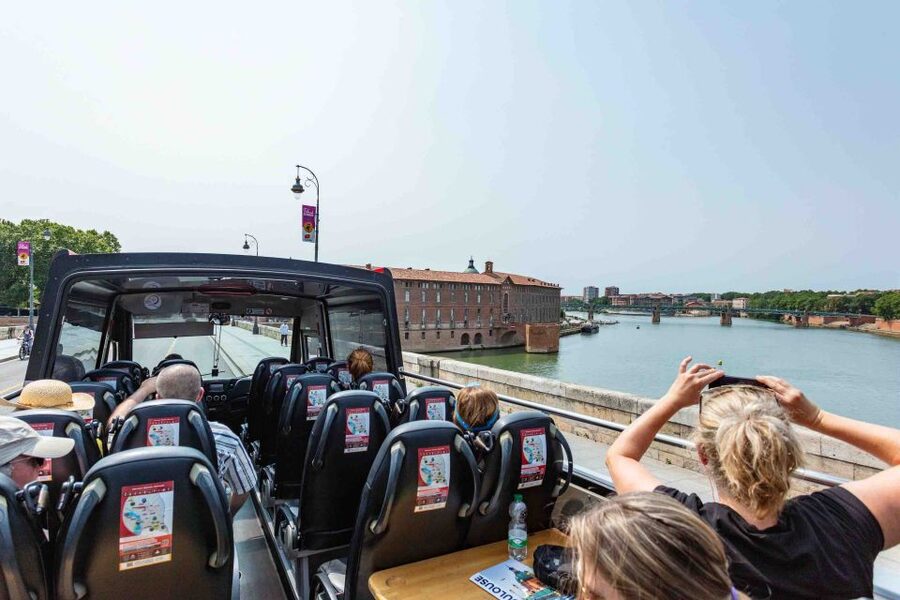
- Open-top minibus route that fits into a tight schedule, without the stress of navigating
- Cathedral Saint-Étienne de Toulouse and Basilica of Saint-Sernin highlighted as core landmarks
- Pink terracotta Ville Rose moments, especially as you move through older streets
- Hôtel d’Assézat and the Bemberg Foundation façade for art-and-architecture fans
- River Garonne and the Canal du Midi connection to understand Toulouse’s waterways
- Audio quality varies by moment, so keep your eyes on landmarks as the story plays
Where you board: Toulouse Welcome at Rue du Poids de l’Huile, by the Capitole
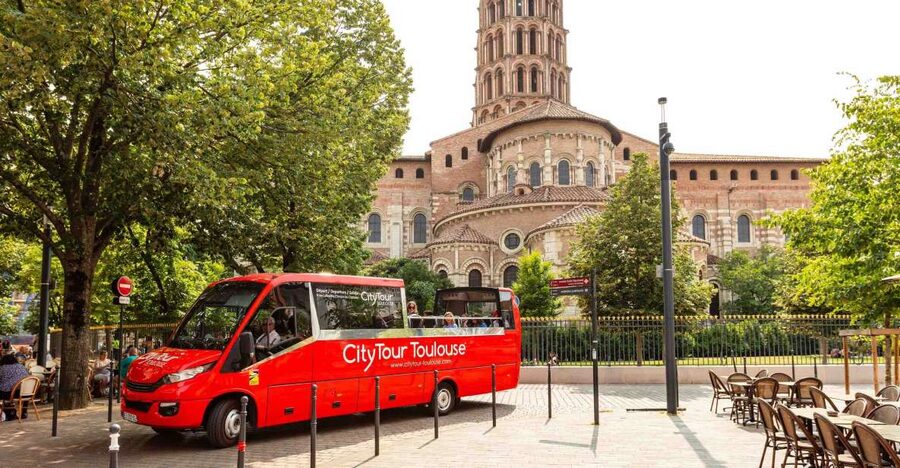
I like tours that start where you already want to be. This one launches at 2 rue du Poids de l’Huile, close to the Donjon du Capitole. The bus departs from the corner of Rue du Poids de l’Huile and Rue de la Pomme, directly opposite the Capitole building. That location matters because it means you’re not commuting across town before you even start sightseeing.
If you’re arriving on foot, use the Capitole area as your anchor. It’s easy to spot, and the meetup point is close enough that you won’t lose time doing detective work. Also, the tour runs with a minimum of 4 passengers, so you’re less likely to have the awkward wait that sometimes happens with tiny-group tours.
You can also read our reviews of more tours and experiences in Toulouse.


The open-top ride: Ville Rose views without the walking tax
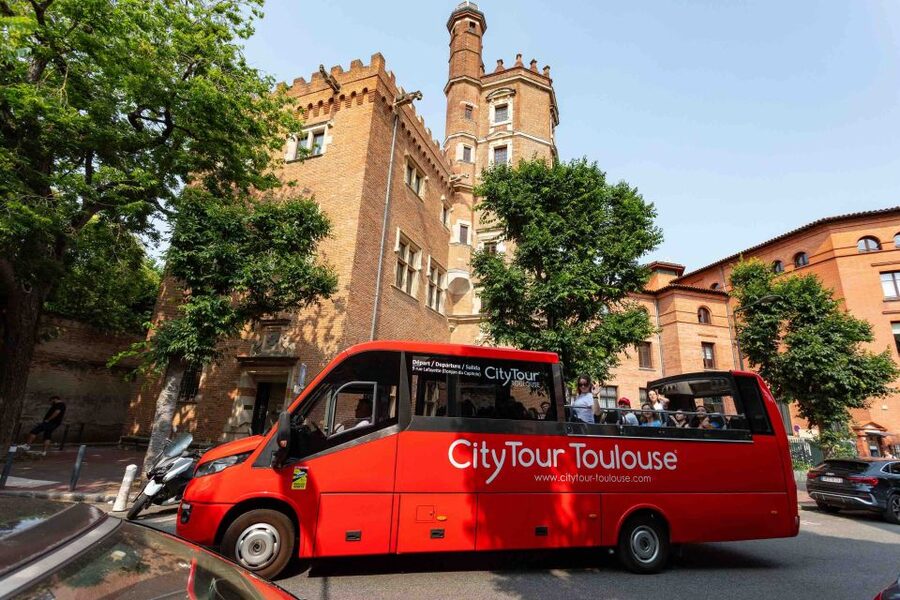
The heart of this experience is simple: you cruise Toulouse in an open-topped minibus through streets and alleyways, with the comfort of staying seated. For me, the value isn’t just the novelty of being up high. It’s the way the bus glides through areas you might not choose if you were walking randomly.
You’ll see the look that makes Toulouse famous: the pink terracotta bricks that give the city its Ville Rose identity. From the road, that color reads differently than it does on postcards. It pops in daylight, and even on cloudy days you still get that warm, slightly rose-toned glow along building fronts.
One practical note: the tour is designed as a stay-on-the-bus circuit (there’s no hop-on setup mentioned here), so don’t plan to treat it like a pick-your-own adventure. Treat it like a guided “get your bearings fast” loop. People also note the ride is comfortable, and there are comments about a retractable roof that helps when weather shifts. Even if the day is sunny when you leave your hotel, it’s worth keeping a light layer for the ride.
Saint-Étienne Cathedral and Saint-Sernin Basilica: the landmarks you can place on a map
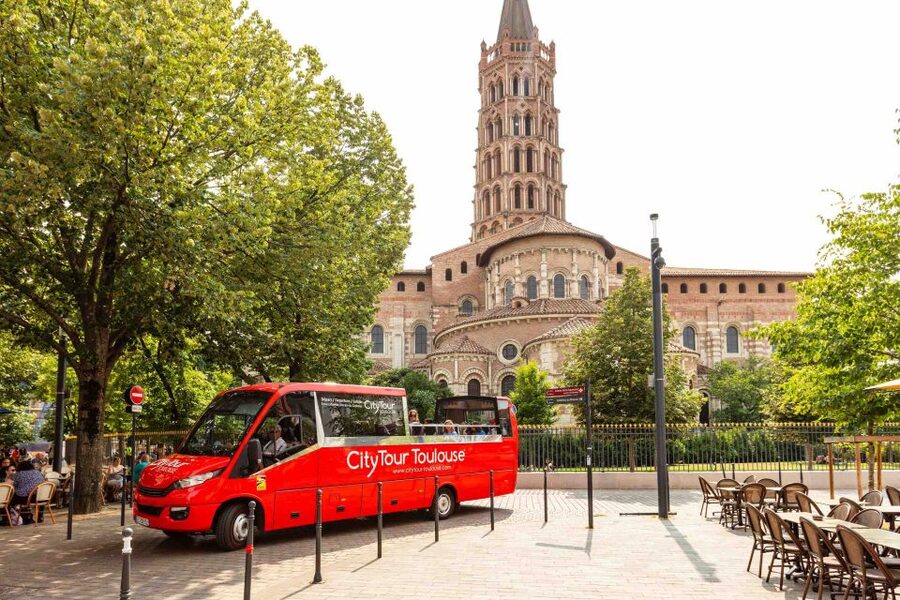
The tour focuses on Toulouse’s best-known churches, and it does it in a way that’s useful later. You pass the Cathédrale Saint-Étienne de Toulouse and the Basilica of Saint-Sernin—two buildings that can feel overwhelming if you’re trying to locate them while also learning the city.
From the bus, you’re not just seeing a silhouette. You’re getting context for how these sites sit within the older street grid. That helps you return on your own with a clearer sense of direction: you start to understand which streets lead toward the cathedral zone and how the basilica area relates to the surrounding neighborhood.
Here’s what I’d do if you want the most out of this church section:
- Keep your phone away and actually look at the building during the audio segment.
- When the narration points something out, note the street direction you’re facing, not just the name of the monument.
- After the tour, use those cues to guide your walking route.
Even if you don’t step inside during this hour, you’ll learn where to aim your time if you want to go deeper later.
Hôtel d’Assézat and the Bemberg Foundation: architecture you can recognize later
One of the most satisfying parts of a short tour is when you learn a detail you can spot later without help. This is where the Renaissance façade of the Hôtel d’Assézat comes in. You pass it while the audio points you toward the Bemberg Foundation, known for its collection of 19th- and 20th-century French paintings.
Why this matters: façades are like Toulouse’s visual shorthand. Once you’ve seen the distinctive frontage from the road, you’ll be better at picking it out on a return walk. If you’re the type who likes to connect art to architecture, this stop is a win because it links what you can see outside to what’s inside the foundation.
A small practical caution: the bus moves at city traffic speed. You may not catch every ornament at once. Use the audio as your cue, then look again when the vehicle slows or turns. You’re not trying to photograph everything. You’re training your eyes.
Along the Garonne and Canal du Midi: why Toulouse matters between oceans
Toulouse isn’t only about churches and brick facades. The tour also steers you toward the banks of the River Garonne and the Canal du Midi, with the story that ties the Atlantic Ocean and Mediterranean Sea together through this waterway connection.
This is one of those details that makes a city feel bigger than its streets. When you understand Toulouse’s canal link, the city stops being just a pretty stop and starts feeling like a historical crossroads—built on movement, trade, and travel routes.
From the bus, you’ll get that “Toulouse isn’t only medieval” feeling. You’ll also notice how the pink brick look changes as you approach river-and-canal zones. The materials, the setting, and the way buildings meet open space all shift. That contrast helps you decide what kind of walk you want next.
If you like practical sightseeing, this is also a good mental bookmark. After the hour is done, you’ll know which direction points you toward water and which areas feel more church-and-old-town centered.
Audio guide and language options: how to get clear value from the narration
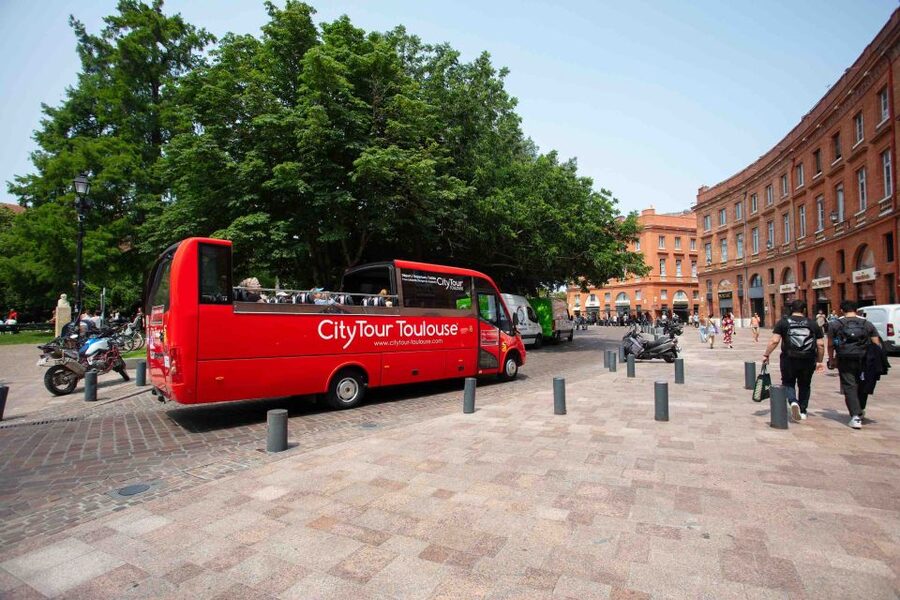
The audio guide is a big part of why this tour works for short stays. You can listen in Chinese, English, French, German, Italian, Japanese, Russian, and Spanish. There’s also a live tour guide in English, French, German, Italian, Spanish, and Traditional Chinese.
In practice, that means you should be able to pick a language you’re comfortable with. Reviews commonly praise the audio quality and the fact that narration is easy to follow. Some people even mention a playful tone from the English voice, which helps keep your attention during a city loop.
Now, the honest downside: a few comments mention issues like audio timing being a little out of sync with the bus position, or the speech being harder to catch when music is too loud. Another issue is simple and fixable—you might hear a building name but not know which exact structure the guide means unless you’re watching the window carefully.
My advice:
- Choose your language before boarding, so you’re not fumbling with headsets.
- When the narration mentions a monument, turn your head to match the side of the street you’re seeing.
- If you miss a detail, don’t try to rewind. Instead, jot a quick name down on your notes app and look it up while you’re still in the area.
Timing and what you should do after the 75 minutes
This is designed to be about an hour. The schedule is listed as 75 minutes, so you can expect a short, efficient loop rather than a deep architectural walk.
That time frame is the sweet spot for a first visit. You leave with:
- a set of recognizable major landmarks (cathedral and basilica)
- at least one architecture stop you can later locate (Hôtel d’Assézat)
- a water-and-trade context story (Garonne and Canal du Midi)
- the visual cue of Toulouse’s pink terracotta look across neighborhoods
When the bus drops you back at Toulouse Welcome, you’re positioned for your next move. Since the meetup is near the Capitole area, it’s easy to transition into wandering on foot. I’d recommend you use the tour as a map and then pick one pocket to explore slowly. If you try to see everything right after, the hour becomes less useful. If you choose one or two zones, it becomes a smart shortcut.
Also, if it’s a rainy day or you’re carrying luggage, a covered option helps. Even if the tour is described as open-top, people mention a retractable roof setup, which is exactly the kind of practical detail you want in a place where weather can shift.
Value for $19: when this bus tour makes sense
For $19 per person, the value is strongest if you meet two conditions: you have limited time, and you want a fast orientation that covers major highlights.
You’re paying for convenience and guidance:
- You don’t have to figure out an efficient route.
- You don’t need to read every street sign to learn what you’re looking at.
- You get a structured pass by major monuments, plus context about Toulouse’s waterways and the canal story.
Could you do it for less by walking? Maybe, but walking a full circuit of top sights in a short window is harder than it sounds. The bus does the heavy lifting. And because the tour is short, you can still spend the rest of your day eating, browsing, and taking longer looks at the places that grab you.
Where the value drops a bit is if you’re chasing depth. This isn’t a lecture that pauses for close inspection. It’s a “see the highlights and understand what they are” experience. If you already know Toulouse very well and want deeper museum time, you may feel this is too light.
Who should book this Toulouse CityTour bus
This is a great fit for:
- first-timers who want bearings more than detail
- travelers who don’t want to juggle navigation while learning the city
- anyone who likes architecture and wants quick context for key churches and façades
- people who prefer short, efficient outings and then want free time afterward
It can be less ideal if you’re very sensitive to audio timing issues. Since a few people mention moments when narration doesn’t perfectly match what’s outside, you’ll want to stay observant and ready to look for the landmark the audio is describing.
Should you book the Toulouse Welcome CityTour by bus?
Yes, if you want a simple, well-structured intro to Toulouse in about an hour. The biggest strength is that you cover the essentials—Saint-Étienne, Saint-Sernin, the Ville Rose pink terracotta streets, the Hôtel d’Assézat/Bemberg Foundation façade, and the Garonne/Canal du Midi story—without spending your whole day commuting around.
I wouldn’t rely on it as your only Toulouse plan. Use it as your starting point, then follow up on foot where your interests land. If you do that, the $19 feels like a practical shortcut, not just a ticket.
FAQ
How long is the Toulouse CitySightseeing bus tour?
The tour runs for about 1 hour (often described as 75 minutes).
Where do I meet the bus?
Meet at 2 rue du Poids de l’Huile, near the Donjon du Capitole. The bus departs from the corner of Rue du Poids de l’Huile and Rue de la Pomme, opposite the Capitole building.
What languages are available for the audio guide?
The audio guide is available in Chinese, English, French, German, Italian, Japanese, Russian, and Spanish.
Is there a live guide or is it only audio?
A live tour guide is available in English, French, German, Italian, Spanish, and Traditional Chinese, and the audio guide is included as well.
Is the bus open-top?
Yes. It’s an open-topped minibus.
Are there any rules during the tour?
Smoking is not allowed.
What’s the minimum number of passengers for the tour to run?
The tour operates with a minimum of 4 passengers.
Can I get a refund if plans change?
Yes. There is free cancellation up to 24 hours in advance for a full refund, and you can often reserve and pay later to keep plans flexible.
Check-in times vary?
You’ll need to check availability to see starting times, since the tour duration is 1 hour and departures can vary.