REVIEW · COPENHAGEN
Explore Copenhagen: Self-Guided Audio Tour
Book on Viator →Operated by Citywalksz Ltd · Bookable on Viator
A good city walk should feel like a guide, not a test. This Copenhagen self-guided audio tour strings together major landmarks with a clear flow and GPS map support, so you can move at your pace.
I especially like the self-paced format (no rushing, no set group pace) and the straightforward focus on big hitters across central Copenhagen. One thing to weigh: audio playback quality can be inconsistent, with some people finding narration harder to hear than they expected.
In This Review
- Quick hits before you go
- How the audio tour actually works on your phone
- Stop 1: Copenhagen City Hall Square, with Martin Nyrop’s National Romantic style
- Stop 2: The Round Tower’s ramp and the Trinitatis Complex
- Stop 3: Rosenborg Castle’s Dutch Renaissance look and royal planning
- Stop 4: Frederiks Kirke (Marmorkirken) and Scandinavia’s biggest dome
- Stops 5–6: Amalienborg’s royal residence and the Royal Danish Theatre
- Stop 7: Christiansborg Palace’s Royal Kitchens and the Blue Tower story
- Price and value: what $15.29 buys you (and what it doesn’t)
- The audio quality weak point, and how to plan around it
- Who this Copenhagen audio tour fits best
- Should you book this Copenhagen audio tour?
- FAQ
- How long is the Copenhagen self-guided audio tour?
- What language is the audio tour offered in?
- What is the price per person?
- Where do I start and end the tour?
- What’s included in the ticket?
- Are admission fees included for the stops?
- Do I need my own audio device?
- Is transportation included?
- What physical fitness level is recommended?
- Are service animals allowed?
Quick hits before you go
- Start in Rådhuspladsen, finish at Tivoli Gardens so your walk naturally ends in a fun area.
- About 15 minutes per stop keeps you from lingering too long or speeding through.
- Designed for mobile use in English, with a mobile ticket and downloadable audio files.
- You’ll hit City Hall, the Round Tower, Rosenborg Castle, Marmorkirken, Amalienborg, the Royal Danish Theatre, and Christiansborg.
- Admission fees are not included, so plan on mostly exterior viewing unless you buy tickets separately.
- Moderate physical fitness is recommended, since you’ll be walking a city route.
How the audio tour actually works on your phone
This is a self-guided walk you run from your own smartphone. You get a mobile ticket, plus audio files and a GPS map. Before you start, you’ll need to download the audio and get it ready, using the instructions provided in the Before You Go section.
The big practical win here is that the tour is built to be usable without you constantly worrying about whether live GPS is behaving. Instead, you follow audio guidance and use the map file that comes with the download package. That matters in Copenhagen, where you’ll be surrounded by streets, side streets, and pedestrians, and your phone can decide to act up at the worst moment.
Plan for about 2 to 3 hours, with each of the seven stops getting roughly 15 minutes. Realistically, you’ll spend extra time transitioning between stops, checking what to look at, and (if you choose) stepping inside for sights where tickets are sold separately.
Two smart prep steps:
- Download everything first, then test audio volume at your starting point.
- Make sure your phone battery has enough juice. You’re doing navigation plus audio for several hours.
You can also read our reviews of more tours and experiences in Copenhagen.


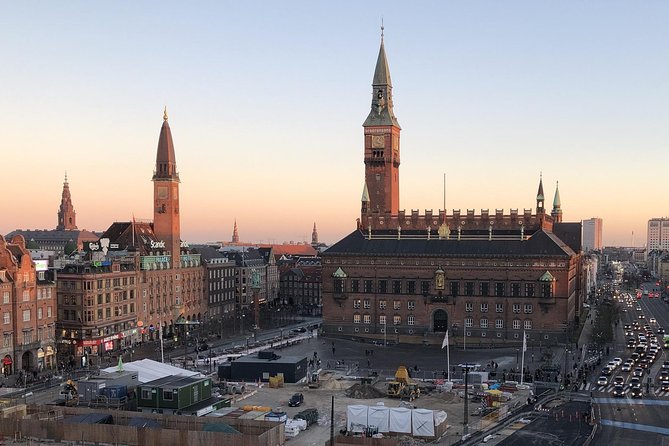
Stop 1: Copenhagen City Hall Square, with Martin Nyrop’s National Romantic style
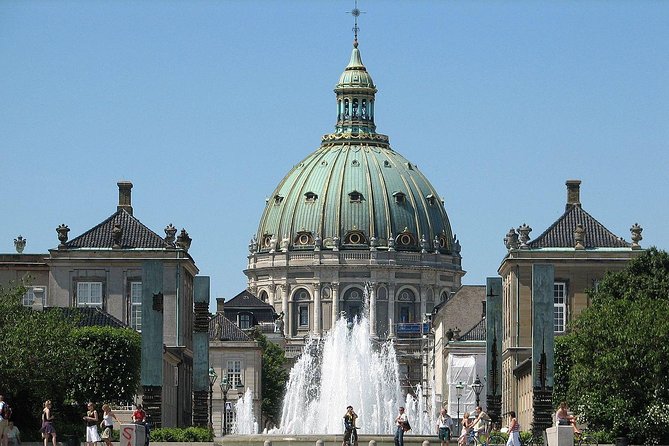
Your route kicks off at Rådhuspladsen (the address shows up as Rådhuspladsen 1599). This is City Hall Square, Copenhagen’s largest square, and it’s a great way to get your bearings fast.
What makes the City Hall area worth your time:
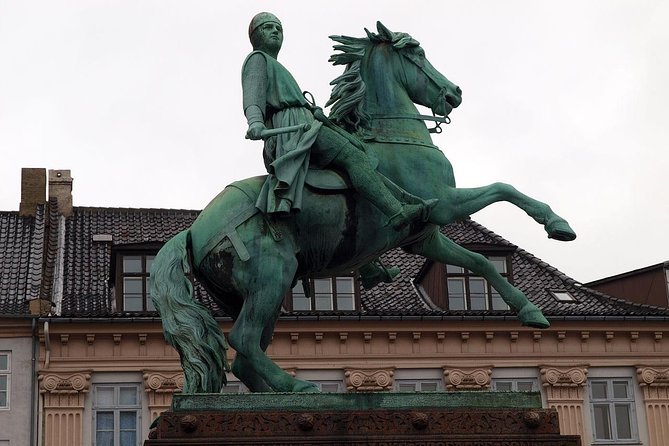
- The building stands out immediately thanks to the ornate brick façade, the clock tower, and the gilded statue of the city’s founder, Bishop Absalon.
- The architecture is National Romantic, shaped by architect Martin Nyrop.
- The design draws inspiration from the City Hall in Siena, Italy—a neat reminder that European cities borrow ideas and remix them into local styles.
Important value note: admission isn’t included here, so don’t plan on spending your 15 minutes inside as your main event. Instead, treat it like a landmark stop where the audio helps you spot the details that you’d otherwise miss while walking through a busy square.
Stop 2: The Round Tower’s ramp and the Trinitatis Complex
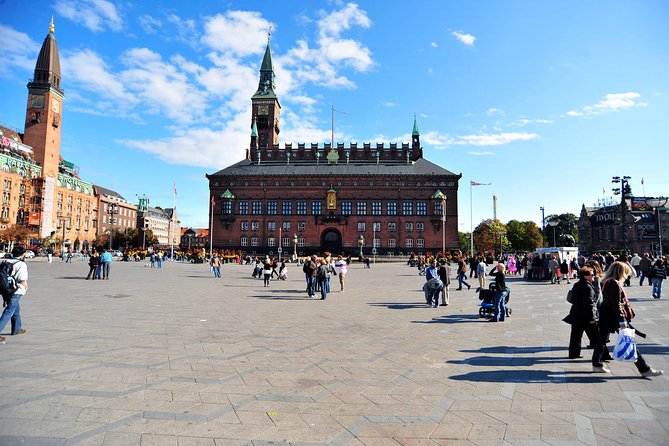
Next up is the Round Tower, part of the Trinitatis Complex, alongside Trinitatis Church and a neighboring academic library tied to Copenhagen University.
Here’s what the audio tour helps you understand:
- The Round Tower is a 17th-century astronomical observatory.
- The university library opened in 1657, and at one point held the university’s entire collection—about 10,000 books.
- The signature feature isn’t stairs. Instead, there’s a spiraling ramp up the tower.
That ramp detail changes how you think about the experience. You’re not just looking at a tower; you’re seeing how function shaped the design. It also makes this stop feel less intimidating than it could if it relied on stairs.
Again, admission fees aren’t included, so you should decide in advance if you want to pay for interior access at this site. Either way, the outside context and the design story are worth your time.
Stop 3: Rosenborg Castle’s Dutch Renaissance look and royal planning
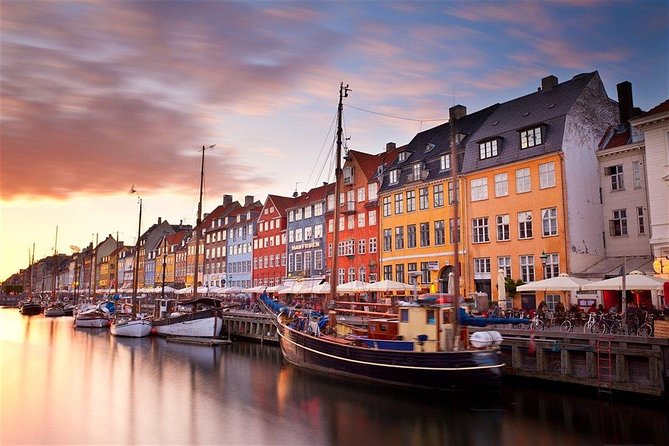
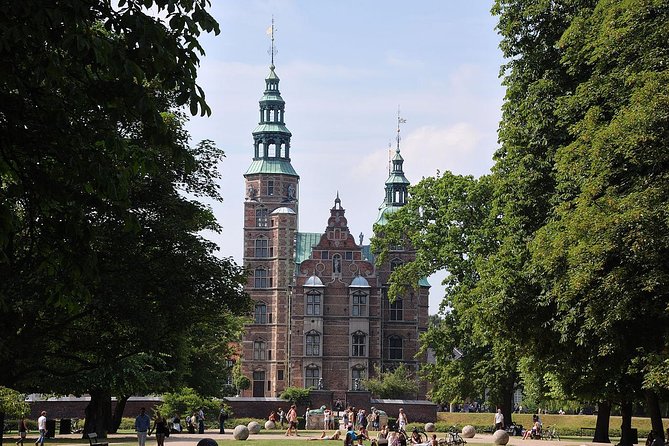
Then comes Rosenborg Castle, commissioned under King Christian IV. If you’re watching for architecture cues, you’ll notice the castle’s Dutch Renaissance style, recognizable for its high gables and spires.
A useful detail the audio will give you:
- The project didn’t stay still after the initial build. It kept expanding, and the castle reached its current state in 1624.
Because admission fees are not included, you’ll likely get the most from Rosenborg as a visual stop: take in the shape, the roofline, and the overall presence of the building. The audio should help you connect what you’re seeing to the king’s long-term building ambitions.
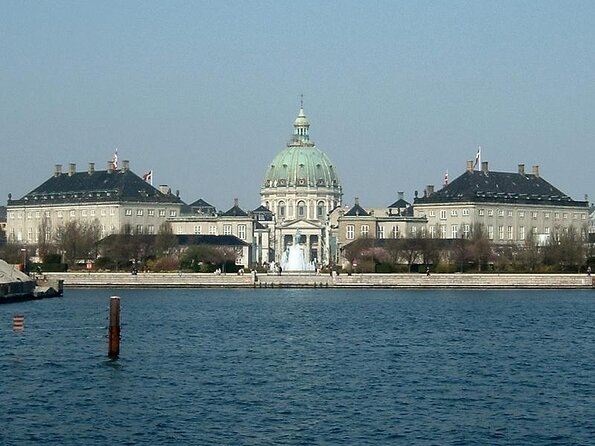
Stop 4: Frederiks Kirke (Marmorkirken) and Scandinavia’s biggest dome
Your next landmark is Frederiks Kirke, also known as Marmorkirken (Frederik’s Church). The headline fact is huge for architecture lovers: it has the largest church dome in Scandinavia.
The audio tour also adds the city-planning context:
- Construction planning links to King Frederik V.
- In 1748, he began planning the grand city district called Frederiksstaden.
That’s the kind of detail that makes a church stop more than a photo moment. You start to see it as part of an urban vision, not just an isolated building.
As with the other stops, admission fees aren’t included, so if you want interior time, you’ll need to plan for separate tickets. If you don’t, you can still use the audio to focus your attention on the dome and the church’s role in the Frederiksstaden district.





Stops 5–6: Amalienborg’s royal residence and the Royal Danish Theatre
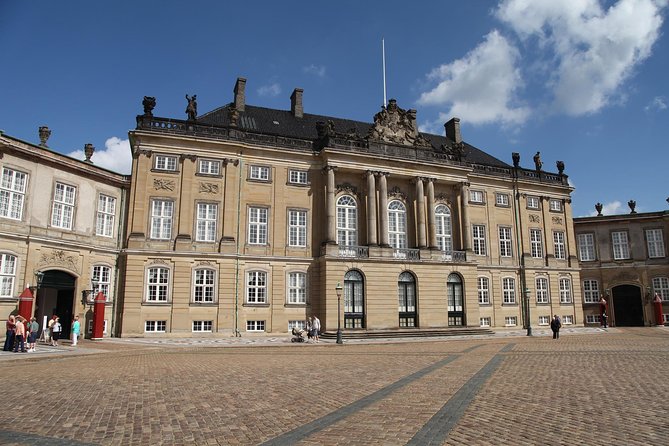
Now you reach Amalienborg, the current residence of the Danish royal family.
What the tour helps you connect:
- The first palace on the site was built between 1669 and 1673 by Queen Sophie Amalie, wife of King Frederik III.
- The current palace complex was designed as a crowning feature of Frederiksstaden.
- Frederik V dismantled the existing palace and built the octagonal complex you see today.
This is a great stop because it’s both political and visual. Even if you only take a short break here, you can still use the audio to read the place like it has layers—original palace, royal district planning, then the final octagonal design.
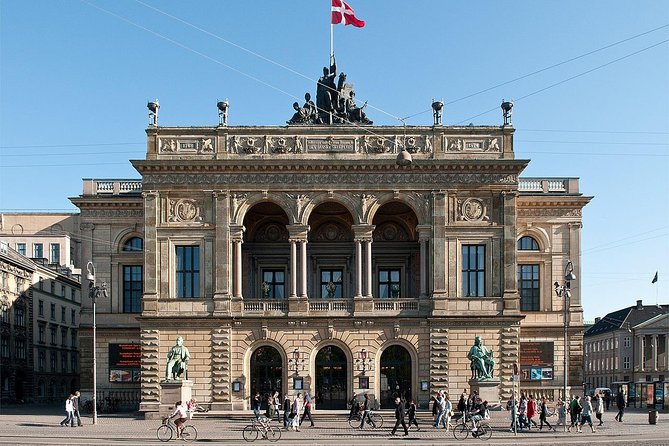
From Amalienborg, your route continues to the Royal Danish Theatre Play House. The audio provides a timeline that makes the theatre feel grounded, not vague:
- The first theatre built at this location dates to 1748.
- It seated 800 people and employed eight actors and four actresses.
- Performances were mainly French comedies.
- In 1774, the theatre was rebuilt for a larger audience.
- The Royal Danish Theatre became home for performing arts including ballet, opera, and the royal orchestra.
This pair of stops works well because they show two sides of culture: monarchy as a physical presence at Amalienborg, and the performing arts as a long-running civic institution.
Stop 7: Christiansborg Palace’s Royal Kitchens and the Blue Tower story
Your final major site is the Royal Kitchens of Christiansborg Palace.
Christiansborg has a layered past, built over remnants of multiple older castles:
- In 1167, Absalon built the first castle on the island, and it lasted over 200 years.
- After Absalon’s castle was destroyed by the Hanseatic League, Copenhagen Castle was built over the ruins.
- One reason Christiansborg is so memorable: the Blue Tower, which held Leonora Christina, the daughter of Christian IV, captive for almost 22 years.
Even if your time is limited and you don’t go deep into interior rooms, the Blue Tower detail is the kind that changes your mental map. Suddenly the area isn’t just “a palace site.” It’s a place where major European power struggles left a human mark.
Your tour ends at Tivoli Gardens, at Vesterbrogade 3, 1630 København V. That’s a smart landing point—once you finish your last audio segment, you’re right near a lively destination rather than back at a dead-end metro stop.
Price and value: what $15.29 buys you (and what it doesn’t)
At $15.29 per person, you’re paying for what’s essentially a guided script delivered through your phone: audio files and a GPS map, plus the mobile ticket and self-paced structure.
What you should not assume is included:
- Admission fees are not included.
- Transportation isn’t included.
- Food and drinks aren’t included.
- The audio device isn’t included (you’ll use your own phone and speaker setup).
So is it good value? Yes—if you want structure without paying for a paid guide or scheduling a group. You’re getting seven landmark stops with context you’d otherwise have to look up on your own while standing in the street.
If you plan to enter multiple buildings, your total cost will rise once you add admissions. In that case, your best approach is to decide which sites you’re actually buying tickets for ahead of time, then use the audio for the rest.
The audio quality weak point, and how to plan around it
This tour’s biggest risk isn’t the route. It’s how the audio comes through on your setup.
Some people have reported that:
- Background sounds and effects can muffle the narration.
- Playback can turn staticky when the volume is pushed too high.
- The narrator delivery may feel flat or overly scripted.
That doesn’t mean the tour is unusable. It means you should treat the first stop as a sound check. Start playing audio as you’re approaching Rådhuspladsen, and confirm you can clearly hear the main voice.
Practical fixes you can try:
- Use a quieter volume if distortion starts when loud.
- If you have them, use headphones to cut down street noise.
- Keep your phone screen brightness and power settings sensible so nothing throttles playback.
If audio clarity is a deal-breaker for you, consider whether you’d rather pair this tour with a backup plan: short visits for the exterior parts, plus separate ticket entry only when you’re sure you want to spend the money.
Who this Copenhagen audio tour fits best
This is a strong match for you if:
- You like walking and want a route that makes sense without rigid timing.
- You want major sights in one compact loop rather than a scattered checklist.
- You’re comfortable managing your own phone audio and downloads.
- You’re traveling in English and prefer self-guided flexibility.
It may be less ideal if:
- You rely on high-volume, speaker-only audio and hate any chance of muffled narration.
- You want a lot of indoor time without separately purchasing admissions.
The requirement notes a moderate physical fitness level. The route is walkable, but it’s still a city walk, so give yourself time and wear shoes you trust.
Should you book this Copenhagen audio tour?
I’d book it if you want a low-cost, structured way to see Copenhagen’s classic landmarks in a few hours, with useful background details you can actually apply while you’re looking at the buildings. The self-paced format and the practical mapping approach make it feel like planning with training wheels.
Skip it or plan carefully if you know you’re sensitive to audio quality, or you’re expecting admissions and a physical guide to be included. This is a tour that rewards you for prep: download early, test volume, and treat admission sites as optional upgrades.
If you do that, you’ll get a satisfying loop from City Hall to Tivoli Gardens, with just enough story to make each stop feel earned.
FAQ
How long is the Copenhagen self-guided audio tour?
It runs about 2 to 3 hours (approximately), with around 15 minutes per stop.
What language is the audio tour offered in?
The tour is available in English only.
What is the price per person?
The listed price is $15.29 per person.
Where do I start and end the tour?
You start at Rådhuspladsen 1599, Copenhagen and end at Tivoli Gardens, Vesterbrogade 3, 1630 København V.
What’s included in the ticket?
You get audio files and a GPS map, and a mobile ticket. It’s self-paced.
Are admission fees included for the stops?
No. Admission fees are not included, so some attractions may require separate tickets if you want to go inside.
Do I need my own audio device?
Yes. An audio device is not included, so you’ll use your own phone.
Is transportation included?
No. Transportation is not included.
What physical fitness level is recommended?
It’s recommended for travelers with a moderate physical fitness level, since it involves walking.
Are service animals allowed?
Yes. Service animals are allowed.