REVIEW · CHARLESTON
Charleston Self-Guided Audio Walking Tour
Book on Viator →Operated by Adventures with Action · Bookable on Viator
Charleston tells its stories as you walk. This GPS-based audio route turns downtown into a timeline, with narration that starts playing automatically as you reach key spots, including places like Rainbow Row and the Old Charleston Jail area. I particularly liked the hands-free setup and the offline maps option, which keeps you going even when your signal drops. One thing to plan for: the walk covers more than 2 miles, and the first part can feel long before you get convenient breaks.
At $14.99 per person for about 1 to 3 hours of listening time, you’re not buying access to one locked-in “guided group tour.” You’re buying a repeatable way to explore Charleston at your pace, with optional extra context through an in-app Learn More section. And because the access has no expiry and doesn’t expire, you can use it on a first visit now and still have it ready for a second pass later.
In This Review
- Key highlights worth your time
- Price and value: $14.99 for a repeatable Charleston route
- How the Action app guides you (and what can make it better)
- Stop-by-stop: what you’ll see between Circular Church and City Market
- Circular Congregational Church: dissent, fire, and continuity
- Hibernian Hall: Irish roots and community support
- South Carolina Historical Society Museum: where context gets official
- Four Corners of Law: Broad and Meeting streets, power in stone
- South Carolina Society Hall: a charity-building with political reach
- John Robert Pringle House: everyday life for colonists
- Patrick O’Donnell House rumor: a construction story with romance
- White Point Garden: Oyster Point, defense, and the Civil War
- Palmer Home: political leadership in a house built for status
- Edmondston-Alston House: an 1825 home with layered visitors
- Longitude Lane: a pretty alley with a serious detail
- Rainbow Row: merchants, trading, and the look of commerce
- Slave Auction Site Memorial: history you can’t soften
- Pineapple Fountain: a playful shape with a connection
- Old Slave Mart Museum: a key hard-history stop
- Dock Street Theater: from theatre beginnings to later reopenings
- St. Philip’s Church: Church Street’s curve, explained
- Charleston City Market: crafts, food, and a practical ending
- The downloadable, GPS-based experience: the good and the watch-outs
- Who this walking tour is best for
- Should you book the Charleston Self-Guided Audio Walking Tour?
Key highlights worth your time
- GPS-triggered audio: stories start when you reach each stop, so you can wander without feeling lost
- Offline-ready after download: no signal needed once you’ve downloaded the tour correctly
- 45+ audio stories plus bonus listening when you choose
- Picture breaks built in: you can pause, stop for photos, and keep moving when you’re ready
- A route packed with contrasts: churches, civic buildings, historic houses, and hard-history memorials
- Lifetime access so you can revisit the walk anytime
Price and value: $14.99 for a repeatable Charleston route
At $14.99 per person, this doesn’t compete with a private guide on depth per hour. What it does offer is control and convenience. You’re paying for a walking route that includes narration at specific sites, so you’re not just “seeing stuff” from the sidewalk—you’re getting the story tied to what you’re looking at.
The best value comes from two things:
- You can go at your pace. If you want to linger at Rainbow Row or stop for lunch, you don’t derail the experience.
- You keep the access. This matters in Charleston. The first time you walk, you’re moving fast and taking notes. The second time, you slow down and notice details you missed.
If you prefer someone guiding every turn and answering questions, a live tour may still feel better. But if you like walking, reading a plaque for context, and pressing play when something catches your eye, this price is easy to justify.
You can also read our reviews of more tours and experiences in Charleston.

How the Action app guides you (and what can make it better)

This is a self-guided tour. No one meets you at the start. Instead, you open the Action tour app at the starting point and the audio cues begin based on where you are.
A few practical notes that can make or break the experience:
- Download the tour while you have strong Wi‑Fi or cellular. After that, it works offline.
- Keep your phone awake. If the device goes into sleep mode, GPS-based triggering can get flaky.
- Bring headphones/earbuds. The audio is designed to play hands-free when you’re near each story point.
- Use a device with GPS support (iPhone iOS 15+ or Android 9+ are recommended).
- If you detour, don’t assume the audio will perfectly follow you. Staying near the intended path helps the GPS trigger normally.
I also liked the “flex” model: you can pause anytime, then resume from where you left off. That’s perfect for Charleston, where it’s normal to stop for a drink, check out a storefront, or step into a museum nearby.
Stop-by-stop: what you’ll see between Circular Church and City Market

The route is designed as one continuous downtown walk, and it ends at Charleston City Market. Even if you finish early, you’ll still come away with a stronger sense of how Charleston built its wealth, its power, and its resistance—side by side in the same streets.
Circular Congregational Church: dissent, fire, and continuity
Your first big anchor is Circular Congregational Church (established 1681). You’ll hear how dissenters who didn’t conform to the Church of England used this as a meeting place, starting from the White Meeting House era. The current circular building dates to 1891, rebuilt after an earlier structure was destroyed by fire.
What I like about leading with this stop: it sets up a theme you’ll keep seeing later—Charleston is full of places that were reshaped by events, not just decorated for postcards.
Hibernian Hall: Irish roots and community support
Next up is Hibernian Hall, built in 1840 and connected to the Hibernian Society of Charleston. That society began in 1801, founded by Irish immigrants and their descendants to provide aid, support, and cultural activities within the Irish community.
This stop gives you a calmer, human scale to the city. Before the route gets dramatic, you see how people organized community life in 19th-century Charleston.
South Carolina Historical Society Museum: where context gets official
A short hop brings you to the South Carolina Historical Society Museum, founded in 1855. Even if you don’t go inside, the narration helps you understand what the museum is there for: collecting, preserving, and promoting the history of South Carolina.
If you do want a break, this is a good place to pause and stretch—especially if you’re walking at a slower pace than the audio timing suggests.
Four Corners of Law: Broad and Meeting streets, power in stone
At Broad and Meeting, you’ll hear the meaning behind the Four Corners of Law. It refers to how several important buildings representing law and government concentrate at that intersection. This is Charleston’s “who had authority here” moment, right in the open.
Even if architecture isn’t your focus, this is a helpful story point because it makes the city’s historic decisions feel less abstract.
South Carolina Society Hall: a charity-building with political reach
Next is South Carolina Society Hall, built in 1803. The narration connects it to the South Carolina Society, a group founded in 1737, known for charitable work and influence in Charleston’s political and social life.
The key value here is the link between “nice institution” and “power structure.” You’ll start to see how public life in Charleston was shaped by organizations, not just individuals.
John Robert Pringle House: everyday life for colonists
You’ll pass by the John Robert Pringle House and hear about Pringle’s story as a snapshot of life for a European colonist in early Charleston.
This kind of stop is great for balance. After the civic and institutional buildings, you get a more personal angle: how people lived, not only how they ruled.
Patrick O’Donnell House rumor: a construction story with romance
A bit farther along, you’ll encounter the Patrick O’Donnell House. The tour shares a rumor that O’Donnell wanted the house to be perfect for his fiancée, and that it took 12 years to build.
I treat rumor as a flavor note, not a fact—but as a way to make you slow down and notice details in the façade, it works.
White Point Garden: Oyster Point, defense, and the Civil War
White Point Garden is a major narrative stop. You’ll learn it once was Oyster Point, a public gathering place going back to the 18th century. You’ll also hear how it served as a defensive position during war.
This is where the tour shifts into high-stakes context. Charleston became strategically important in the Civil War because of its deepwater port and its role in cotton production and export. Controlling Charleston mattered to both Confederate and Union forces.
And you’ll also hear about the monument dedicated to General William Moultrie, tied to the Revolutionary War and the Battle of Sullivan’s Island (1776).
What to do here: pause. The garden gives you a breather between architectural stops, and it’s one of the places where you can look around and connect the history to the geography.
Palmer Home: political leadership in a house built for status
Next is the Palmer Home, built in 1825 for Thomas Bennett Jr., who served as Governor of South Carolina from 1820 to 1822. The name comes from John Ravenel Palmer, who purchased it in 1861, and the family owned it for decades.
This stop works best if you’re paying attention to time periods. It’s a reminder that households were tied to political power during Charleston’s rise.
Edmondston-Alston House: an 1825 home with layered visitors
You’ll also pass the Edmondston-Alston House, built in 1825. The audio frames it as a home with a long list of notable residents and visitors tied to Charleston’s wider circles.
Even if the building details are hard to spot while walking, the narration is what helps you see the “social map” behind the walls.
Longitude Lane: a pretty alley with a serious detail
Then you’re in Longitude Lane, one of Charleston’s most picturesque alleys. Here’s the fun contrast: the tour mentions the cannon story you might notice around White Point Garden, and then tells you this is where the real cannon was taken from.
This is the kind of detail you’ll remember because it connects two different places into one story.
Rainbow Row: merchants, trading, and the look of commerce
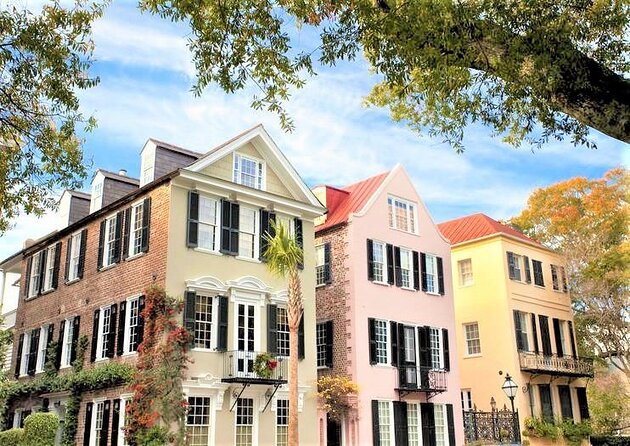
At Rainbow Row, you’ll hear that the houses were originally built as mercantile stores and residences for merchants and traders. Over time, restoration and preservation kept the visual identity intact, turning the row into a signature of Charleston’s architectural heritage.
You don’t need to be an architecture nerd to appreciate this. The narration helps you read the buildings as working spaces, not just painted scenery.
Slave Auction Site Memorial: history you can’t soften
This stop is a memorial marking where slave auctions occurred in the late 1700s and early 1800s. The audio doesn’t sugarcoat what was at stake. Even if you want a photo here, I’d keep your pace respectful and let the story land first.
This is one of the most important parts of the walk because it grounds Charleston’s earlier wealth story in human suffering, not just in “economic growth.”
Pineapple Fountain: a playful shape with a connection
Next comes the Pineapple Fountain, built in 1990, with references to Charleston history. It’s a lighter moment, but not an empty one. The narration helps you see why even a playful landmark belongs on this route.
Old Slave Mart Museum: a key hard-history stop
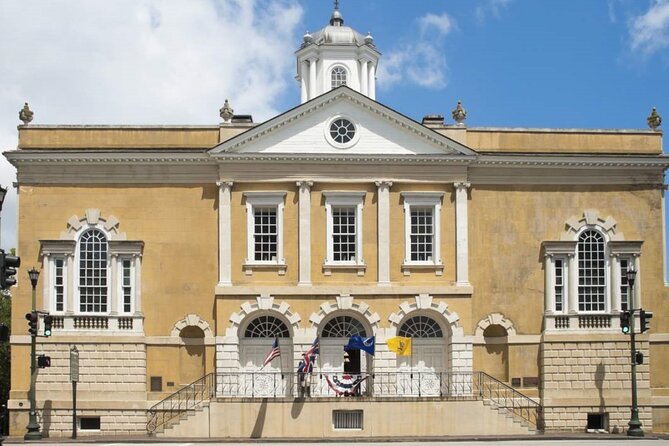
You’ll pass by the Old Slave Mart Museum. The tour describes it as similar in theme to the Old Exchange, while also pointing out differences.
Even if you only take a moment outside, this is another where you’re reminded the city’s past isn’t only “old buildings.” It’s institutions, documents, and decisions.
Dock Street Theater: from theatre beginnings to later reopenings
At Dock Street Theater, you’ll hear it began as a theatre in 1736, then reopened again in 1937. The narration also makes you wonder about the gap years, which is exactly the point of this stop—it points you toward how the same building can change meaning over time.
St. Philip’s Church: Church Street’s curve, explained
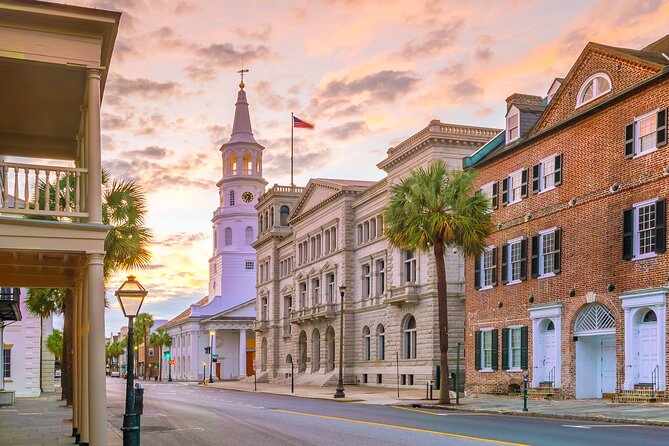
You’ll notice that St. Philip’s Church juts out onto Church Street. The narration explains how the street bends along the church and then straightens again.
This is a “look with your eyes” moment. After hearing it, you can’t unsee how the street layout was influenced by a major landmark.
Charleston City Market: crafts, food, and a practical ending
Finally, you reach Charleston City Market. It’s been here since 1804 and is a place where you’ll find arts and crafts, including Gullah sweetgrass baskets, plus plenty of food options.
If you’re still energized, stay for a while. If you’re cooked, sit somewhere and let the walk settle in. Either way, ending here is smart: it’s a natural “I’m done” point with options right next door.
The downloadable, GPS-based experience: the good and the watch-outs

This is one of those tours that feels modern without being complicated. Offline access is a huge plus if you’re the kind of person who hates hunting for signal. And the audio is designed to be location-based, so you don’t need to constantly press buttons or check directions.
But here are the practical watch-outs I’d plan around:
- Some stops may not trigger if your GPS drifts. If the audio seems to stall, get back toward the route and check the app map.
- Phones that go into sleep mode can cause GPS timing hiccups. Keep the phone active during the walk.
- Bathroom access can be limited early in the route. If you need facilities sooner, use the app’s extra tools like Near Me options for nearby restrooms and food.
Also, a quick note from the way the experience is built: you’ll likely get the first major audio section after you’ve walked a short distance from the start point. So don’t worry if the earliest minutes feel like you’re just getting oriented—Charleston is spread out more than it looks.
Who this walking tour is best for

This works especially well if you:
- Prefer self-paced walking over a group schedule
- Want audio at specific sites without paying for multiple tickets
- Enjoy pairing street views with historical narration
- Like the idea of a tour you can repeat later without buying again
It may not be ideal if you want constant direction like turn-by-turn guidance at every step, or if you’re extremely sensitive to GPS triggering. On the other hand, if you can follow a simple downtown route and keep your phone awake, it’s a strong fit.
Should you book the Charleston Self-Guided Audio Walking Tour?
If you’re trying to see Charleston’s core sights—churches, historic houses, the signature downtown corners, and key hard-history memorials—without committing to a live guide, I think this is a smart buy. The combination of offline access, hands-free audio, and lifetime usability gives you good value, especially for a city where you’ll want to revisit.
Book it if you want a flexible day that still feels guided by stories. Skip it only if you need lots of indoor time during the first stretch or you prefer constant, step-by-step human direction over GPS-based cues.