REVIEW · SALT LAKE CITY
Salt Lake City Self-Guided Walking Audio Tour
Book on Viator →Operated by Travel with Action · Bookable on Viator
A voice guide, minus the tour bus. This self-guided walk turns downtown Salt Lake City into a storybook, with 30+ audio scenes along a route that takes about 1 to 2 hours. You’ll pass major church landmarks, civic buildings, and monuments tied to Mormon pioneer life and Utah statehood, all told in plain English.
I especially like the hands-free, location-triggered audio. The narration plays on its own as you get close to each stop, so you can pause for photos or a snack without losing your place. I also like the offline maps and offline playback after you download once on solid signal, which matters in a downtown you’ll want to explore on your feet.
One consideration: navigation and audio timing depend on you following the route and starting at the correct point. If you start late, walk way off pace, or miss a transition, the audio may feel jumpy instead of smooth.
In This Review
- Key highlights you’ll care about
- Price and value: what $14.99 really buys you
- Getting set up: Action’s app, password, and the one-time wifi rule
- Route basics: 2.5 miles, automatic stop cues, and good pacing
- Downtown Mormon sights: from the Crandall Building to Temple Square
- Stop 1: Visit Salt Lake area and the Crandall Building
- Stop 2: Brigham Young Monument
- Stop 3: Handcart Pioneer Monument
- Stop 4: Seagull Monument and the crop-cricket story
- Stop 5: Salt Lake Assembly Hall
- Stop 6: Salt Lake Tabernacle
- Stop 7: Utah Temple and Angel Moroni
- Stop 8: Temple Square
- Church civic core: Relief Society, Brigham Young Historic Park, City Creek
- Stop 9: Relief Society Building
- Stop 10: Brigham Young Historic Park
- Stop 11: City Creek Park
- From territory to statehood: Old City Hall and Utah Capitol area
- Stop 12: Salt Lake City Council Hall (Old City Hall)
- Stop 13: Utah State Capitol
- Stop 14: Mormon Battalion Monument
- Stop 15: Martha Hughes Cannon statue
- Victorian mansion to church archives: McCune to FamilySearch Library
- Stop 16: McCune Mansion
- Stop 17: Salt Lake City Conference Center
- Stop 18: Church History Library
- Stop 19: Church History Museum
- Stop 20: FamilySearch Library
- How to keep it smooth: audio timing, photos, and when the app hiccups
- Should you book this Salt Lake City self-guided audio tour?
- FAQ
- Where does the tour start?
- Where does the tour end?
- How long is the walk?
- Does it work offline?
- What devices are recommended?
- Is this a guided tour with a person?
- Are museum entry tickets included?
- When can you start at the meeting point?
- What’s the cancellation window?
Key highlights you’ll care about
- $14.99 value for a long story-walk (about 2.5 miles, 30+ audio stories)
- Offline maps after one-time download so you’re not stuck if signal drops
- Automatic audio based on location with hands-free stop cues
- Temple Square to the Capitol in one loop without booking timed tickets
- A focused church-history cluster including the Church History Library, Church History Museum, and FamilySearch Library
Price and value: what $14.99 really buys you
At $14.99 per person, this is priced like a solid “one outing” activity, not a bargain throw-in. The trade is simple: you’re paying for the narration and self-guided route, not museum admissions or reserved entry.
For me, the value comes from two things you can feel right away: the route covers a lot of recognizable landmarks (Temple Square, the Utah State Capitol, church history stops), and you get more than enough content to keep a 1–2 hour walk interesting. You can also stretch it longer, because you’re not tied to a group schedule—you can stop for photos, read a nearby plaque, or just walk slower.
The one “watch-out” on value is this: if you expect the audio tour to replace entrance tickets into museums or libraries, it won’t. The tour is built around street-level viewpoints and exterior stops, with optional deeper exploration only if you choose to pay separately.
You can also read our reviews of more tours and experiences in Salt Lake City.

Getting set up: Action’s app, password, and the one-time wifi rule
This is run through Action’s Tour Guide App (download needed), plus a password sent to you by email/text after booking. You’ll get instructions and your password, then you enter that password inside the app to unlock the correct tour.
Here’s the practical part: the app must be downloaded while you have strong wifi/cellular. After that, the tour works offline, so you’re free to keep walking even if downtown service gets spotty.
Your device matters for GPS navigation. The recommended setup is an iPhone with iOS 15+, an Android phone with version 9+, or an iPad/tablet with GPS and cellular connectivity.
My tip: bring headphones/earbuds. The whole experience relies on listening, and it’s much easier than trying to hear narration over street noise.
Route basics: 2.5 miles, automatic stop cues, and good pacing
The route is about 2.5 miles long and includes more than 30 audio stories. The timing estimate is 1 to 2 hours, but you’ll control your actual pace. You can also start anytime and pause anywhere, then resume later—helpful if you want to fold in a coffee stop or linger near Temple Square.
To make the audio behave the way it’s supposed to, start at the official meeting point: 90 S W Temple St, right by the Visit Salt Lake area. No one meets you—this is truly self-guided. Once you’re at the first story point, the audio should start automatically, and then each next stop cue triggers as you approach.
Also stick to the tour route and the app’s suggested pace. If you zip ahead or wander far off, you can end up out of sync—an annoyance you can avoid with a simple “stay on track” mindset.
Downtown Mormon sights: from the Crandall Building to Temple Square
This section is your core “Salt Lake City identity” loop: church symbolism, pioneer-era memorials, and the places where the city’s story became public.
Stop 1: Visit Salt Lake area and the Crandall Building
You begin at Visit Salt Lake Center (90 S W Temple St). If you’re not already there, go first—this is where the tour really clicks into gear.
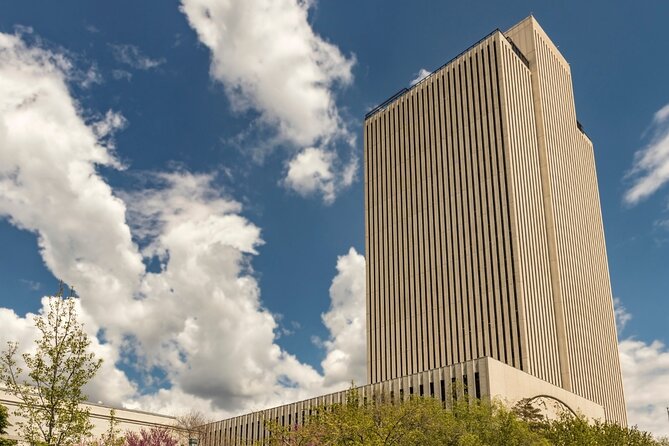
From there you’ll meet the Crandall Building, Salt Lake City’s first skyscraper. It has an arched entryway carved into the façade, and it dates to the 1890s. It originally housed McCornick Bank, and it was among the early local buildings with an elevator—so yes, the novelty was enough that people (including women in calico dresses) apparently made a point of riding it.
Stop 2: Brigham Young Monument
Across the road, look for the 25-foot bronze statue of Brigham Young. This stop is less about “who’s famous” and more about why he mattered to the region’s religious and political direction—especially his early background and the personal decision that led him to Mormonism.
Stop 3: Handcart Pioneer Monument
Next comes the Handcart Pioneer Monument: a bronze scene of a man and woman struggling with a cart. The detail I like here is that it’s specifically tied to a 1856 wave of Mormon pioneers who traveled from Europe, not just the first group you might assume.
Stop 4: Seagull Monument and the crop-cricket story
A pillar with gold seagulls can look out of place in a landlocked city—so this stop explains why it’s there. The narration links the monument to a legend: after settling in 1848 and planting crops, crickets destroyed the harvest hopes. The response was prayer, and that story is part of why the seagulls show up in Mormon pioneer folklore.
Stop 5: Salt Lake Assembly Hall
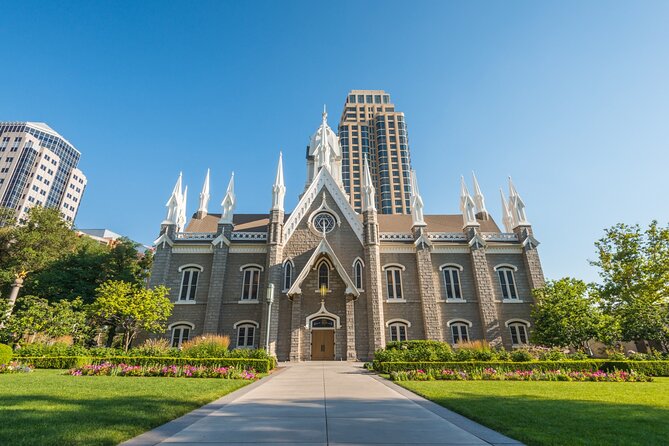
This massive building on your left is the Salt Lake Assembly Hall, built in 1882 and used as a gathering place for nearly 150 years. If you’re interested in how communities organized worship and public life, it’s one of the better “big picture” structures on the route.
Stop 6: Salt Lake Tabernacle
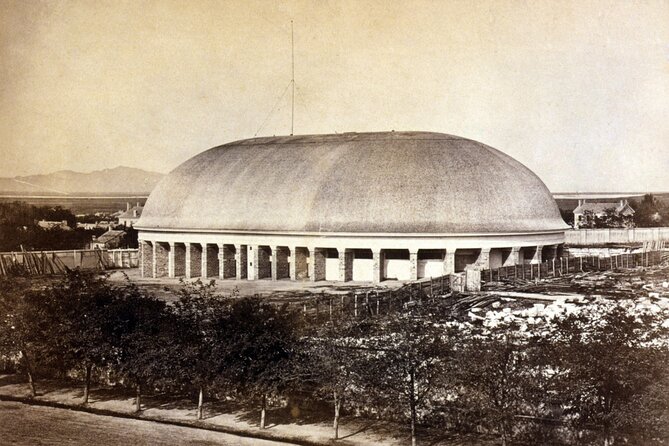
To continue the theme, you’ll pause by the Salt Lake City Tabernacle (built between 1863 and 1867). This one was designed for large events for the Mormon Church, so it helps you connect architecture to crowd needs rather than treating it as just another historic building.
Stop 7: Utah Temple and Angel Moroni
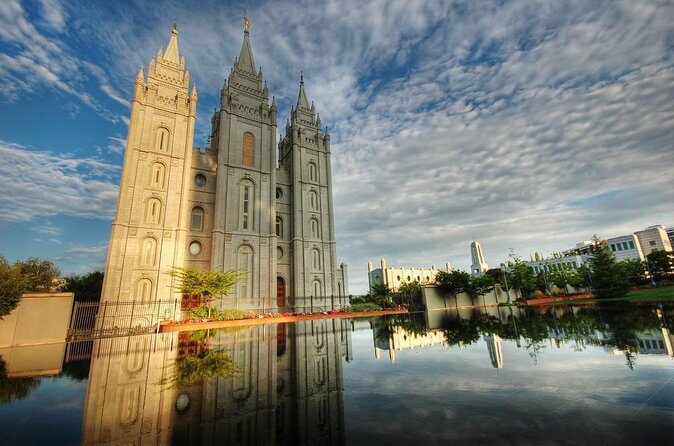
On your right rises the Salt Lake Temple with spires and the statue of the angel Moroni. The stop ties the symbolism back to Joseph Smith—Moroni as the figure associated with the golden tablets of the Book of Mormon. It’s a straightforward way to understand what you’re seeing without needing a full religious lecture.
Stop 8: Temple Square
Then you walk through Temple Square, which the Mormons planned as the heart of the city. The story here leans into hardship: the early settlement struggled through its winter, lived on very limited bread, and then faced a measles outbreak. It’s a reminder that monumental places often start from survival.
Church civic core: Relief Society, Brigham Young Historic Park, City Creek
These stops shift you from worship-centered spaces to civic life, land use, and practical city planning—still tied to the same pioneer narrative.
Stop 9: Relief Society Building
The Relief Society Building (white with tall pillars) is tied to a women’s organization of the Mormon Church. You’ll hear that it was first organized in 1842 by Joseph Smith and focused on helping the poor. The narration also points out that it became part of early religious struggle—so this isn’t just feel-good philanthropy history.
Stop 10: Brigham Young Historic Park
To your right sits Brigham Young Historic Park on land owned by Brigham Young and his family in the 1800s. The estate stretched farther than the park footprint you see today (north nearly three blocks), and the narration mentions a mix of sheds, barns, and orchard produce like apples, peaches, and pears.
Stop 11: City Creek Park
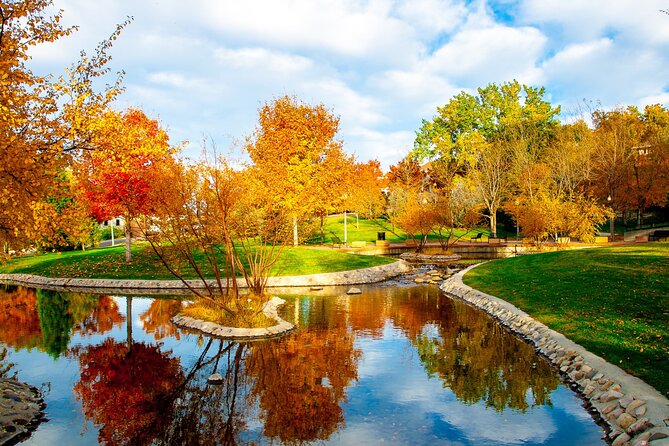
Next you enter City Creek Park and follow the path, staying left of the creek. The story here focuses on damming the creek soon after the Mormon pioneers settled, to soften ground for growing produce like turnips. It’s one of the most practical “how they made life work” moments on the route.
From territory to statehood: Old City Hall and Utah Capitol area
Now the walk widens into state politics and public institutions. You’ll go from religious settlement to the machinery of government—and the push to become a state.
Stop 12: Salt Lake City Council Hall (Old City Hall)
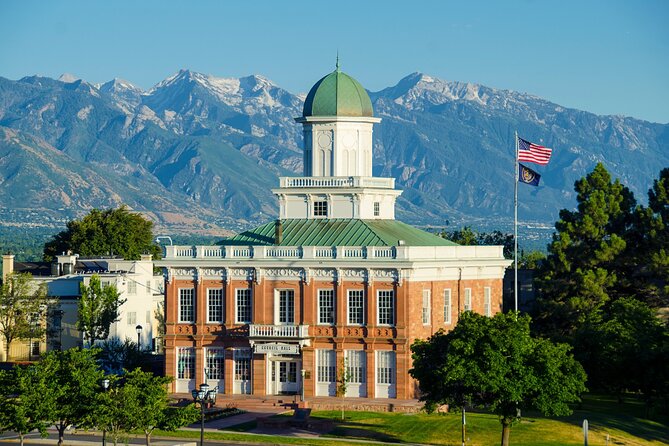
You’ll see the white building with a green cupola: the former Old City Hall, now the Salt Lake City Council Hall. Today it houses the Utah Office of Tourism and the Utah Film Commission, but the narration explains that the building didn’t always have that exact role—or even that it was always in this precise location.
Stop 13: Utah State Capitol
The Utah State Capitol stop connects to the timeline that many people don’t realize: from 1850 to 1896, Utah functioned as a territory, not a state. The narration also includes the frustration—locals petitioned the federal government seven times before statehood finally happened.
If you’re trying to picture the walking flow here, pay close attention to the audio’s “where to walk” cues. One common snag on this route is getting oriented around the Capitol area, so go slow and let the app guide you.
Stop 14: Mormon Battalion Monument
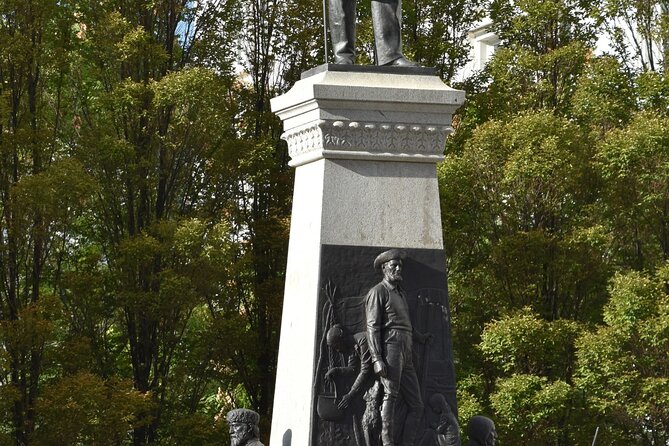
Straight ahead you’ll find the Mormon Battalion Monument. It commemorates 500 Mormon pioneer volunteers who joined the U.S. Army during the Mexican-American War, built in 1927 by Gilbert Riswold. What makes it worth pausing is that it adds a different kind of pioneer story—service and national connection, not only settlement.
Stop 15: Martha Hughes Cannon statue
Next up is Martha Hughes Cannon, nicknamed Mattie, the first female state senator in the U.S. The narration includes personal details (including how she worked while young and how she adjusted her clothing and boots for walking to work). It also notes her work as a typesetter for a women’s newspaper printed by the Mormon church—so you get career history, not just a nameplate fact.
Victorian mansion to church archives: McCune to FamilySearch Library
This final run turns the volume down from monuments to institutions—homes, conference buildings, and record-keeping places.
Stop 16: McCune Mansion
You’ll pass the McCune Mansion, an expansive brick Victorian completed around the turn of the century. The builder was Alfred McCune, who made his fortune building parts of the Utah Southern Railroad. The narration adds the social-world angle too, tying McCune’s wealth to famous business circles (including mention of J.P. Morgan and William Randolph Hearst and that Hearst is the man Citizen Kane is based on).
Stop 17: Salt Lake City Conference Center
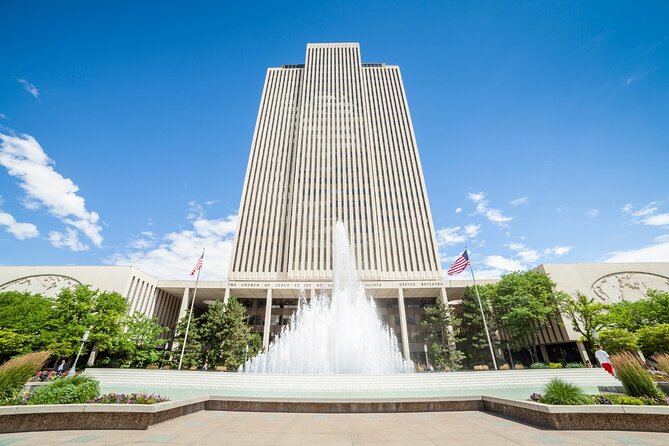
Next is the Salt Lake City Conference Center, completed in 2000. It’s used for the semiannual general conference of the LDS, with members gathering worldwide in April and October. Even if you’re not there during conference week, seeing this scale helps you understand how the city supports big religious events.
Stop 18: Church History Library
On your left, the Church History Library opened for business in 2009. It preserves materials related to the Mormon church, including documents from the 1820s. If you like primary-source style history, this stop sets the expectation that you’re not just looking at stories—you’re seeing preserved records.
Stop 19: Church History Museum
To the right, the Church History Museum (built in 1984) uses interactive exhibits and artifacts focused on the pioneer journey to Salt Lake City. Even if you don’t go inside, the audio framing helps you understand what kind of artifacts and timelines you’re likely to find there if you choose to pay for entry.
Stop 20: FamilySearch Library
Finally, you reach the large gray Family History Library (FamilySearch Library). The narration emphasizes help from expert researchers and notes the collection includes names from over 3 billion people, housed through microfilm, books, and periodicals.
If genealogy is your thing, this is a great “last stop” because it gives you a direct next step: after the walk, you can use the experience as momentum.
How to keep it smooth: audio timing, photos, and when the app hiccups
This tour is built to feel easy—just start and follow cues. Still, small habits make a big difference.
First: keep your pace close to what the app suggests and don’t cut across blocks. Audio triggers based on location, so wandering off the route can lead to gaps when the next stop doesn’t fire.
Second: begin at the real starting point. If you skip ahead or start down the street, you can miss the first activation sequence, and then later transitions can feel delayed.
Third: plan for quick breaks. Because the tour is self-guided, you can pause whenever you want, then resume. It’s a good setup if you want to step into a nearby store for water or take a longer look at the state capitol details.
A small money-saving tip that fits real life: couples can share one tour by splitting headphones (if that works for your comfort level). It’s a simple way to cut per-person cost while still following the same narration.
Should you book this Salt Lake City self-guided audio tour?
Book it if you want a low-stress way to see the main downtown landmarks without dealing with a schedule. The route is packed with story-rich stops—from Temple Square monuments to the Utah Capitol area to church-history institutions—and at $14.99, it’s a strong “pay once, walk as long as you want” outing.
Skip it or switch to a different format if you strongly prefer a guided pace or if you don’t want to manage app-based navigation. This tour shines when you’re comfortable following directions on your phone and using headphones, and it depends on location-triggered audio working smoothly.
If you do book: arrive at the start point, download the app on solid wifi, and expect about 2.5 miles of walking. Do those three things, and you’ll get the best mix of easy logistics and memorable Salt Lake City context.
FAQ
Where does the tour start?
It starts outside Visit Salt Lake at 90 S W Temple St, Salt Lake City, UT 84101.
Where does the tour end?
It ends at 60 North Temple, Salt Lake City, UT 84150.
How long is the walk?
It takes about 1 to 2 hours and covers about 2.5 miles with 30+ audio stories.
Does it work offline?
Yes. You need to download the tour while you’re on strong wifi/cellular, then it works offline after the download.
What devices are recommended?
The tour recommends an iPhone with iOS 15+, Android version 9+, or an iPad/tablet with GPS and cellular connectivity for navigation.
Is this a guided tour with a person?
No. No one meets you. It’s fully self-guided, and audio plays based on your location.
Are museum entry tickets included?
No. The tour does not include attraction passes, entry tickets, or reservations.
When can you start at the meeting point?
The start location hours listed are 6:00 AM to 9:00 PM (daily), within the stated date range.
What’s the cancellation window?
Cancellation is free up to 24 hours in advance for a full refund. If you cancel within 24 hours, the amount paid is not refunded.