REVIEW · PHILADELPHIA
Philadelphia Historic Sites Self-Guided Walking Tour
Book on Viator →Operated by Action Day Trips · Bookable on Viator
Philadelphia’s founding story is easier than you think. This self-guided GPS audio walking tour takes you from the Liberty Bell area through Independence Hall and on to Franklin landmarks at your own pace. You get hands-free stories that start as you reach each spot, so you can move, pause for photos, and keep going without staring at a screen.
I really like two things here: the offline-friendly setup (no signal needed once downloaded) and the way the narration is built for quick city-walking—lots of stops, each with a focused story. The route is short enough for many people to manage, but still packed with major landmarks.
One consideration: the app experience depends on your phone and setup, and if you’re dealing with weak internet at download time or technical access issues later, it can derail the plan. Also, if you walk very fast and skip pausing, some audio may start before you finish the prior clip.
In This Review
- Key highlights at a glance
- A GPS audio walk that keeps Philadelphia moving
- Price and value: $14.99 for a lifetime pass
- Start at City Hall, then follow the thread toward Independence Hall
- Liberty Bell Center to City Hall: freedom symbols and the sparks behind them
- Independence Square and the Declaration story arc (Independence Hall without the overload)
- Benjamin Franklin’s zone: museums, inventions, and the Arnold twist
- Franklin Square and the Bolt of Lightning Memorial: science that became legend
- Constitution Center to the Mint: rights on paper, money in practice
- Elfreth’s Alley and Christ Church: daily life meets revolutionaries
- Museum of the American Revolution area: decide if you want more inside
- How the app experience really works (and how to avoid frustration)
- Who this tour suits best
- Should you book this Philadelphia Historic Sites walking tour?
- FAQ
- How long does the Philadelphia Historic Sites self-guided walking tour take?
- Does it work without internet?
- Is this tour only in English?
- Are entrance tickets included for the stops?
- Where do I start and where does it end?
- What if I cancel?
Key highlights at a glance
- GPS-triggered stories: audio plays automatically based on where you are, so you don’t have to tap through.
- Offline maps and audio: after you download in strong Wi‑Fi/cellular, it works without internet.
- Lifetime access: no expiry, so you can replay parts on later trips.
- A tight route with many stops: about 1.5 miles, 30+ audio stories, around 1–2 hours total.
- Real landmark variety: founding-era icons, Franklin sites, and a stop at the African American Museum in Philadelphia area.
- Extra flexibility: start anytime onsite and pause anytime, so you can slow down for what interests you.
A GPS audio walk that keeps Philadelphia moving
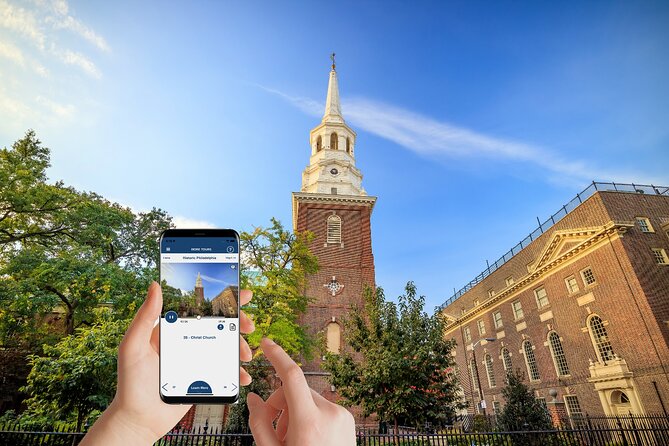
Philadelphia rewards people who can look up and keep walking, and this tour matches that style. Instead of being tied to a fixed group schedule, you use the Action’s Tour Guide App for location-based audio that cues the next story as you reach each stop.
The big win is pacing control. You can rush through the quick highlights, or linger longer at the places that pull you in—then just resume when you’re ready. And because the tour includes more than 30 audio stories across a compact route, you’re not stuck doing long stretches without context.
For me, it feels like the sweet spot between a guidebook and a live tour: the route is mapped out, but you stay in charge of your time.
You can also read our reviews of more tours and experiences in Philadelphia.


Price and value: $14.99 for a lifetime pass
At $14.99 per person for a self-guided experience, the value comes from two things: flexibility and time. You’re buying a reusable walking guide for the price of a single admission to one small exhibit, and you can take it across multiple trips.
The other value lever is that you’re not paying extra per story. Even if you choose not to enter every ticketed building, you still get the core context from the audio as you walk by. Some stops are marked admission ticket free, while others are explicitly not included, so you can decide on the spot where to spend money and where to just appreciate from outside.
Also, the “lifetime access, no expiry” part matters more than it sounds. If you come back to Philly later, you can re-walk the route and notice details you missed the first time—or add an extra pass through a single favorite zone.
Start at City Hall, then follow the thread toward Independence Hall

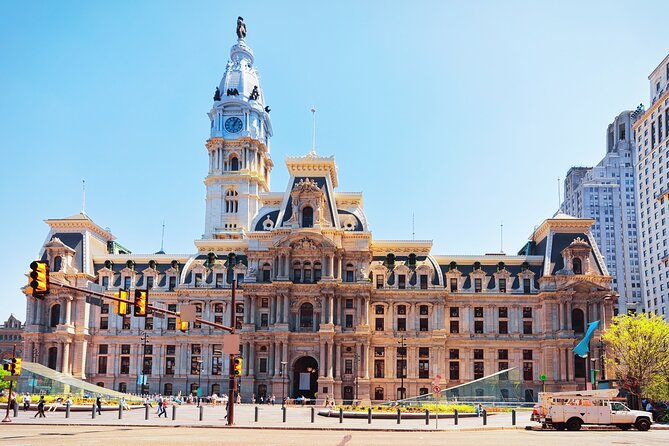
The route starts at Philadelphia City Hall (1400 John F Kennedy Blvd) and ends near the Museum of the American Revolution (101 S 3rd St). It’s designed as a walk-first route through the historic core, which means you’re mostly navigating on foot among major sites rather than crisscrossing the city.
Plan on about 1–2 hours. The tour notes say it’s around a 1.5-mile walk with many short story stops. That’s ideal if you want the main “founding-era” arc without committing to a half-day tour—or if you’re combining this with a museum visit later.
If you’re walking with kids, use the pause control. The tour’s structure works well for shorter attention spans because each stop is timed like a mini chapter, not a marathon lecture.
Liberty Bell Center to City Hall: freedom symbols and the sparks behind them
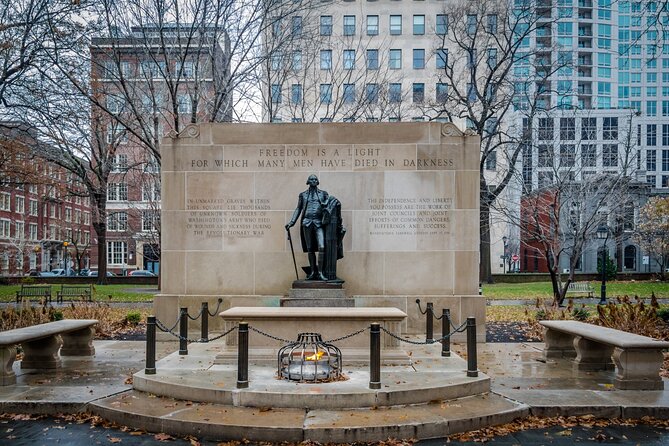
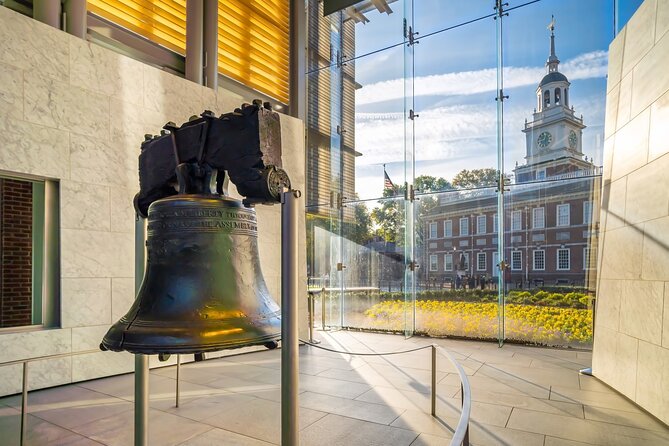
You kick off at the Liberty Bell Center. The audio focuses on why the bell became iconic—and why it’s famously susceptible to cracks. Then it links the bell’s story to later struggles for freedom from slavery, equal voting rights, and the broader idea of liberty. This stop is powerful because you’re standing at a physical object that became a moral symbol, not just a landmark on a map.
Next comes the Betsy Ross House. The key angle here is that the American flag’s birth is often overshadowed by the Declaration and Constitution. The tour brings it back to a specific moment: Betsy Ross and her meeting with George Washington during Sunday service at Christ Church. It’s a reminder that history doesn’t only happen in courtrooms and congresses; sometimes it happens in everyday religious spaces.
Then you head to Philadelphia City Hall. Even if you don’t go inside, the audio frames the building as part of a larger story: the Revolutionary War foundations, the roles of figures like George Washington and Benjamin Franklin, and the chain of events that helped push revolt—highlighting the Tea Tax as a catalyst.
Practical tip: you’ll be outside a lot, and street conditions change fast in the Center City blocks around here. If rain is in the forecast, bring a light layer. You’ll thank yourself halfway through.
Independence Square and the Declaration story arc (Independence Hall without the overload)
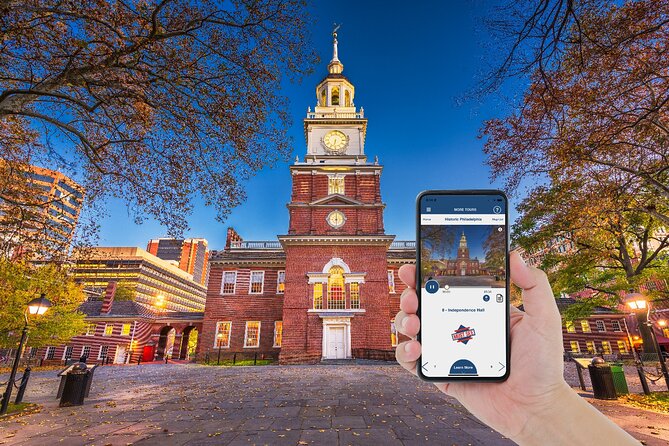
Once you arrive at Independence Square, the tour shifts to the core stage of early American governance. This is where the First Continental Congress unified colonial states into one working entity, and where planning for battles against the British took shape. The audio also covers the Second Continental Congress and how votes gathered across colonies culminated in the Declaration of Independence being brought to life.
You’ll also get context on key figures like John Hancock, Patrick Henry, and John Adams, plus a real-life sense of what Independence Hall meant to colonial Americans—and what it means now.
Near it, West Washington Square gives you a quick grounding moment: the site connected to the First Continental Congress, letting you understand the “beginning here” idea before you settle into the bigger Independence Hall narrative.
And if you like seeing multiple “told from the same spot” angles, this section is a good one. It’s not just names and dates; it’s how decisions got made, then how those decisions turned into symbols Americans still use today.
Benjamin Franklin’s zone: museums, inventions, and the Arnold twist
After Independence, the tour turns into a Franklin track, and it’s a good change of pace because Franklin is not just one thing. You go from governance and revolution into personality, invention, and political drama.
The Benjamin Franklin Museum stop is built around his interests and how those interests shaped his impact. The audio doesn’t only praise him—it also introduces the “anti-hero” angle with Benedict Arnold, focusing on what he planned. This makes the story feel more like real politics, with risk and betrayal, not just heroic portraits.
Then you pass by the President’s House, described as the first presidential home of George Washington and later John Adams. That’s a fascinating pivot: you’re walking through the early “executive branch” story, which helps fill in the gap between the revolution and the government that followed.
Next is Declaration House, connected to the Graff House, where Thomas Jefferson wrote the Declaration of Independence, with Ben Franklin helping edit. If Jefferson is your focus, this is the stop where the audio centers the writing and collaboration moment rather than the later political outcomes.
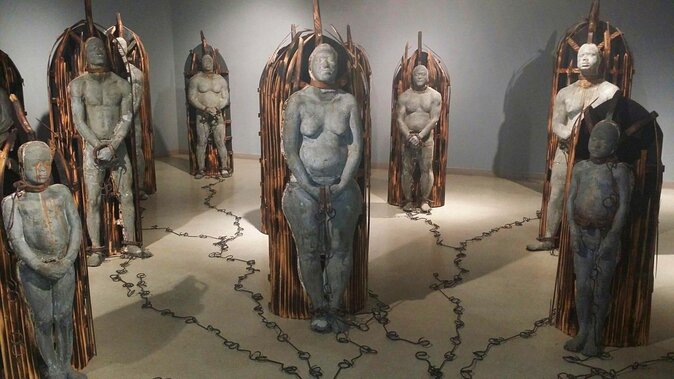
You also pass by the African American Museum in Philadelphia. The audio frames the theme directly: independence and freedom did not apply in the same way to African-Americans in early America. It includes names and contributions such as Crispus Attucks, tying major events to the people affected by them and the structures that limited their freedom.
This is one of the more important sections because it adds a layer that many quick tours skip: the contrast between ideals and lived reality.
Franklin Square and the Bolt of Lightning Memorial: science that became legend
After the heavy themes, you get some breathing room at Franklin Square. The audio stays on Franklin’s ideas and experiments—books, curiosity, and the range of his pursuits. It’s a practical break too because this is where you can rest and reset before the final stretch.
Right after that is the Bolt of Lightning Memorial to Benjamin Franklin. The narration focuses on what Franklin was discovering, why he wanted to test it, and how he planned to do it. It’s the science version of Franklin: less marble-statue reverence, more curiosity and method.
If you like history that explains cause-and-effect (why someone tried something, what risk they took, what they expected), this is where you’ll likely lean in.
Constitution Center to the Mint: rights on paper, money in practice
At the National Constitution Center, the audio connects Philadelphia’s revolutionary-era gathering to the creation of a concrete national union. The emphasis here is rights—how fundamental protections were framed in a way that still shapes society today.
Then you walk to the United States Mint, where the audio shifts to economics. You learn how early American money was tied to metals like gold and silver, plus copper and nickel, and how paper money fits into the evolving story. It’s a nice reminder that a new nation had to build trust and function every day, not just declare ideals.
After that, there’s a quieter, reflective moment at Benjamin Franklin’s Grave. The audio ties Franklin’s legacy to the future—specifically the role of the University of Pennsylvania (UPenn) as a reflection of Franklin’s ideals for the next generation.
Elfreth’s Alley and Christ Church: daily life meets revolutionaries
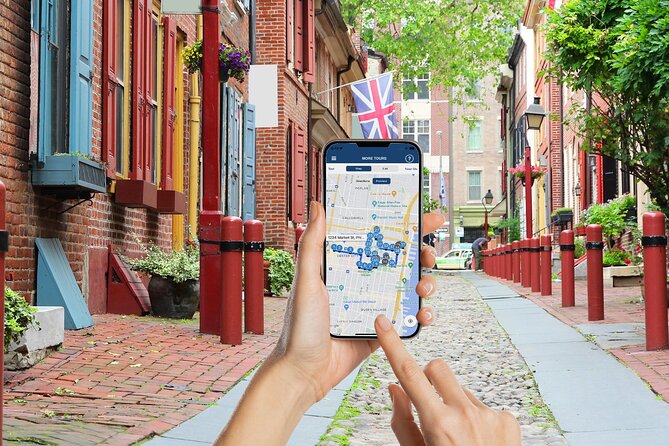
One of the more charming segments is Elfreth’s Alley, often a favorite because it feels like the city stepped back in time. The tour frames it as a downtown beginning, then tracks how it changed while keeping a colonial character. The audio also acknowledges it as a modern photo magnet, but the point is the layered timeline you can actually see in the street.
Then you head to Christ Church. The audio connects it to worship and community among revolutionaries like George Washington and Betsy Ross. It’s a strong payoff after you’ve heard about meetings and flag-making and political gatherings: the church gives you the “place where people gathered” thread.
Museum of the American Revolution area: decide if you want more inside
The final stop is near the Museum of the American Revolution. The audio journey ends here, but it intentionally gives you the option to keep going if you want more detail beyond what the walking tour provides.
If you’re short on time, this is a good finishing line: you get the big arcs without feeling like you must enter every museum. If you have more energy, it’s also a natural transition into an indoor deepening session.
How the app experience really works (and how to avoid frustration)
This tour is self-guided, which means no person meets you at the start. Instead, you open the Action’s Tour Guide App once you’re onsite, enter your password, and start at the location where story #1 begins. The audio then plays automatically based on GPS cues.
Two tech notes matter a lot:
- Download first in strong Wi‑Fi/cellular. The tour says you must download the tour while your connection is strong. After that, it works offline.
- Use headphones/earbuds. The tour recommends this for best listening, especially while you’re walking near traffic.
From the reported experiences, the app is usually easy to follow once downloaded. People like that the map is clear, the audio starts at the right times, and you can pause/restart.
That said, if you’re having access issues (wrong password, device mismatch, or the app not loading), don’t wait until you’re halfway through the route. Fix it early, while you’re still near the start.
Who this tour suits best
This is a strong fit if you want:
- a short, focused walk through Philadelphia’s founding landmarks
- self-paced freedom with hands-free audio
- a budget-friendly way to get context before paying for any optional museum time
It’s also a good choice if you’re traveling with mixed interests. Some people will love the Liberty Bell and Independence Hall core. Others may prefer Franklin’s inventions and the science memorial. The route has room for both.
If you’re trying to do it in a hurry, remember it’s designed to be walked. If you start looping around due to one-way streets or distance confusion, it can turn from pleasant to annoying fast.
Should you book this Philadelphia Historic Sites walking tour?
If you want Philadelphia’s founding story delivered in manageable chunks, this is an easy yes. The offline audio, the clear GPS-based start-and-stop behavior, and the lifetime access for $14.99 make it a smart value—especially if you like exploring on your own schedule.
I’d book it if you’re comfortable using a phone for navigation and you can download the tour on good internet before you start. I’d think twice if you rely on perfect app reliability every time, since setup problems can happen and you’re on your own once you begin.
Bottom line: it’s a practical way to get the big landmarks right, while still letting you linger where you care most.
FAQ
How long does the Philadelphia Historic Sites self-guided walking tour take?
It takes about 1 to 2 hours, depending on how much you pause for each story and any photos or side stops.
Does it work without internet?
Yes, it’s designed to work offline after you download it. The instructions note you must download the tour while in strong Wi‑Fi or cellular so it’s available without signal later.
Is this tour only in English?
Yes, the tour is offered in English.
Are entrance tickets included for the stops?
No. Some stops are marked admission ticket free, while others are marked as admission ticket not included, meaning you’d need separate tickets if you want to enter those specific places.
Where do I start and where does it end?
You start at Philadelphia City Hall (1400 John F Kennedy Blvd, Philadelphia, PA 19107) and you end near the Museum of the American Revolution (101 S 3rd St, Philadelphia, PA 19106).
What if I cancel?
Free cancellation is available if you cancel up to 24 hours in advance for a full refund. If you cancel less than 24 hours before the experience start time, the amount paid is not refunded.