REVIEW · MARRAKESH
Marrakech: Self-Guided City Smartphone Audio Tour
Book on GetYourGuide →Operated by Clio Muse Tours · Bookable on GetYourGuide
Smartphone-led Marrakech beats group stress. This self-guided tour turns the old city into a choose-your-own-walk with app pause/resume control and audio you can play while you roam. I like the offline maps setup too, because Marrakech streets can be busy and cell service can be flaky.
The one drawback to plan for is map behavior. In at least some situations, the navigation may try to route you toward a turn that does not match what you can actually walk, so keep your eyes up and be ready to adjust manually.
In This Review
- Key things I’d clock before you go
- A 90-minute Marrakech plan that lives on your phone
- Starting at Bab Ftouh: getting your bearings fast
- Souk Semmarine and Rahba Kadima: shop with a story in your ear
- Souk Semmarine: lamps, ceramics, and the why behind it
- Rahba Kadima: a square you can actually savor
- Medersa Ben Youssef: where your eyes need a little help
- Sidi Abdel Aziz Tabaa mausoleum: religion, place, and quiet details
- Jamaa El Fna square: what to listen for while you watch
- Offline maps and offline audio: make technology behave
- Price and value: why $11 can work here
- Who this self-guided Marrakech tour suits best
- Should you book this Marrakech smartphone audio tour?
- FAQ
- How long is the Marrakech smartphone audio tour?
- Where does the tour start?
- What’s the easiest way to reach Bab Ftouh?
- Do I need a live guide?
- Is the tour available in English?
- Can I use the tour offline?
- How much storage does the audio tour need on my phone?
- What phones can run this tour?
Key things I’d clock before you go

- Bab Ftouh is your launch point: you start right at the gate of the old walled city and get oriented fast.
- You control the pace with pause and resume, so you can linger at Rahba Kadima without feeling rushed.
- Souk Semmarine through headphones: the tour adds narration as you move past stalls selling lamps and ceramics.
- Medersa Ben Youssef makes more sense: the app explains what you’re looking at, not just where to stand.
- Jamaa El Fna gets context: you hear the facts and stories behind the square while you watch daily life unfold.
- Offline navigation matters: you get an offline maps feature, but you should still double-check the route you’re seeing on the ground.
A 90-minute Marrakech plan that lives on your phone

This is a self-guided smartphone audio tour built for independence. You download the app content (with offline support), then follow the route to major landmarks like Bab Ftouh, the madrasa of Medersa Ben Youssef, and the religious complex tied to Sidi Abdel Aziz Tabaa.
The big practical win is that you are not locked into a live guide’s pace or a group timetable. If you stop for photos, duck into a side lane to check a crafts stall, or just want a breather, you can pause the audio and restart when you’re ready.
At 90 minutes, it’s short enough to fit into a half-day, but long enough to feel like you actually learned something. Also, you can keep your plan in your pocket instead of juggling a paper map through Marrakech wind, noise, and crowds.
You can also read our reviews of more tours and experiences in Marrakesh.


Starting at Bab Ftouh: getting your bearings fast

The tour is designed to start at Bab Ftouh, a historical gate in the old city walls. If you’re coming in by bus, the easiest approach is to reach Ph Koutoubia bus station, then walk about 500 meters to Bab Ftouh.
Why this start matters: Bab Ftouh is a natural way to enter the maze. Instead of guessing where “old Marrakech” begins, you begin at a clear landmark, with the audio acting like your guide for the first steps.
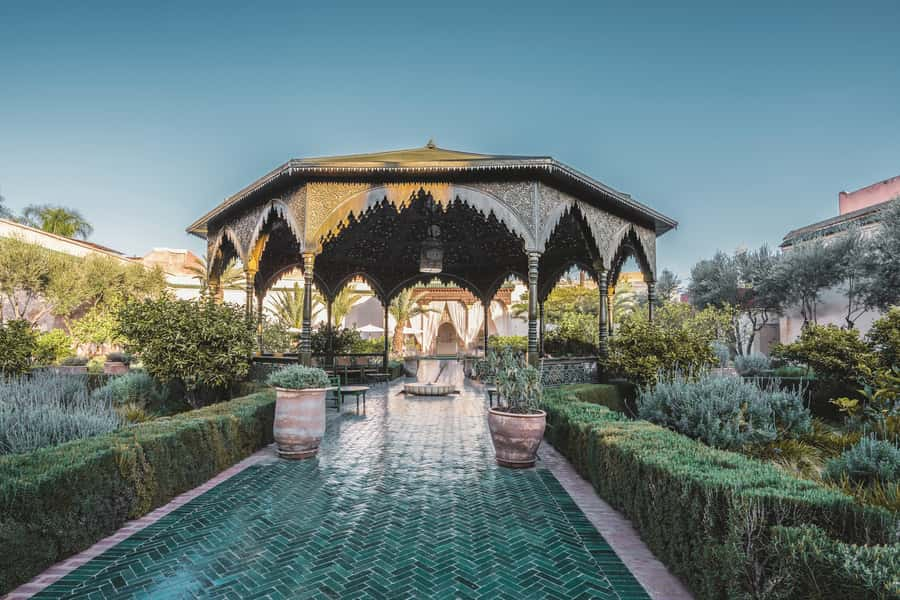
After you start, the tour also points you toward a secret garden. That’s the sort of little mental reward Marrakech does well: you leave the stone-and-street noise and suddenly you’re in a calmer pocket—at least long enough to take a breath and refocus.
Tip: put on your headphones before you cross into the busiest lane. It takes less than a minute, and it prevents the classic problem of walking two blocks while you’re still trying to make the app volume behave.
Souk Semmarine and Rahba Kadima: shop with a story in your ear
One of the tour’s strongest values is that it doesn’t just list sights. It gives you what to notice as you walk through markets and squares.
Souk Semmarine: lamps, ceramics, and the why behind it
The tour highlights the stalls at Souk Semmarine, including the feel of walking past lamps and ceramics. With audio in your ears, you can focus less on trying to interpret everything and more on absorbing how the market works and what’s behind the scenes.
Markets in Marrakech can feel like sensory overload. A self-guided audio track helps you slow down without needing a human guide translating on the fly. You get to listen, then you choose what to look at closely.
A small consideration: the audio experience works best if you stay near the route enough to catch the cues. If you wander far off into random lanes, you may not hear the matching narration.
Rahba Kadima: a square you can actually savor
The tour also builds in time for Rahba Kadima square. The nice part is that the tour can be paused and resumed, so you can stand at the edge, watch how people move, then come back to the next audio segment when you’re ready.
Rahba Kadima feels like a reset point. You’re not hunting for one specific building; you’re observing the rhythm of a neighborhood square. The audio context makes it easier to understand why this place matters, beyond the fact that it looks good for photos.
Medersa Ben Youssef: where your eyes need a little help

The tour routes you with maps to Medersa Ben Youssef, a famous Islamic madrasa. If you’ve ever visited a dramatic religious complex and felt like you were “just looking at walls,” this is where the audio earns its keep.
You’ll hear history and facts tied to the madrasa—so you can connect architectural details to the purpose of the building. That means less “spot the pretty tile” and more “I understand what this space was meant to teach.”
Practical comfort note: religious sites can mean slower walking, more standing, and sometimes cooler or warmer microclimates than you expect. Wear comfortable shoes and keep your head uncovered with a hat if the sun is high.
Also, headphones matter here. The audio is English, and you’ll want to catch the specifics while you’re in the right viewing position.
Sidi Abdel Aziz Tabaa mausoleum: religion, place, and quiet details
Another key stop is the religious complex and mausoleum of Sidi Abdel Aziz Tabaa. The tour again uses your phone’s navigation to get you there, then provides context as you look around.
Why this works as a self-guided moment: mausoleums and religious complexes often have layered meaning—who it’s connected to, why it’s honored, and how the space functions in the city. Without a live guide, it can be hard to know what question to ask. The audio gives you a starting point, so your visit feels grounded.
This is also the kind of place where pausing the audio might be useful. If you want to be respectful with your attention, you can let the track play when you’re ready, then stop it if the surroundings demand a quieter vibe.
Jamaa El Fna square: what to listen for while you watch
The tour includes Jamaa El Fna square and adds a story layer to what you see. Instead of arriving at the most famous square in Marrakech and feeling like you’re just watching the show, you can listen for the background facts that explain why this square keeps its power.
This matters because Jamaa El Fna is one of those places where the scene moves constantly: people, performers, vendors, and the sense of the city in motion. When you understand a bit of context, the square becomes more than a one-time photo stop.
If you’re short on time, use this as a planning anchor. Even if you don’t linger as long as you want, you’ll still get a better experience because the audio helps you interpret what’s right in front of you.
Offline maps and offline audio: make technology behave
The tour is built so you can avoid roaming charges by using offline content. It also includes an offline-capable maps feature, and you only need 100–150 MB of storage space on your phone for the tour.
Here’s what you should do before you leave:
- Make sure your headphones work and your phone is charged
- Download/activate the content with enough battery to start the route
- Keep your phone in a safe spot since you’ll be moving through busy areas
If you’re hoping the app will solve everything perfectly, manage expectations. One concern that comes up is navigation accuracy. If the map tells you to turn where there is no clear path, don’t fight it. Step back, re-orient visually, and continue toward the landmark cues you see in the real world.
Also note the device limits. You need Android 5.0+ or iOS, and it’s not compatible with Windows phones or older Apple devices (like iPhone 5/5C and older models listed in the activity notes). If you’re traveling with an older tablet or a spare phone, test it before you rely on it.
Finally, book per device, not per participant. That can be an easy budgeting win if you’re traveling as a pair and only one phone will do the navigating.
Price and value: why $11 can work here
At $11 per person for an English audio experience running about 90 minutes, the value depends on how you like to travel.
If you enjoy independence and you hate waiting for groups, the price makes sense because you’re paying for flexibility, not someone’s guiding time. You’re also getting more than “random audio.” The app includes text, audio narration, and maps, and it’s designed to move you between major landmarks like Medersa Ben Youssef, Sidi Abdel Aziz Tabaa, Rahba Kadima, and Souk Semmarine.
Where the money can feel wasted is if your phone struggles, the audio doesn’t load as expected, or the map can’t keep up with what you see on the street. The tour is still useful without flawless navigation if you can follow landmark cues, but your experience will be smoother if your app setup is solid.
Still, compared to booking a live guide for a short window, $11 is a low-stress way to get structure without losing your own rhythm.
Who this self-guided Marrakech tour suits best

This is a great match if you:
- Want a plan that you can pause and resume
- Prefer learning at your own pace rather than in a group
- Like major stops (Bab Ftouh, Ben Youssef, Jamaa El Fna) with enough context to understand what you’re seeing
- Travel with a smartphone you can use confidently offline
It’s also a decent choice if you want to explore beyond the exact path. The format leaves room for detours, and the app style makes it easier to jump back into the next segment when you’re ready.
If you’re the type who hates tech tasks while traveling—charging phones, downloads, headphone checks—then consider a backup plan. A self-guided audio tour only works as well as your phone setup.
Should you book this Marrakech smartphone audio tour?
Book it if you want a structured walk through old Marrakech without giving up control of your time. The tour is priced to be low risk, and it targets the landmarks that most visitors come to see—like Souk Semmarine, Rahba Kadima, Medersa Ben Youssef, and Jamaa El Fna—with audio explanations and offline support.
Skip it (or bring a backup strategy) if you don’t trust your phone for offline navigation, you’re using an unsupported device, or you prefer live answers to questions as you walk. In that case, you may end up spending more energy troubleshooting than enjoying the city.
If your goal is to get your bearings fast and learn enough to feel confident walking the medina, this is a practical choice.
FAQ
How long is the Marrakech smartphone audio tour?
The tour is designed for about 90 minutes.
Where does the tour start?
It’s designed to start at Bab Ftouh in the old walled city.
What’s the easiest way to reach Bab Ftouh?
The notes say to reach Ph Koutoubia bus station and then walk about 500 meters to Bab Ftouh.
Do I need a live guide?
No. This is a self-guided smartphone tour, so there is no live guide included.
Is the tour available in English?
Yes, the audio tour is included in English.
Can I use the tour offline?
The tour includes offline content and an offline-capable maps feature to help you avoid data use while navigating.
How much storage does the audio tour need on my phone?
You’ll need about 100–150 MB of storage space on your phone for the tour.
What phones can run this tour?
You need Android (version 5.0 and later) or iOS. The activity is not compatible with Windows phones, and it doesn’t work on older Apple devices listed in the activity notes (including iPhone 5/5C and older models, and older iPad/iPad Mini versions).