REVIEW · BERLIN
Love and War in Berlin: Self-Guided Story Puzzle Walk
Book on Viator →Operated by Questo · Bookable on Viator
Berlin asks you to look closer.
This self-guided story puzzle walk strings together big WWII-era moments with a walk you control, so you can pause for photos or just step aside and breathe. I love the format: offline play on your phone and zero crowd-pushing. I also like that it’s set up for an easy rhythm, with short stages that keep moving you through central Mitte. One thing to keep in mind: the clues are puzzle-based, so if you want a straight facts-only walk, you may have to tolerate a bit of mental work.
If you can handle that, this route is a smart way to get a Berlin center overview without feeling rushed. The stops mix iconic landmarks (like Alexanderplatz and Gendarmenmarkt) with harder history points (like Bebelplatz and the Memorial to the Murdered Jews of Europe), plus a stop at the site of Hitler’s former war bunker as part of the story. The only drawback I’d flag is practical: parts of central Berlin can get busy, and your puzzle route may occasionally need small detours around events or seasonal setups.
In This Review
- Key things I’d plan around
- Why This Berlin Puzzle Walk Works in Mitte
- Price Per Person: What You Really Get for $6
- Start at Alexanderplatz: The Urania World Clock Stage
- Rathaus Architecture Puzzle: Learning Berlin by Reading Stone
- Neptunbrunnen and Marx-Engels-Forum: History in the Middle of Everyday Life
- Lustgarten on Museum Island: Where Power Staged Itself
- Neue Wache: Prussian Neoclassicism with a Modern Reminder
- Bebelplatz Book Burnings: Reading a Square with New Eyes
- Gendarmenmarkt: From a Cuirassier Connection to Konzerthaus
- Hamburg’s State Representation: Politics Happens Here, Daily
- Memorial to the Murdered Jews of Europe: A Place You Control
- Hitler’s Former War Bunker: Where the Story Turns
- How to Keep the Puzzles Fun (Not Frustrating)
- Who Should Book This and Who Might Skip It
- Should You Book Love and War in Berlin: My Decision Guide
- FAQ
- Is this tour self-guided, or do I need a guide?
- Do I need internet to play?
- How long does it take?
- What language is it offered in?
- Where do I start and where do I finish?
- Are there any admission costs for the stops mentioned?
- Are service animals allowed?
- Can I start at any time?
Key things I’d plan around
- Offline-friendly puzzle format: you don’t need internet to play, so you can walk more calmly.
- Private, no-contact experience: you stay in control and avoid crowd chaos.
- Short, stage-based moments: each stop is built for quick problem-solving, then you move on.
- WWII and Nazi-era landmarks in one loop: you get context by walking through the city’s actual geography.
- Flexible start and breaks: you can begin any hour and pause whenever you want.
- Designed for English speakers: it’s offered in English for the story and challenges.
Why This Berlin Puzzle Walk Works in Mitte

This is not a typical guided tour with a single voice and a single pace. It’s a self-guided story puzzle walk that uses a “find the answer, unlock the next stage” approach. That matters because Berlin’s center is huge in places, but your day still has limits. Here, the route is designed so you spend your energy walking between meaningful points, not waiting in lines or searching for directions.
The tour is private—your group plays together without strangers joining your path. And there’s no human contact, meaning you’re not stuck around a guide schedule. If you like to explore on your own terms, this format fits. If you hate phones on trips, you’ll still probably enjoy it, because the puzzles are there to make you look, not to trap you in a screen.
The duration is about 1 hour on average, but your real time will depend on how long you take at each stop. The stages are short, and you can take breaks and resume later, which is great if you’re pairing this with museums nearby or just want an easy win early in the day.
You can also read our reviews of more tours and experiences in Berlin.

Price Per Person: What You Really Get for $6
At $6 per person, this is one of the cheapest ways to turn a walk through central Berlin into a structured mini-journey. You’re paying for the story and puzzle system, not for a lecture or a transport component. That’s why the value is high: Berlin is built for walking, and you’re already in a dense area of major sights.
Also, because it’s always available to book and designed to be played offline, you don’t lose money if your schedule shifts. A guided tour often charges more because someone is staffing it. Here, you get a “guided-by-design” experience without paying for a guide.
Just be honest with yourself: if you love unstructured wandering, you could do this route on your own for free by reading plaques and guidebooks. But if you want the city to steer you toward the right details at the right moments, $6 feels like a bargain.
Start at Alexanderplatz: The Urania World Clock Stage
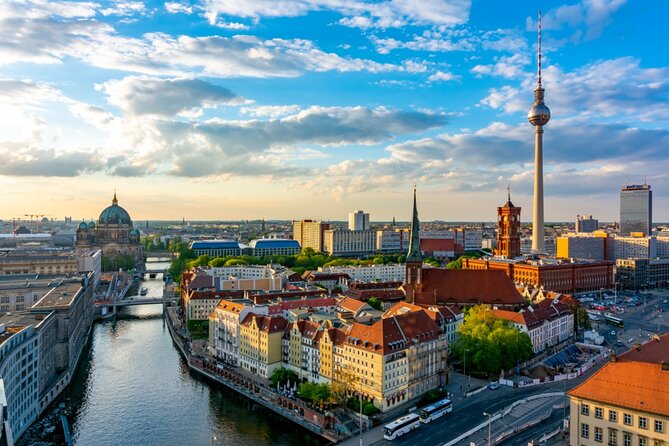
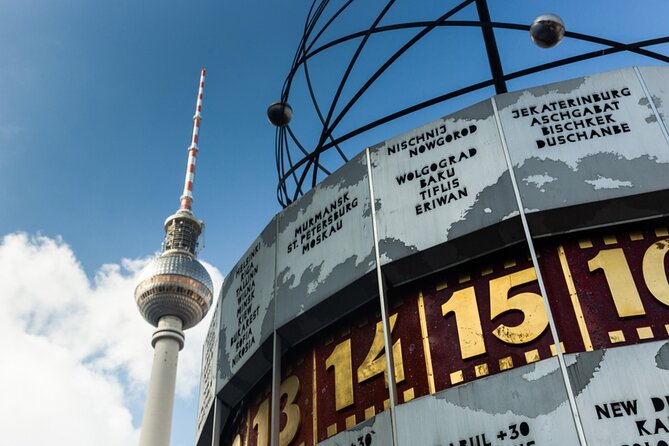
Your walk starts at Alexanderplatz and the classic turret landmark called the Urania World Clock. It’s the kind of place you can see from a distance and then forget, unless something forces you to stop and study it. This puzzle does that.
The challenge here is observational: you look around the metal structure and decode an answer tied to the world clock display. What I like about this first stage is that it gets you into “Berlin mode” fast. Alexanderplatz is busy and visually loud, and the world clock gives you a reason to slow down instead of just rushing across.
Practical note: the clock sits in a public square, so it’s straightforward to reach on foot or by transit. If you’re jet-lagged, this first stop is still easy to start because it’s outdoors and you’re not wrestling with indoor spaces.
Rathaus Architecture Puzzle: Learning Berlin by Reading Stone
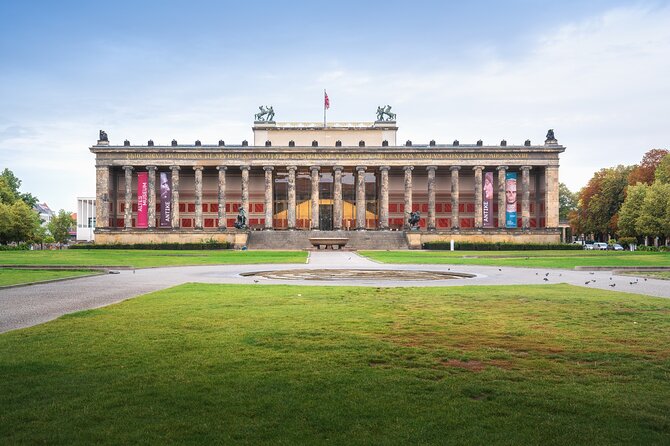
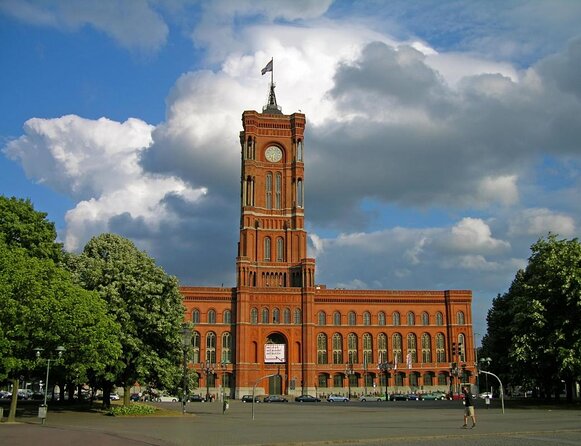
From Alexanderplatz, the route heads toward the Rathaus built between 1861 and 1869. The building style is described as Northern Italy High Renaissance, and it’s modeled on a town hall in Thorn (today Toruń, Poland). Even if you’re not an architecture nerd, those connections are useful, because they remind you that Berlin didn’t develop in a vacuum.
The puzzle stage here asks you to look around for a specific answer tied to the building’s story. That means you won’t just admire the front and move on. You’ll likely notice details you would otherwise skip: design cues in the tower and references implied by the historical modeling.
This is also a nice stage to use your “slow down” power. If you like taking photos, do it here. The Rathaus gives you enough visual material that you can feel like you’re learning while you’re simply standing there.
Neptunbrunnen and Marx-Engels-Forum: History in the Middle of Everyday Life
Next up is Neptunbrunnen, the Neptune Fountain designed by Reinhold Begas, built in 1891. It’s near enough to central traffic that you’re likely to pass it without thinking. The puzzle nudges you to notice the obvious center figure—Neptune—and then connect the stage to the story you’re building.
A short stop like this is smart. It breaks the longer emotional weight points into smaller chunks. Also, the fountain stage is marked as free in ticket terms, so you’re not juggling admission on top of puzzle-solving.
After that, you reach Marx-Engels-Forum, a public park in Mitte named for Karl Marx and Friedrich Engels. The park was created by former GDR authorities in 1986. What’s valuable here is that the route doesn’t treat ideology as abstract. You see it placed in a public landscape, meant for everyday life—not just textbooks.
If you’re trying to build a big-picture understanding of 19th and 20th-century Europe, this stop helps you connect social movements to Berlin’s physical map.





Lustgarten on Museum Island: Where Power Staged Itself
The walk continues to the Lustgarten on Museum Island, near the site of the former Berliner Stadtschloss. The park’s history is explained through its changing roles: parade ground, mass rally space, and then later a public park.
That’s a key theme for this route. Berlin isn’t just a collection of monuments. It’s a set of stages—literal and political. The puzzle stage here pushes you to look for the right answer, but what stays with you is the sense that this exact area has been used by different regimes to gather crowds.
One reason I like adding Lustgarten in a self-guided story walk is that it’s a mental breather. You can sit if you want, watch people move through Museum Island, and then brace yourself for the heavier memorial stops later.
Neue Wache: Prussian Neoclassicism with a Modern Reminder
On Unter den Linden, you reach the Neue Wache, built between 1816 and 1818 by Karl Friedrich Schinkel. It originally functioned as a guardhouse and memorial related to the Liberation Wars. The building is considered a major example of Prussian Neoclassical architecture, and the setting on one of Berlin’s best-known boulevards helps you understand why this structure mattered.
The puzzle stage here is another “look around to find the answer” moment. But don’t underestimate how effective this stop can be even if you don’t feel like you’re solving anything. Neoclassicism can look calm and clean on the outside. Up close, it turns into a reminder that states often package their most intense messages in formal, controlled designs.
This stop is a good place to slow down and take in the contrast: pretty architecture in a location tied to memory and public meaning.
Bebelplatz Book Burnings: Reading a Square with New Eyes
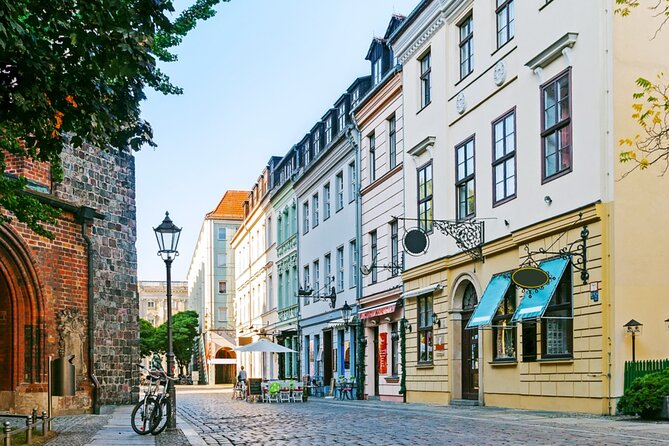
The route then brings you to Bebelplatz, famous for the Nazi-era book burning ceremonies on 10 May 1933. The event was initiated and hosted by the nationalist German Student Association, which helped them steal a march on rival groups tied to National Socialism.
This is one of the points where a puzzle walk does something practical: it makes you stop. That matters, because book burnings can become a line in a history lesson. Here, you stand in the actual urban space and let it hit differently.
The stage is marked as free in ticket terms, which helps. You’re not paying to access meaning. You’re paying in time and attention. For me, that’s the right kind of cost for this kind of place.
Tip: keep your expectations flexible. Some history stops are heavy. If you need a minute to adjust your pace, do it. This format lets you pause without messing up the entire day.
Gendarmenmarkt: From a Cuirassier Connection to Konzerthaus
At Gendarmenmarkt, the story shifts from war and oppression to how Berlin’s center shapes culture and public life. The square gets its name from the “Gens d’armes” cuirassier regiment; their stables were demolished by Friedrich II. Between the churches, a theatre was built, now known as Konzerthaus Berlin.
The puzzle encourages you to look for the answer tied to this place, but the payoff is in how the square feels. It’s formal, designed, and theatrical in the literal sense. And once you know the naming backstory, you start seeing the square as something built to represent order and power—then later repurposed for arts.
This stop is also an easy one to enjoy. It helps balance the emotional load of the memorial-focused stages.
Hamburg’s State Representation: Politics Happens Here, Daily
Midway through the route, you reach the state representation of the Free and Hanseatic City of Hamburg in Berlin, located in the classicist town house on Jägerstraße. The description notes that everyday political life happens there: over 500 events and encounters take place every year, and the site hosts things like discussions and meetings tied to governance.
This is a clever inclusion because it grounds the WWII and memory narrative in what comes after. It’s not just past suffering. It’s a reminder that modern Germany runs on institutions—and those institutions use real spaces in the capital.
The puzzle stage here again uses “look around” to move you through. Even if politics isn’t your main interest, the stop helps you understand Berlin as a living capital, not a museum outdoor.
Memorial to the Murdered Jews of Europe: A Place You Control
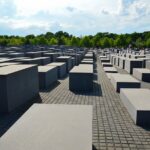
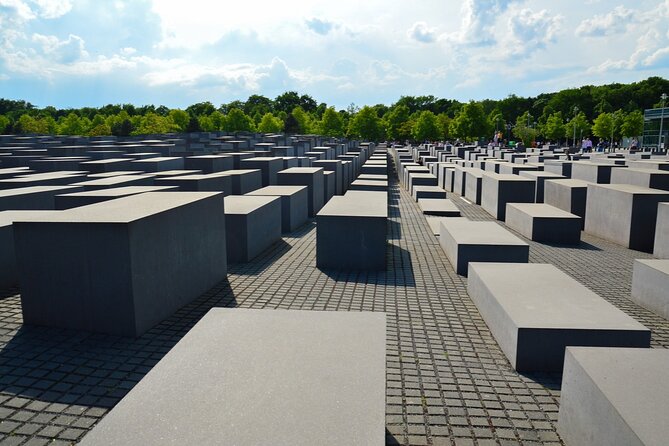
The route ends at the Memorial to the Murdered Jews of Europe, designed by Peter Eisenman and ceremonially opened in 2005. The memorial is part of a major national decision made in 1999, with a design competition that Eisenman won.
What I like about bringing this memorial into a self-guided story format is pacing. Some people want silence. Some want to read every informational element. This walk doesn’t force you to keep up with a group. You can take the memorial at the speed your mind can handle.
The stage here is again puzzle-driven, which can be tricky emotionally, but it also ensures you don’t treat the memorial as a quick photo stop. You’re meant to engage.
If you’re planning to visit other memorials or museums the same day, I’d give this one extra time. Even with an hour-long average experience time, memorial spaces often take longer in real life.
Hitler’s Former War Bunker: Where the Story Turns
The highlight notes that the route includes the site of Hitler’s former war bunker. Even without specific building details provided here, that location matters intensely in any WWII-centered itinerary. This is where the story framing labeled Love and War starts to make sense as a theme rather than just a history list.
A puzzle walk can be surprisingly effective here. Instead of dumping facts on you, it gives you a moment-by-moment way to connect place to meaning. You’ll likely feel the difference between walking through architecture and walking through the geography of decisions.
If you’re the type who likes to understand why memory sites exist, this is one of the moments that can stay with you.
How to Keep the Puzzles Fun (Not Frustrating)
I’ll be real: puzzle walks are only fun if you don’t get stuck. One review noted that some questions are hard and some answers are very precisely defined, which can make it tempting to overthink. I’d plan for that by using a simple strategy:
- If you’re stuck, pause and look at the stage as a scavenger hunt, not a trivia question.
- Read the clue carefully, then scan your surroundings slowly.
- If it’s taking too long, give yourself a short time limit and move on to the next section if the system allows.
Also, central Berlin can throw curveballs. One person mentioned the route passing through areas affected by a Christmas market, requiring detours to stay on the intended path. That’s not a guarantee, but it’s a good reminder: if you see temporary setups blocking the direct line, follow the puzzle guidance and reroute around them rather than forcing it.
Finally, bring comfortable shoes. The route is short, but you’re doing repeated “stop and look” actions across a compact area. Your feet will feel it more than you expect.
Who Should Book This and Who Might Skip It
This experience is a great fit if you want:
- a self-paced way to explore central Berlin’s landmark density
- a phone-based story that helps you notice details you’d otherwise miss
- WWII-centered context that’s built into the walk, not tacked on at the end
It’s less ideal if you want:
- a traditional guided lecture with a single historical narrative delivered nonstop
- zero puzzle-solving effort
- a walk that stays strictly on the most photogenic corners, with minimal emotional weight
The balance here is honest: there’s beauty in places like Gendarmenmarkt, but there’s also a sharp edge in Bebelplatz and the memorial. If that mix works for you, you’ll probably enjoy the pacing.
Should You Book Love and War in Berlin: My Decision Guide
Book it if you like Berlin but want a smarter way to see Mitte than just following a map. For $6, the offline, private puzzle format turns a short window into a real learning walk. It’s also a strong choice if you’re traveling with someone who likes planning but hates rigid group pacing.
Skip it if you truly hate puzzles or want purely guided storytelling without any “look around and solve” moments. And if you have only a few hours and you’d rather spend them inside museums, you might put the walking puzzle on a separate day to avoid overloading.
FAQ
Is this tour self-guided, or do I need a guide?
It’s a private, no human contact experience. You play the story puzzle yourself, using the mobile ticket and the offline game.
Do I need internet to play?
No. You can play offline and you do not need an internet connection to solve the puzzles.
How long does it take?
It’s listed at about 1 hour on average.
What language is it offered in?
It’s offered in English.
Where do I start and where do I finish?
You start at Alexanderpl. 1, 10178 Berlin and end at Cora-Berliner-Straße 1, 10117 Berlin.
Are there any admission costs for the stops mentioned?
Some stops are specifically marked as ticket free, including Neptunbrunnen and Bebelplatz.
Are service animals allowed?
Yes, service animals are allowed.
Can I start at any time?
You can start at any hour, and you can take a break and resume later.