REVIEW · DELPHI
Delphi: Self-guided Audiovisual Tour with 3D Representations
Book on Viator →Operated by Culture App · Bookable on Viator
Delphi can feel confusing without labels. This self-guided audiovisual tour adds a GPS map plus 3D models and 360° panoramas so you can piece Delphi together in your own order. I like that the audio narration and text explain what you’re looking at across many key spots, and it’s offered in 8 languages.
One thing to plan for: the experience needs internet access to work properly, so don’t rely on phone batteries and offline luck.
In This Review
- Key Things to Know Before You Go
- How the Culture App Tour Works (and Why You’ll Care)
- Your Route at Delphi: Simple Start, Clear Stops
- Stop 1: Delphi, the Omphalos, Apollo, and Pythia
- Stop 2: Treasury of the Athenians and Why Politics Shows Up in Stone
- Stop 3: Tholos of Athena Pronaia and the Doric-Ionic-Corinthian Surprise
- The App Content: Audio, Text, 3D Models, Panoramas, and Videos
- Pricing and Value: The $8.09 Reality Check
- When to Go and How Long You Actually Need
- Who This Tour Fits Best (and Who Might Want a Different Option)
- Should You Book This Delphi Audio Tour?
- FAQ
- Where does the Delphi self-guided tour start?
- How long does the tour take?
- Is the entrance ticket included in the $8.09 price?
- What languages are available for the audio narration?
- What do I need on my end to use the tour?
- Does the tour use a map or GPS tracking?
- How many monuments are covered?
- Are there any 3D visuals included?
- What are the opening hours for the activity?
- Can I cancel for free?
Key Things to Know Before You Go
- GPS interactive map helps you move stop to stop without guessing
- 3D reconstructions + 360° panoramas make ruined buildings easier to picture
- Audio + text for 16 monuments keeps the site from turning into random stone
- Video clips for 14 monuments add context when your eyes need help
- 8 languages makes it workable for mixed-language groups
- Start/end at the Athenian Treasury keeps the route simple
How the Culture App Tour Works (and Why You’ll Care)
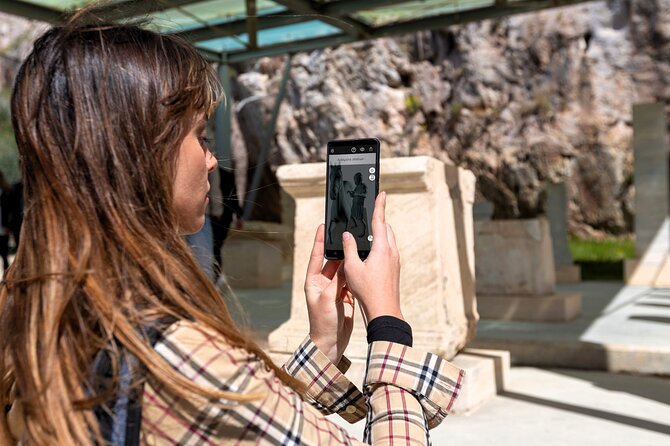
You don’t meet a guide at a podium. Instead, you download the Culture App, pick your language, and the tour takes you through Delphi using an interactive map with GPS tracking. That matters because Delphi is a walk-first site: you’ll be bouncing between slopes and ruins, and it’s easy to lose your place if you don’t have a guide-style roadmap.
The tour runs about 1 hour to 1 hour 30 minutes, so it fits nicely between other Delphi stops (or as your main event if you only have a short window). You also get a content mix: audio narration plus text information, along with 3D models and 360° panoramas for many monuments. For a place where so much is broken and scattered, that combination is a big deal.
Also, since you’re self-guided, you control the pace. If one area makes you pause, you can linger. If you want to power through, you can do that too. You’re not stuck with someone else’s walking speed.
You can also read our reviews of more tours and experiences in Delphi.


Your Route at Delphi: Simple Start, Clear Stops
This tour begins at the Athenian Treasury. When you finish, it ends back at the same meeting point. That round-trip setup is practical: you’re not stuck figuring out transportation back across the site after you’re done.
You’ll follow three main stops that cover Delphi’s story in a logical way. The first stop sets the scene around the oracle center and the famous sacred symbolism. The second stop zooms in on a monument tied to Athenian identity. The third stop shows off a standout piece of architecture in the sanctuary of Athena Pronaia.
The stops are short, so you’ll want to treat the app like your on-site coach. Let the audio tell you what to look for before you look. It’s the fastest way to avoid standing in front of a ruin thinking, I know this matters, but I can’t see why.
Stop 1: Delphi, the Omphalos, Apollo, and Pythia
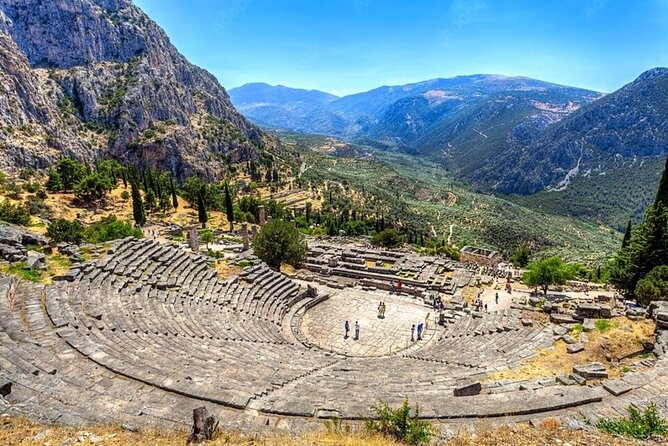
At the first stop, the tour frames Delphi as the famous religious hub at the foothills of Mount Parnassos. You’ll hear the legend about Zeus sending two eagles from the ends of the universe, with their meeting at the foot of Parnassos marking Delphi as the navel of the world (the Omphalos idea). It’s a myth, yes—but it’s also the perfect way to understand why people cared so much about this site.
Then the narration shifts to Apollo and the role of his priestess, Pythia. This is where the ancient world becomes clearer: Delphi wasn’t just a scenic landmark; it was a place people turned to for guidance at important moments. The app also connects that to the Sacred Way, noting how the Greeks built major monuments along the route leading to Apollo’s temple.
A detail I appreciate here is the time jump. The narration notes that Christians took over the sanctuary operations in the 4th century AD. That gives you a fuller view of Delphi’s long life, instead of treating it like a frozen snapshot of antiquity.
Practical tip: don’t rush Stop 1. If you wait until later to listen, you’ll miss the emotional logic of the place. Even if you only have 60 minutes, let the opening audio set the stage first.
Stop 2: Treasury of the Athenians and Why Politics Shows Up in Stone

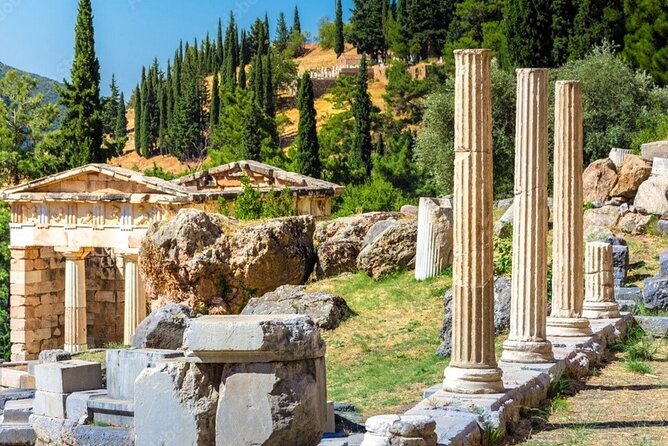
The second stop is the Treasury of the Athenians, tied to Athens’ effort to build a monument in the late 6th or early 5th century BC. This is a smart choice for a self-guided tour because it adds meaning beyond religion. Delphi wasn’t only about gods; it was also about city-states using Delphi to project identity and achievement.
The tour connects the treasury to the development of democracy in Athens and to victory against the Persians at Marathon. It also tells you what was inside: military trophies and votive offerings were kept in the building. That means when you look at the structure, you’re not just looking at architecture. You’re seeing a storage house for symbols of success and gratitude.
If you tend to enjoy when history links to specific events, you’ll like this stop. If you’re the type who wants pure atmosphere and sweeping views, it’s still worth it because it explains why Athens would invest money here in the first place.
Downside to consider: since this stop is very brief (about 5 minutes), you’ll need to keep your phone handy and your attention up. If your app cuts out or your screen brightness is low, you’ll lose context fast.
Stop 3: Tholos of Athena Pronaia and the Doric-Ionic-Corinthian Surprise
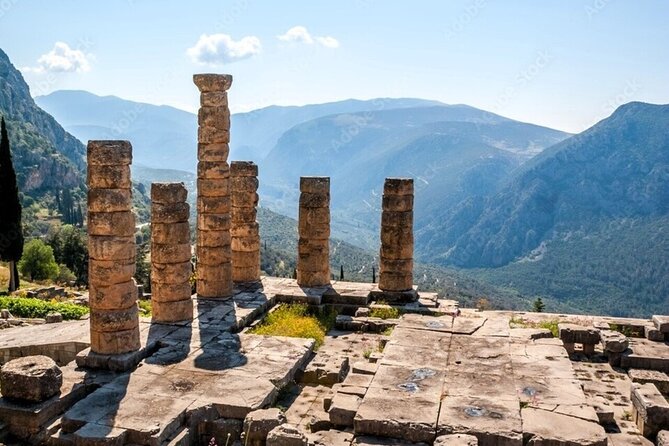
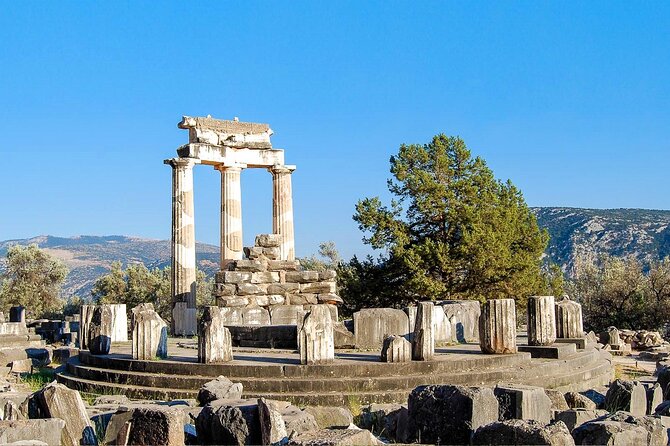
The third stop is the Tholos of Athena Pronaia, dated to 380 BC. The app explains that it was located in the sanctuary of Athena Pronaia and likely connected to a chthonic cult, meaning a practice linked to the underworld.
This is one of the best stops for people who like architecture. The narration highlights something specific: the tholos is known for combining three Greek architectural orders—Doric, Ionic, and Corinthian—within one structure. It’s rare enough to be memorable, and having that explained helps you stop seeing it as just another circular ruin.
You also get a satisfying name drop: the building is associated with the architect Theodoros from Phokaia (the app notes Minor Asia or Phokis as possible origins) and says he also wrote a book on the structure. That’s the kind of detail that makes a stop feel more human, like you’re hearing about a mind behind the stone.
Another reason I like this stop for self-guiding: the app’s 3D models and 360° panoramas can help you understand the shape and design even when you’re staring at fragments.
Practical tip: take a minute to rotate your view slowly and match it to what the model/video section shows. If you just look straight ahead, you might miss the design logic the tholos is famous for.
The App Content: Audio, Text, 3D Models, Panoramas, and Videos
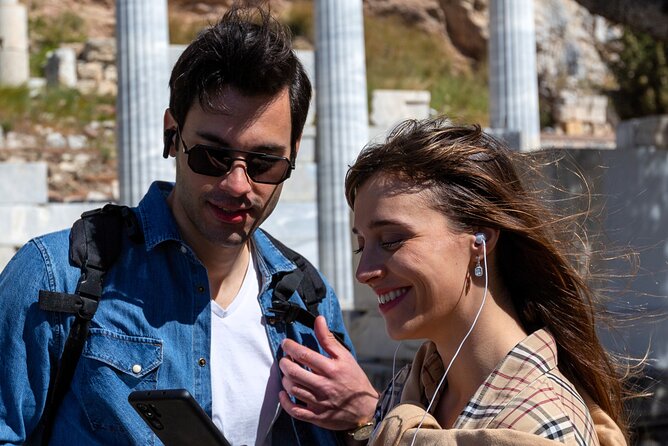
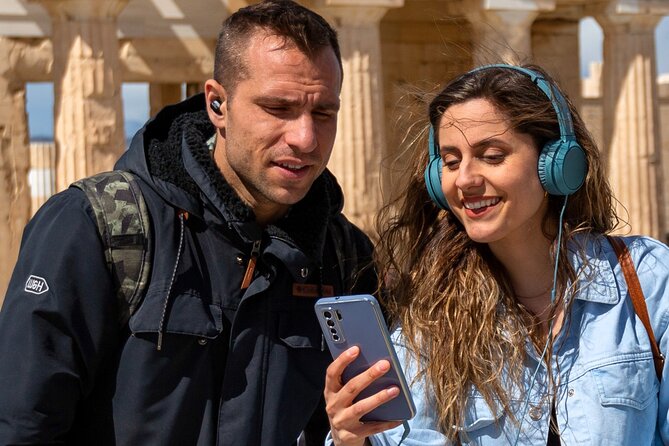
This is where the experience earns its price. The tour includes audio narration and text information for 16 monuments, plus 3D models and 360° panoramas for 14 monuments, along with video clips for 14 monuments. You’re not relying on one format. If your eyes can’t decode a ruin from ground level, the visuals can do the heavy lifting.
I also like that the experience offers 8 languages (English, Greek, Spanish, German, French, Italian, Dutch, and Chinese). That’s especially useful in a mixed group where one person wants English but another prefers something else.
A self-guided tour can go either way: sometimes you get a bunch of audio that sounds generic. Here, the structure is designed around monuments, so the explanations line up with what you’re standing near. The result is less guesswork and more moments where you go, Ah, that’s what I’m looking at.
One note: since the tour needs internet access to function properly, plan for a spotty signal. If you’re the kind of person who runs on low battery, bring a charger. Delphi won’t care that you’re trying to finish the last 30 minutes.
Pricing and Value: The $8.09 Reality Check
The price is $8.09 per person for the self-guided experience. The key detail is that the entrance ticket is not included. The full ticket is 12€ and the reduced ticket is 6€.
So you should think of this as paying for the app experience, not for site admission. Value-wise, that can still be a good deal because you’re getting a lot of content: audio/text for 16 monuments, plus 3D/360 for 14. You’re also not paying for a guide’s time. If you’re comfortable walking and reading the moment you stop, $8.09 is a low-stress way to upgrade what you see.
If you already travel with a lot of guidebooks and don’t need digital help, you might feel it’s extra. But if you’ve ever stared at ruins and thought your brain needed a translator, the 3D and audio combo is exactly that translation.
When to Go and How Long You Actually Need
The site opening hours listed are 8:00 AM to 8:00 PM, daily. That flexibility matters in Greece, where plans change fast and weather can shift your timing.
For your schedule, plan on about 1 to 1.5 hours for the tour itself. The stops are short, but the app content is meant to be consumed while you’re near each monument. If you rush through without listening to the key points, you won’t get the real benefit of the 3D reconstructions and the monument-by-monument explanations.
Also, because the experience is self-guided and capped at a max of 999 travelers, you shouldn’t expect the tour to feel like a tightly controlled group schedule. Still, the actual Delphi site can have its own crowds depending on the time of day, so earlier can be calmer.
Who This Tour Fits Best (and Who Might Want a Different Option)
This tour is a great fit if you:
- prefer a self-paced walk with clear cues via GPS
- want architectural and religious context without booking a guided group
- travel as a pair or small group and want shared discovery without waiting for others
- enjoy when 3D visuals help you understand what ruins are hiding
It may be less ideal if you:
- don’t want to rely on your phone or don’t have internet access available
- need lots of human interaction and Q&A at each stop
- only want a quick pass through ruins with minimal reading/listening
In plain terms: this is for people who enjoy learning on the move. If you like to look, listen, and connect the dots yourself, you’ll get a lot from it.
Should You Book This Delphi Audio Tour?
If you’re visiting Delphi without a guide and you want a clear path through the most important monuments, I’d book it. The price is reasonable, and the mix of audio plus 3D and 360° tools is exactly what helps Delphi make sense.
I’d hesitate only if you know you’ll struggle with internet access or you’re likely to have low battery stress. If your phone is dependable and you can keep connectivity on, this tour is a smart way to turn Delphi from scattered ruins into an understandable story.
FAQ
Where does the Delphi self-guided tour start?
It starts at the Athenian Treasury in Delphi, at Delfi 330 54, Greece, and it ends back at the same meeting point.
How long does the tour take?
The tour lasts about 1 hour to 1 hour 30 minutes.
Is the entrance ticket included in the $8.09 price?
No. The entrance ticket is not included. The full ticket is 12€ and the reduced ticket is 6€.
What languages are available for the audio narration?
The tour is available in English, Greek, Spanish, German, French, Italian, Dutch, and Chinese.
What do I need on my end to use the tour?
You need a smartphone to download and run the app. Headphones are not included, and the tour requires internet access to function properly.
Does the tour use a map or GPS tracking?
Yes. It includes an interactive map with GPS location tracking.
How many monuments are covered?
There is audio narration and text information for 16 monuments, with 3D models and 360° panoramas for 14 monuments, plus video clips for 14 monuments.
Are there any 3D visuals included?
Yes. The tour includes 3D models and 360° panoramas to help you see architectural details.
What are the opening hours for the activity?
The listed opening hours are 8:00 AM to 8:00 PM, Monday through Sunday.
Can I cancel for free?
Yes. You can cancel for free up to 24 hours in advance for a full refund. If you cancel less than 24 hours before the start time, the amount paid will not be refunded.