REVIEW · THE HAGUE
Delft: City Walk with Audio Guide in 7 Languages on your Phone
Book on Viator →Operated by City App Tour · Bookable on Viator
GPS audio makes Delft feel close. This self-guided city walk uses GPS route guidance and a 7-language audio guide on your phone, so you can pace yourself through the sights without getting stuck with a rigid schedule. I like that the route is designed around both big landmarks and lesser-known stories, so you come away seeing Delft with context, not just postcards.
My favorite part is the app’s guidance style. The interface helps you stay oriented, and the route markers fade once you’ve passed an attraction, which keeps the walk from turning into constant checking. One thing to plan for: you’ll need your own smartphone plus internet and GPS, and headphones are not included.
You’re looking at about 2 to 3 hours on foot (around 5.1 km) with 37 audio stops, and you can continue until the end of the next day if you need a slower pace. The tour ends back where you start, which is handy when you’re hopping between cafés and museums.
In This Review
- Key highlights at a glance
- How the phone audio guide keeps you on track
- Nieuwe Kerk: Delft’s skyline church and its tombstone stories
- City Hall on the Markt: fires, rebuilding, and Civic Delft
- Beestenmarkt: where cattle markets once ruled the square
- Vermeer connection and Delft blue pottery shopping on your route
- Oude Kerk and the leaning question that makes you look twice
- Oostpoort: the last city gate and a photo stop with real meaning
- How long it takes and how to plan your breaks
- Price and value: what $8.68 buys you in Delft
- Who should book this self-guided Delft walk
- Should you book this Delft city walk audio guide?
- FAQ
- What is the duration of the Delft city walk audio guide?
- How much walking is involved?
- How much does it cost?
- What’s included in the experience?
- What do I need to bring?
- Do I need internet and GPS on my phone?
- Where does the tour start and end?
- How many stops and stories are there?
- In how many languages is the audio guide available?
- Is free cancellation available?
Key highlights at a glance
- GPS guidance you can trust so you’re not guessing where to turn in Delft’s center
- Audio in 7 languages built right into the app, so you can switch what you need
- Route markers that fade when you’ve seen each stop, reducing constant phone fiddling
- 37 stories across 5.1 km meaning you get variety without a marathon
- Flexible timing: 2 to 3 hours typical, but you have until the end of the next day to finish
How the phone audio guide keeps you on track
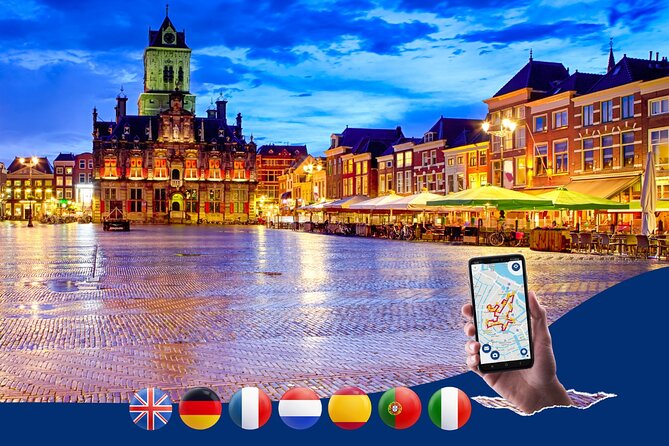
This experience is built around a simple idea: you walk, the app talks, and GPS tells you where you are. You get an app with an audio guide in 7 languages and turn-by-turn style support via GPS. That matters in Delft, because the city center is compact, but the best photo angles and the most interesting corners aren’t always on the main drag.
You’ll also get instructions by email on how to activate the self-guided tour. After that, you’re free to control the pace—linger near church monuments, pause for Delft blue pottery browsing, or duck into a break without losing the thread.
Practical note: the tour requires an internet connection and GPS function on your phone. So before you start, check battery levels and data access. If your phone battery is shaky, bring a charger or power bank if you can. Finally, don’t forget headphones. The tour audio is designed to be listened to on your phone, not on speakers.
You can also read our reviews of more tours and experiences in The Hague.



Nieuwe Kerk: Delft’s skyline church and its tombstone stories
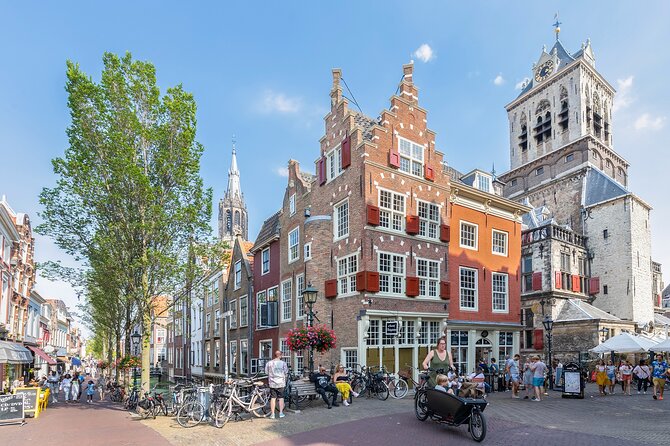
The walk opens you up to one of Delft’s most recognizable silhouettes: the Nieuwe Kerk, or New Church. This historic Gothic church dates to the late 14th century and has a soaring brick spire that rises over 100 meters. Even if you only catch it from one angle, you’ll immediately understand why it anchors the city’s skyline.
Inside, the audio focuses on why this church matters beyond architecture. You’ll hear about monuments and tombstones, including the final resting place of Dutch royalty. It’s also still active—used for worship and cultural events—so you’re not just reading museum-style facts. You’re seeing a working landmark where history still has a pulse.
One tip for getting the most out of this stop: don’t treat it like a quick photo and walk-through. Give yourself a few extra minutes to listen to the audio before you move on. The height and age of the church are impressive, but the story helps it click.
Possible drawback: churches can be unpredictable for visitor flow during events. Since this is self-guided, you can’t control entry times, so if you arrive during something busy, you might need to wait for access or simply adjust your timing.
City Hall on the Markt: fires, rebuilding, and Civic Delft
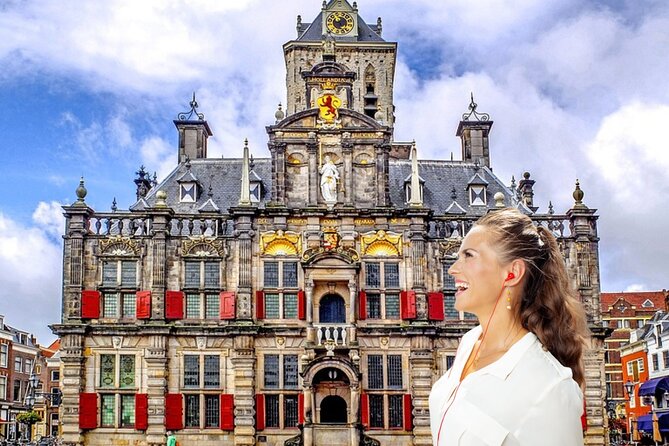
Right across from the Nieuwe Kerk is the Markt square—and the Delft City Hall sits on that square as a core part of the city’s identity. The guide’s storytelling gives you a useful frame: this building wasn’t just decoration for the rich; it was part of how Delft governed itself.
Construction began around 1200, with renovations or reconstruction around 1400. The city hall survived a major city fire in 1536, but it later burned down on March 4, 1618. That one detail is more than trivia. It explains why Dutch city centers can feel layered: buildings repeat and renew after disasters, and Delft’s present-day look is shaped by those interruptions.
When you’re listening to the audio here, I’d suggest you stand where you can see both the church and the city hall in the same view. That way, you’re comparing the spiritual power of the Nieuwe Kerk with the civic power of the hall. It’s an easy way to make sense of why the Markt square became the center of daily life.
Beestenmarkt: where cattle markets once ruled the square
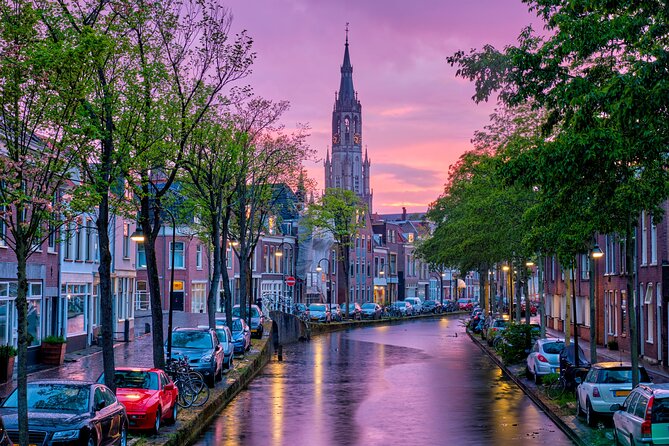
A great moment in the walk is reaching the Beestenmarkt, a square that’s big on purpose. The audio introduces it as a 60 by 50 meter area in Delft, and then gets specific about how it was created: it came from demolishing the Minderbroederklooster, or Lesser Brothers Monastery.
From 1595 to 1972, this square was the location for Delft cattle markets. Farmers from the Westland region displayed their livestock here. That’s the kind of detail that makes a modern square feel alive. You look around and imagine the movement, the noise, the working rhythm—then you compare it to what it is now.
A small consideration: since this is a self-guided walk, you’ll want to pace yourself so you don’t just pass through Beestenmarkt while you’re still on your way to the next stop. Give yourself time to stand still for the audio portion. It’s one of those places where the story does most of the work.
Vermeer connection and Delft blue pottery shopping on your route
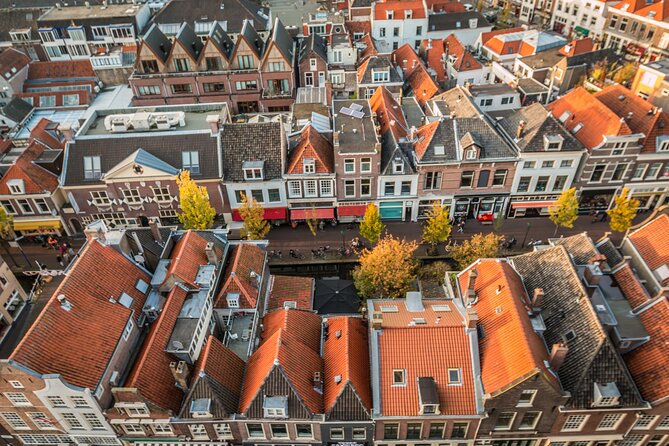
Delft is famous for Delft blue pottery, and this walk ties it to the city’s other big thread: the Royal House and its relationship with painter Johannes Vermeer. The audio guide nudges you to connect the dots as you move through the center, including a pass by the House of Vermeer, where Delft blue pottery is sold.
Even if you don’t plan to buy anything, the stop makes shopping meaningful. Instead of treating stores as distractions, you understand why Delft blue became part of the city’s brand and identity. And if you do want a souvenir, this is exactly the kind of place where a small purchase can feel like it belongs to the story.
A practical way to use this part of the tour: listen to the audio first, then decide if the pottery style and design match what you want to take home. Without that order, you might end up with something that looks nice but doesn’t feel tied to Delft.

Oude Kerk and the leaning question that makes you look twice
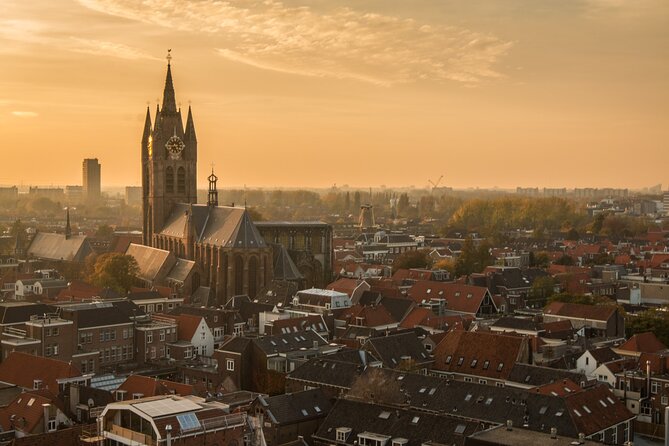
Another stop in the overall route is the Oude Kerk, the Old Church, including the classic Delft curiosity: why the Oude Kerk is leaning. Even without a detailed engineering lecture in the audio, the guide frames the leaning as something worth noticing in context.
Here’s why it’s valuable. A leaning church can become a quick gimmick if you don’t understand what to look for. With the audio, you’re encouraged to pay attention to the building itself—its age, how it sits in the city, and how Delft’s older structures have survived real time.
Because this walk is self-guided, you can spend longer here if the story pulls you in. If you’re not into structural quirks, you might breeze through. But I’d recommend at least one careful listen. The leaning is the kind of detail you’ll remember later when you see photos from Delft.
Oostpoort: the last city gate and a photo stop with real meaning
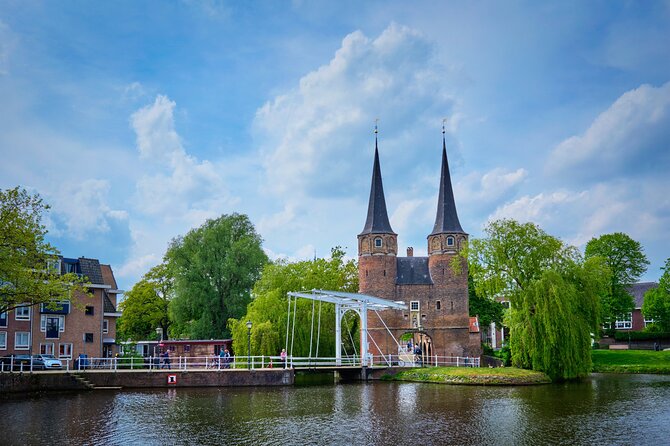
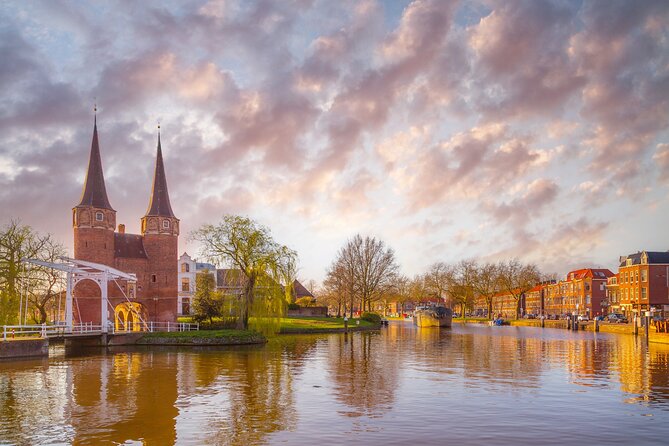
Toward the end of the walk, you’ll pass the Oostpoort, described as the only remaining city gate in Delft. That’s a big deal, because city gates are functional history. They mark borders, defenses, and how movement into a city worked.
And yes, it’s also a great photo moment. The audio sets you up to see it as one of the most picturesque scenes in the center. Even if you don’t take a formal photo, this is a solid spot to pause, let the story land, and reset your legs before you finish.
I like using moments like Oostpoort as a final check-in point. If you’ve been listening and walking for a while, you’ll be more alert and less rushed. That makes the last stretch feel calmer.
How long it takes and how to plan your breaks
The walking time is usually 2 to 3 hours, with a total walking distance of about 5.1 km. That’s a realistic city walk—enough to feel like you saw a lot, not so much that it’s a full-day hike.
The best part is your pacing control. You’re not locked into staying at each stop. Since the audio guide is delivered through your phone with GPS, you can pause to buy something in between attractions, take photos, or step into a café.
You also get flexibility on timing: you can finish the tour by the end of the next day. So if you hit a museum you can’t resist, you’re not trapped. You can come back and wrap up the audio stops later.
Price and value: what $8.68 buys you in Delft
At about $8.68 per person, this is priced like an easy add-on for a day in Delft. The value comes from the structure: 37 stops and stories, GPS guidance, and audio in 7 languages. Instead of paying for multiple museum tickets, you’re using the city itself as the “exhibit.”
Important trade-off: attraction admission fees are not included. That’s normal for an outdoor walking tour, but it affects how you plan. You should treat this as a guided walk that helps you understand what you’re seeing, not as a pass that gets you into paid sites automatically.
Also, you’ll need your own smartphone and headphones. That’s usually fine for most people, but if you’re traveling with a low-tech plan, that’s a cost to consider.
One more value detail: it’s private for your group, meaning you’re not mixing with strangers. If you’re traveling as a family or in a small circle, that tends to make the experience feel smoother, because you’re all following the same audio flow at your own pace.
Who should book this self-guided Delft walk
This tour works best if you like moving at your own tempo and want context without paying for a traditional guide. You’ll probably be happiest with it if you:
- enjoy walking through city centers and prefer audio you can control
- want to link Delft’s landmarks to the Vermeer/Delft blue story
- travel in a group and want everyone on the same route without coordinating a live guide
- need a flexible plan that can stretch from 2 to 3 hours into more time across the day
It may be less ideal if you hate using your phone for navigation, or if you’re likely to run into weak mobile signal and battery issues. Since the tour requires internet and GPS, plan for that.
Should you book this Delft city walk audio guide?
I think it’s a good booking if you want a low-stress way to see Delft’s center with guided storytelling. The strengths—GPS guidance, audio in 7 languages, and the way the app helps you track your progress—make it easy to stay oriented without constant map switching. Add in the stops around Nieuwe Kerk, the Markt City Hall, Beestenmarkt’s cattle market past, and the Oostpoort city gate, and you get a route that feels like it has logic, not just random sights.
I’d skip it only if you need paid-entry access included, or if you don’t want to rely on your phone’s internet and GPS. If you can handle those basics, this is a solid way to turn a walk into a story you’ll remember.
FAQ
What is the duration of the Delft city walk audio guide?
The walk usually takes about 2 to 3 hours, and you have until the end of the next day to finish.
How much walking is involved?
The total walking distance is about 5.1 km.
How much does it cost?
The price is $8.68 per person.
What’s included in the experience?
You get an app with an audio guide in 7 languages on your smartphone, plus GPS guidance.
What do I need to bring?
You need to bring your own smartphone and headphones. Admission fees for attractions are not included.
Do I need internet and GPS on my phone?
Yes. The tour requires an internet connection and GPS function on your phone.
Where does the tour start and end?
It starts at 2611 GA Delft, Netherlands and ends back at the meeting point.
How many stops and stories are there?
There are 37 stops/stories.
In how many languages is the audio guide available?
The audio guide is available in 7 languages.
Is free cancellation available?
Yes, free cancellation is available. You can cancel up to 24 hours in advance for a full refund.