REVIEW · ABERDEEN
500 Years of Crime and Punishment: A Self-Guided Audio Tour
Book on Viator →Operated by VoiceMap Audio Tours · Bookable on Viator
Crime has a soundtrack in Aberdeen. This self-guided audio walk uses real city landmarks to tell the ugly side of local life—gaols, public punishment, dissection, witches, and even a child-snatching gang—while still letting you roam at your own pace. You can also start whenever you want, which matters when Aberdeen weather decides to do its own thing.
I like the flexibility of a self-guided format. You’re not stuck with a group pace, and you can pause for photos or to catch every last detail. I also love the offline VoiceMap setup, which means you can keep moving even when your phone signal gets moody.
One caution: the walk can include spots where navigation feels tricky, and construction or the starting-point visibility can slow you down. If you’re the type who needs turn-by-turn perfection, you’ll want to take a little care with the app map before you set off.
In This Review
- Key things that make this audio walk worth your time
- Why Aberdeen’s crime stories work better on foot
- Price and value: $8.99 for a self-guided city script
- Using VoiceMap: the format you need for an easy start
- Tolbooth Museum gaol: where punishment got real
- Mercat Cross: announcements, treason, and a stone calendar of power
- A Balmoral-modelled tower photo stop
- Seabury Court near St Andrew’s Cathedral: winding streets, old Aberdeen feel
- Anatomy Rooms and bodysnatchers: medicine’s darker side
- The graveyard stop: the Mither Kirk, church punishments, and witches
- The Green: street art today, child-snatching gang stories in the past
- Harbour area: when Aberdeen’s growth fed unpleasant punishments
- Maritime Museum: a lighter ending (with an optional ticket)
- Getting directions right: how to avoid the main frustration
- Walking reality check: pace, safety feelings, and comfort
- Who should book this audio tour
- Should you book 500 Years of Crime and Punishment in Aberdeen?
- FAQ
- How long is the 500 Years of Crime and Punishment audio tour?
- Where does the tour start and end?
- Do I need a smartphone and headphones?
- Does the tour work offline?
- Is the tour available year-round or only at certain times?
- Is this tour guided by a person in real time?
- Can I cancel and get a refund?
Key things that make this audio walk worth your time
- A dark theme built around real Aberdeen stops, not vague storytelling
- Offline audio, maps, and geodata so you can walk without constant signal
- A start-time that fits your day, not someone else’s schedule
- You control the pace, including stopping for photos and lingering where you care
- A route through city streets (so expect walking, uneven footing, and occasional wayfinding friction)
Why Aberdeen’s crime stories work better on foot

Crime-and-punishment tours are often heavy on facts, light on place. This one does the opposite. It sends you between key sites in central Aberdeen and uses what you’re seeing—buildings, streets, and squares—to make the stories stick.
And the tone is practical. You’re not just told that punishments happened. You’re guided to where public announcements would have been made and where people were held. That turns the city into a kind of open-air timeline.
You can also read our reviews of more tours and experiences in Aberdeen.

Price and value: $8.99 for a self-guided city script

At $8.99 per person, this is the sort of deal that works when you’re trying to spend money on experiences, not tickets. You don’t pay extra per stop, and you get lifetime access to the tour in English.
What you should factor in: museums and entrances along the way aren’t included. There’s a stop near the Maritime Museum, and you’ll have the chance to go in, but you’d need your own ticket if you want to. Still, walking the route with the audio is the core value.
For the time you get—about 45 minutes to 2 hours 15 minutes—this can also be a smart plan B. If you want an evening stroll that’s more interesting than wandering, this fits.
Using VoiceMap: the format you need for an easy start

This is a private, self-guided audio experience, delivered through the VoiceMap app on Android or iOS. You get offline access to audio, maps, and geodata, which is great news for a city walk.
Just be ready with what’s on you:
- A smartphone
- Headphones
No headphones, no audio. Also, if you want the walk to feel smooth, download before you leave and use the on-screen map when you’re approaching a transition between stops.
One small bit of wisdom: the start point is by the Tolbooth Museum on Castle St, and that area can be harder to spot than you’d expect if you show up late in the day or distracted. Give yourself a few minutes to get oriented before pressing play.
Tolbooth Museum gaol: where punishment got real
Your tour starts at The Tolbooth Museum, Castle St, Aberdeen (AB11 5BB). That’s the right mood-setter. The Tolbooth is a former gaol, and the audio begins by pointing out where criminals were kept and where public hangings used to take place.
This stop works because you can connect the story to something tangible: a place built for holding people, with the memory of public spectacle attached. Even if you’re not a history buff, the setting makes the topic feel specific instead of generic.
If you’re the type who likes to photograph buildings, look around at the start area first. The tour kicks off there, so it’s worth taking 60 seconds to line up your bearings.
Mercat Cross: announcements, treason, and a stone calendar of power
Next, you’ll head to the Mercat Cross, which is where public announcements would have been made. The audio ties that civic center to public punishment, so you can see how authority played out in everyday space.
You’ll also notice carved details on the structure—Scottish monarchs—and the tour focuses on the story of one queen and how she dealt with an outbreak of treason. It’s a clever angle: you get power politics, not just crime.
Practical tip: take a moment here just to look up at the carvings. The audio is doing its best to turn the square into a lesson, and your eyes help it land.
A Balmoral-modelled tower photo stop

At some point, you’ll pass by a building whose tower is modelled on the one at Balmoral Castle. The audio flags it as a great photo stop, and honestly, it is.
This is one of those moments where the tour gives you a break from the darkest themes. The architecture lets you catch a sense of Aberdeen’s wider story—how grand influence and local life overlap.
Seabury Court near St Andrew’s Cathedral: winding streets, old Aberdeen feel

You’ll pass through Seabury Court, just by St Andrew’s Cathedral. The point here is atmosphere: you’ll get a sense of the winding streets Aberdeen used to have.
This section helps the “crime-and-punishment” theme breathe. Instead of only describing events, the audio makes you notice the city’s shape—tight streets that would have mattered for how quickly crowds gathered, how people moved, and how announcements spread.
If you like urban texture, slow down a little here. Even when the story gets intense, the street pattern is part of the evidence.
Anatomy Rooms and bodysnatchers: medicine’s darker side
One of the most intriguing stops is tied to the University of Aberdeen. The audio takes you around to the Anatomy Rooms, explaining where medical students would study and where dissections took place.
Then comes the connection that still makes people uneasy: Aberdeen’s relationship with bodysnatchers. The point isn’t sensationalism. It’s that society’s demand for medical knowledge collided with who was allowed to provide bodies, and the result was a shadow industry.
If you want to understand how crime connects to everyday needs, this is where the tour does it well. It shows how “wrongdoing” isn’t always random—it can grow where desperation and systems collide.
The graveyard stop: the Mither Kirk, church punishments, and witches
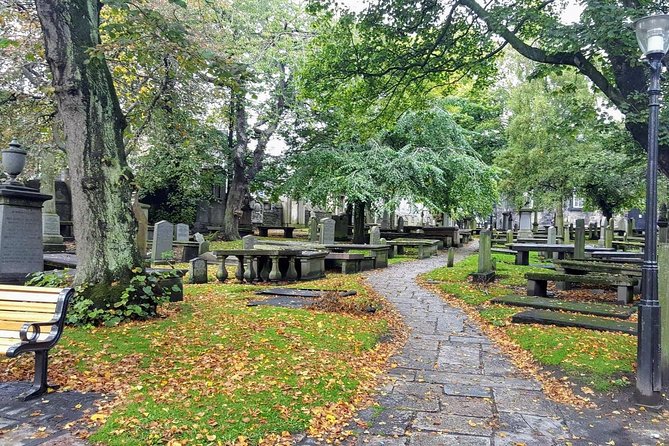
You’ll move into an atmospheric graveyard loaded with stories. The audio points out the grave of a doctor whose morals left a lot to be desired, and it also highlights the mither kirk—which used to be the centre of early Aberdeen.
This is where the tour gets sharply historical about religion and control. You’ll hear about horrible church punishments and how witches were imprisoned.
This section is heavy, but it’s also honest in its focus. It doesn’t just say that people were afraid. It shows that fear had institutions behind it.
The Green: street art today, child-snatching gang stories in the past
You’ll walk through The Green, a place where people have lived for thousands of years. The audio underlines that it’s not old-fashioned in vibe—it’s a small, more modern, independent area with street art and local shops and restaurants.
And then the mood flips again. Here, you’ll hear stories of a child-snatching gang that used to operate in Aberdeen.
That contrast is part of why the tour works. You’re not just learning history in isolation—you’re seeing how the city’s “then” and “now” share the same walking ground.
Practical tip: if you’re hungry or want a quick break, The Green is a good place to pause after the darker segments.
Harbour area: when Aberdeen’s growth fed unpleasant punishments
Aberdeen grew around its harbour, and this tour uses that fact to explain why the area became tied to unpleasant punishments over time.
You don’t need maritime expertise to appreciate the logic. Ports and trade bring people, money, tension, and crowds. The audio connects that to why certain punishments were staged where the city’s energy gathered.
If you’re walking near the harbour, take in the scale of the area. It helps make the stories feel less like rumors and more like decisions made in real public spaces.
Maritime Museum: a lighter ending (with an optional ticket)
The tour passes by the Maritime Museum, described as a delightful little place that helps you get your head around Aberdeen’s maritime past—from fishing to the oil industry.
Even if you don’t go in, it’s a nice tonal shift. After gaols, punishments, and body-related crime, moving from “what was done” to “what shaped the economy” gives your brain a reset.
If you do pop inside, keep the audio in mind. The tour route ends shortly after, so you’ll want to manage time if you care about hearing every stop.
Getting directions right: how to avoid the main frustration
The most common annoyance with self-guided walking tours is simple: you hit a stop transition and the map feels off.
Here’s how you prevent that:
- Download offline audio and maps first.
- When you’re approaching a new stop, use the app’s map on your screen rather than guessing from street names alone.
- If construction changes sightlines near the start, don’t panic. Take an extra minute to visually confirm where you are before you try to “force” the route.
One person’s experience also flagged that the starting point can be hard to see through construction. That doesn’t mean the tour is broken—it means you should arrive with a little patience and a quick orientation check.
Walking reality check: pace, safety feelings, and comfort
This is a walking tour. It can run anywhere from 45 minutes to 2 hours 15 minutes, depending on how long you linger and how often you stop for photos.
A practical note for your comfort: the route includes older streets and parts of the city that may not feel equally pleasant at all hours. One listener raised concerns about a section near multi-storey flats and suggested extra care if you’re out on your own.
I’d treat that as a sensible personal check. If something feels off, adjust your timing, stay aware, and move with confidence rather than drifting.
Who should book this audio tour
You’ll likely love it if:
- you enjoy city walks with a story tied to specific places
- you want something flexible and not locked to a group schedule
- you like darker themes, but not in a cartoonish way—you want context and location
You might want to skip it (or go in with extra caution) if you:
- hate navigating without a live guide
- need perfect turn-by-turn certainty and get stressed by street-level changes
For families: the content includes witches, church punishments, and crime against children, so you’ll want to judge what’s appropriate for your group.
Should you book 500 Years of Crime and Punishment in Aberdeen?
Yes—if you want a low-cost, high-interest way to learn Aberdeen through the streets themselves. The offline VoiceMap approach plus the lifetime access makes it a practical purchase, and the stop choices (gaol, Mercat Cross, anatomy rooms, the mither kirk, The Green, the harbour) create a route that feels like a true guided walk, just without the group pressure.
Before you commit, go in with the right expectations: you’re responsible for navigation, and you’ll want headphones ready and the app map available. If you do that, you’ll get a memorable, slightly unsettling tour that makes the city’s past feel close enough to touch.
FAQ
How long is the 500 Years of Crime and Punishment audio tour?
The tour takes about 45 minutes to 2 hours 15 minutes (approx.), depending on your walking pace and how long you linger at each stop.
Where does the tour start and end?
It starts at The Tolbooth Museum, Castle St, Aberdeen AB11 5BB and ends outside the Aberdeen Town House on Union St, Aberdeen AB11 5BU.
Do I need a smartphone and headphones?
Yes. The tour includes the VoiceMap app and offline audio access, but a smartphone and headphones are not included.
Does the tour work offline?
Yes. Included details say you’ll get offline access to audio, maps, and geodata.
Is the tour available year-round or only at certain times?
The provided hours show it’s available daily from 12:00 AM to 11:59 PM.
Is this tour guided by a person in real time?
No. It’s a self-guided audio tour using the VoiceMap app. It’s also described as a private experience for your group.
Can I cancel and get a refund?
Yes. You can cancel for a full refund if you do it at least 24 hours before the experience start time. If you cancel within 24 hours, the amount paid is not refunded.