REVIEW · ST LOUIS
Saint Louis Self Guided Driving and Walking Audio Tour
Book on Viator →Operated by History with Action · Bookable on Viator
A steel-and-stone day is waiting. This self-guided driving and walking audio tour strings together St. Louis’ big stories, from the Gateway Arch design to French-rooted landmarks and then into Forest Park. It’s built for people who want a smart route, a great narrator, and the freedom to pause when a photo or a sidewalk detour calls your name.
I especially like two things: the GPS-triggered audio that plays automatically as you reach each stop, and the way the narration turns familiar sights into clear context you can actually use. Even better, the route is structured so you’re not guessing where to go next.
One thing to consider: this kind of tour depends on phone connectivity and location cues. If you have car-audio trouble or GPS gets confused by closures or signal quirks, the audio can stall or skip the next directions, as some past users have reported.
In This Review
- Key takeaways before you hit the road
- Price and value: $16.99 per group for a full St. Louis loop
- How the audio works: GPS cues, offline maps, and start-anytime freedom
- Downtown opener at Kiener Plaza Park: sports legend, Olympic ties
- Gateway Arch and the French threads: Saarinen’s daring design and the Old Cathedral
- Public Library Central Library: the stone landmark and the earlier origin
- New Masonic Temple: columns, bronze doors, and what a fraternity means here
- Forest Park Forever: why the tour changes gears
- St. Louis Zoo, Art Museum, and the Emerson Grand Basin walk
- How long you’ll spend: a realistic sense of the 2–3 hours
- Ending at the Dennis & Judith Jones Visitor & Education Center
- Practical tips so the GPS audio doesn’t get cranky
- Should you book this Saint Louis self-guided driving and walking audio tour?
- FAQ
- How long does the St. Louis driving and walking audio tour take?
- What does it cost?
- Does the tour work offline?
- Is this tour guided by a person?
- Where does the tour start and end?
- Do I need tickets or reservations for attractions?
- What’s the best device to use?
- Can I pause and resume the tour?
- Do I need headphones?
Key takeaways before you hit the road
- Up to 4 people for $16.99 means better value than per-person tours when you’re splitting costs.
- 47+ audio stories over 10.5 miles gives you depth without turning into a long guided lecture.
- Offline maps and offline operation after download help when cell service is spotty in parks and around buildings.
- Hands-free, location-based playback makes it feel like a guided route without the group pressure.
- The Forest Park section is where you’ll notice any GPS hiccups, so plan on using headphones and being ready to restart.
Price and value: $16.99 per group for a full St. Louis loop
At $16.99 per group (up to 4), this tour is priced like an efficient day ticket rather than a “per person” attraction splurge. If you’re traveling with a partner or family, that group pricing is the main win. You’re paying for the audio experience and route planning, not for admissions.
It also saves you effort. With a route this long (about 10.5 miles) and 2–3 hours of content, you’re getting a ready-made plan that helps you cover major downtown landmarks and several Forest Park highlights in one go. That makes the cost feel fair, especially when you’re paying for time and direction more than for museum entry fees.
One more quiet value point: the tour includes lifetime access with no expiry. So if you take a wrong turn, miss a stop, or simply want to revisit later, you can rerun the stories without paying again.
You can also read our reviews of more tours and experiences in St Louis.

How the audio works: GPS cues, offline maps, and start-anytime freedom
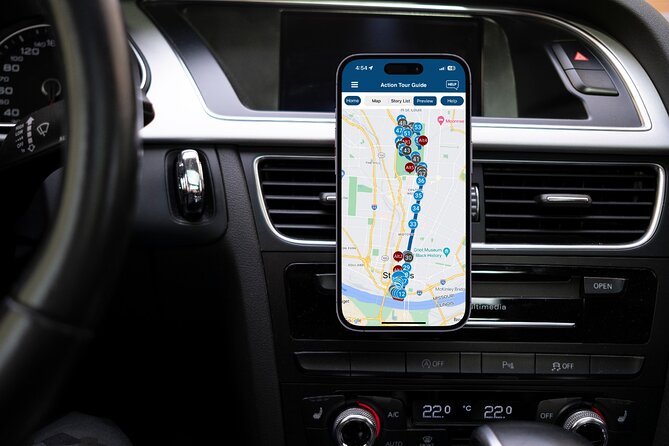
This is a self-guided experience. No one meets you at the starting point at 698 Chestnut St—you start the first audio story where you’re told to stand, and the rest follows. The audio stories are designed to play on their own based on your location, so you don’t need to constantly tap the screen.
You’ll want two practical things to make it smooth:
- Download the tour while you have strong Wi‑Fi or cellular before you rely on offline mode.
- Stick to the tour route and reasonable speed, because the phone uses location timing to trigger the next story.
For the best “set it and forget it” experience, bring headphones or earbuds, especially for the Forest Park walking portion. The device guidance also matters: the tour is recommended for iPhone iOS 15+, Android 9+, or an iPad/tablet with GPS and cellular. If your device is out of date, your location accuracy can suffer, and that’s when audio cues can get weird.
Downtown opener at Kiener Plaza Park: sports legend, Olympic ties
The tour kicks off at Kiener Plaza Park, and the audio immediately gives you a reason to look up at the space instead of walking through it. You learn about William Kiener—born and raised in St. Louis—who built a reputation as a sportsman across boxing, wrestling, and swimming. He even competed in the 1904 Olympic Games as part of the U.S. track team.
This is a good “warm up” stop because it sets tone. Rather than start with pure landmark trivia, you get a person-driven history angle. And since Kiener Plaza is right in the downtown flow, it’s an easy first point before you head into heavier architecture and big civic monuments.
Timing-wise, budget about 10 minutes here. If you like to linger, you can pause the audio whenever you want, then resume later once you’re ready to move on.
Gateway Arch and the French threads: Saarinen’s daring design and the Old Cathedral
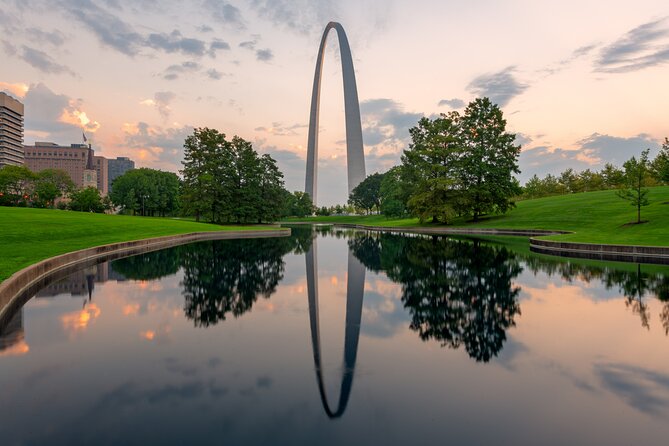
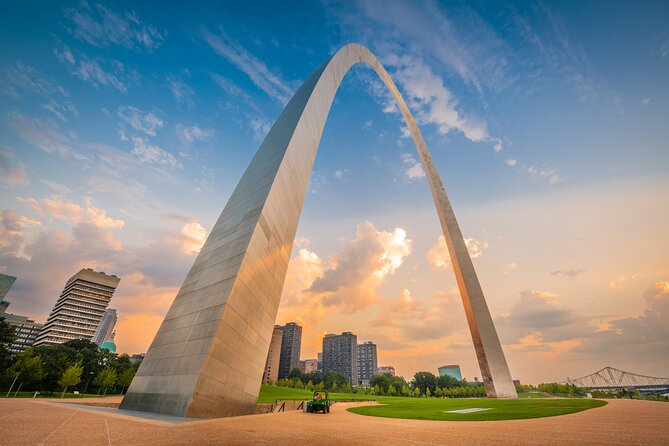
As you continue along the route, one of the headline stories focuses on the Gateway Arch. The narration explains how more than 170 architects submitted designs—and how Eero Saarinen’s arch concept caught attention for being different from what a monument was supposed to look like. It wasn’t just about marking western expansion; the story also frames the Arch as a nod to the modern age.
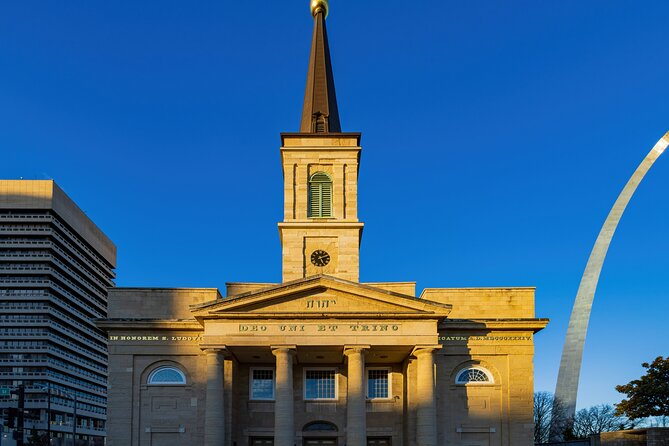
Then the tour steers you into St. Louis’ French connection, including the area that stayed put when the Gateway Arch National Park was taking shape. A key stop centers on the Old Cathedral (the Basilica of Saint Louis, King of France in the tour’s flow), which the narration describes as an exception and a long-standing community anchor.
You also get architecture context that makes the building feel more than just a photo. The audio points to its twin pillars and fortress-like look as examples of French Second Empire architecture. It explains the post–Civil War mood too: cities wanted pride restored, so in 1873 Alfred Mullett was commissioned to design something to remind locals of St. Louis’ French roots.
If you enjoy architecture stories that explain the why behind the style, this section is one of your best bets. It also pairs well with a visual habit: after the audio talks history, I’d look at the façade again and try to spot what the narrator described.
Public Library Central Library: the stone landmark and the earlier origin

Next comes the St. Louis Public Library – Central Library at the Locust and 13th area, a stop you can’t miss because the building is grand and very “yes, I’m important” in its stone presence.
The narration adds a key fact that helps you understand the institution rather than just admire the architecture: the library system first opened in 1865, though it wasn’t in this specific building. That one detail changes how you read the place. You’re no longer just seeing a structure; you’re seeing the continuing life of an idea.
Plan for around 15 minutes at this stop. It’s enough time to get the exterior, read the story audio, and snap a couple of photos without feeling rushed.
If you’re the type who likes to pair buildings with nearby streets, this is also a nice moment to slow down and look around. The tour has you there at the exact point where the downtown grid feels like it was designed for pedestrians who enjoy architecture.
New Masonic Temple: columns, bronze doors, and what a fraternity means here
After the library, the route heads toward the New Masonic Temple. The audio spotlights its multi-layered stone design, giant columns, and huge bronze doors—a combination that makes it feel ceremonial even from the sidewalk.
There’s also a real-world update: the building was a Freemason temple, but it was sold in 2017. The narration also explains what that membership structure means: Freemasons are a fraternal society with closed membership and groups around the world.
This stop is short—about 10 minutes—but it’s valuable because it teaches you to interpret what you’re looking at. Instead of guessing at symbolism, you get enough context to understand why the architecture is the way it is.
Forest Park Forever: why the tour changes gears

Then comes the big gear shift: you enter Forest Park, described in the audio as the heart of downtown St. Louis. The park’s scale is hard to ignore—1,300 acres, with the narration even comparing it to New York City’s Central Park at 843 acres.
This matters for how you experience the tour. In downtown, the audio feels like a walking-and-driving history thread through distinct buildings. In Forest Park, the same audio becomes a wayfinding tool through a large open area where your attention naturally slows down and stretches out.
Budget about 10 minutes to transition at the park entrance. After that, you’ll spend real time on the major sights inside the park, where the tour is designed around a practical walk.
St. Louis Zoo, Art Museum, and the Emerson Grand Basin walk
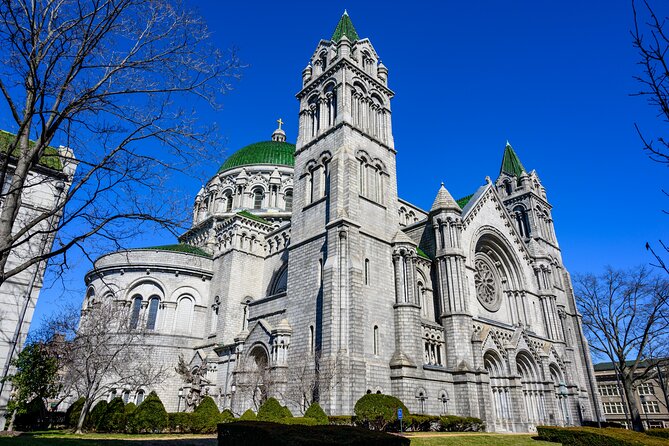
Once you’re in Forest Park, the audio itinerary packs multiple classic attractions into an efficient loop.
First up is the St. Louis Zoo, which the narration ties directly to the 1904 World’s Fair. The audio says it was built for the fair, then kept because it was too good to discard. It also explains that it wasn’t a proper zoo at the beginning—it started as an aviary on loan from Washington, D.C., plus a few exotic exhibits. That’s a great reminder that modern institutions often start with a temporary idea.
Next, you’ll reach the Saint Louis Art Museum. The audio calls out King Louis IX of France, known as the Apotheosis of St. Louis, and adds an important detail: it’s a replica of the original. That fact is the kind of nugget that makes your photos feel more intentional—now you know what the statue is referencing.
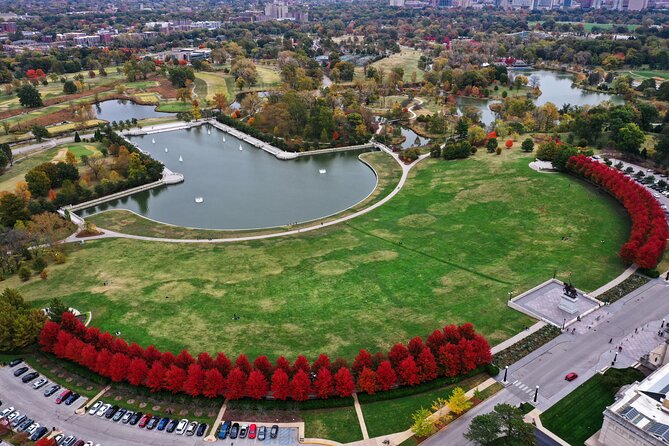
Then comes Emerson Grand Basin, described as a centerpiece during the World’s Fair. The narration explains why the view is so good: temporary exhibition buildings surrounded the basin, so visitors got a wide, framed experience rather than walking from one isolated display to the next.
The nice part about this section is pacing. Even if you don’t linger like a museum-goer, you’ll still cover a lot. And if you do linger, you can pause and return to the next story when you’re ready—one advantage of a self-guided format.
How long you’ll spend: a realistic sense of the 2–3 hours
The tour is about 2 to 3 hours to complete, covering roughly 10.5 miles. That range is generous, because it reflects two realities: you might move faster between downtown stops, but you’ll slow down in Forest Park—especially if you stop for pictures, grab water, or step off the main path for a better view.
I’d plan for closer to the middle of the range if you want a comfortable pace. Also, remember the audio is designed for location-triggered play, so staying near the intended route helps keep your playback in sync.
The tour includes more than 47 audio stories, so you’re not just hearing a single narration per stop. The content density is one reason it feels worth it, even when you’re only spending short times at each place.
Ending at the Dennis & Judith Jones Visitor & Education Center
The tour finishes at the Dennis & Judith Jones Visitor & Education Center in Forest Park. This stop is your cue to shift from “tour mode” to “explore mode.”
The audio makes a practical recommendation: parking here, grab a map, and spend more time in the park. That’s smart because Forest Park is big, and a map turns your remaining time into an organized choice instead of a wandering experiment.
The visitor center is open daily from 6:00 AM to 10:00 PM (for the listed range in your tour info). So you can match your schedule to it—early start for cooler temps, or later if you want a calmer walk.
If your audio loop is complete, this is also where you can step away from headphones and just enjoy the park.
Practical tips so the GPS audio doesn’t get cranky
A self-guided audio tour can be great, but you’ll get the best results if you set yourself up.
Here’s what I’d do:
- Use headphones for the walking parts so you don’t have to fight street noise.
- Test your car connection method before you roll. If you run into trouble connecting car audio, a Bluetooth setup can be the workaround mentioned by the provider response to past issues.
- Download the tour first in strong Wi‑Fi or cellular. Offline maps are included, but you still need that initial download.
- Expect GPS to sometimes struggle with changes, like street closures. If the tour feels off, staying within the recommended route line is your best fix.
Also keep in mind a reported technical issue: one user described audio cutting off inside Forest Park and not giving directions to leave. That’s rare, but it’s exactly why I’d keep your phone charged and be ready to restart the audio if needed.
Should you book this Saint Louis self-guided driving and walking audio tour?
If you like architecture, you enjoy history that’s explained in plain language, and you want control over your pace, I think this is a strong booking. The GPS-triggered storytelling and the way the route links downtown civic landmarks to Forest Park highlights makes it a very efficient use of a half day.
You should probably skip or rethink it only if you hate phone-based navigation or you’re traveling without a device that can run the audio reliably. Since the tour relies on location cues, poor GPS accuracy or strict phone constraints can turn the experience from smooth to frustrating.
Overall, at $16.99 per group with lifetime access and offline operation, this is a good deal for a structured St. Louis day where you’re both exploring and learning.
FAQ
How long does the St. Louis driving and walking audio tour take?
It takes about 2 to 3 hours to complete and covers roughly 10.5 miles.
What does it cost?
The price is $16.99 per group, up to 4 people.
Does the tour work offline?
Yes. It includes offline maps, but you must download the tour while you have strong Wi‑Fi or cellular first. After download, it works offline.
Is this tour guided by a person?
No. It’s self-guided, and no one meets you at the start. You start the audio at the first story location.
Where does the tour start and end?
The tour starts at 698 Chestnut St, St. Louis, MO 63101 and ends at Dennis & Judith Jones Visitor & Education Center, 5595 Grand Dr, St. Louis, MO 63112.
Do I need tickets or reservations for attractions?
Attraction passes, entry tickets, and reservations are not included. The tour itself is an audio experience with stops you can visit on your own.
What’s the best device to use?
The tour is recommended for iPhone (iOS 15 or later), Android (version 9 or later), or an iPad/tablet with GPS and cellular connectivity.
Can I pause and resume the tour?
Yes. You can start anytime, pause anywhere, and you can also use it over multiple days.
Do I need headphones?
Headphones/earbuds are recommended, especially for the walking portion of the tour.