REVIEW · POMPEII
Pompeii Archaeological Park Skip-the-line Entry and Audio Guide
Book on Viator →Operated by Vox City International Ltd · Bookable on Viator
Pompeii feels close when you follow the right route. You get a skip-the-line entry ticket plus a digital audio guide that points you to major sights without dragging you through a scripted route. I love that the app covers 130+ points of interest, including highlights like the House of the Faun and detailed mosaic areas. The trade-off: it’s self-guided, so if you don’t manage your phone and map carefully, you can end up listening to the wrong stop or losing your bearings.
Before you even enter, you’ll exchange your voucher at the info point in Piazza Esedra, 1, right in front of Hotel Vittoria. Once inside, you can wander at your own pace and still hit big moments like the Pompeii Forum and the eruption impact areas with ash-covered remains and plaster casts. My practical watch-out is simple: bring walking shoes, because the site covers a lot of ground and the paths are not exactly stroll-friendly.
In This Review
- Key highlights at a glance
- Skip-the-line entry at Pompeii: what “fast” really means
- Using the smartphone audio guide and map without getting lost
- The first big sights: temples, streets, and the House of the Faun
- Pompeii Forum: the center of trade and politics
- The eruption impact: ash-covered homes and plaster casts
- Suburban Villas and Villa dei Misteri: the one big exclusion
- How long you really need (and how not to waste it)
- Price and value: $35.32 plus what to budget
- Who this Pompeii format suits best
- Should you book this Pompeii skip-the-line entry and audio guide?
- FAQ
- What is included with the Pompeii entry and audio guide?
- How do I get the audio guide before I arrive?
- Do I need headphones or a mobile device?
- Does this ticket include the Suburban Villas or Villa dei Misteri?
- Where do I exchange my voucher for an entry ticket?
- How long should I plan to spend inside Pompeii?
Key highlights at a glance

- Skip-the-line entry with a reserved ticket to Pompeii, so you can start exploring faster
- Smartphone audio guide with 130+ points of interest and a digital map
- Temple stops and city life themes, including areas tied to Venus, Apollo, and Jupiter
- Forum core of the city for a clear sense of politics and trade in ancient Pompeii
- Eruption aftermath on display via ash-covered homes and haunting plaster casts
- No Suburban Villas included (Villa dei Misteri and others cost extra, if you want them)
Skip-the-line entry at Pompeii: what “fast” really means

Pompeii is popular, and that’s why a reserved ticket matters. Your voucher gets exchanged at Piazza Esedra, 1, 80045 Pompei NA, in front of Hotel Vittoria, at the info point. After that, you’re using your entry ticket to get into the Archaeological Park—so arriving with the right paperwork is non-negotiable.
The main value of the skip-the-line part is time saved at the gate. Instead of spending your best energy in queues, you start spending it on streets, courtyards, and temples. And because the audio guide is self-paced, getting in sooner also gives you more flexibility to handle the crowds later.
One more detail that helps: download the audio guide before arrival. The process is based on scanning the QR code on your voucher, and doing this early saves you from phone-stress once you’re already inside.
You can also read our reviews of more tours and experiences in Pompeii.


Using the smartphone audio guide and map without getting lost

This experience is built around a digital audio tour. You’ll get an app-based audio guide with commentary in English, French, Spanish, German, and Italian, plus a digital map. The goal is simple: you can follow a set of points of interest across Pompeii and choose how long to linger at each one.
Here’s the part that makes a real difference for your experience: manage your device setup before you enter. Bring your own mobile phone, and don’t forget headphones—those aren’t included. I’d also make sure your phone battery is topped up, because you’re relying on it for both audio and navigation.
The audio coverage is a big deal for first-timers. The guide is designed to pull you through the key layers of the city—major landmarks, mosaics, and historic residences—so you’re not just looking at stones and hoping you’re interpreting them right. And because you visit over 130 points of interest, you can build a route that feels complete without locking yourself into a strict group schedule.
A possible frustration is also baked in. When you’re moving, it can be easy to stop, start, or wander while the guide expects you to be at another location. If you hate that risk, go slower than you think you need to and pause the audio only when you’re actually stepping out of your current spot.
The first big sights: temples, streets, and the House of the Faun

Once you’re inside, you’re free to wander the ancient Roman stone paths at your own pace. The audio guide is structured to help you connect what you’re seeing to the city’s everyday life—temples, residences, and public spaces—so you start building a mental map of how Pompeii worked.
One highlight theme is the cluster of temples tied to major Roman gods, including Venus, Apollo, and Jupiter. Even without a formal lecture, these are the kinds of stops where the “why” clicks: you’re seeing how religious life was woven into civic space, not shoved off into some separate corner.
Then there’s the residential side of Pompeii, where the experience gets more intimate. The House of the Faun is named as a key residence in the audio itinerary, and it’s the kind of stop that helps you understand social status in the city. Look around carefully: it’s not only about the big rooms, but also about how a wealthy home connected daily life to shared public streets nearby.
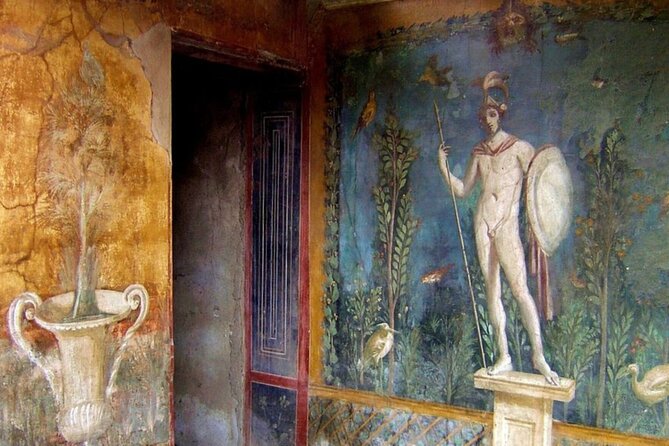
The mosaics are another reason this works so well as an audio-based stroll. In Pompeii, details reward patience. If you’re willing to slow down for a few minutes at each mosaic or decorative area, the audio points help you focus on what matters instead of just scanning walls.
Pompeii Forum: the center of trade and politics
If you want one “anchor” moment that makes the rest of Pompeii click, aim for the Pompeii Forum. The Forum is described as the trading hub and political center, and that context is exactly what you need while you’re walking through the ruins.
Standing in the Forum area, the audio guide’s job is to give you the city logic. You can connect your earlier temple and residential stops to the spaces where people met, conducted business, and shaped public life. Without that kind of framing, Pompeii can feel like a set of impressive buildings. With it, you start seeing a functioning urban system.
This is also where the site’s scale starts to matter. Pompeii covers about 44 square hectares, and that’s a lot to cover on foot. If you treat the Forum like a “quick photo stop,” you’ll miss the sense of how everything ties together.
The eruption impact: ash-covered homes and plaster casts
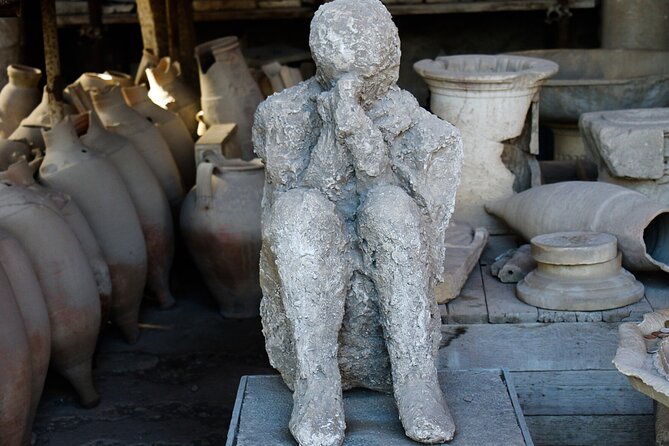
One of Pompeii’s hardest and most compelling features is what survived the eruption. The experience includes stops tied to the ash-covered impact on homes and the plaster casts of victims. These are the kinds of sights that don’t need extra drama from a guide—the ruins already carry the weight.
What makes this section work with an audio guide is contrast. You can move from everyday city life—temples, residences, and public spaces—into the eruption aftermath, and the sequence helps you understand that Pompeii wasn’t empty at the moment of catastrophe. It was still a living city.
A practical tip: keep your eyes open for how the ash changes the look of rooms and corridors. When the city was sealed, it preserved shapes in a way that feels almost unreal. If you’re sensitive to heavy scenes, decide in advance how much time you want to spend here. You’re in charge of pacing, and that control matters.
Suburban Villas and Villa dei Misteri: the one big exclusion
You should know what this ticket does not include: access to the Suburban Villas, including the Villa of the Mysteries (Villa dei Misteri), Villa of Diomedes, and Villa Regina. The note is clear that the ticket does not include those locations, and the additional access is priced at 8€.
This matters because the Suburban Villas can change the feel of your visit. If you’re the type who wants a “full set” and loves seeing how villas outside the city connected to wealth and farming life, you may end up feeling like your visit is missing a chapter.
If, on the other hand, you’re mainly focused on Pompeii’s core city life—the streets, major landmarks, mosaics, and the Forum—then skipping the suburban areas may actually help you enjoy the trip more. You won’t feel pressured to keep moving across extra distances.
Bottom line: decide based on your priorities. If Villa dei Misteri is on your must-see list, you’ll want a plan for the extra 8€ before you arrive.
How long you really need (and how not to waste it)

The experience is listed at about 2 to 3 hours, but real visits typically run 2 to 4 hours. Pompeii is bigger than many people expect, and your feet will tell you that quickly.
To get the best value from your time, don’t try to sprint. Use the audio guide as your guide rails, not as something you race through. If you want to see both major landmarks and quieter details like mosaics and decorative areas, you’ll need more than the “minimum” time.
Also, wear shoes that handle uneven stone. The site isn’t built for speed, and the walking adds up. Bringing comfortable footwear is one of the simplest upgrades you can make to your day.
Price and value: $35.32 plus what to budget
At $35.32 per person, you’re paying for three key things: a reserved entry ticket, a digital audio guide (130+ points), and a digital map. That’s a strong value mix because you’re covering both access and orientation.
Where your cost can climb is in the extras you choose to add. The Suburban Villas are not included, and access to the Villa dei Misteri area is an extra 8€. Also, headphones and your mobile device are on you. If you show up without earbuds, you’ll be stuck finding a solution on the spot, which is never fun.
Overall, this is a good value option if you want control over your pace and you like learning as you walk. If you want a live human guide or you’re aiming to hit absolutely everything on your first visit, you might compare other formats—but for many people, this audio + ticket combo is a practical sweet spot.
Who this Pompeii format suits best
This setup is ideal if you:
- Want to explore at your own speed instead of following a group pace
- Prefer using a phone for interpretation and direction
- Plan to spend enough time to notice details like mosaics and residential layouts
- Like having a structured set of stops without paying for a full guided tour
It may be less ideal if you:
- Strongly rely on an easy, foolproof map system and get frustrated when audio prompts don’t match your exact position
- Want to spend most of the day on the suburban villas without paying extra
- Don’t want to manage device basics like headphones and battery life
Should you book this Pompeii skip-the-line entry and audio guide?
Yes, you should book it if you want a smart, flexible way to experience Pompeii without wasting time in lines. The reserved entry ticket plus the audio guide’s 130+ points is the core value, and the pacing works well for people who like to stop, look, and learn as they go. Just don’t underestimate the walking, and don’t arrive expecting headphones or suburban-villa access to be included.
If Villa dei Misteri or the Suburban Villas are the main reason you’re coming, factor in the extra 8€ and your time needs. Otherwise, this format gives you a solid, self-directed path through the city center, the Forum, and the eruption aftermath—exactly the stuff that makes Pompeii unforgettable.
FAQ
What is included with the Pompeii entry and audio guide?
You get a reserved entry ticket to Pompeii, a digital audio guide with 130+ points of interest, a digital map, and multilingual audio commentary in English, French, Spanish, German, and Italian.
How do I get the audio guide before I arrive?
Scan the QR code on your voucher to download the audio guide prior to arrival.
Do I need headphones or a mobile device?
Yes. Headphones and your mobile device are not included, so you’ll need to bring your own.
Does this ticket include the Suburban Villas or Villa dei Misteri?
No. Access to the Suburban Villas, including Villa of the Mysteries (Villa dei Misteri), Villa of Diomedes, and Villa Regina, is not included and costs an additional 8€.
Where do I exchange my voucher for an entry ticket?
Exchange your voucher at the info point located at Piazza Esedra, 1, 80045 Pompei NA, in front of Hotel Vittoria.
How long should I plan to spend inside Pompeii?
Pompeii is open daily, and most visitors spend about 2 to 4 hours inside. The experience duration is listed as about 2 to 3 hours.