REVIEW · COLMAR
Colmar Walking Tour with Audioguide on Your Smartphone
Book on Viator →Operated by TouringBee · Bookable on Viator
Colmar tells its stories on your phone. This self-guided smartphone audioguide covers Colmar’s top sights in about 1 hour 30 minutes, with 27 English recordings by a professional historian and an offline route map. I especially like how the narration is clear and lightly humorous, and how you can pause for photos or drift into a museum without feeling rushed or dependent on a person.
One catch: you’re doing the setup yourself. You’ll need your own headphones, and you must download the app, activate your purchase, and follow the route on your screen (GPS helps if you turn location services on).
In This Review
- Key highlights at a glance
- Why an audioguide is the smartest way to do Colmar
- Starting at Parc du Champ de Mars and setting your walk timing
- Getting oriented fast: how the app route actually helps
- Colmar Old Town icons: Hansi Museum and the faces you can’t forget
- Hansi Museum (Alsatian folklore through Jean-Jacques Waltz)
- House of Heads (Renaissance drama in stone)
- Pfister House (1537: murals, octagonal turret, and mixed styles)
- More medieval street stops: Zum Kragen, Schongauer’s houses, and Adolph House
- Zum Kragen and Schongauer’s Houses
- Adolph House (a quieter 14th-century reminder)
- Dominican Church and St Martin: Gothic you can feel in your feet
- Église des Dominicains (stained glass and the Rose Bush Madonna)
- Collégiale Saint-Martin de Colmar (Gothic scale and a bell tower on the skyline)
- Bartholdi connections: Unterlinden Museum, the Bartholdi Museum, and a vine-holding fountain
- Unterlinden Museum (from Dominican convent to world-famous altarpiece)
- Bartholdi Museum (birthplace of the Statue of Liberty sculptor)
- Fontaine Schwendi (1898, Bartholdi-designed, and the Tokay grape story)
- Koïfhus, the Covered Market, and Little Venice: the walk’s payoff
- Old Customs House (Koïfhus) and the old trade route feel
- Marché Couvert (the kind of stop that becomes your snack plan)
- Little Venice (canals, half-timbered houses, and quiet walking)
- The practical value: why $8.39 can make sense here
- Who should book this, and who might prefer something else
- Should you book this Colmar walking audioguide?
- FAQ
- How long is the Colmar walking tour?
- Is this tour guided by a person?
- What language is the audioguide in?
- Do I need internet to use the audio guide?
- What should I bring with me?
- Where does the tour start and end?
- Are there entrance fees for the stops?
- Can I cancel for a refund?
Key highlights at a glance
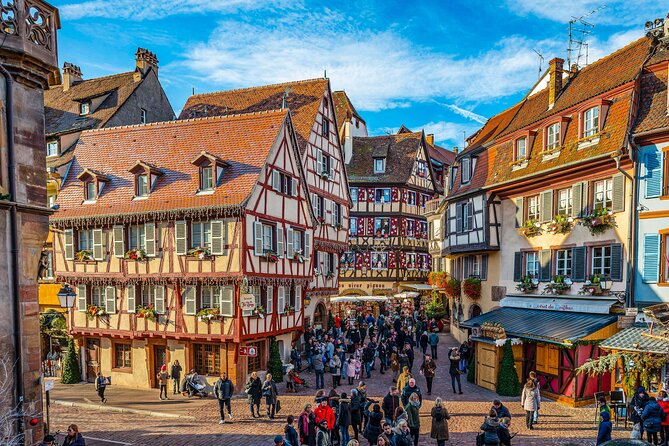
- 27 historian audio tracks in English, available for 1 year after purchase
- Offline map + GPS navigation to keep you moving through Old Town streets
- Illustrations to spot landmarks fast (handy when façades blend together)
- No meeting-point pressure since it’s fully self-guided
- Music-of-stone stops: Gothic churches, Renaissance façades, and canal views
- Photo-friendly pacing: the route is planned around quick looks, but you can linger
Why an audioguide is the smartest way to do Colmar
Colmar is compact, pretty, and full of details. That’s great for walking, but it can be chaotic if you’re trying to read everything while also finding the next stop. This tour solves that with audio you can start, pause, and replay as you walk.
I like that the guide is built for your rhythm. The tour expects a fast pass for about 90 minutes, but it also supports slower wandering, museum detours, and photo stops. If you’re the type who stops at every half-timbered façade and then suddenly realizes it’s been an hour, you’ll feel right at home.
The other advantage is consistency. You get the same stories every time, with the names and context you might miss while you’re just admiring stonework. That’s how you go from seeing a church window to understanding why it matters.
You can also read our reviews of more tours and experiences in Colmar.



Starting at Parc du Champ de Mars and setting your walk timing
The walk starts at Parc du Champ de Mars, Av. de la République in Colmar, and it ends back at the same place. The tour is designed so you can do it in roughly 1 hour 30 minutes, with most stops paced around short breaks.
Here’s the practical tip: don’t judge the time by the planned stop length. If you want more than quick glances, build in extra time. Colmar’s best assets are the small ones—sculpted faces, ornate gables, stained-glass details—so you’ll naturally slow down at the exact moments the audio is describing.
Also plan to walk in comfortable shoes. The route is in town streets, and you’ll spend your time on cobblestones and old-road textures. Nothing technical, but it’s still a real walk.
Getting oriented fast: how the app route actually helps
This is a self-guided tour run through the TouringBee app on iOS and Android. You should expect to use your phone for two jobs: playing the audio and following the route on the map.
You’ll get an offline map with the route, plus illustrations that help identify where you are (and what you’re looking at). That matters in Colmar because many buildings look similar until the audio snaps your attention to a specific façade feature.
If the map feels hard to use, turn on location services before you start. GPS can show where you are in real time, which helps a lot in tight Old Town streets where you might otherwise loop past the same corner twice.
Colmar Old Town icons: Hansi Museum and the faces you can’t forget
Your first cluster of stops is where Colmar’s character becomes obvious—Alsatian creativity, Renaissance flourishes, and the kind of architecture that begs for closer viewing.
Hansi Museum (Alsatian folklore through Jean-Jacques Waltz)
The Hansi Museum is dedicated to Jean-Jacques Waltz, better known by his pen name Hansi. Expect illustrations and caricatures that capture everyday Alsatian life, plus postcards and posters that show how locals viewed themselves through changing times. The museum is housed in a timber-framed, old-style house, so it feels like part of the neighborhood—not a separate stop in a different world.
House of Heads (Renaissance drama in stone)
Then comes one of Colmar’s most memorable façades: the House of Heads. Built in 1609, it’s covered with over 100 sculpted heads, each with its own expression. This isn’t just decoration. It’s a whole visual program, like an old-book illustration turned into stone.
Look for the ornate gable at the top, crowned with a statue of a cooper. The point of the stop is to help you notice that Colmar’s Renaissance style isn’t bland—it’s theatrical.
Pfister House (1537: murals, octagonal turret, and mixed styles)
Another must-see is the Pfister House, built in 1537. You’ll see intricate woodwork, an octagonal turret, and colorful murals showing biblical and secular scenes. Even if it reads as medieval at first glance, it mixes Gothic and Renaissance elements.
This is the stop where audio helps most. The building is visually busy, so it’s easy to just admire it and move on. The guide nudges your eye toward what to notice and why it was done that way.
More medieval street stops: Zum Kragen, Schongauer’s houses, and Adolph House
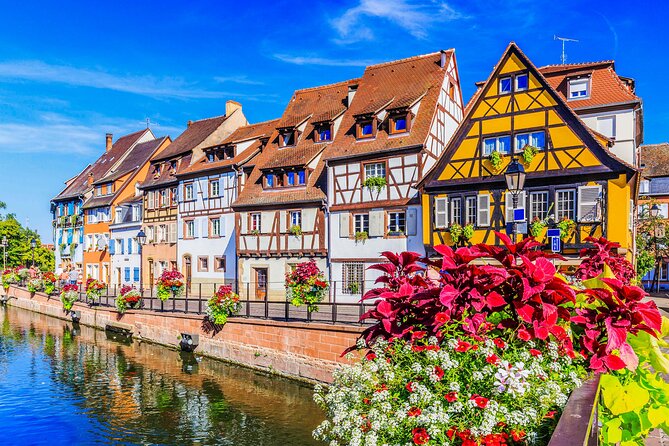
Colmar rewards you for not rushing. After the big-name highlights, you get a set of smaller, very satisfying façades that make the Old Town feel lived-in rather than staged.
Zum Kragen and Schongauer’s Houses
Zum Kragen is known for an ornate façade with wooden carvings and Renaissance elements. It’s the kind of building you might overlook if you’re only hunting for the biggest postcard views, but it fits the town’s vibe perfectly.
Nearby, Schongauer’s House connects to Martin Schongauer, the German engraver and painter. It’s a way to connect the dots between art history and local architecture, especially later when you see his work referenced in the churches.
Adolph House (a quieter 14th-century reminder)
The Adolph House is believed to date to the 14th century, and it shows a traditional half-timbered look with stone construction. It’s close to the central area, but it still feels like a hidden pause in the street.
If you like medieval textures and you’re the type who enjoys noticing construction details, you’ll appreciate this stop more than you expect.
Dominican Church and St Martin: Gothic you can feel in your feet

Now you shift from Renaissance façades to Gothic interiors. Two churches anchor this part of the route. They’re free to visit as part of the walking plan, and they’re exactly where the audio gives you a way to slow down without feeling bored.
Église des Dominicains (stained glass and the Rose Bush Madonna)
The Dominican Church, dating back to the 13th century, is known for its stained-glass windows. The standout detail mentioned in the tour is the Madonna of the Rose Bush by Martin Schongauer.
Even if you only have a few minutes, you can spend that time smarter: let the audio point you toward what to look for, then use the silence for a quick scan of the light and color in the glass.
Collégiale Saint-Martin de Colmar (Gothic scale and a bell tower on the skyline)
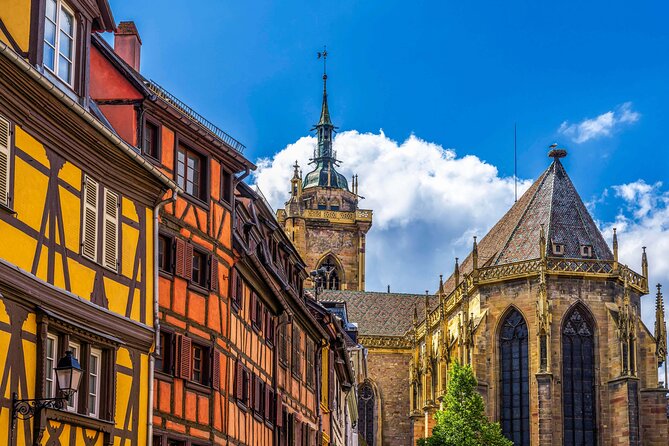
Next is St. Martin’s Church, also from the 13th century Gothic era. It’s often described as a cathedral due to its impressive scale. You’ll see intricate stone carvings and stained glass that light up the spacious interior.
The bell tower helps you orient in Colmar too. It becomes a visual reference point in your walk, which is useful when you’re moving between streets and canal glimpses.
Bartholdi connections: Unterlinden Museum, the Bartholdi Museum, and a vine-holding fountain
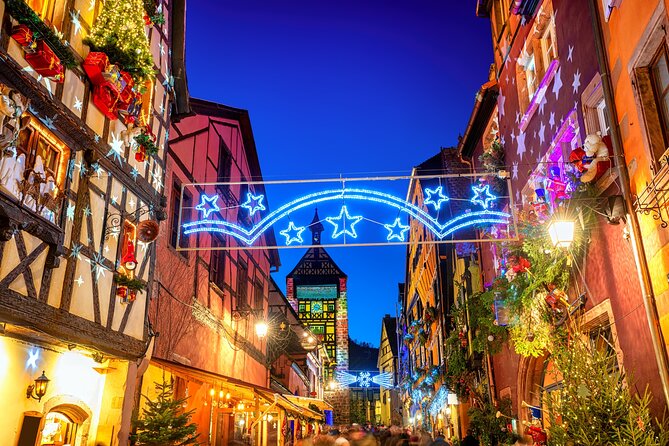
Colmar has a strong art thread, and this tour leans into it. You see major collections, but also the personal origins of a famous sculptor.
Unterlinden Museum (from Dominican convent to world-famous altarpiece)
The Unterlinden Museum sits in a former 13th-century Dominican convent. It’s famous for the Isenheim Altarpiece and spans art from medieval to contemporary.
This is one of those stops where the setting matters as much as the paintings. You’re not just entering a museum building. You’re stepping into something that once served religious life, which helps the art feel less like an exhibit and more like a continuation of ideas that changed over centuries.
Bartholdi Museum (birthplace of the Statue of Liberty sculptor)
The Bartholdi Museum focuses on Frédéric Auguste Bartholdi, born here. You’ll find models, sculptures, and personal artifacts that trace his contribution to monumental art, including his link to the Statue of Liberty. The museum is in an 18th-century building, which keeps the experience feeling local and personal rather than grand and distant.
Fontaine Schwendi (1898, Bartholdi-designed, and the Tokay grape story)
Then you hit Fontaine Schwendi. Erected in 1898, it features a statue of Schwendi holding a vine, tied to the idea that he introduced the Tokay grape to Alsace. It was designed by Frédéric Auguste Bartholdi.
This is a nice example of how the tour uses art to explain culture. You’re not just seeing another statue. You’re getting a story that connects agriculture, reputation, and sculptural style.
Koïfhus, the Covered Market, and Little Venice: the walk’s payoff
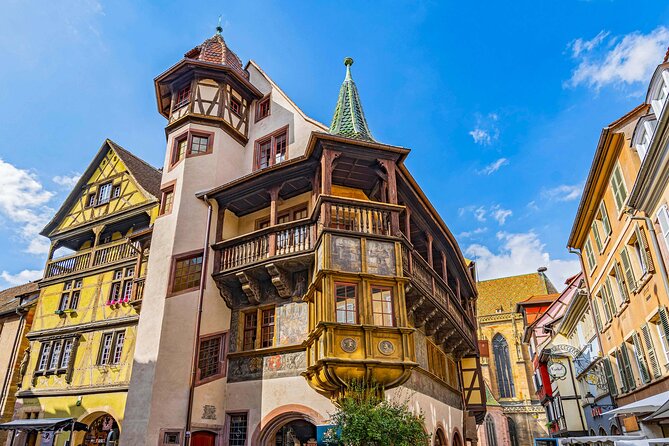
As the route moves toward the river and canals, it gets more relaxed and more sensory. This is where Colmar turns into postcard territory, but you’re still grounded in real street life.
Old Customs House (Koïfhus) and the old trade route feel
The Old Customs House, known as Koïfhus, is the town’s oldest public building, built in the 15th century. It once served as a hub for trade and taxation.
Look for the Gothic and Renaissance architecture: the tiled roof and arcades are part of what made this building functional, not just decorative. Today it hosts cultural events, exhibitions, and markets, which keeps the building tied to community rhythms.
Marché Couvert (the kind of stop that becomes your snack plan)
At the Marché Couvert, you’re back in Alsace food territory. It’s in a 19th-century building along the Lauch River. Expect fresh produce, artisanal cheeses, and regional specialties like sausages and pastries.
This is a great moment to take a break that doesn’t cost you time. Even if you only buy something small, the market keeps you from turning “sightseeing hunger” into “hangry sightseeing.”
Little Venice (canals, half-timbered houses, and quiet walking)
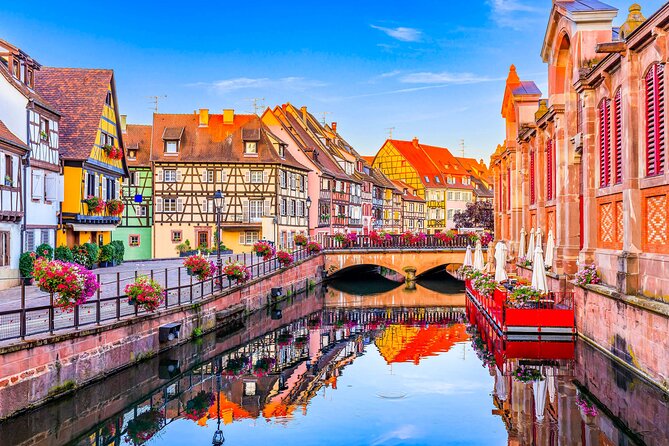
Finally, you reach Little Venice—one of Colmar’s most romantic neighborhoods. It’s defined by scenic canals lined with colorful half-timbered houses. You can cross flower-adorned bridges, relax by canal-side cafés, or even take a boat ride if you want a slower view of the scenery.
If you want a closing photo set, do it here. It’s the part of Colmar where the architecture and water combine into one easy picture. And because the route ends back near the starting area, you don’t have to worry about getting stranded in a scenic zone.
The practical value: why $8.39 can make sense here
At $8.39 per person for an audio tour lasting about 1 hour 30 minutes, the best value isn’t just the price tag. It’s what you get for that time: 27 historian-narrated recordings, a structured route with an offline map, and a plan that covers both art highlights and everyday street sights.
Colmar’s charm is details plus pacing. If you can spend your mental energy looking at buildings instead of figuring out where you are, the guide becomes worth it quickly.
I’d also call out the long tail: you get 1 year access in your chosen language (English is offered here). That means you can replay sections later or review what you saw while it’s still fresh in your head.
Who should book this, and who might prefer something else
This tour is a good fit if you want independence. You’ll like it if you enjoy walking, checking out architecture, and getting context without staying tied to a schedule or a person. The app also works well if you travel with a mixed group—someone wants museums, someone wants photos, and both can happen without negotiating.
You might want a different format if you strongly dislike phone-based navigation or you prefer a live guide to answer questions on the spot. Since there’s no human guide at the start, the experience depends on you getting set up and using your headphones.
Should you book this Colmar walking audioguide?
If you’re visiting Colmar and want a low-stress way to learn what you’re seeing, I’d book it. The route hits major sights—Hansi Museum, the House of Heads, Unterlinden Museum, the Dominican Church, St. Martin’s, the Bartholdi Museum, Koïfhus, the Covered Market, and Little Venice—and it keeps you moving with an offline map and landmark illustrations.
Just do a quick prep checklist before you leave: download the app, activate your audio, and bring headphones. Then turn on location services so GPS can support you if you get turned around in narrow streets.
If you want a guided, conversational experience with fewer steps on your side, you may prefer a human-led tour instead. But for most independent walkers, this offers a smart mix of depth and freedom for the price.
FAQ
How long is the Colmar walking tour?
It lasts about 1 hour 30 minutes (approx.).
Is this tour guided by a person?
No. It’s self-guided. You won’t find a human guide at the meeting point.
What language is the audioguide in?
The tour is offered in English.
Do I need internet to use the audio guide?
The tour includes an offline map, and the audio guide can be used after setup. Exact offline audio behavior isn’t specified beyond the offline route support.
What should I bring with me?
Bring your own smartphone and headphones. Smartphones and headphones are not included.
Where does the tour start and end?
It starts at Parc du Champ de Mars, Av. de la République, 68000 Colmar and ends back at the meeting point.
Are there entrance fees for the stops?
The tour information states that no route requires an entry fee, and the itinerary marks stops as admission ticket free.
Can I cancel for a refund?
Yes. You can cancel for a full refund up to 24 hours in advance.