REVIEW · SANTA BARBARA
Solvang City Personalized Self-Guided App Tour
Book on Viator →Operated by Pintours · Bookable on Viator
Solvang feels Danish, even in California. This self-guided app tour stitches together real place history and fun Danish-flavored stops, starting at Mission Santa Inés and ending at the Hans Christian Andersen Museum. It’s an easy way to cover the key sights at your own pace in about 1 to 2 hours.
I like that you get a built-in route with time estimates, so you’re not wandering in circles trying to decide what’s next. I also like the mix: mission-era roots at the start, then charming Danish landmarks like the Solvang Windmill and Hamlet Square, plus several free museum stops along the way. The only real drawback is that if you’re craving big, high-energy surprises, the storytelling can feel more like practical context than a “wow” performance.
In This Review
- Quick hits for your Solvang app tour
- Starting at Mission Santa Inés: California’s Santa Ynez Valley beginning
- Solvang Windmill at Fredensborg Canyon: a 1922 working farm detail
- Elverhøj Museum of History & Art: Danish-style architecture with local roots
- Hamlet Square: the downtown pause that makes Solvang feel like Solvang
- Copenhagen Sausage Garden: a Denmark-themed food break without the planning headache
- Solvang Amber Museum: from small pieces to big fossilized drama
- Hans Christian Andersen Museum: a replica home that turns stories into scenes
- How the self-guided format makes sense for 1 to 2 hours
- Price and value: $5 per group is the whole point here
- Best fit: who will love this route, and who should adjust
- Should you book this Solvang City Personalized Self-Guided App Tour?
- FAQ
- How much does the Solvang City Personalized Self-Guided App Tour cost?
- How long does the tour take?
- Where does the tour start and end?
- Is the tour available in English?
- Are there admission tickets required for the stops?
- What time is the Hans Christian Andersen Museum open?
- Is this tour private and can service animals join?
Quick hits for your Solvang app tour
- Mission Santa Inés sets the tone with its founding on September 17, 1804 by Father Estevan Tapis and ties to the earlier mission system led by Father Junípero Serra.
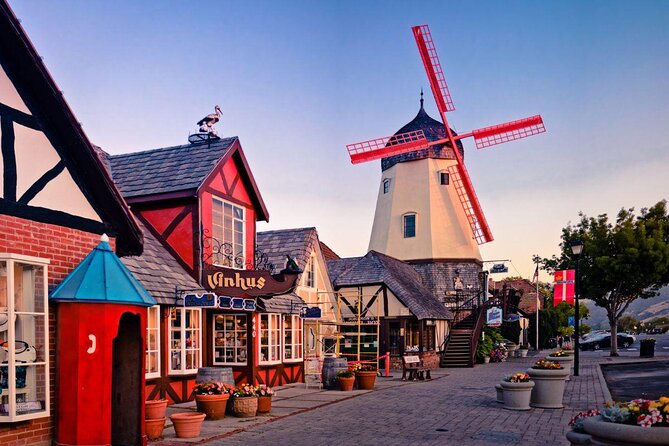
- Solvang Windmill (built 1922) was made by J.C. Wulff on Fredensborg Canyon and served an actual working well for his farm.
- Elverhøj Museum of History & Art sits in a Danish-style building that was once the home of the Petersen family.
- Hamlet Square is your downtown photo-and-stroll pause in the middle of everything.
- Copenhagen Sausage Garden gives you an easy, outdoors break that fits the Denmark theme without over-planning.
- Amber Museum + Andersen Museum are your “smart stops,” with amber pieces ranging from small items to large sculptures, and exhibits built around Andersen’s life in a replica home.
Starting at Mission Santa Inés: California’s Santa Ynez Valley beginning
You begin at Mission Santa Inés, 1760 Mission Dr, Solvang. This is the kind of first stop that helps your whole day make sense, because it anchors the Danish-themed town look in California’s mission-era story.
The mission you’ll read about was the nineteenth of 21 missions built in California between 1769 and 1836 by Spanish Franciscan priests. It was founded on September 17, 1804 by Father Estevan Tapis, and it’s described as the first European settlement in the Santa Ynez Valley. If you’re the sort of traveler who likes context, this opening gives you a reference point before you hit the town’s playful side.
One smart way to use this start: take a few minutes to orient yourself to the mission area first, then treat the rest of the route as a contrast—mission-era seriousness to Danish-style charm. If you’re short on time, don’t overstay here; the tour’s schedule is built for a steady flow.
You can also read our reviews of more tours and experiences in Santa Barbara.

Solvang Windmill at Fredensborg Canyon: a 1922 working farm detail
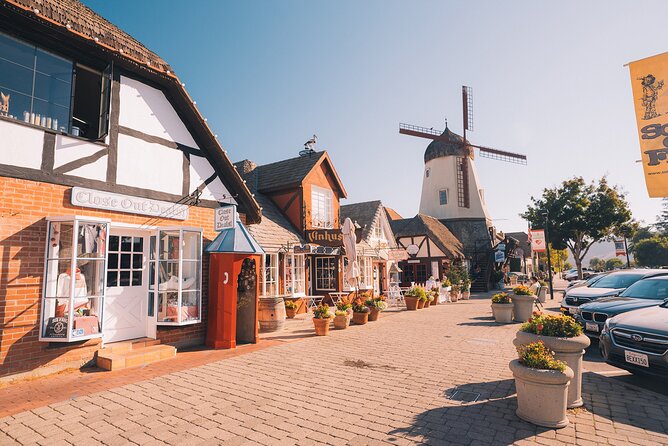
Next up is Solvang Windmill with a roughly 10-minute slot. Built in 1922 by J.C. Wulff on Fredensborg Canyon, it was part of an actual working well for his farm—so it’s not just a decorative prop.
That working-well detail matters. It gives the stop weight, especially if you’ve seen other windmills that exist mainly for photos. Here, you can think of it as a snapshot of practical rural life that later became part of Solvang’s visual language.
Since you’re only budgeting about 10 minutes, keep your expectations tight: this is a quick stop for understanding, photos, and moving on. If the sun is harsh, aim to photograph and then step into the shade nearby as you continue toward the next museum.
Elverhøj Museum of History & Art: Danish-style architecture with local roots
Your next museum stop is the Elverhøj Museum of History & Art, allotted about 25 minutes. The big draw here is the setting: it’s in a historic Danish-style building that once served as the home of the Petersen family.
That home-to-museum transformation is a useful lens. Even if you don’t spend hours reading every exhibit label, the building itself tells you what Solvang wanted to be—Danish in look and feel, but built from real people and real settlement stories. If the day is moving quickly, this stop is long enough to feel like you actually learned something without turning into a full museum marathon.
Keep an eye on the pace you set inside. With only about 25 minutes, you’ll get the most out of it if you skim broadly first, then linger where something catches your attention—especially if you’re drawn to Danish design cues in the architecture.
Hamlet Square: the downtown pause that makes Solvang feel like Solvang
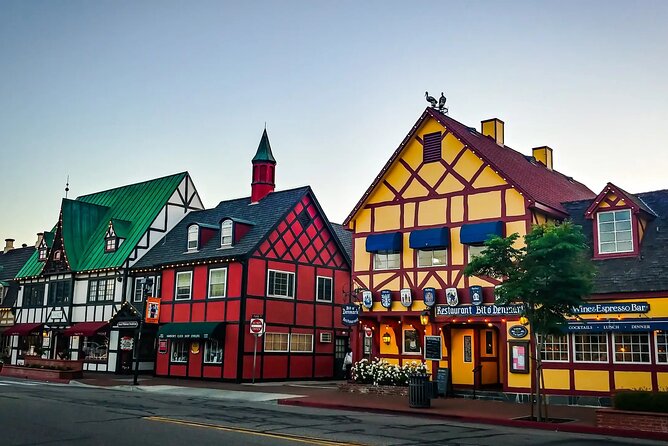
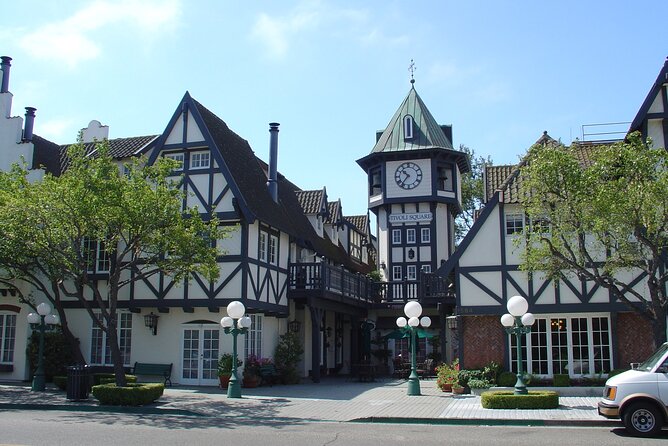
Hamlet Square is your most direct “stroll and reset” stop, around 10 minutes. It’s described as the most charming and picturesque area of Solvang and sits right in the heart of downtown.
For a self-guided plan like this, the value of Hamlet Square is simple: it gives you a visual break. You can slow down for photos, check the flow of the street scene, and mentally plan your last few stops so you don’t end up speed-walking through the museums.
The practical consideration: because it’s a square in downtown, it can feel busy when foot traffic is high. So if you want cleaner photo angles, pick a moment when you can step aside and let the stream of people pass.
Copenhagen Sausage Garden: a Denmark-themed food break without the planning headache
About 25 minutes later (on the schedule), you’ll hit the Copenhagen Sausage Garden. This is an outdoor eatery that’s popular with foodies visiting Solvang, known for delivering a unique and authentic Danish-style taste.
This stop is a smart mid-route choice because it’s flexible. If you’re hungry, you can eat and stay on track. If you’re not, you still get the atmosphere and can use it as a breathing point before you move into the more “information-heavy” museums.
One note for your expectations: the tour time is there to support your walking rhythm, not to guarantee you’ll finish a full meal without delay. If you want a sit-down lunch, give yourself a little buffer beyond the estimated time so you’re not stressed about the next museum.
Solvang Amber Museum: from small pieces to big fossilized drama
Next is the Solvang Amber Museum, with about 15 minutes on the plan. This one is for anyone intrigued by amber, and it’s described as having an impressive collection that ranges from small trinkets to large sculptures.
Amber can be fascinating because it sits at the intersection of nature and human collecting. Even if you don’t know much going in, a short museum stop like this helps you learn the basic visual language—what amber looks like, how pieces vary, and why it’s collectible.
With only 15 minutes, the best strategy is to pick a few favorites instead of trying to see everything. If you linger too long, you’ll feel rushed at the end. If you keep it focused—look, read a few key labels, and take photos when allowed—you’ll get the most value for your time.
Hans Christian Andersen Museum: a replica home that turns stories into scenes
Your final stop is the Hans Christian Andersen Museum at 1680 Mission Dr. It’s in a replica of Andersen’s childhood home, and the exhibits focus on his life and legacy.
This is a strong capstone because it matches the tone of Solvang’s Danish identity: it’s not just Danish-looking scenery. It’s a story-driven museum built around a named figure, so the route ends with a clear theme.
You’ll also have a long daily window on paper for the last stop: Monday through Sunday, 5:00 AM to 11:30 PM (for the listed date range). That’s unusually wide, and it means you can usually time your visit around daylight, crowds, or your energy level.
If you’re visiting with kids or you just like narrative museums, aim to spend a bit more time here than the earlier stops. Even within a self-guided format, ending with a story museum can make the whole walk feel more satisfying.
How the self-guided format makes sense for 1 to 2 hours
This is designed for an easy hit of Solvang in a short window. With the scheduled stop times—10 minutes at the windmill, 25 at Elverhøj, 10 at Hamlet Square, 25 for Copenhagen Sausage Garden, 15 for the Amber Museum, and 20 at Andersen’s—you’re basically set up for a paced walk without needing to make constant decisions.
The personalized part matters because it usually helps you move stop to stop with less friction. You’re not relying on internet research mid-walk. You’re following a route that’s already mapped to what’s in town.
Two practical tips that make self-guided tours work better:
- Start at a time when you’re comfortable walking for at least an hour, because you’ll be mentally switching gears between history and Danish-themed sights.
- If you want photos, do them in quick bursts. Don’t let pictures eat up your museum time, especially at the Amber Museum where you only have about 15 minutes.
Also, this is available in English, and the experience is described as private, meaning only your group participates. That’s a quiet advantage if you don’t want to squeeze into someone else’s pace.
Price and value: $5 per group is the whole point here
At $5.00 per group (up to 15 people), this is one of those “low-cost, high-structure” outings. For most people, the real value is that the listed stops are Admission Ticket Free, including the windmill, Elverhøj Museum, Hamlet Square, Copenhagen Sausage Garden, Solvang Amber Museum, and the Andersen Museum portion tied to the itinerary.
Even if you plan to eat, the baseline sightseeing cost stays tiny. That’s what makes this appealing compared with paid guided tours where you pay for both the guide and the ticketed attractions.
The main value tradeoff is your storytelling experience. The app format gives you background and practical context, but it can feel more informational than exciting. If you’re the type who wants a lively live guide personality, you may want to supplement this with extra time at your favorite stop.
Best fit: who will love this route, and who should adjust
This is a great match for:
- You if you like Danish-themed towns in California and want a short, coherent way to see the core sights.
- You if you prefer self-paced travel and hate scrambling for what to do next.
- You if your group includes mixed interests—history at the mission, art at Elverhøj, and story at Andersen—because the route includes something for different moods.
It may not be the best match if you want nonstop entertainment. Since the stops are a mix of museum visits and charming downtown moments, the experience can feel calm and evenly paced rather than eventful. If you go in expecting a big theatrical storyline throughout, you might end up wishing you had chosen something more guided.
A good compromise: use the app for orientation, then spend extra time at whichever stop grabs you most—often that’s the museum setting (Elverhøj, Amber, or Andersen) where you can slow down without losing the plot.
Should you book this Solvang City Personalized Self-Guided App Tour?
I’d book it if your goal is a smooth, affordable Solvang route where you can start at Mission Santa Inés and end at Andersen’s museum without planning yourself into a headache. For the price, the free admission across multiple key stops makes it easy to justify, even if you only care about part of the itinerary.
I’d think twice if you want a tour that feels like a show. This experience is more about steady background and practical sightseeing than big surprises. In that case, you’ll likely enjoy it most as a foundation—and then add your own time at one or two stops you want to expand.
If you’re traveling with a group up to 15, keep it simple: pick a start time, walk the route, and let the museums be your “anchor moments.” That’s where you’ll feel the best return on your time.
FAQ
How much does the Solvang City Personalized Self-Guided App Tour cost?
It costs $5.00 per group, up to 15 people.
How long does the tour take?
It takes about 1 to 2 hours.
Where does the tour start and end?
It starts at Mission Santa Inés, 1760 Mission Dr, Solvang, CA 93463, and it ends at the Hans Christian Andersen Museum, 1680 Mission Dr, Solvang, CA 93463.
Is the tour available in English?
Yes, it is offered in English.
Are there admission tickets required for the stops?
The itinerary lists admission ticket free for the stops included on the route.
What time is the Hans Christian Andersen Museum open?
The listed hours are Monday through Sunday, 5:00 AM to 11:30 PM (for the provided date range).
Is this tour private and can service animals join?
It’s private, so only your group participates. Service animals are allowed, and the tour is near public transportation.