REVIEW · PANTHEON ROME
Rome: Pantheon Fast-Track Ticket and Official Audio Guide
Book on GetYourGuide →Operated by D'Uva · Bookable on GetYourGuide
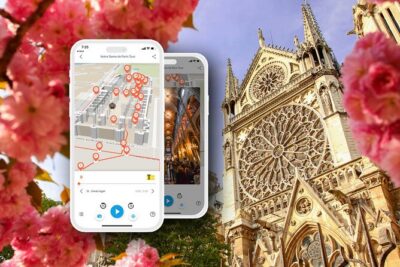
The fastest way into Rome’s oldest mystery. With a fast-track entry ticket and an official audio guide, you trade waiting time for a focused one-hour visit. You’ll hear the Pantheon’s story through Emperor Hadrian, Pope Boniface IV, Raphael, and Queen Margherita.
I love how the audio guide points your eyes at the big stuff without turning the Pantheon into homework. The dome’s math (43.44 meters across) and the oculus working like a sundial make the building feel instantly understandable, even if you’re not an architecture nerd.
I do think the main trade-off is logistics. You pick up your ticket at OhMyGuide – Roma Museum Store (Via dei Bergamaschi 49), and you’ll need a physical ID or credit card deposit to borrow the audio guide, plus the Basilica dress code is strict.
In This Review
- Key highlights you should care about
- Why this Pantheon audio tour works better than just showing up
- Getting your ticket at OhMyGuide (and using the separate entrance)
- Inside the Pantheon: Hadrian’s vision, the dome’s diameter, and the oculus
- Portico first impressions: Egyptian pink granite and what that choice signals
- Pope Boniface IV and the 609 conversion: seeing the Pantheon as a church
- Raphael, the Savoy royals, and how names change what you notice
- What you actually hear: actor voices, original music, and multiple languages
- Timing and crowd management: how to get the most from an hour
- Dress code rules at the Basilica door (and the ID deposit requirement)
- Price and value: is $6 for fast-track audio a smart buy?
- Who should book this Pantheon fast-track ticket
- Should you book this Pantheon fast-track ticket and official audio guide?
Key highlights you should care about
- Fast-line entry so you can spend your time inside, not at the bottleneck.
- Adriano to Margherita storytelling that connects politics, art, and faith in one circuit.
- Dome and oculus explanation including the 43.44-meter diameter and the light effect.
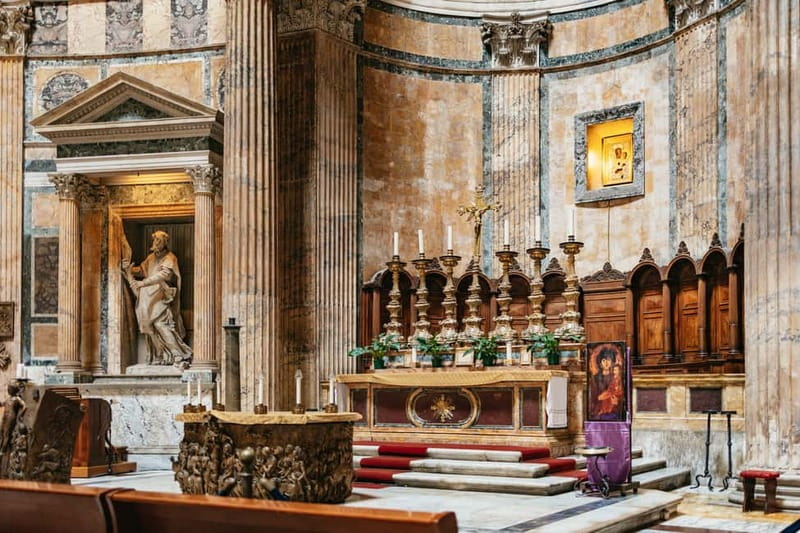
- Basilica viewing angles guided to see the Pantheon as both monument and church.
- Recorded performances with actor voices and original music performed with the Orchestra of Teatro La Fenice.
- Your ticket supports Santa Maria ad Martyres through the donation built into the experience.
Why this Pantheon audio tour works better than just showing up
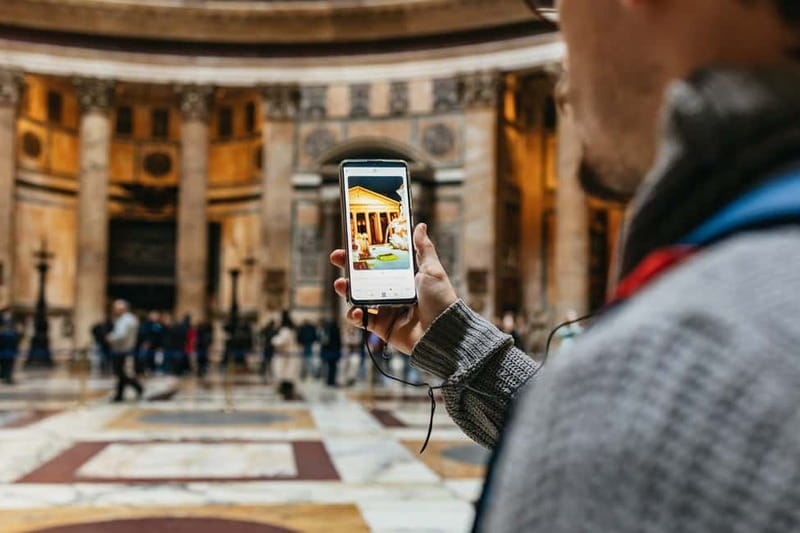
The Pantheon is the kind of site where you can either wander aimlessly with your camera up, or you can actually see it. This setup is built for that second option: a fast-track ticket plus an audio guide you can follow at your own pace. Since the experience runs about one hour, you’re not stuck for a half-day trying to “complete” something huge.
What makes it work is the way the audio guide doesn’t just list facts. It tells a chain of stories tied to people you’ll recognize from Rome’s long timeline—starting with Emperor Hadrian and moving into later religious and artistic chapters. So when you look up at the dome or around at the portico, you’re not just appreciating shape. You’re understanding why it mattered.
There’s also a practical side that you’ll feel immediately. A timed entry helps you avoid the worst crush, and the guide gives you a rhythm for moving through the interior. You can pause when you want, but you’re not guessing what to look at next.
You can also read our reviews of more tours and experiences in Pantheon Rome.

Getting your ticket at OhMyGuide (and using the separate entrance)
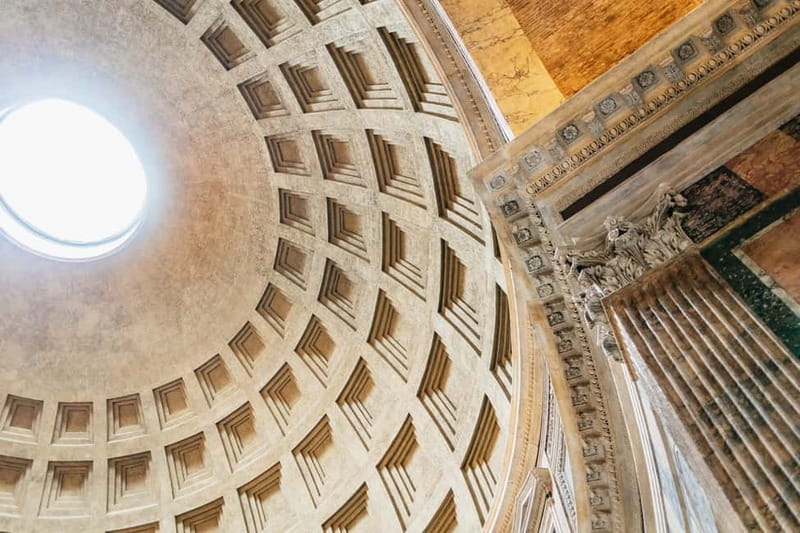
Your pickup point is OhMyGuide – Roma Museum Store, Via dei Bergamaschi 49. It’s close enough that most people handle it fine on foot, but still far enough that you’ll want to show up with time in hand. The experience is also clear about timekeeping—stick to your reservation time so you don’t end up rushing.
Once you have your ticket, you go straight to the Pantheon. Entry is through the booking line tied to your ticket type, which is the whole reason to choose fast-track. After that, the audio guide piece kicks in once you’re inside.
One small but important note: the audio guide isn’t handled like a free-for-all. You’ll need a valid ID or credit card deposit to borrow it, and the accepted forms are physical documents (photos of IDs and digital IDs aren’t accepted). If you’re traveling light, that’s worth planning for before you leave your hotel.
Inside the Pantheon: Hadrian’s vision, the dome’s diameter, and the oculus
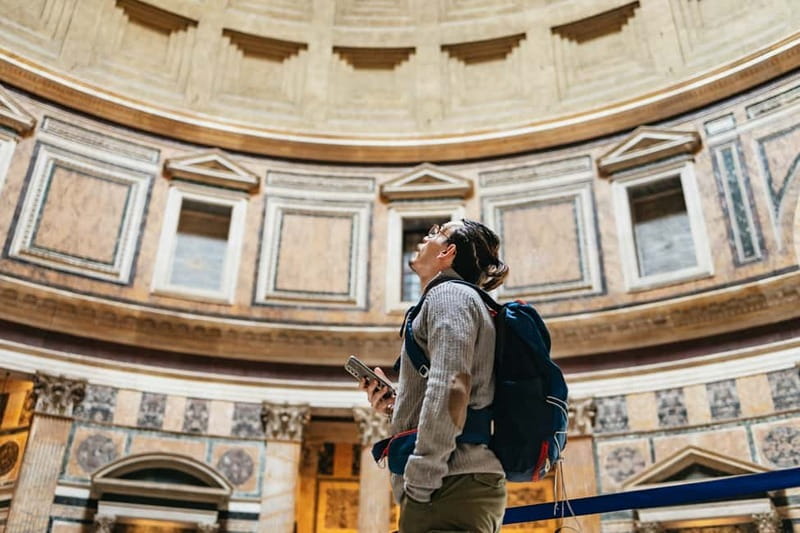
You start in the spirit of Emperor Hadrian, the ruler who commissioned the Temple of all the Gods as it stands in today’s form. The audio guide uses his voice to set the tone, and it helps you understand that this wasn’t built as a single-purpose monument. It was designed to impress, unify, and symbolize Rome’s power.
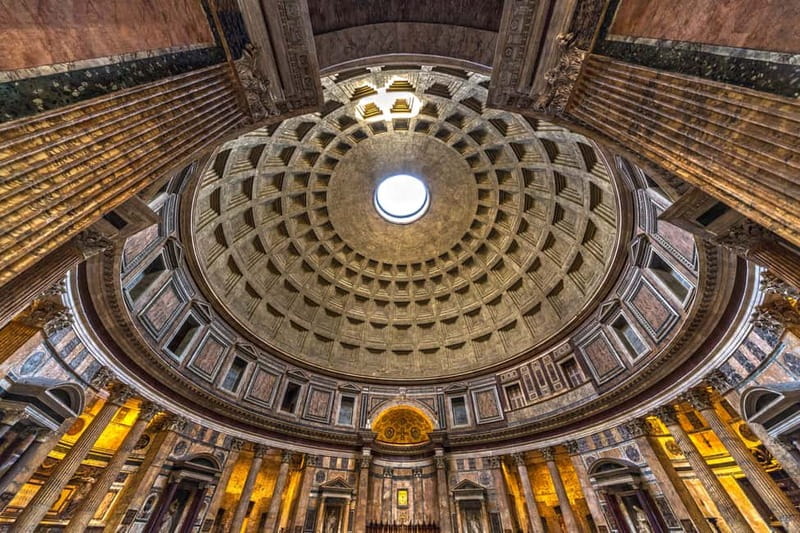
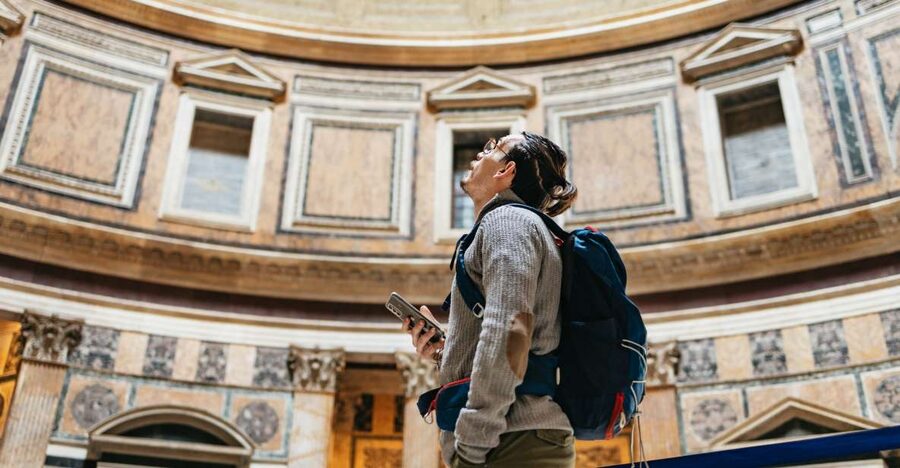
Then you hit the architecture. The guide frames the dome as a kind of technical miracle: 43.44 meters in diameter. When you look up at that scale after hearing how it was intended to work, the interior feels less like decoration and more like engineering aimed at awe.
And then there’s the oculus. The audio guide explains what the opening does beyond being pretty: sunlight falls into the space in a way that behaves like a sundial. Even if weather changes your lighting, you’ll still notice how the oculus controls the mood—light comes from above, and your attention gets pulled upward naturally.
If you like to connect what you’re seeing with why it exists, this first section is the sweet spot. You can almost feel the building teaching you how to look.
Portico first impressions: Egyptian pink granite and what that choice signals
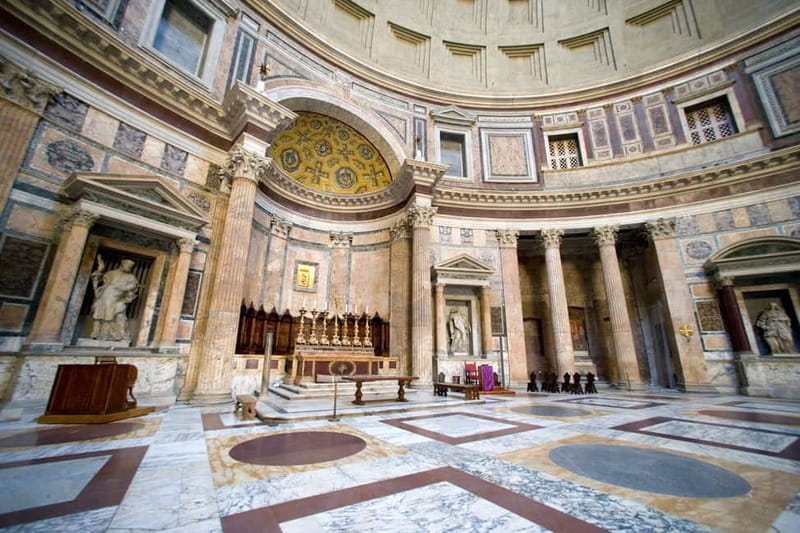
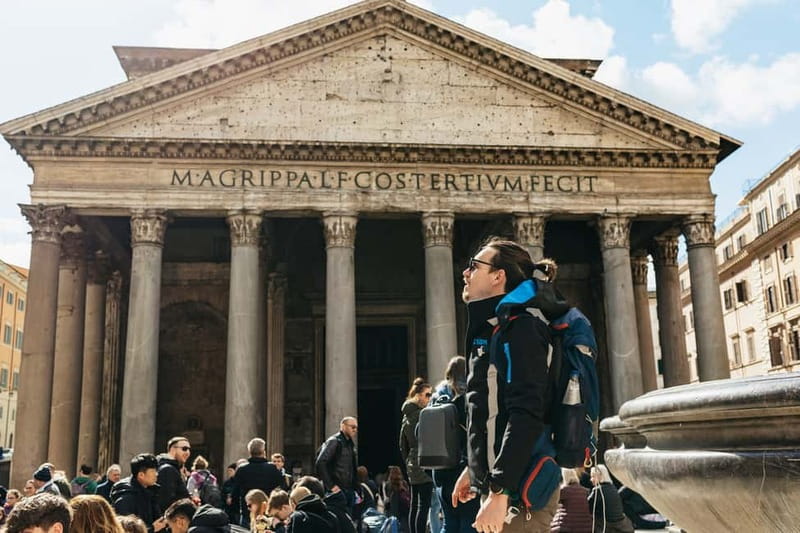
Before you get fully swallowed by the interior, the guide brings you to the portico and its columns. One detail I think you’ll appreciate: the columns are pink granite from Egypt. That’s not random. Rome loved pulling materials and symbolism from across the empire, and these columns are part of that message.
The audio guide also helps you slow down in the right places. You’re not just walking past the façade and snapping a photo. You’re registering the materials, the proportions, and the way the exterior “sets up” the view you’ll get once you step inside.
This is also where the audio format shines. With a live guide, you’d have to follow on their schedule and keep up with a group. Here, you can listen, look, and step aside when you need to reframe what you’re seeing.
Pope Boniface IV and the 609 conversion: seeing the Pantheon as a church
One of the best parts of this experience is how it handles the Pantheon’s religious shift. In the year 609 AD, Pope Boniface IV converted the temple into the Basilica of Mary and all Martyrs. That turn is a big deal, because it explains why the structure survived the way it did and why it still feels active, not abandoned.
The audio guide talks about safeguarding the building from plunder and keeping it intact. That matters because so many historic sites in Rome have layers of loss. Here, the Pantheon becomes a rare survivor with a continued purpose.
As you listen, you’ll also get prompted to watch how the interior functions as worship space. The Pantheon isn’t just museum architecture; it’s still a church you enter with rules and expectations. The guide even brings in a modern voice perspective from Mons. Micheletti, the archpriest rector of the Pantheon in Rome, to steer you toward viewing the building through different eyes.
If you only come for the “ancient wonder” angle, you might miss how meaningful the site is as a living place of devotion. This audio route makes that connection without getting preachy.
Raphael, the Savoy royals, and how names change what you notice
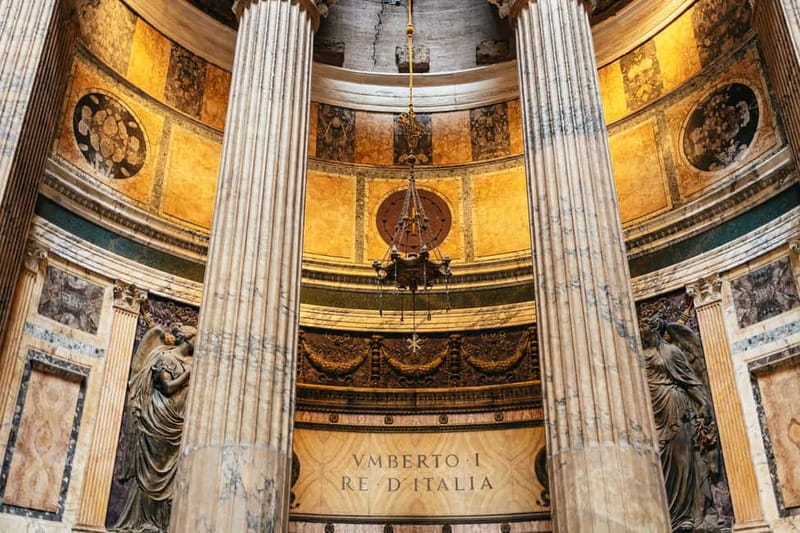
Then you move into the art-and-memory layer. The portico and interior aren’t just Roman engineering; they’re also tied to the afterlives of famous people.
You’ll hear about Raphael Sanzio of Urbino, a painter and architect buried here along with other Renaissance artists who admired classical architecture. That’s a fascinating loop: a Roman masterpiece inspiring Renaissance thinkers who then become part of the Pantheon’s story. You don’t have to know art history already, either. The audio guide gives you enough context to understand why someone like Raphael would matter in a space like this.
The guide also brings in the Savoy dynasty. Queen Margherita is resting at the Pantheon with King Umberto I and Vittorio Emanuele II of Savoy. When you hear those names in sequence, it’s easier to see the Pantheon as a long-standing stage for Italy’s evolving identity, not just a single time period.
And there’s one more image that sticks. You’ll listen to the tradition of red rose petals descending from the oculus each year to commemorate Pentecost, marking the descent of the Holy Spirit upon the Apostles. Even if you’re not visiting on Pentecost day, the story makes the oculus feel more theatrical—and more intentional.
What you actually hear: actor voices, original music, and multiple languages
This experience isn’t a dry narration track. The audio guide is voiced by professional actors such as Sergio Rubini, Alessandro Haber, Daniele Parisi, Giusi Cataldo, and Mons. Daniele Micheletti. Those voices keep the experience from turning into a lecture you tune out.
There’s also original composition work by Antonio Fresa, performed with the Orchestra of Teatro La Fenice. That matters because the Pantheon is an echoing, spiritual-feeling space. Music and sound design are part of how you experience the interior mood, not a random add-on.
Language coverage is broad. The audio guide is available in Chinese, English, French, German, Italian, Portuguese, Russian, Spanish, Arabic, Dutch, Korean, and Polish. That’s a huge plus if you’re traveling with someone who prefers a language other than English, or if you want accuracy over guessing at explanations in a secondhand way.
Timing and crowd management: how to get the most from an hour
Because the tour is scheduled for about one hour, you should treat it like a focused circuit, not an open-ended wandering session. When you arrive and enter through the fast line, you immediately gain something valuable: you avoid the long pre-entry waits that can steal your energy and patience.
Once inside, don’t feel forced to rush to the next story beat. Use the audio guide like a pacing tool. Pause when you want to look up at the dome again, or stand where the oculus light effect is strongest. The audio format is designed for listening while you observe, and the pacing is flexible enough that you can linger at the moments that grab you.
Also keep in mind that the Pantheon can have anticipated closures, postponed openings, masses, concerts, or other events that may vary the service time. Rome runs on calendars with personality. If you’re traveling close to a date with religious events, it’s wise to keep your schedule flexible and check your timing again the day you go.
Dress code rules at the Basilica door (and the ID deposit requirement)
The Pantheon visit isn’t a casual “come as you are” situation. Access to the Basilica requires suitable attire. Shorts, short skirts, and sleeveless shirts aren’t allowed, and you may also run into restrictions like vests needing to be avoided. If your wardrobe is borderline, plan ahead so you’re not stuck deciding whether to buy something quick on the street.
You should also plan for the audio guide deposit system. The guide is borrowed on-site with a required valid ID or credit card deposit. Photocopies, pictures on your phone, student cards, and digital IDs aren’t accepted. If you’re the type who leaves your passport in the hotel safe, this is the moment to rethink that habit.
One more practical tip: bring a credit card or ID you’re okay lending temporarily as a deposit. It’s the kind of rule that’s easy to overlook until you reach the counter.
Price and value: is $6 for fast-track audio a smart buy?
At about $6 per person, this isn’t just a bargain ticket. The value comes from what you’re paying to avoid: a long queue and a lot of standing around without direction. If you’ve ever done the Pantheon the slow way, you know how quickly impatience builds.
You’re also paying for structure. The audio guide ties together architecture, religious transformation, and major figures like Hadrian, Boniface IV, Raphael, and Margherita of Savoy. That context is what turns a “pretty building” into a “now I get it” experience.
Finally, part of what you pay supports the Basilica of Santa Maria ad Martyres through donations included in the experience. That doesn’t automatically make it charity-worthy, but it does mean your ticket helps keep the site’s activities supported.
The main thing you give up versus a live guide is human improvisation. Here, the guidance is prerecorded, voiced by actors and designed to follow a set path. For most people, that’s the right trade: clear and consistent, with you in control of pacing.
Who should book this Pantheon fast-track ticket
I’d point you toward this experience if you want:
- a fast, efficient entry into one of Rome’s biggest crowd magnets
- an audio guide that tells you who’s who and why you should look up at the right moments
- a format that works well for groups or mixed interests, since you can focus on your own listening while still seeing everything together
- multiple language options, since the audio is offered in many languages
It also lists wheelchair accessibility, which is a practical win if mobility is part of your planning.
Where it might not fit as well is if you strongly prefer a live guide style—someone answering questions on the spot—or if you’re the type who wants zero rules and zero deposits. But if you’re comfortable with a timed entry and a simple deposit process, this is a very workable way to do the Pantheon.
Should you book this Pantheon fast-track ticket and official audio guide?
If you’re coming to the Pantheon for the first time, I think this is an easy yes. The fast-track ticket protects your time, and the audio guide fills the gaps between “I see it” and “I understand it.” In an hour, you’ll get the big architecture moments, the key historical pivot in 609 AD, and the cultural layers tied to Raphael and the Savoy royals.
If your schedule is tight, or you hate waiting, this choice makes your trip calmer. Just plan for the pickup point at Via dei Bergamaschi 49, bring the right ID or credit card for the deposit, and dress for the Basilica so you don’t hit a surprise barrier. Do that, and you’ll leave feeling like you didn’t just visit the Pantheon—you actually read it.