REVIEW · PORT ANGELES
Olympic National Park Self-Guided Driving Audio Tour
Book on Viator →Operated by Adventures with Action · Bookable on Viator
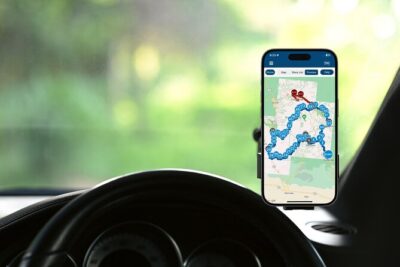
Washington’s rain-soaked coasts get context fast. This self-guided Olympic National Park driving audio tour strings together scenic stops and hands-free, location-based stories so you spend less time guessing and more time looking. You also get offline maps and turn-by-turn audio cues, which matters on the Olympic Peninsula when cell service can be spotty.
I especially like the value: it’s priced per group (up to 4), so your car is your ticket. I also like the flexibility—start when you want, pause for photos, and jump back in without feeling rushed by a live guide.
One thing to plan for: you still need a park pass, and you’ll want to download/setup the app on strong Wi‑Fi before you go offline.
In This Review
- Key highlights worth planning around
- How this self-guided Olympic drive really works (and why it’s good)
- Price and value: $16.99 per group and what you should compare
- Route reality check: 43+ miles of stops, but it’s not every part of the park
- Starting at the Olympic National Park Visitor Center: good orientation, easy first win
- Madison Falls trailhead: short, paved, and wheelchair friendly
- Elwha River + Upper Elwha Dam overlook: when the scenery has a story
- Lake Sutherland and Lake Crescent: deep-lake calm between bigger viewpoints
- Marymere Falls trailhead and Meldrim Point: quick nature wins near the lakes
- Sol Duc Valley: your halfway-to-coast reset
- From rainforest to beaches: Hoh Rainforest, Ruby Beach, and Rialto Beach
- Hoh Rainforest
- Ruby Beach
- Rialto Beach
- Hurricane Ridge: viewpoints plus short alpine-style payoff
- Forks-area additions: timber history, state park time, and a different pace
- Audio reliability and setup tips (so you don’t lose the day)
- Time planning: how to avoid the end-of-day scramble
- Should you book this Olympic National Park audio tour?
- FAQ
- How much does the Olympic National Park self-guided audio tour cost?
- How long does the tour take?
- Where does the tour start and end?
- Is the tour guided by a person?
- Does it work offline?
- Do I need a park pass?
- What devices and setup are recommended?
- What audio equipment can I use in the car?
- Is Apple CarPlay supported?
- Can I pause and resume the tour?
Key highlights worth planning around
- GPS-triggered audio playback keeps your eyes on the road while the stories start as you reach each stop
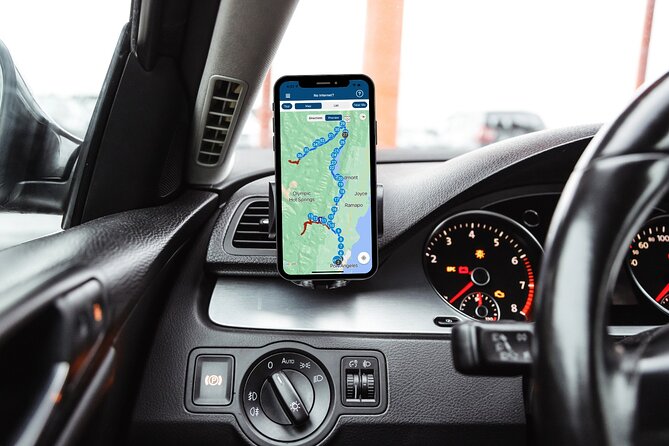
- Offline maps help you keep moving even with weak or no cellular signal
- Per-group pricing (up to 4 people) makes it cheaper than hiring a guide for a family or small group
- A big mix of Olympic ecosystems is covered: lakes, river/dam history, temperate rainforest, and Pacific beaches
- Short stops with built-in sightseeing time work well if you don’t want to hike all day
How this self-guided Olympic drive really works (and why it’s good)
This tour is built for a simple idea: you drive, and the audio guides you at each point of interest. After booking, you get a password by email/text. You download the Action’s Tour Guide app (and the tour content) while you have strong Wi‑Fi or cellular—then it’s meant to work offline afterward.
On site, you open the audio tour app, launch the correct tour version, and you start at the designated starting point. From there, the stories play automatically based on your location, so you’re not constantly tapping your phone. If you want a classic Olympic experience without paying for a full guided day, that hands-off format is the main reason to consider it.
You’ll also like that this isn’t a “locked schedule.” You can pause the tour whenever you want, take snack/photo breaks, and keep going when you’re ready. That freedom matters on Olympic Peninsula drives, where weather can change quickly and pullouts can be crowded.
Price and value: $16.99 per group and what you should compare
At $16.99 per group (up to 4), this is priced like an activity for your car—not per person. That’s a big deal at Olympic National Park, where a live guide can easily cost much more for the same time window.
Here’s how I’d think about value. You’re paying for:
- narration and storytelling at 33+ stops
- offline maps and GPS-triggered audio
- self-paced timing across multiple regions
What you’re not paying for is a guide who can answer random questions on the fly, steer you toward additional hikes based on your pace, or adjust the plan if you get detoured by traffic or weather.
If you’re the kind of group that likes control and doesn’t need a person in a vest, the per-group pricing is hard to beat.
Route reality check: 43+ miles of stops, but it’s not every part of the park
This drive tour covers 43+ miles and is designed around a sequence of viewpoints, trailheads, and scenic areas. It also has more than 33 audio stories. Plan around about 5–6 hours total for a comfortable day with stops and photos. The listening portion alone can be shorter (around 2–3 hours) if you move briskly.
One practical truth about Olympic: a huge chunk of what people love most is best reached by hiking. Even if you do short strolls at each stop, you’re still mostly in “drive-and-look” mode. In other words, you’ll get a strong overview—lakes, river history, temperate rainforest, and coast—but you won’t cover every trail in the way a multi-day hiking plan would.
If your goal is “see the variety quickly,” this works. If your goal is “experience Olympic by foot all day,” you might want to pair this with a separate hike plan.
Starting at the Olympic National Park Visitor Center: good orientation, easy first win
Your tour begins at the Olympic National Park Visitor Center near Port Angeles. This is one of those start points that makes the day easier, even if you don’t buy anything.
Why? Because Olympic National Park is basically four regions you’ll bounce between:
- the Pacific coastline
- alpine areas
- the west-side temperate rainforest
- the drier east-side forests
The park also has three distinct ecosystems you’ll hear about through the audio: subalpine forest and wildflower meadows, temperate forest, and the rugged Pacific coast. Starting at the Visitor Center sets you up to understand what you’re seeing as the audio moves you from lakes and rivers to rainforest and beaches.
If you arrive early, this is a great time to do quick bathroom/leg-stretch logistics before you start driving.
Madison Falls trailhead: short, paved, and wheelchair friendly
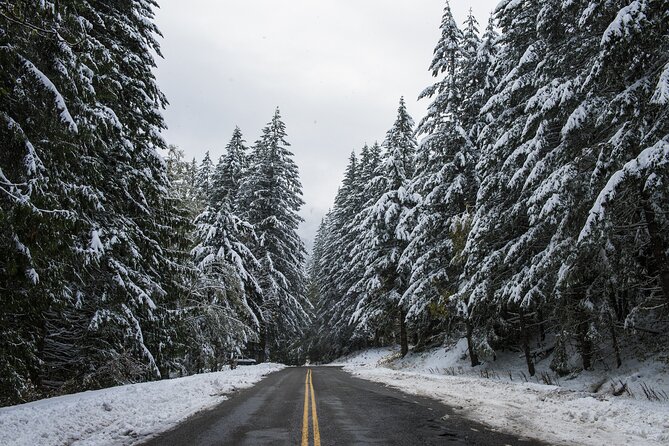
One of the nicer “low-stress” stops is Madison Falls Trailhead. The falls are about 50 feet high, with a light flow in a horsetail shape. There’s also mention of another higher fall above the first—but that higher portion is inaccessible.
The trail to the falls is concise (less than 100 meters) and is wheelchair accessible. That’s perfect if:
- you want a quick payoff
- you’ve got kids or anyone who doesn’t want a long hike
- you’re doing a full day of driving and don’t want to burn time on steep terrain
Consideration: because the hike is short, your “wow” moment depends on what the weather/flow is doing that day. If you’re going after rainy-season power, aim for a day with recent rain if you can.
Elwha River + Upper Elwha Dam overlook: when the scenery has a story
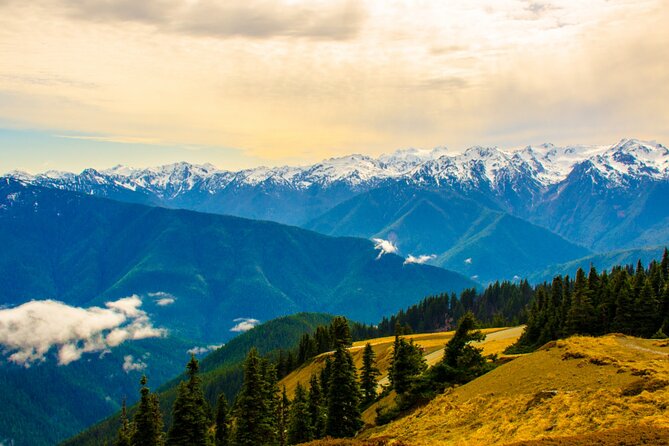
The audio spends real time on the Elwha River. The river is 45 miles (72 km), generally flows north to the Strait of Juan de Fuca, and much of its course sits inside Olympic National Park. It starts at Elwha snow finger in the Olympic Mountains.
Then you get a specific engineering landmark: Glines Canyon Dam Overlook, also known as the Upper Elwha Dam. It was built in 1927, and it’s described as a 210-foot (64 m) high concrete arch dam on the Elwha River, located within the park.
This pairing is smart for two reasons:
- It grounds you in the “what am I looking at” basics (river system).
- It adds human history and scale (that dam size number sticks with you).
If your group usually skips history, don’t. This kind of audio makes the natural scenery feel deeper without forcing you into a museum.
Lake Sutherland and Lake Crescent: deep-lake calm between bigger viewpoints
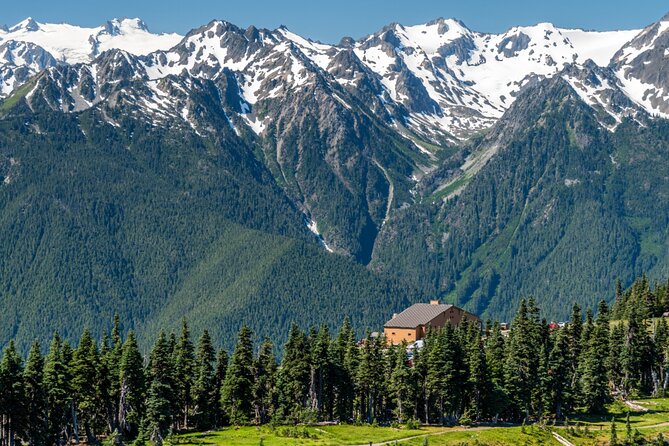
Next up is Lake Sutherland, about 17 miles (27 km) west of Port Angeles, near Lake Crescent. The audio notes that it drains into Indian Creek, a tributary of the Elwha River.
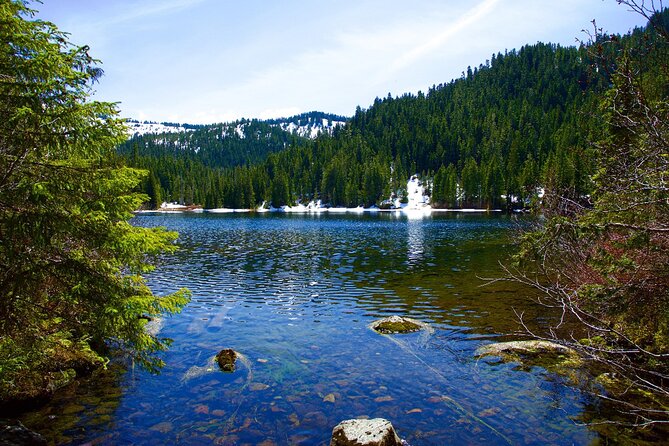
Then you hit Lake Crescent—a deep lake entirely within Olympic National Park, about 17 miles (27 km) west of Port Angeles on U.S. Route 101, near the community of Piedmont.
These stops are a good breather. After river/dam context, you’re rewarded with the visual “pause” of lake water and shoreline viewpoints. It’s also a logical time to take photos, refill water, and decide if you want to stretch your legs at nearby trailheads (like Marymere Falls, which comes next).
Marymere Falls trailhead and Meldrim Point: quick nature wins near the lakes
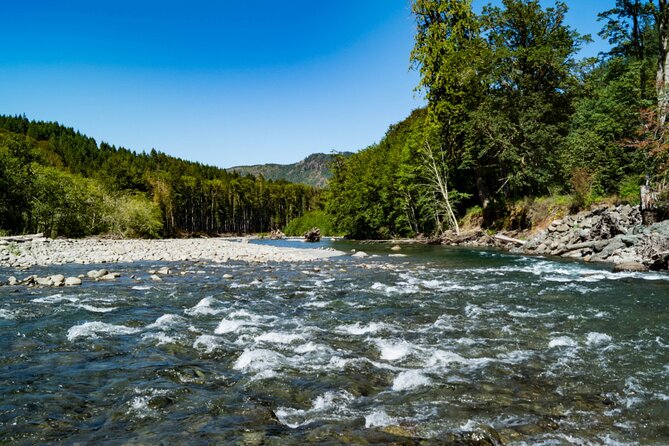
Near Lake Crescent, you’ll reach Marymere Falls Trailhead. The audio keeps this stop simple and oriented around the hike experience, which makes it a good fit for a driving day where you don’t want to commit to a marathon.
Right after, you get Meldrim Point, described as a cape near Ovington and Lake Crescent. Cape viewpoints are a classic Olympic Peninsula move: you’re often able to see far enough to understand the coastline-and-valley shape, even if you don’t have time for a long hike.
For both stops, the big value is pacing. They help prevent the drive-from-stop-to-stop fatigue, because there’s typically something real and photogenic at the end of each short detour.
Sol Duc Valley: your halfway-to-coast reset
The tour includes Sol Duc Valley, described as being in the northwest region of Olympic National Park.
Even without a long hike commitment, Sol Duc works as a mental reset. You’ve been hearing about lakes and river systems, and now you’re headed toward rainforest and coastline themes later in the tour. Expect the day to feel more varied from here—more “ecosystem hopping” than single-feature sightseeing.
From rainforest to beaches: Hoh Rainforest, Ruby Beach, and Rialto Beach
This is where the tour earns its keep, because it covers dramatic changes in scenery without you needing to study a map for hours.
Hoh Rainforest
The tour includes Hoh Rainforest, called one of the largest temperate rainforests in the U.S. on the Olympic Peninsula. The audio provides specifics: it includes 24 miles (39 km) of low-elevation forest, from about 394 to 2,493 feet (120 to 760 m) along the Hoh River. The Hoh River valley was formed thousands of years ago by glaciers.
If you love forests, this is the stop that can make the whole drive feel worthwhile. Temperate rainforest is not just “lots of trees.” The audio numbers help you picture scale.
Ruby Beach
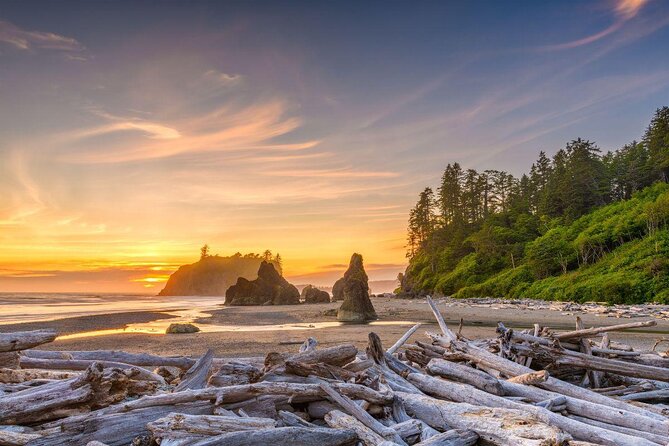
You’ll also get Ruby Beach. The audio emphasizes driftwood—lots of it, like virtually all northern-coast beaches—and points out its sea stacks.
Sea stacks are one of those details you can miss if you’re rushing. The narration helps you notice them and understand why that shoreline looks the way it does.
Rialto Beach
Rialto Beach is included as a Pacific Ocean beach stop. Even though the tour doesn’t spell out extra numbers here, it gives you a structured reason to pull over and look instead of treating the coast as just a drive-through.
Hurricane Ridge: viewpoints plus short alpine-style payoff
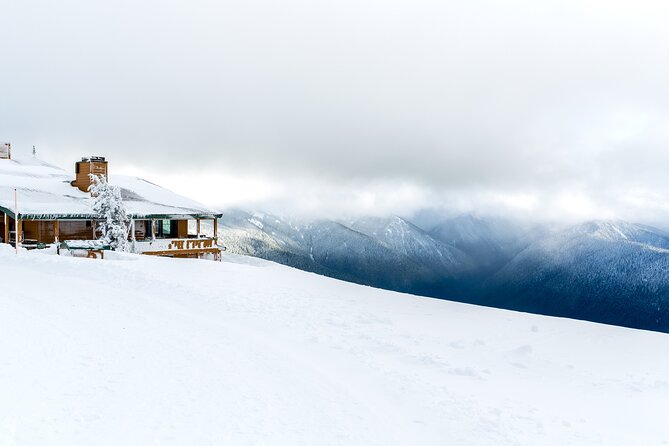
The tour includes Hurricane Ridge, described as a mountainous area within Olympic National Park. The audio themes at Hurricane Ridge focus on:
- a must-see viewpoint at Hurricane Ridge Road
- an ending reward with a more vigorous hike option
- a short alpine outing with expansive vistas, wildlife, and wildflowers
Hurricane Ridge is great for two reasons. First, you often get a different feel from the rainforest and coast. Second, you can choose how hard you want to go—short and family-friendly options exist right alongside more energetic ones.
If you’re traveling with mixed abilities, this is a place to split the difference. One person can do the longer effort while the other stays at the viewpoint. The audio structure helps you coordinate without losing the story thread.
Forks-area additions: timber history, state park time, and a different pace
Toward the western side, you’ll reach stops tied to the Forks area and local outdoor recreation:
- Forks Timber Museum (focused on forestry in the region)
- Bogachiel State Park, near the Bogachiel River, about four miles south of Forks on Highway 101
These stops keep the tour from feeling like a nature-only checklist. They give you a quick sense of how people have interacted with the forested Olympic Peninsula.
If you’re in a family group or a mixed-interest group, this section helps. Not everyone wants waterfalls and trees every stop. Timber-and-forest context can give your group something to talk about in the car.
Audio reliability and setup tips (so you don’t lose the day)
This tour’s biggest strength—automatic audio triggered by GPS—also means setup matters.
Here’s what I’d do to avoid problems:
- Download the tour while you have strong Wi‑Fi/cellular. The info you’re given is explicit: you must download properly for offline use.
- Use the app once you’re onsite to start the tour at the right starting point and direction.
- For sound, connect to your car stereo using Bluetooth, USB, or AUX. Headphones can help if you step out for short walks.
- Apple CarPlay is described as compatible, but some users have reported it may not behave as expected. If your car system causes issues, switch to Bluetooth/USB/AUX immediately rather than fighting the phone.
Also, remember: there’s no person meeting you at the start. You start self-guided by launching the app and letting the first story begin automatically at the correct location.
Time planning: how to avoid the end-of-day scramble
Because the tour includes a lot of stops, time management is your job. The good news is that most segments are designed around short scenic moments and quick trailhead visits.
My practical timing advice:
- Do the lake and falls sections earlier in the day if you can. They’re great in softer light.
- Save Hurricane Ridge and Hoh-style stops for when weather is most cooperative, because clouds and rain can change visibility quickly.
- Build in a little buffer. If you’re enjoying one stop more than expected, you can pause and keep the rest without feeling punished.
If you want the maximum payoff without hiking all day, stick to the short stops and choose one “bigger effort” hike option at Hurricane Ridge.
Should you book this Olympic National Park audio tour?
Book it if:
- you want a self-paced day through multiple Olympic ecosystems
- you like having narration and directions at your fingertips
- you’re traveling as a group up to 4 and want per-car value
- you care about understanding what you’re seeing—lakes, river systems, rainforest scale, and beach details
Skip it or pair it differently if:
- you’re expecting a full guided substitute with constant, personalized answers
- you’re trying to cover every major Olympic hike in one day
- you don’t want to manage phone setup and downloading before going offline
If you want a strong introduction to Olympic National Park by car—without overspending—this tour is a smart buy. Just budget for the park pass, download correctly before signal fades, and treat it as an easy way to learn while you drive.
FAQ
How much does the Olympic National Park self-guided audio tour cost?
It costs $16.99 per group, for up to 4 people.
How long does the tour take?
Plan for about 5 to 6 hours on average. The listening portion can take about 2 to 3 hours.
Where does the tour start and end?
It starts at the Olympic National Park Visitor Center at 3002 Mt Angeles Rd, Port Angeles, WA 98362, and it ends at Sol Duc Trailhead on Sol Duc Rd, Port Angeles, WA 98363.
Is the tour guided by a person?
No. It’s self-guided. You start by launching the app onsite; no one meets you at the starting point.
Does it work offline?
Yes. You’re expected to download the tour while you have strong Wi‑Fi or cellular, and then it works offline afterward.
Do I need a park pass?
Yes. Park passes are required to visit Olympic National Park, and they are not included.
What devices and setup are recommended?
An iPhone with iOS 15 or later, an Android device version 9 or later, or an iPad/tablet with GPS and cellular connectivity are recommended.
What audio equipment can I use in the car?
You can connect your phone to your car stereo using Bluetooth, USB, or AUX. Headphones can also help during walking moments.
Is Apple CarPlay supported?
Playback is described as compatible with Apple CarPlay, but some users have reported CarPlay-related problems. If that happens, using Bluetooth/USB/AUX is the alternative.
Can I pause and resume the tour?
Yes. You can start anytime and pause anywhere, then continue at your own pace.