REVIEW · EPHESUS
Ephesus Entry Ticket with Mobile Phone Audio Tour
Book on GetYourGuide →Operated by Clio Muse Tours · Bookable on GetYourGuide
Ephesus is one of those places where stones still talk. This mobile phone audio tour turns the site into a clear, self-guided story, with skip-the-line entry and offline content plus interactive maps so you can move at your pace instead of chasing a guide.
What I like most is how practical it is: you get in quickly, then the phone audio keeps you oriented through the major landmarks. The other big win is the order of stops, which helps you connect Roman, Hellenistic, and early Christian layers without feeling lost.
One catch to plan for: the audio experience depends on your device. You’ll need an Android/iOS phone (and enough storage), plus your own headphones—so if your tech is old or your download glitches, you’ll feel the inconvenience right away.
In This Review
- Quick highlights: what you’ll enjoy most
- Ephesus, your way: what this phone audio setup really does
- Timing and pacing: can you see the big hits in 2.5 hours?
- Where to start at Ephesus: Upper Gate matters
- The stop-by-stop walk: what each landmark adds to the story
- State Agora: Ephesus’ political center
- Bouleuterion: council meetings and performances
- Temple of Domitian: the unusual U-shaped altar layout
- Curetes Street: connecting civic and commercial Ephesus
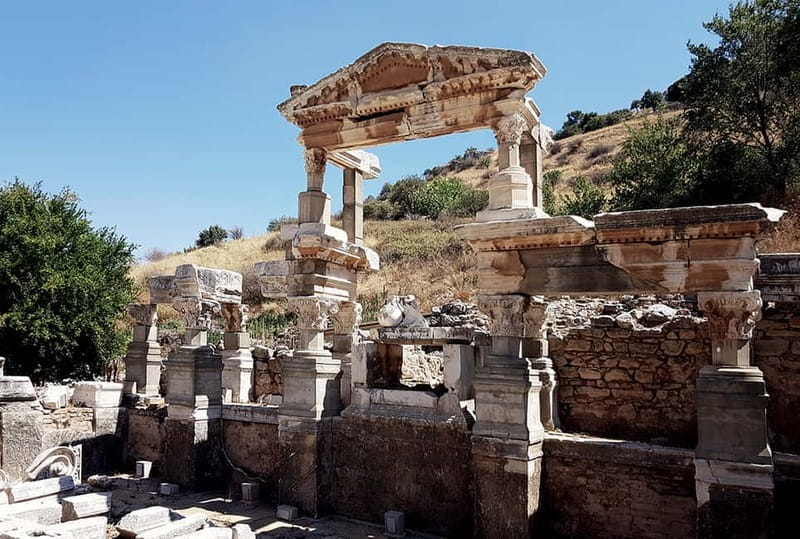
- Emperor’s Fountain: a legend you can picture
- Scolastica baths: marble latrines and a sense of everyday life
- Arsinoe’s grave: the Egyptian princess connection
- Celsus Library: the landmark everyone talks about
- Gate of Mazeus and Mithridates: transitional, but meaningful
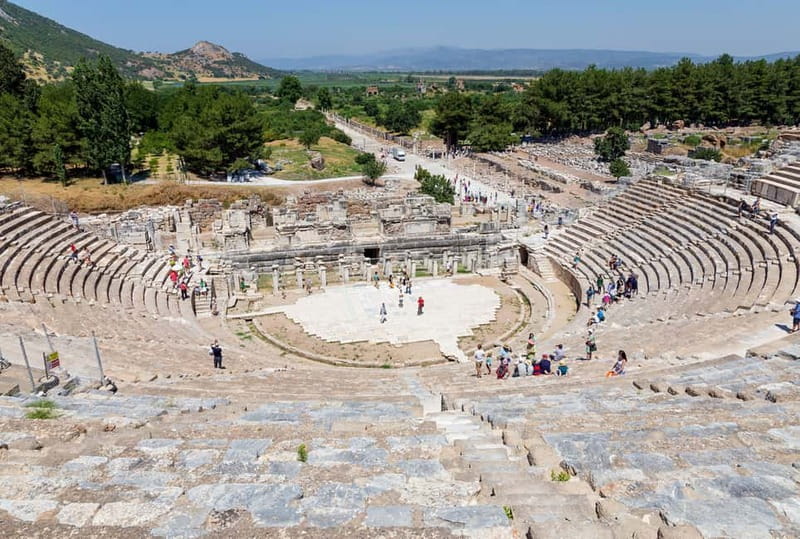
- Grand Theatre: performances and gladiatorial games
- Arcadiane crossroads and the Church of Mary ruins
- Skip-the-line entry: is it worth it?
- Tech checks that can save your day
- What about the number of stops vs official signs?
- Who this is best for (and who should skip it)
- Practical packing for Ephesus
- Should you book the Ephesus mobile audio ticket?
- FAQ
- FAQ
- Where does this audio tour start inside Ephesus?
- How long is the visit with this ticket?
- Do I get skip-the-line entry with this ticket?
- What languages are available for the audio tour?
- Is the audio tour usable offline?
- What devices are supported?
- Do I need to bring a smartphone and headphones?
- How do I access the ticket and audio after booking?
- Is Ephesus entry wheelchair accessible for this activity?
- Is the booking per participant or per device?
Quick highlights: what you’ll enjoy most
- Skip-the-line entry to reduce the most annoying part of Ephesus logistics
- Offline phone audio + interactive maps to keep you moving between key ruins
- A tight 2.5-hour route that hits the Celsus Library, Grand Theatre, and Church of Mary area
- Great language match with English and German narration
- Small group setup (up to 10) while you still explore independently
- A clear start point at the Upper Gate (South entrance) near Magnesia Gate
Ephesus, your way: what this phone audio setup really does
Ephesus can be overwhelming even when you’re excited. The ruins cover a lot of ground, signage can be confusing, and you’re constantly asking yourself: What is this? Why does it matter? Where do I go next?
That’s where this format shines. Instead of a live guide talking at you on a fixed schedule, you get an audio route designed for a smooth walk. You can pause, speed up, or backtrack if a doorway, inscription, or mosaic catches your eye. And because the content is available offline with interactive maps, you’re not forced to rely on spotty reception.
This approach is especially good if you:
- Prefer learning through short sections rather than one long lecture
- Want to spend more time at the parts you care about (the library façade, the theatre seating, the church ruins)
- Are traveling with a mix of interests and don’t want everyone to stay tightly together
It’s less ideal if you want a human to answer questions on the spot, explain context with extra nuance, or help you handle any phone issues that come up.
Timing and pacing: can you see the big hits in 2.5 hours?
The duration is listed at 2.5 hours, which is a sensible length for Ephesus highlights without turning the visit into a full-day marathon. You’re not trying to see every corner of the site—this is more like a “core route” that connects major civic, religious, and entertainment spaces.
In practice, that means you’ll likely spend time at:
- The State Agora and nearby political buildings
- The Celsus Library (the signature photo stop)
- The Grand Theatre (where entertainment and spectacle took place)
- The area connected to the Church of Mary
If you tend to linger—especially at libraries, theatres, and view points—you may still be fine, but you’ll want to keep an eye on your phone’s progress so the route doesn’t drift.
Also, remember this is self-guided. The “small group” limit (up to 10) is more about organization than about you following a person through the site.
Where to start at Ephesus: Upper Gate matters
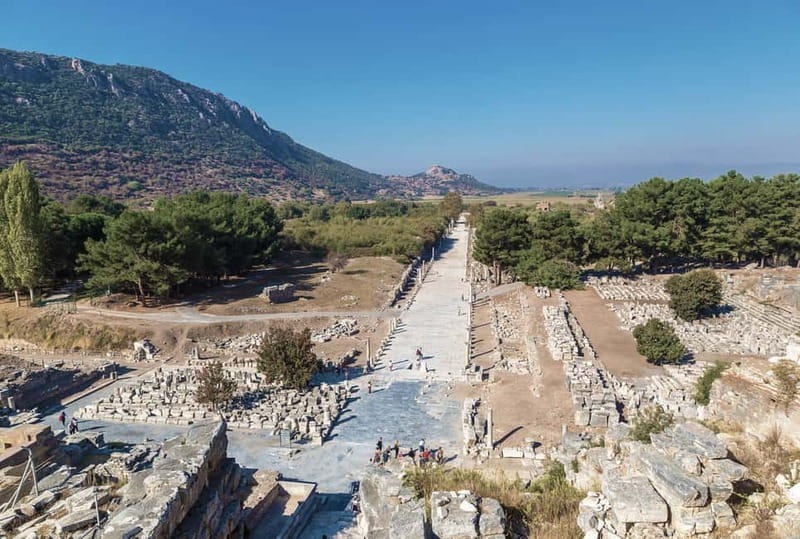
Start matters a lot here. The tour is designed to begin at the Upper Gate of the archaeological site (South entrance) near the Magnesia Gate.
Plan to go directly to the entrance and use your entry e-ticket to skip the ticket line. The easiest way to reach that area is by taxi from Kuşadası or Selçuk.
Why this matters: the audio route and map flow are built for that starting point. If you start at the wrong gate, you can waste time re-routing yourself and you’ll likely miss the clean “next stop” rhythm the audio tour is set up to follow.
The stop-by-stop walk: what each landmark adds to the story
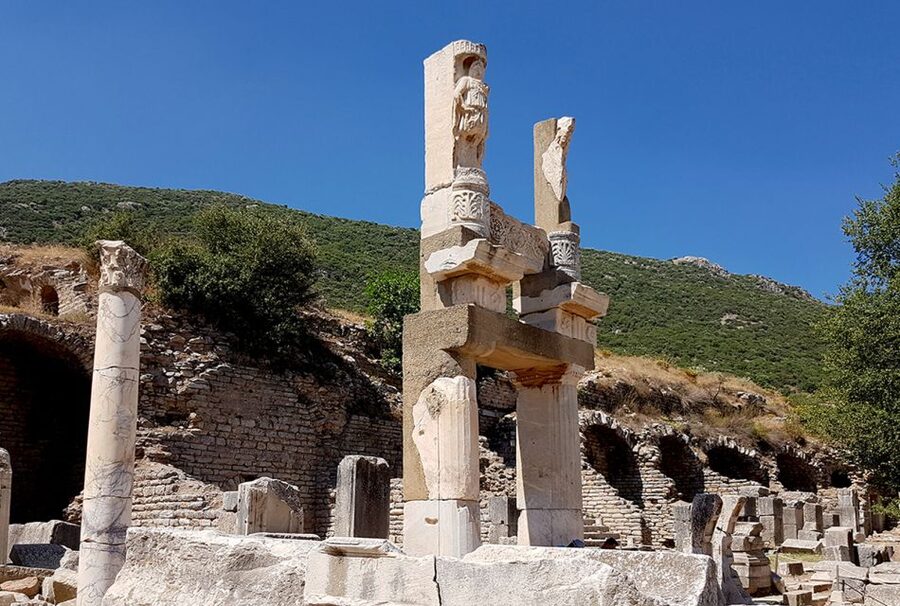
This route follows the city’s flow—politics and commerce first, then culture and spectacle, ending with the Church of Mary ruins area.
State Agora: Ephesus’ political center
Your first stop is the State Agora, once the city’s political heart. You’ll see why a large square like this mattered. It wasn’t just a place to walk past—it was the kind of space where decisions became public and civic identity lived in stone.
With the audio on, you get short context on what “state” meant in a Roman-era city that grew from Greek roots. Even if you’re not a history person, this helps you stop treating the site like a collection of walls.
Bouleuterion: council meetings and performances
Next comes the Bouleuterion, associated with the city council. The audio framing here is useful: you’re not only looking at seating structures, you’re imagining meetings, speeches, and possibly even performances.
That’s the mental shift that makes Ephesus click—buildings weren’t static. People used them for real actions.
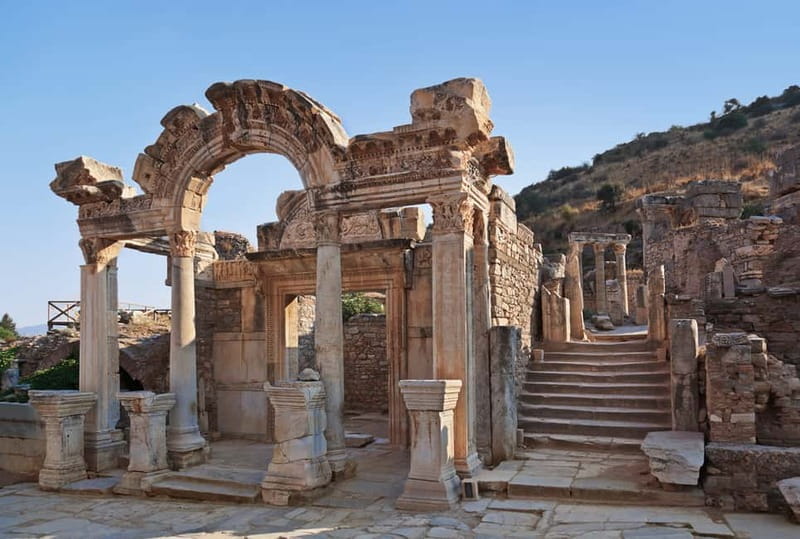
Temple of Domitian: the unusual U-shaped altar layout
Then you reach the Temple of Domitian, where the standout detail is its unusual architecture, including a U-shaped altar layout. This is one of those stops where your eye tends to miss what matters unless you know what to look for.
The audio helps you read the design. You’ll start noticing shapes and how spaces guided ritual movement and worship.
Curetes Street: connecting civic and commercial Ephesus
You’ll then walk down Curetes, a connection between political and commercial areas. This section is where the site starts to feel like a city street, not a museum.
If you want an authentic-feeling experience, slow down here. Even with only ruins left, the street-to-building pattern tells you how daily life moved through public spaces.
Emperor’s Fountain: a legend you can picture
A short stop later, you’ll hear the legend of the emperor’s fountain. Even if you don’t fully buy every story tied to ancient monuments, legends are how people explained meaning when history was living memory.
This kind of local storytelling makes the stones feel less dead and more human.
Scolastica baths: marble latrines and a sense of everyday life
The audio then leads you into the bath complex at Scolastica, including marble latrines. It’s an unexpected detail, but it’s also exactly what makes Ephesus more than a sightseeing checklist.
These are the kinds of spaces that reveal what the average person might have experienced—comfort, routine, and public life—rather than only official power.
Arsinoe’s grave: the Egyptian princess connection
Next is the grave of Arsinoe, an Egyptian princess. This stop adds a different kind of context: Ephesus wasn’t cut off from wider Mediterranean worlds. The city’s identity formed through connections, not isolation.
It’s a reminder that you’re standing in a crossroads city, not a one-culture backwater.
Celsus Library: the landmark everyone talks about
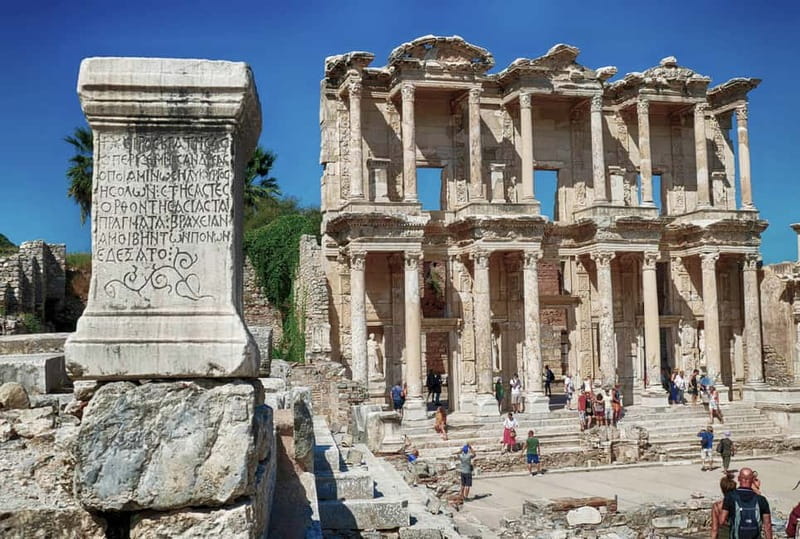
Then comes the Celsus Library, often the most famous landmark in Ephesus. You’ll understand why fast. Even as a ruin, the façade is dramatic, and it’s one of the best places to practice “seeing like a city.”
With the audio running, it’s easier to focus on what you’re looking at—so you get more than a photo moment. You hear what the library represented, and you can connect its status to the city’s wealth and education.
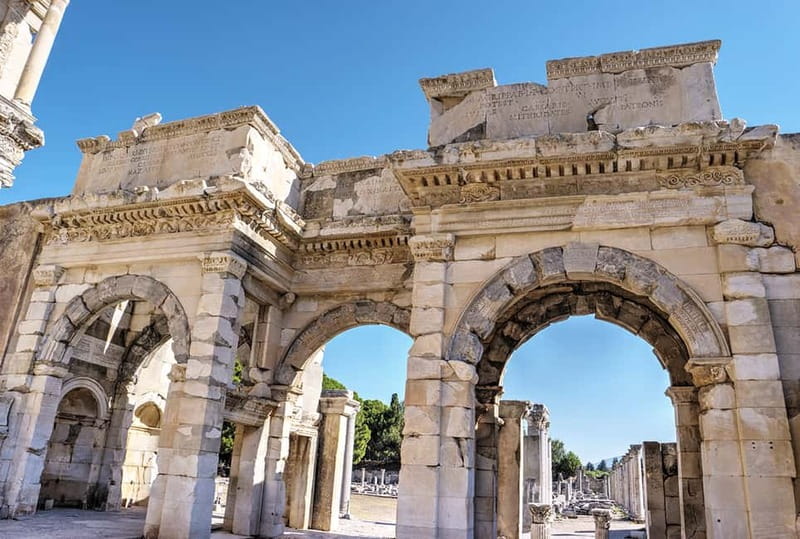
Gate of Mazeus and Mithridates: transitional, but meaningful
From there the route goes toward the gate of Mazeus and Mithridates. Gates are more than entrances. They reflect who controlled movement, how the city projected authority, and how people approached the urban core.
If you’re rushing, this might feel like a breather stop. Give it a minute anyway—gates are where you often notice the “street sense” of the place.
Grand Theatre: performances and gladiatorial games
Next is the Grand Theatre, where performances and gladiatorial games took place. This is where the scale of Ephesus hits. Audio helps you picture the seating arrangement and what kinds of crowds filled it.
If you like theatre architecture, you’ll likely spend extra time here—because the structure is both functional and theatrical in how it frames an audience.
Arcadiane crossroads and the Church of Mary ruins
Finally, you reach the Arcadiane crossroads, then follow a smaller path leading to the spectacular ruins of the enormous Church of Mary.
This end point works well for a self-guided tour because it gives you a clear destination. The church area brings the story into early Christianity without requiring you to mentally rearrange every earlier stop.
Skip-the-line entry: is it worth it?
Skip-the-line access is a key part of the value. Ephesus can get busy, and saving time at the start is a real quality-of-life win—especially when your visit window is only 2.5 hours.
That said, the phone audio format also drives a portion of the price. At $77 per person, it’s not a bargain ticket. It’s best seen as a package: you pay for e-ticket convenience + skip-the-line + an organized audio route.
If you’re the type who enjoys planning a walk and learning as you go, the value holds up. If you’d rather spend the money on a live guide who can handle questions and adjust on the fly, you might feel this is pricey for an audio-only experience. One note from a separate visitor: the price can feel steep compared with other cities where similar tours may cost less.
My practical take: for most people who want freedom and don’t want to fuss with guides, this can be a fair trade. For budget travelers or groups who already know Ephesus well, it may not feel worth it.
Tech checks that can save your day
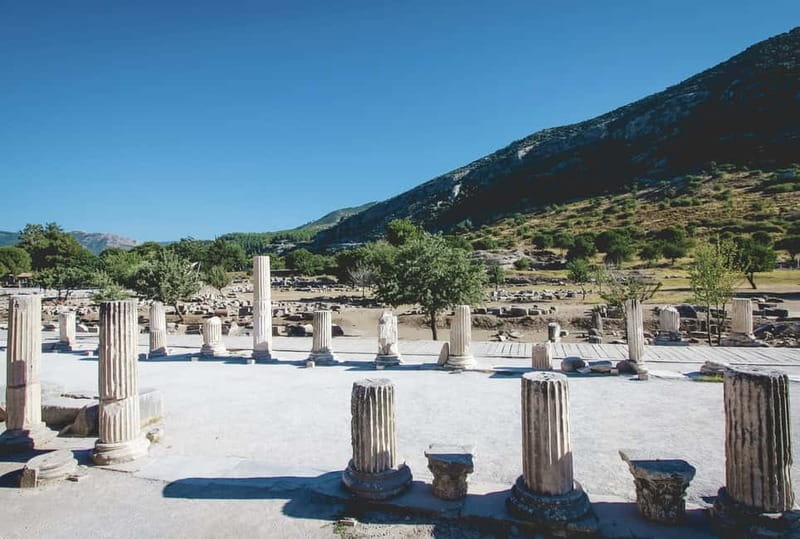
This tour is very phone-dependent, so do a quick prep before you arrive.
You’ll need:
- An Android or iOS phone
- Enough storage space (listed at 100–150 MB)
- Your own headphones
- A charged smartphone
There’s also a device compatibility limit. The audio isn’t compatible with Windows phones and certain older iPhone/iPod/iPad models (including iPhone 5/5C and older, plus several older iPads and iPad Mini 1st generation).
If you’re traveling with a newer phone, you’re probably fine. If you’re using an older model, double-check compatibility first. Also, plan for the possibility that the audio download doesn’t behave as expected on the day—bring time to troubleshoot.
One more tip: after booking, you’ll receive a separate email from the local partner with your ticket and audio tour. Check spam if you don’t see it quickly.
And yes, audio start clarity matters. If you don’t immediately spot where the route begins on your screen, pause and confirm you’re at the Upper Gate. That starting alignment makes the whole route easier to follow.
What about the number of stops vs official signs?
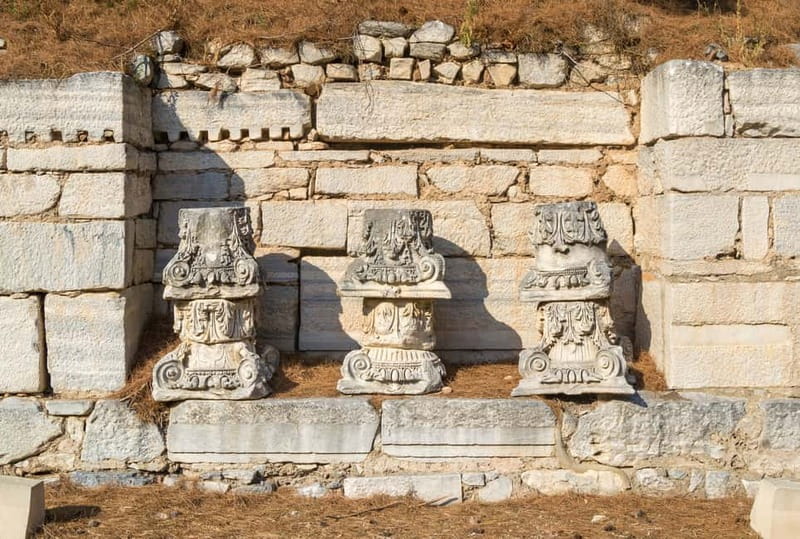
Your audio route includes a set of stops, and that set may not match the total number of points you see on official signage. That’s not a problem with you—it’s a difference in how the audio route is curated.
In practice, the route still covers the major highlights you’ll want for a 2.5-hour visit, including the Celsus Library, Grand Theatre, and the Church of Mary area.
If your goal is “finish every single official stop,” this won’t be that experience. But if your goal is “see the key story beats in an organized walk,” it delivers.
Who this is best for (and who should skip it)
This works really well for:
- First-timers who want context without committing to a live guide
- Travelers who like independent pacing and don’t want to wait for anyone
- People comfortable using a phone for navigation
- Visitors who enjoy short, story-based interpretation at each major ruin
You might reconsider if:
- Your phone is old or you’re unsure about audio compatibility
- You hate troubleshooting apps or downloads while traveling
- You prefer a human guide who can answer questions and adjust to your interests
- Your group doesn’t want to coordinate phone use (remember: bookings are per device, not per participant)
Practical packing for Ephesus
Don’t show up with only a dream and a camera. The site involves walking on uneven ground.
Bring:
- Comfortable shoes
- Water
- Hat
- Headphones
- A fully charged smartphone
- A bit of storage space (if you’re loading audio ahead of time)
If it’s sunny, hat + water matter more than you think. If it’s cooler, you’ll still want layers because the walking and sun exposure can swing quickly.
Should you book the Ephesus mobile audio ticket?
I’d book this if you want skip-the-line entry and a guided-feeling route without a live guide. It’s a strong option for a tight 2.5-hour highlights walk, and the offline audio + interactive maps make it easier to connect what you see to what it meant.
I’d hesitate if your phone is incompatible, if you’re bringing no headphones, or if you’d rather pay for human storytelling. At $77, you’re paying for convenience and structure—so if you don’t want that, spend your money elsewhere.
FAQ
FAQ
Where does this audio tour start inside Ephesus?
It starts at the Upper Gate (South entrance) near the Magnesia Gate.
How long is the visit with this ticket?
The experience is designed for about 2.5 hours.
Do I get skip-the-line entry with this ticket?
Yes, it includes skip-the-line access to the Ephesus archaeological site.
What languages are available for the audio tour?
The audio tour is available in English and German.
Is the audio tour usable offline?
Yes. It includes offline content with interactive maps.
What devices are supported?
The audio tour requires an Android or iOS phone. It is not compatible with Windows phones and certain older Apple devices listed in the important information.
Do I need to bring a smartphone and headphones?
You need to use your own smartphone and headphones. These aren’t included.
How do I access the ticket and audio after booking?
After booking, you’ll receive a separate email from the local partner with your ticket and audio tour. Check your spam folder if you don’t see it.
Is Ephesus entry wheelchair accessible for this activity?
Yes, the activity is listed as wheelchair accessible.
Is the booking per participant or per device?
Bookings are per device to be used, not per participant.