REVIEW · LOIRE VALLEY
Chartres Self-Guided Walking Tour with an APP
Book on Viator →Operated by Trippy Tour Guide · Bookable on Viator
Chartres tells its story in small, walkable pieces. This self-guided app tour strings together art, churches, streets, and fortifications into a route you can follow at your pace. I like how the plan isn’t just about one big sight—it gives you lots of angles on the city’s identity.
Two things I really like: the fully offline map (so you’re not hunting for service mid-walk) and the fact that you get 25+ narration points across the route. One drawback to consider: the audio quality is not universally loved, so if you rely on the narration for direction, you’ll want to be ready to pause, look, and use the map when needed.
In This Review
- Key takeaways before you go
- Why a self-guided Chartres walk makes sense
- Getting started at Cloître Notre-Dame and ending at the Fortifications
- Stop 1: Museum of Fine Arts in Chartres (art beyond the cathedral)
- Stop 2: Chartres International Stained Glass Centre (where craft meets artistry)
- Stop 3: Graffiti de Jean Moulin (WWII memory in street form)
- Stop 4: Place Sainte-Foy (a calmer pause with deep roots)
- Stop 5: Statue du général Marceau (youth, bronze, and memory)
- Stop 6: City Hall (practical architecture and local life around it)
- Stop 7: Hotel Montescot (16th-century building with weight)
- Stop 8: Église catholique Saint-Aignan (quiet focus in a busy day)
- Stop 9: Galerie Magi (a simple cultural detour)
- Stop 10: Marche aux Legumes (medieval market energy, modern produce)
- Stop 11: Chartres Congrès – Maison du Saumon (timber framing and salmon carving)
- Stop 12: Pont Bouju (a historic bridge built in 1735)
- Stop 13: Old Chartres Fortifications (finish with medieval lines)
- Price and value: $9.99 plus two optional $7 entries
- The app experience: offline map helps, audio varies
- Who this Chartres app tour suits best
- Should you book this Chartres self-guided app tour?
- FAQ
- FAQ
- How long is the Chartres self-guided walking tour?
- What language is the tour available in?
- Is the Museum of Fine Arts in Chartres included in the tour price?
- Is the Chartres International Stained Glass Centre included in the tour price?
- Do I need Wi-Fi to use the app?
- Where does the tour start and end?
- What are the operating hours listed for this activity?
Key takeaways before you go

- Offline map you can trust: Download once, then walk without Wi-Fi anxiety.
- 25+ narration points across popular sights and quieter corners.
- Two paid stops to plan for: Museum of Fine Arts and the Stained Glass Centre cost extra.
- A mix of eras: medieval fortifications, 18th-century bridge, and WWII-era Jean Moulin art.
- Short stops by design: expect quick looks unless you add extra time inside.
Why a self-guided Chartres walk makes sense
Chartres is the kind of place where you can over-plan and still miss what you actually care about. This tour leans into the opposite idea: you get a structured route that still lets you slow down for a detail, step back for a better view, or speed up when you’re itching to move.
The route is built around a tight 2 to 3 hour loop, starting in the cathedral area and ending at the old fortifications. Along the way, the app gives you directions and an audio guide, so you’re not constantly checking your phone map. That’s a big deal in a historic center where street layouts can change names mid-block.
You’re also not paying for an in-person guide. That matters in value terms. You’re paying for access to the app experience, and then you choose whether to pay entry fees at two stops.
Getting started at Cloître Notre-Dame and ending at the Fortifications
The walk starts at 12 Cloître Notre Dame, 28000 Chartres and ends at Old Chartres Fortifications, Rue de la Prte Guillaume, 28000 Chartres. If you like finishing strong, the ending here is a smart choice: it sets you up to look at the city’s medieval defensive outline after you’ve already been walking through its cultural and religious landmarks.
Timing is another practical win. With a posted open window of 9:00 AM to 8:00 PM (for the listed date range), this tour fits many travel days without forcing a strict schedule. And since it’s a private activity limited to your group, you don’t have to match a stranger’s pace.
Tip: when you arrive at the start point, take two minutes to orient yourself before you start the audio. Even when narration is great, the best experience is when you know what you’re looking at before the first speech starts.
Stop 1: Museum of Fine Arts in Chartres (art beyond the cathedral)

The tour’s first storytelling pivot is Museum of Fine Arts in Chartres. The idea is simple: cathedral views are only part of Chartres. This museum gives you a “see it on canvas and sculpture” counterpoint, with a span that runs from medieval-era creativity into Renaissance and Baroque work.
Important practical note: the museum entry fee is not included. You’ll be paying $7.00 per person if you go inside. The app’s suggested time is about 15 minutes, which is great for highlights and quick orientation, but short if you want a full museum visit. My advice: if you’re on a tight schedule, treat this stop like a curated sampler. If you want depth, you may want to shorten other parts of the walk later or plan a separate museum afternoon.
If you’re the type who likes to connect art styles to a place’s identity, this opening stop sets you up well. You’ll start noticing how the city’s craft culture shows up in more than just stained glass.
Stop 2: Chartres International Stained Glass Centre (where craft meets artistry)
Next up is Chartres International Stained Glass Centre. This stop is built for anyone who wants to understand stained glass as more than decoration. You’ll be directed to look at historical and contemporary work and learn about craft and techniques—and you may even get a sense of how artisans approach the material.
Like the museum, admission here is not included, with another $7.00 per person cost. The guided time is also 15 minutes, which again leans toward quick learning rather than a full deep visit.
The value of this stop is that it changes how you see the rest of Chartres. Even if your main memory of town is the big cathedral, this kind of behind-the-scenes look helps you spot what makes stained glass work: the planning, the skill, and the way light turns the windows into a storytelling device.
Stop 3: Graffiti de Jean Moulin (WWII memory in street form)
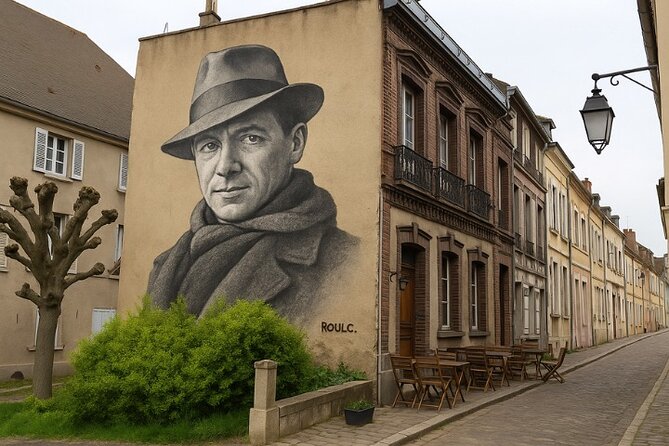
Then the tone shifts. Graffiti de Jean Moulin brings you to a striking modern memorial tied to a major figure in the French Resistance. The app frames it as honoring Jean Moulin’s courage and sacrifice during World War II.
This is a short stop—about 5 minutes—but it’s meaningful. It’s also a good example of how the route keeps Chartres from turning into a museum-only city. You’re seeing how memory lives in public space today, not only in stone structures.
Practical tip: even if you don’t linger, take a second to step back and frame it in context. The location is part of the message, and the surrounding streets help you understand what this memorial is doing in the modern city.
Stop 4: Place Sainte-Foy (a calmer pause with deep roots)
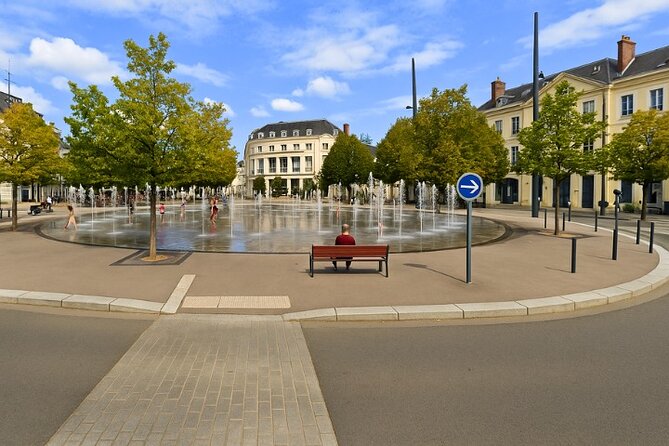
Place Sainte-Foy is described as quieter and more reflective, linked to the former Église Sainte-Foy. The origins go back to the 7th century, so even though you’re standing in an open space today, you’re near a very old layer of the town.
This is also a 5-minute stop. That short slot works well because the point isn’t to rush through—it’s to give you a brief pause. If you’ve been moving quickly from stop to stop, this is a good moment to slow down, look around, and let the earlier cathedral-area energy settle.
Stop 5: Statue du général Marceau (youth, bronze, and memory)
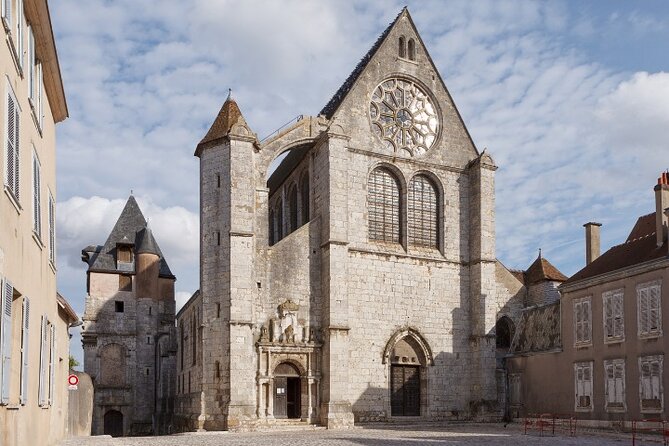
Next is Statue du général Marceau. This one is short—about 5 minutes—but it packs a story: a bronze statue of Chartres’ young hero, General Marceau, with his ashes resting nearby.
If you like monuments that connect person-to-place, you’ll probably enjoy this. It’s the kind of stop where a tiny attention boost changes what you see. Instead of thinking of “a statue,” you’re thinking of why it’s here and what the city chose to remember.
Stop 6: City Hall (practical architecture and local life around it)
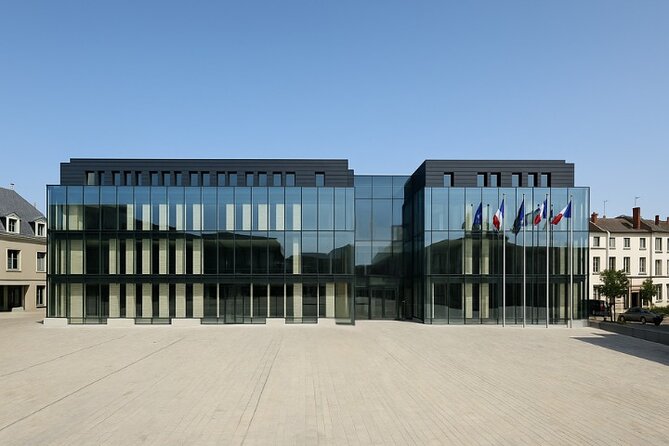
The City Hall stop gives you a look at classic French architecture and acts as a natural anchor for a square. The tour also nudges you toward easy local dining options nearby, which is helpful when you’re planning the rest of your afternoon or deciding where to take a break.
This stop is about 10 minutes. It’s long enough to reset your direction mentally, but not so long that it breaks the flow of the walk.
Stop 7: Hotel Montescot (16th-century building with weight)
At Hotel Montescot, you get a glimpse into a 16th-century building with a significant past. This stop is about 10 minutes, and it’s the right length for exterior viewing and getting the architectural mood of the city.
One thing to remember: not every historic building is a museum you can wander freely. Even if you can’t go inside (the tour doesn’t promise entry), this is still a useful step for building visual context as you move toward older fortification structures later.
Stop 8: Église catholique Saint-Aignan (quiet focus in a busy day)
The app then directs you to Église catholique Saint-Aignan. It’s positioned as reflective, connecting you to history and quiet devotion.
Time here is 15 minutes. That suggests the tour expects you to take your time a bit, even if you’re only stepping in for a short moment. If you’re visiting during church hours, this can become one of the more peaceful stops of the day, especially after more outward-looking sights.
Stop 9: Galerie Magi (a simple cultural detour)
Galerie Magi is listed as a free stop and described as more than just browsing—it’s a connection. The tour doesn’t add more specifics, so this is the kind of stop where your experience will depend on what’s on display that day.
Treat it like a low-pressure cultural break. If you enjoy small galleries, you’ll likely be glad it’s on the route. If you’re not into browsing, you can probably keep it moving without losing the tour’s bigger story.
Stop 10: Marche aux Legumes (medieval market energy, modern produce)
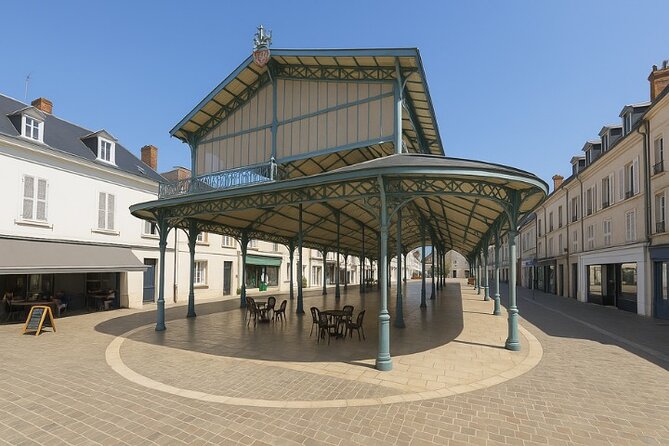
Then you hit Marche aux Legumes—described as a medieval social scene that’s now a vegetable market. This stop is about 5 minutes.
Even if you don’t buy anything, markets are useful stops on walking tours. They’re where you see everyday rhythm, not only monuments. If you want a real Chartres moment, this one can do it quickly.
Stop 11: Chartres Congrès – Maison du Saumon (timber framing and salmon carving)
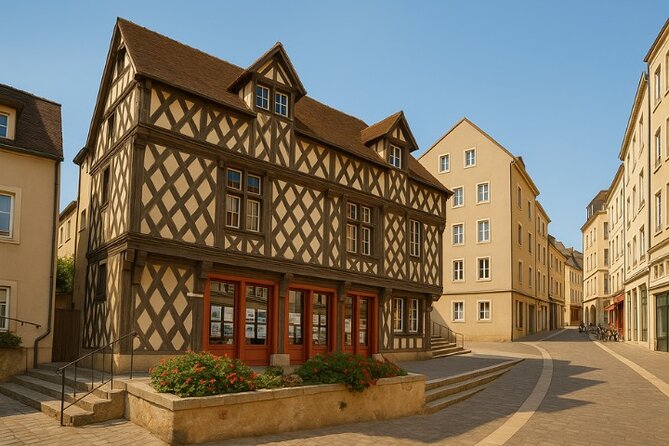
Chartres Congrès – Maison du Saumon is one of the most visually specific stops on the route. You’re told it dates to the 15th and 16th centuries, with a timber-framed structure and salmon carving noted as recognizable features.
Time here is 15 minutes, which is good. If you like noticing construction details, this is the kind of place where you can spend a few extra minutes looking at woodwork and local building style—without turning the walk into a long museum marathon.
Stop 12: Pont Bouju (a historic bridge built in 1735)
The tour crosses to Pont Bouju (the listing also spells it as Pont Bonju), a historic bridge built in 1735. The app frames it as once being a lively street over the river Eure.
Time is 5 minutes, so treat it like a quick perspective shift. A bridge is where you look both ways: the street behind you and the view ahead. If you’re taking photos, this is an easy stop to get them quickly and then move on.
Stop 13: Old Chartres Fortifications (finish with medieval lines)
The final stop is Old Chartres Fortifications. The app describes medieval defense-era structures—walls, towers, and gates—so as a closing scene, it helps your brain re-map the city’s past.
It’s listed as 15 minutes and that fits well for a final “wrap your eyes around the shape of the place” moment. After seeing churches, art, markets, and bridges, fortifications give the city a strong physical outline.
Price and value: $9.99 plus two optional $7 entries
At $9.99 per person, this tour is priced like an app add-on, not a guided walking tour package. That’s good for value if you want structure without extra guide costs.
But there’s a catch you should plan for: the route includes two stops with separate $7.00 admission fees—the Museum of Fine Arts in Chartres and the Chartres International Stained Glass Centre. If you enter both, you’re looking at an additional $14.00 on top of the $9.99 tour access.
Here’s how I see the value:
- If you mainly want the walk, directions, and audio stories, the app fee is a strong deal because most other stops are free.
- If you plan to pay both museum admissions, the total becomes higher, but you’re still getting a multi-stop route plus guided context for where you’re going.
If you want maximum value, decide in advance whether you’re going inside both paid locations—or treat them like optional add-ons depending on your energy.
The app experience: offline map helps, audio varies
Two real strengths show up in how this experience is described: the offline map and the smooth process for getting the tour going even on low network areas. That’s exactly what you want in a historic center where cell coverage can be spotty.
Now the balanced part: the audio guide experience isn’t perfect for everyone. One review called it terrible, saying it didn’t give enough practical information and didn’t guide your attention well before going into long descriptions. That warning is worth taking seriously.
So how do you use this smartly?
- Bring headphones and start at the beginning, but be ready to pause the audio when you’re trying to locate the exact spot.
- If the narration is wordy, focus on following the directions and using the map first, then let the story play when you’re already looking at the right place.
- Keep your expectations realistic: this is an audio guide plus directions, not an in-person expert lecture.
In other words, the app is useful even if you don’t love the voice track. Use it as navigation and interpretation support, not as the only way to enjoy the city.
Who this Chartres app tour suits best
This walking route fits best if you:
- like planning your own pace but still want a guided order of stops,
- are comfortable using an app and headphones outdoors,
- want a route that mixes major sights with smaller cultural stops (market, monuments, bridges, and fortifications),
- want offline reliability more than you want a live guide.
It may feel less satisfying if you:
- need heavy, highly detailed audio to tell you exactly where to look before the story starts,
- want long museum time at the Museum of Fine Arts or Stained Glass Centre, since the app’s pacing suggests quick highlight visits.
A good strategy is to carry extra time if you’re museum-focused. If you’d rather keep the tour moving, treat the paid stops as quick hits and save deeper museum time for another day.
Should you book this Chartres self-guided app tour?
I’d book this if you want an organized, independent walk with offline navigation and a storyline that connects art, craft, monuments, and medieval streets. The price is low enough that even with the two $7 admission fees, you still get a lot of walking value for a half-day plan.
I would hesitate if you strongly prefer highly practical, tightly directed narration over interpretation. With one bad audio experience noted, you should be comfortable using the map and directions when the audio isn’t helping you spot the view fast.
If you’re tech-comfortable and you like mixing churches, markets, and small monuments, this tour has enough variety to keep it interesting from start to finish.
FAQ
FAQ
How long is the Chartres self-guided walking tour?
The tour takes about 2 to 3 hours.
What language is the tour available in?
The tour is offered in English.
Is the Museum of Fine Arts in Chartres included in the tour price?
No. Admission to the Museum of Fine Arts is not included and costs $7.00 per person.
Is the Chartres International Stained Glass Centre included in the tour price?
No. Admission to the Chartres International Stained Glass Centre is not included and costs $7.00 per person.
Do I need Wi-Fi to use the app?
No. The tour includes a fully offline map, so you do not need Wi‑Fi or data.
Where does the tour start and end?
It starts at 12 Cloître Notre Dame, Chartres, and ends at Old Chartres Fortifications on Rue de la Prte Guillaume.
What are the operating hours listed for this activity?
The listed hours are 9:00 AM to 8:00 PM, Monday through Sunday, for 05/16/2025 through 02/16/2027.