REVIEW · TRIER
Trier: City Walk with Audio Guide in 7 Languages on your Phone
Book on Viator →Operated by City App Tour · Bookable on Viator
A phone walk beats a hurry. This self-guided route lets you roam Trier at your own tempo while GPS-linked audio tells stories as you pass key sights. I love the flexible pace (start, pause, stop when it suits you) and the way the narration mixes legends with real context. One thing to consider: the English audio/text can show occasional machine-translation glitches and a few stops may feel thin on audio or text.
You’ll cover about 5.5 km across the city and hit major highlights like Porta Nigra, the Hauptmarkt, Trier Cathedral, the Karl Marx House, and the Basilica of Constantine. Most of the time, this feels like a smart budget-friendly way to see Trier’s center without waiting around for a group. Budget for the practical stuff too: you’ll need a charged smartphone, solid internet/GPS, and headphones.
In This Review
- Key things to know before you hit play
- Why this Trier walk feels easier than a rigid tour
- Price and what you really get for $9.03
- Getting the audio running: GPS, internet, headphones, and battery life
- Porta Nigra and the Trier center: where the walk starts to click
- Trier Cathedral: the Holy Robe and why pilgrims come
- Karl Marx House: a philosophy detour that fits the route
- Basilica of Constantine (Aula Palatina): Roman power in plain sight
- The 27 stories idea: how narration beats random stop-by-stop sightseeing
- Pace, timing, and how long you should plan
- Private by default: small-group comfort without the group hassle
- Who should book this Trier audio walk
- Should you book this Trier phone audio walk?
- FAQ
- How long is the Trier city walk with audio guide?
- Where does the tour start and end?
- What do I need on my phone to use the audio guide?
- What languages are available?
- Do I need tickets or admission fees for the sights?
- Is this tour group or private?
Key things to know before you hit play

- 27 stories over 5.5 km: short segments guide you from one landmark to the next.
- Start, pause, stop anytime: you control timing, breaks, and detours to nearby sights.
- GPS guidance on your phone: you follow waypoints as you walk.
- Audio in 7 languages: the format is designed for independent travelers.
- Major sites included along the walk: Porta Nigra, Hauptmarkt, Trier Cathedral, Marx House, Basilica of Constantine.
- Admission fees aren’t included: if a stop has a ticketed interior, you’ll pay that separately.
Why this Trier walk feels easier than a rigid tour

Trier is a city where wandering makes sense. The center is packed with big-name landmarks close enough to walk, and a phone-based route helps you avoid the classic problem: being rushed through the parts you actually want to linger over. With this experience, the core promise is control. You can stop the walk when you want a coffee, duck into a church space, or step off to browse a museum.
The second big reason it works is the storytelling approach. Instead of dry lists of dates, the route is built around stories, legends, and fun facts collected by a local guide. That matters because Trier’s sights span Roman and medieval worlds. When the narration connects those eras instead of treating them as random photo stops, your brain starts to see the city as one place.
Price and what you really get for $9.03
At about $9.03 per person, you’re paying for access to a self-guided audio experience on your phone, not for staff-led guiding or museum entry. That’s important value math. You still need to manage your own walking pace, and if you want to go inside a ticketed attraction, you’ll pay those admission fees separately.
But for many travelers, this is exactly the right kind of spend. You get a structured walking route (27 narrated stops) with GPS help. In a city like Trier, that saves the time you’d otherwise spend stitching together directions, reading signs, and guessing what’s worth your attention. If you’re comfortable using your phone outdoors, the price-to-satisfaction ratio is typically strong.
Getting the audio running: GPS, internet, headphones, and battery life
This experience runs through an app on your smartphone with GPS guidance and an internet connection. That means it’s not a set-it-and-forget-it museum audio. It’s more like a live walking guide that depends on your phone doing its part.
Plan for three practical points before you start:
- Bring headphones (you’re not provided them).
- Charge your phone to the max or take a power bank.
- Make sure you have working internet and GPS during the walk.
One caution from real-world use: if your group is doing it on more than one phone, battery matters. If the main device runs out, it can interrupt the rhythm for anyone relying on the primary phone’s progress. If you’re traveling as a couple, keep an eye on how your phones are paired—there’s a chance the system expects you to stay together on the same route flow.
Porta Nigra and the Trier center: where the walk starts to click
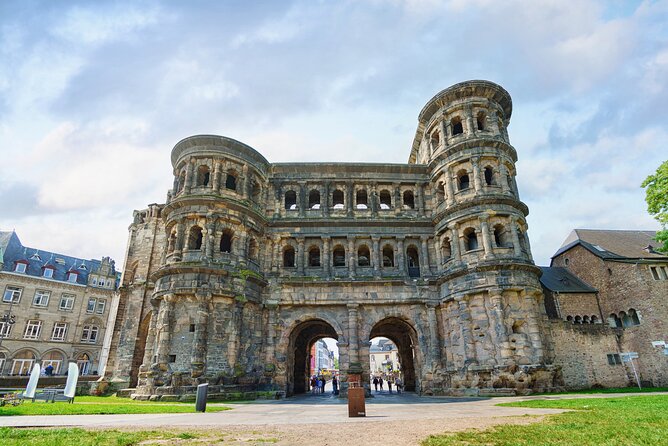
Your route begins in Trier and loops back to the starting point. The first anchor is Porta Nigra, the famous Roman city gate from the 2nd century AD. It’s preserved to an impressive degree, built from massive stone blocks, and it originally functioned as a defensive structure. In audio form, it’s a great early start because it frames Trier’s identity: this wasn’t just a medieval stop on the map—this was a Roman city with serious architecture.
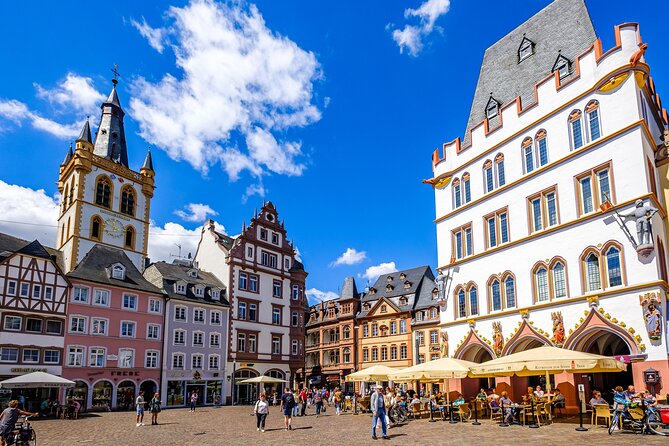
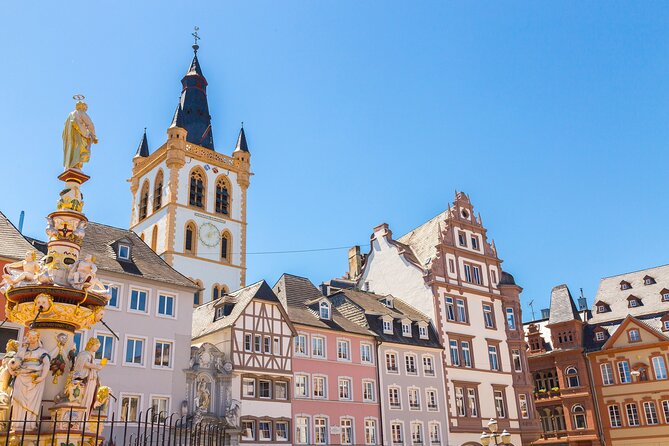
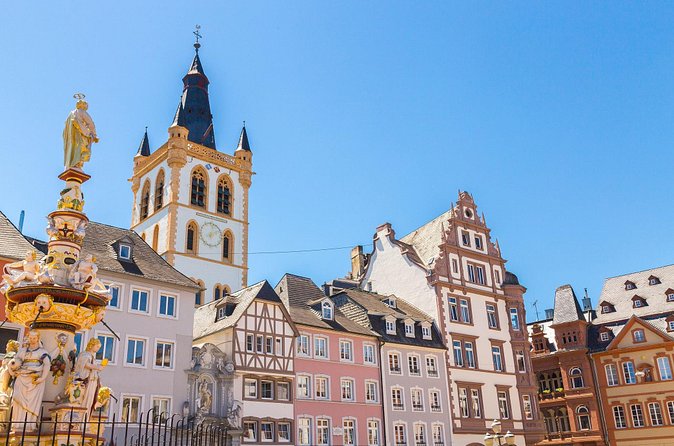
Next comes the Hauptmarkt, Trier’s central square and one of Germany’s oldest market places. The square is surrounded by historic buildings and colorful half-timbered houses. You’ll also hear about standout nearby landmarks like St. Gangolf Church and the Roman Fountain. This is a good moment to pause if you want a snack, because the walk’s rhythm changes here. Market squares invite you to slow down and look around.
A useful tip: keep your eyes on the waypoints, but don’t treat them like a strict marching order. The route is designed so you can adjust—walk a little ahead, circle back, or spend extra time reading the stonework.
Trier Cathedral: the Holy Robe and why pilgrims come

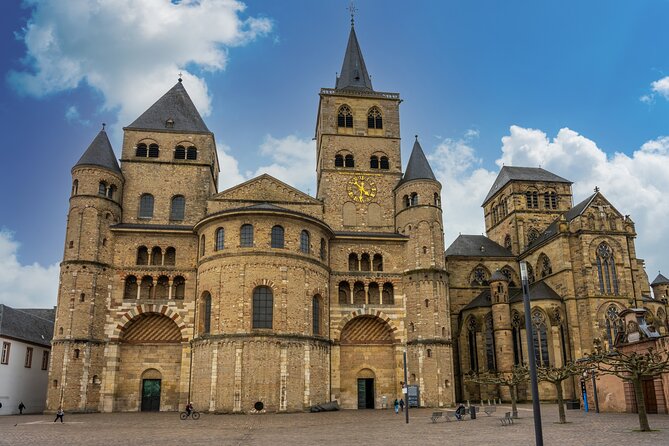
No Trier walk is complete without the Cathedral of Saint Peter, known as Trier Cathedral. The route highlights why it’s so significant: it’s considered the oldest cathedral in Germany, with construction beginning in the 4th century under Emperor Constantine. Architecturally, it’s Romanesque in character, but centuries of expansion and renovation created a mix of styles.
The storytelling focus is especially valuable here because the cathedral isn’t just impressive from the outside—it’s meaningful. The audio points you toward the relic connection that makes this a major pilgrimage destination: the Holy Robe, believed by tradition to be the tunic worn by Jesus. Even if you’re coming as a casual visitor, that helps you understand why crowds show up and why people make a point of looking for specific religious details rather than just taking photos.
Karl Marx House: a philosophy detour that fits the route
Trier’s intellectual side shows up at the Karl Marx House, the philosopher’s birthplace and childhood home. The building is now a museum dedicated to his life and legacy, with exhibits that include documents, photographs, and context about his ideas and the political environment of 19th-century Europe.
This stop works well inside the walking format because it adds contrast. After Roman stones and cathedral-scale faith, it shifts the story toward modern history and political thought. If you like understanding how places shaped ideas, you’ll probably appreciate this mid-route change of pace. If you prefer purely visual sightseeing, you can treat it as a quick exterior stop and continue—but the audio narration is built to explain why the museum matters.
Basilica of Constantine (Aula Palatina): Roman power in plain sight
The walk’s Roman payoff comes at the Basilica of Constantine, also called the Aula Palatina. It’s a palace basilica from the early 4th century, built during the reign of Constantine the Great. The route frames it as an audience hall within a larger palace complex, which helps you picture the building’s original job: formal space for receiving important visitors.
What makes this stop hit is its architecture. The hall is large and rectangular, with a high flat wooden ceiling. The style is described as simple but grand—exactly the kind of Roman imperial messaging that doesn’t need decoration to make a point. Today, it’s used as a Protestant church, and it remains one of the best-preserved Roman structures in the region.
The 27 stories idea: how narration beats random stop-by-stop sightseeing
A normal self-guided walk gives you waypoints. This one gives you a narrative thread. With 27 stories along the 5.5 km route, you’re not just collecting landmarks—you’re learning why each one mattered. The narration aims to cover more than facts, including legends and fun side details that keep you from zoning out.
That matters for two reasons:
1) Trier’s attractions overlap across eras, so short stories help you sort chronology without feeling like school.
2) You’re not forced to read signs the entire time, which is a real win if you prefer your attention to stay on the walk itself.
Still, keep one expectation realistic. The audio/text quality can vary by language. If you’re relying on English, be ready for occasional odd phrasing. If you spot a waypoint that shows only numbers with no audio or text, just treat that as a signal to keep moving and let the next segment carry you.
Pace, timing, and how long you should plan
The walk is typically about 2–3 hours on the phone guide flow. The best part is that you’re not trapped in a one-and-done window. You can finish the route by the end of the next day, which is a gift if you want to take your time, return when light changes, or fit in a museum break.
In practice, I’d plan your day like this: aim for the full core loop in one sitting, then decide on the fly if you want to add extra time at cathedral areas, squares, or the Karl Marx museum stop. Trier is perfect for that slow-travel rhythm.
Private by default: small-group comfort without the group hassle
This is listed as private, meaning only your group participates. That’s a meaningful difference versus group tours in a compact city. You don’t have to wait for late arrivals, and you don’t feel pressured to keep up.
If you’re traveling solo, this is also a straightforward way to avoid awkward silence with a stranger guide. If you’re traveling as a couple or small party, it can work well—just keep an eye on phone syncing expectations so the two devices don’t fall out of step.
Who should book this Trier audio walk
This is a strong fit if you:
- like exploring on your own schedule
- want a low-cost way to cover the city center highlights
- enjoy audio storytelling more than reading every plaque
- are comfortable navigating with GPS and using your phone outdoors
It might feel less ideal if you:
- hate relying on your smartphone battery
- want a fully assisted tour with consistent human-led explanations
- expect perfect English translation at every single waypoint
Should you book this Trier phone audio walk?
I’d book it if your goal is to get oriented fast and then spend your time choosing what to linger over. The route hits the big Trier anchors—Porta Nigra, Hauptmarkt, Trier Cathedral, Karl Marx House, and the Basilica of Constantine—and the narration gives you context that’s hard to pull together quickly on your own.
If you’re the kind of traveler who needs every stop to have flawless audio/text, I’d test the language on your phone before you start and bring backup battery power. If your phone setup is solid, this is an affordable, flexible way to experience Trier’s Roman-to-medieval lineup without scheduling your day down to the minute.
FAQ
How long is the Trier city walk with audio guide?
The walk typically takes about 2–3 hours. You also have until the end of the next day to finish it.
Where does the tour start and end?
It starts at 54 Trier, Germany and ends back at the same meeting point.
What do I need on my phone to use the audio guide?
You’ll need a smartphone plus internet connection and GPS working on your device. You’ll also need headphones.
What languages are available?
The audio guide is available in 7 languages, and English is offered.
Do I need tickets or admission fees for the sights?
Admission fees for attractions you pass by are not included, so any ticketed entry is your responsibility.
Is this tour group or private?
It’s private, meaning only your group participates.