REVIEW · PELOPION
Olympia: Archaeological Site & Museum E-Ticket & Audio Guide
Book on GetYourGuide →Operated by Clio Muse Tours · Bookable on GetYourGuide
Olympia hits different when you hear the story. This setup pairs a prebooked e-ticket with a self-guided offline audio guide on your phone, so you can explore ruins at your pace without hunting for explanations.
Two things I really like: the route is built to be easy to follow in order, and the narration focuses on places people often skim, like Pheidias’ workshop and the Nymphaion. The main consideration is practical: you must do the download and ticket email setup before you arrive, and you’ll need a compatible smartphone and headphones to get the full experience.
In This Review
- Key highlights worth planning around
- Olympia in One Day, the Right Way
- Price and Value: what $41 buys you (and what it doesn’t)
- E-Ticket and Entry Timing: museum slots vs anytime ruins
- Starting at the Gymnasium: how the audio route keeps you oriented
- Temple of Zeus and the Heraeon: the headline sights, explained
- Ancient Stadium: a place you can understand by walking
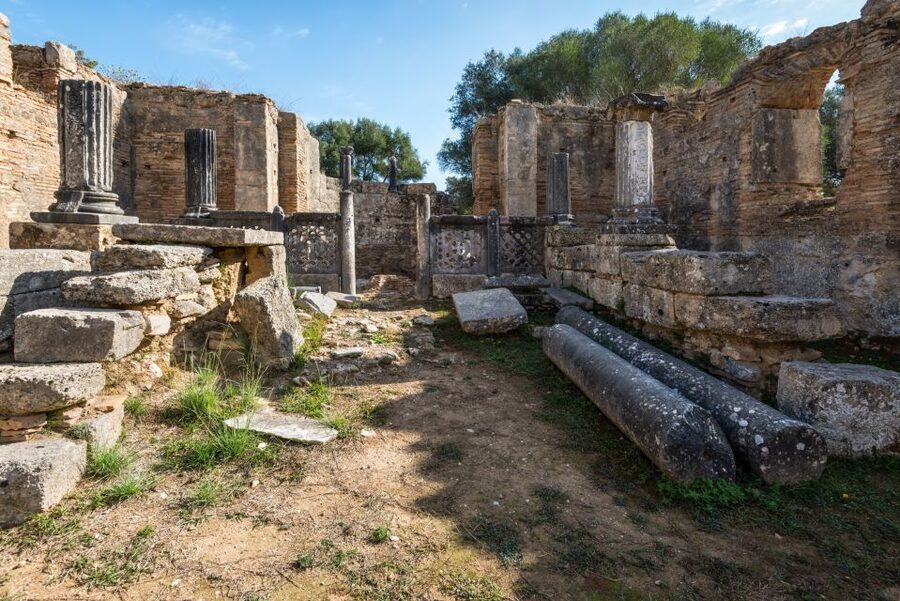
- Pheidias workshop, Nymphaion, and the “less obvious” Olympia
- Gymnasium, Palaestra, and the civic buildings: you’ll connect the dots
- How to prep your phone so the day stays smooth
- Smartphone compatibility you should check now
- What’s included, what’s not, and how to plan your time
- Practical tips: shoes, shade, and using audio without stress
- How loud should your audio be?
- Accessibility reality check (so you don’t get surprised)
- Languages: better than hunting for translation
- Combining it with other tech: good if you want more, not necessary
- Should you book Olympia with this audio-and-ticket option?
- FAQ
- Where does the self-guided audio tour start?
- Where does the self-guided audio tour end?
- Is there a meeting point for this experience?
- What do I receive after booking?
- Do I need headphones?
- Can I use the audio guide offline?
- Is there a live guide included?
- Which parts of Olympia are included with the ticket?
- Which languages are available for the audio guide?
- What smartphone devices are compatible?
- Are there bag restrictions?
Key highlights worth planning around
- Timed museum entry, plus anytime ruins so your day stays flexible
- Offline audio and maps (plan for 100–150 MB of storage)
- Starts at the Gymnasium, ends at Pheidias’ workshop for a smooth flow
- Covers the big icons and the supporting cast like the Heraeon and Nymphaion
- English plus four other languages for an easier family split
- No live guide means you can pause, snack, and backtrack without stress
Olympia in One Day, the Right Way
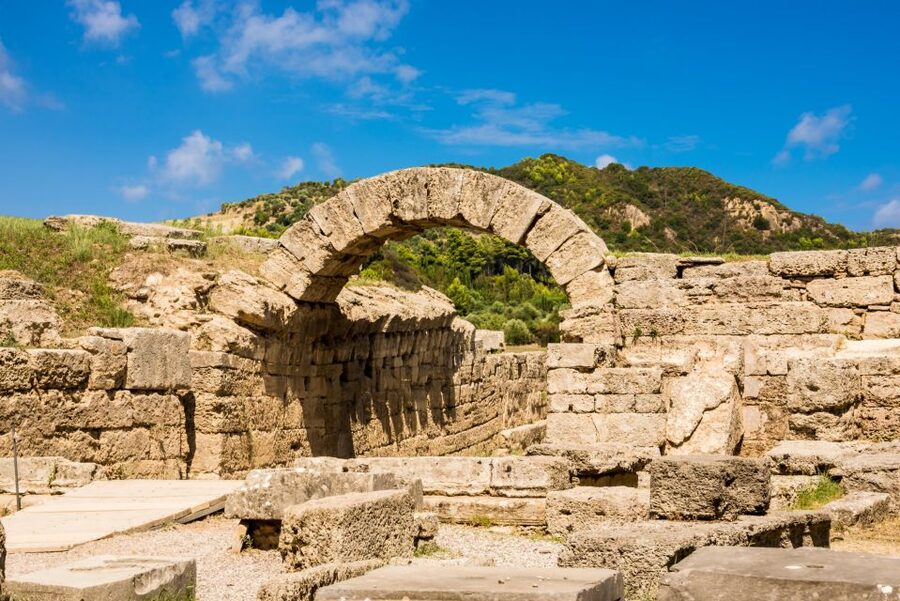
Olympia is the kind of site where it’s easy to get lost—physically and historically. This audio-and-ticket combo fixes that with a timed museum slot and a phone tour designed to keep you moving through the archaeological grounds in a logical order.
I like that it’s not trying to do everything at once. You get access to the key museum and ruins, but you’re still in charge of your pace, your breaks, and how long you linger at Temple of Zeus or the Ancient Stadium.
And you’ll appreciate the storytelling angle. The tour is presented as short, researched stories and anecdotes, which is exactly what keeps a place like Olympia from turning into just another set of stones.
Price and Value: what $41 buys you (and what it doesn’t)
At about $41 per person for a 1-day experience, the value comes from two pieces working together.
First, you’re paying for guaranteed entry with an e-ticket for the archaeological museum at a selected date and time slot, plus site access on the same day. Second, you’re paying for a ready-to-go audio tour with offline narration, maps, and text, so you’re not relying on spotty cell service or guidebooks at every turn.
What you’re not paying for matters too. There’s no live guide, no smartphone included, and the audio guide is for the archaeological site—not the museum. So if you want a human explaining things in real time, this isn’t built for that.
E-Ticket and Entry Timing: museum slots vs anytime ruins
Here’s how the access works in plain terms:
- Archaeological Museum of Ancient Olympia entry is tied to a selected date and time slot.
- Archaeological site of Ancient Olympia entry is anytime on your selected date.
- Olympia Ancient Olympic Games Museum entry is anytime on the selected date.
That split is useful. You can schedule the museum part when it suits you, then spend the rest of the day walking the ruins—Temples, stadium, and the smaller structures that reward slower touring.
Also, there is no traditional meeting point. Since the self-guided route is designed to start in the site itself, your day is built around getting your phone ready and walking in the right direction once you arrive.
Starting at the Gymnasium: how the audio route keeps you oriented
The audio tour is designed to start inside the archaeological site at the Gymnasium. The tour also ends back inside the site near the workshop entrance of Pheidias, at Archaia Olympia 270 65.
This “start/end inside the complex” design is a big deal for self-guided touring. Without a clear start point, Olympia can feel like you’re wandering until you stumble into the next landmark. Here, the audio narration is meant to guide you step-by-step, including where to go next.
I also like that parts of the experience are set up for repeated use. The audio tour content can be used anytime, before or after your visit, so you can refresh the story while you’re at the site (or re-listen later at home to connect details).
In at least one review, the tour pace felt straightforward enough that the chronological path was easy to follow. Another review noted it takes a bit of getting used to the app controls if you walk slowly or quickly, so I’d treat that as a normal learning curve rather than a deal-breaker.
Temple of Zeus and the Heraeon: the headline sights, explained
Olympia’s most famous structures are also the easiest to appreciate. The Temple of Zeus is where many people start mentally, even if they arrive physically elsewhere first.
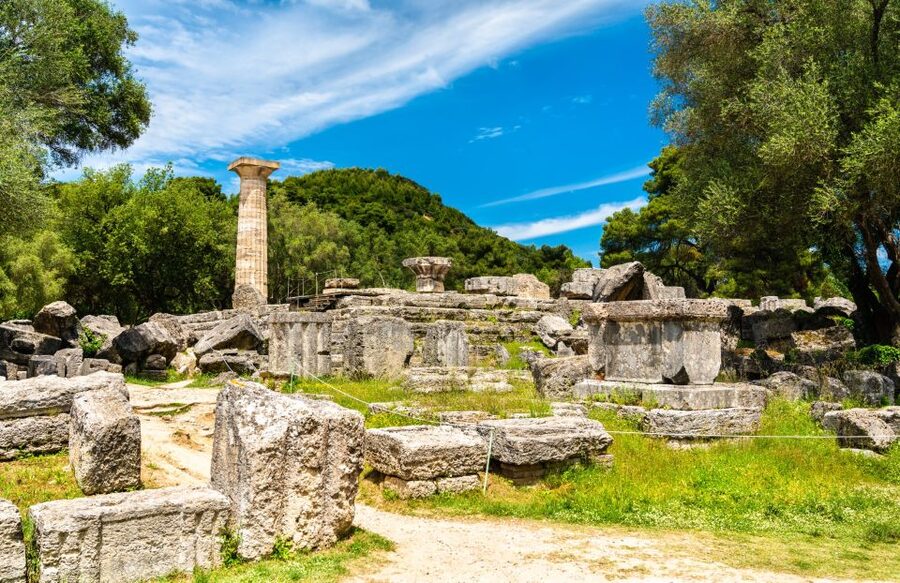
This audio tour includes the Temple of Zeus as a highlight, along with the Ancient Stadium and the Heraeon. What makes that pairing good is that it covers two different sides of Olympia: the religious center and the athletic spectacle.
The Heraeon deserves attention, and the tour does that by keeping the narration focused on what you’re actually standing near. Instead of treating these as generic “ruins,” you’re guided through what the structures meant and how they fit into the larger Olympia story.
Ancient Stadium: a place you can understand by walking
The Ancient Stadium is one of the best places in Olympia to slow down. Even without expert architecture knowledge, the shape and scale help you grasp why these events mattered.
The audio tour’s value here is in how it frames what you’re seeing. You’re not just looking at empty stone seating; you’re listening for context—why this was a stage, and how the Olympic tradition shaped the identity of the site.
If you tend to get impatient with long museum explanations, you might love this part most. Walking through the stadium area with narration can feel like stepping into the original rhythm: start, pause, look, then move on.
Pheidias workshop, Nymphaion, and the “less obvious” Olympia
Olympia isn’t only temples and sporting grounds. Some of the most interesting moments can be the structures tied to craftsmen, water, and daily civic life.
This tour highlights places like:
- Pheidias workshop
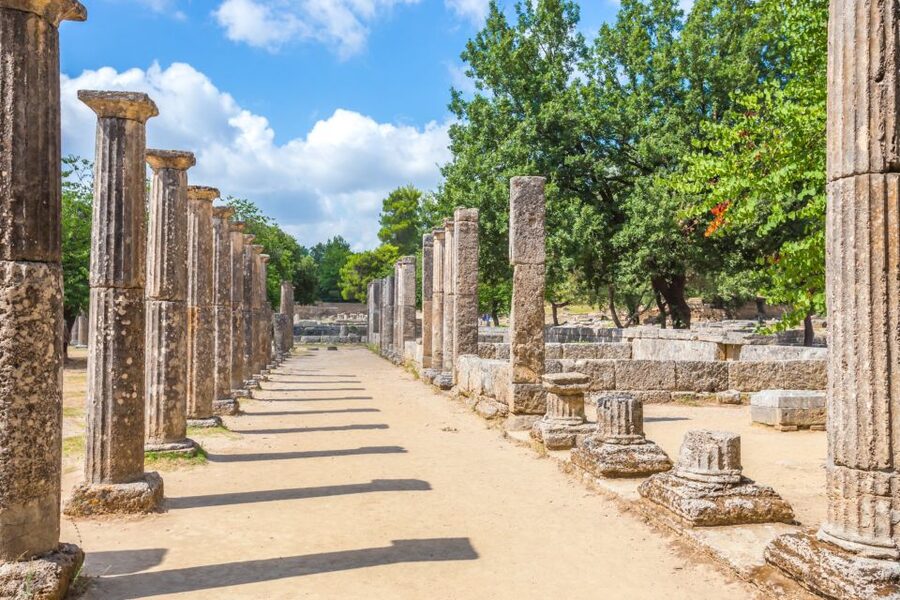
- Palaestra
- Nymphaion
The reason these stops matter is that they round out Olympia. You start thinking about Olympia not only as a yearly festival, but as a working space with practical needs—training, maintenance, and people doing real jobs.
And since the tour ends at the entrance of Pheidias’ workshop, you’re encouraged to finish with the creative and technical side of the world behind the myths. That ending point can feel satisfying: the story closes with people, not just monuments.
Gymnasium, Palaestra, and the civic buildings: you’ll connect the dots
One of the tour’s stronger ideas is that it doesn’t isolate the athletic parts. It connects them to the broader environment you’re walking through.
You’ll hear narration that takes you through areas such as the Gymnasium and the Palaestra, then continues into civic and religious-adjacent buildings like:
- Prytaneion
- Philippeion
- Temple of Hera (connected to the Heraeon highlight)
Here’s the practical takeaway: these named stops give you a mental framework. Even if you don’t retain every Greek term, you’ll understand that Olympia had an everyday “system”—training spaces, public buildings, and sacred structures woven together.
That’s also why a self-guided format works. When you can pause at a specific building and let the audio explain it, your brain has an anchor. You’re not relying on memory alone after the fact.
How to prep your phone so the day stays smooth
This experience lives or dies on one step: download everything before you go.
After you book, you’ll receive an email with instructions for accessing your ticket and audio. Plan to do the setup ahead of time, ideally at home or somewhere with reliable Wi-Fi.
Audio is offline, including text, narration, and maps, but you’ll need storage space—expect about 100–150 MB on your device.
You also want your phone battery charged. Headphones are not included, and at least one reviewer reported using the phone speaker instead when they skipped earphones. Still, for a more comfortable visit—especially if it gets crowded—bring headphones.
Smartphone compatibility you should check now
The audio tour works on Android (version 5.0 and later) and iOS smartphones, but it’s not compatible with Windows Phones, and it also doesn’t support older Apple models listed like iPhone 5/5C and older iPod Touch and iPad models.
If you’re traveling with older devices, don’t wait until you arrive. Do a quick test before you leave your hotel.
What’s included, what’s not, and how to plan your time
Included with your purchase:
- Archaeological Museum of Ancient Olympia entry (selected time slot)
- Archaeological site of Ancient Olympia entry (anytime on the date)
- Olympia Ancient Olympic Games Museum entry (anytime on the date)
- Self-guided audio tour for the archaeological site on your smartphone
- Offline content (text, audio narration, and maps)
Not included:
- Live guide
- Smartphone or headphones
- Self-guided audio tour for the museum
- Food and drinks
- Transportation
This means your best strategy is to plan your day around walking and listening, then using the museums as “bookends.” If you want deeper museum interpretation, you’ll likely need to rely on museum signage there, since the audio is specifically for the archaeological site.
Also consider timing realistically. One review noted the audio tour took about 1 hour for the archaeological site portion, but your total time on the ground will be longer once you add museum time, breaks, and picture stops.
Practical tips: shoes, shade, and using audio without stress
Comfort matters at Olympia. You’ll want comfortable shoes because you’re walking across an archaeological complex.
For sun protection, bring a hat and sunscreen. Shade is limited, and one review recommended adding things like a hat or umbrella-like shade if you get heat-sensitive.
Logistically, keep luggage light. Oversize luggage and large bags are not allowed. This matters for museum entry checkpoints, and it can affect how painless your arrival feels.
How loud should your audio be?
Some visitors use headphones for privacy and clarity, while others have used the phone’s speaker. If you’re with family, the speaker can be a simple option. If you’re alone, headphones make it easier to hear narration clearly while you focus on each landmark.
Accessibility reality check (so you don’t get surprised)
This is a place with mixed accessibility. The information provided says parts of the site are not wheelchair accessible.
The main entrance is where the museum is located and involves steps, which can be a barrier. The guidance offered is that people with lesser mobility may want to use the other entrance.
If accessibility is a key concern, I’d treat this as a pre-planning moment: check route expectations at the site and plan your day around what parts you can physically reach.
Languages: better than hunting for translation
Audio support is available in English, German, Italian, French, and Spanish. That’s a helpful detail if you’re traveling as a group with mixed languages.
It also means you can set expectations early. Everyone can listen to the same guide in their own language while still following the same on-site route.
Combining it with other tech: good if you want more, not necessary
One review described pairing the audio guide with VR glasses from a different company, calling the combination fantastic. That tells me something important: this audio tour is a strong base, and it can work alongside other add-ons if you already planned for them.
But the audio experience doesn’t depend on VR. It’s designed to stand on its own as a clear, self-paced way to understand Olympia’s main zones.
Should you book Olympia with this audio-and-ticket option?
Book it if:
- You want a hassle-free entry with e-ticket convenience
- You like exploring at your own pace and don’t want a set-group rhythm
- You’re okay doing a one-time download and setup on your phone
- You want clear narration focused on multiple landmarks, including Zeus’ temple, the stadium, and sites like Palaestra and the Nymphaion
Skip or rethink it if:
- You need a live guide for questions and real-time explanations
- Your phone is old or you’re unlikely to have storage/battery to handle offline audio
- You’re counting on full wheelchair accessibility across the whole complex
If your goal is to leave Olympia feeling like you actually understood the place—not just seen it—this is a smart way to do it. The combination of timed museum access and an audio route that guides your walking gives you structure without stealing your freedom.
FAQ
Where does the self-guided audio tour start?
The audio tour is designed to start at the Gymnasium inside the Archaeological site of Olympia.
Where does the self-guided audio tour end?
It ends at the entrance of the workshop of Pheidias inside the archaeological site, at Archaia Olympia 270 65.
Is there a meeting point for this experience?
No, there is no meeting point. The tour starts at the Gymnasium inside the archaeological site.
What do I receive after booking?
You receive an email with instructions to access your e-ticket and to download the audio tour onto your smartphone.
Do I need headphones?
Headphones are not included. You’ll need headphones for the audio, though one review mentioned using the phone’s loudspeaker.
Can I use the audio guide offline?
Yes. The tour includes offline content, including text, audio narration, and maps.
Is there a live guide included?
No live guide is provided. This is a self-guided audio experience.
Which parts of Olympia are included with the ticket?
You get entry to the Archaeological Museum of Ancient Olympia (for a selected time slot), the Archaeological site (anytime on the selected date), and the Olympia Ancient Olympic Games Museum (anytime on the selected date).
Which languages are available for the audio guide?
The audio guide is available in English, German, Italian, French, and Spanish.
What smartphone devices are compatible?
Android is supported on version 5.0 and later. iOS smartphone is required. It is not compatible with Windows Phones, and it also lists older iPhone/iPad/iPod Touch models as not supported.
Are there bag restrictions?
Yes. Oversize luggage and large bags are not allowed.