REVIEW · IRELAND
Maria Edgeworth Center-A Self-Guided Audio Tour
Book on Viator →Operated by Maria Edgeworth Centre · Bookable on Viator
Maria Edgeworth has a way of surprising you. This self-guided audio tour at the Maria Edgeworth Visitor Centre turns a literary figure into a real person, with an on-site story of family life, education reform, and 18th- and 19th-century Ireland.
I love two things here: the 19th-century school-room recreation that makes the themes easy to picture, and the fact that you get an admission ticket included for a low, fixed price. The one drawback to plan around is that this is self-guided, so if you want lots of back-and-forth with a live guide, this may feel a bit quieter than other options.
In This Review
- Key highlights you should know
- Entering the Maria Edgeworth Visitor Centre: A Small Place With a Big Focus
- The Self-Guided Audio Flow: What You’ll Hear in the Visitor Centre
- Maria Edgeworth, Richard Lovell Edgeworth, and the Enlightenment Era
- The Recreated 19th-Century School-Room: Where Hedge Schools Come Alive
- Primary School System of 1831: A Timeline You Can Actually Use
- Museum Artifacts: The Tangible Stuff That Makes Stories Stick
- Staff Welcome and Your Pace: How the Visit Feels in Real Time
- Price and Value: Why $9 Makes Sense for This Kind of Tour
- Getting There and Practical Tips That Matter
- Who This Tour Suits Best (and Who Might Want a Different Option)
- Should You Book the Maria Edgeworth Centre Audio Tour?
- FAQ
- How long does the Maria Edgeworth Centre self-guided audio tour take?
- What is the price for the audio tour?
- What language is the audio tour offered in?
- Do I get a mobile ticket?
- Is admission to the visitor centre included?
- Can service animals enter the centre?
- Is the visitor centre near public transportation?
- Is there free cancellation?
Key highlights you should know
- Audio-first storytelling inside a recreated old school-room setting
- Hedge Schools explained, plus how education moved toward a government priority
- A clear timeline that reaches the Primary School System of 1831
- Maria Edgeworth’s connections to major literary names across Britain and beyond
- Artifacts on display, including items dating back to the 18th century
- Easy visit length, roughly 1 to 1.5 hours, ideal as a focused stop
Entering the Maria Edgeworth Visitor Centre: A Small Place With a Big Focus
This experience is built around one main address: the Maria Edgeworth Visitor Centre. Instead of scattering your time across multiple distant sites, you concentrate on one well-set story—Maria Edgeworth, her father Richard Lovell Edgeworth, and what their ideas meant for education in Ireland.
You’ll also like the setting if you enjoy rooms that feel “period correct.” Several visitors point to the old-school building feel, with a layout that makes it simple to move from one point to the next without getting lost. It’s the kind of stop that works even if you’re not a die-hard history person, because the audio keeps the human scale front and center.
If you’re arriving in Edgeworthstown for a day of walking, browsing, and eating at a slow pace, this is an ideal counterweight. You can get your bearings, learn a lot, and still leave without feeling stuck for the whole afternoon.
The Self-Guided Audio Flow: What You’ll Hear in the Visitor Centre
The whole experience is essentially one audio journey. You start at the Maria Edgeworth Visitor Centre, then the self-guided audio tour guides you through Life & Times of Maria Edgeworth.
Here’s what the audio does well: it doesn’t treat Maria like a name on a page. It places her in context—her era, her family, and the world she moved through. The goal is to help you understand why she was such a celebrated novelist in her time, including her place alongside contemporaries like Jane Austen and Byron.
The audio also links Maria’s story to her father, Richard Lovell Edgeworth. He’s presented not just as a family figure, but as an inventor, surveyor, and educator—so you understand the “idea engine” behind the household. That matters because education is the theme that keeps returning, even when the narrative shifts to literature and Irish life.
Maria Edgeworth, Richard Lovell Edgeworth, and the Enlightenment Era
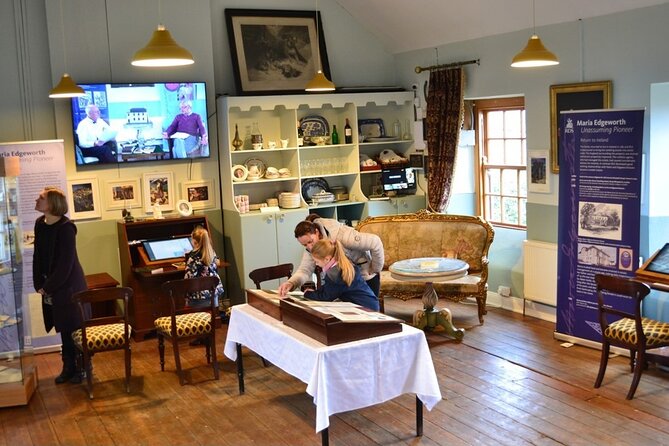
Maria Edgeworth is often associated with novels, but the centre frames her as more than an author. The audio emphasizes her role as a major English-language writer of the period, and it ties her success to a family culture that prized learning.
I like this approach because it gives you two entry points. If you’re into books, you’ll appreciate her standing among famous writers. If you’re into how societies work, you’ll notice the education thread that runs through the story.
The centre also connects the Edgeworth family to other big names, which gives you a satisfying “who was where” feeling. You’ll hear about connections involving Oliver Goldsmith, Sir Walter Scott, William Wordsworth, and Oscar Wilde. Even if you don’t know every author mentioned, seeing the network laid out makes the story feel bigger than one local museum.
The Recreated 19th-Century School-Room: Where Hedge Schools Come Alive
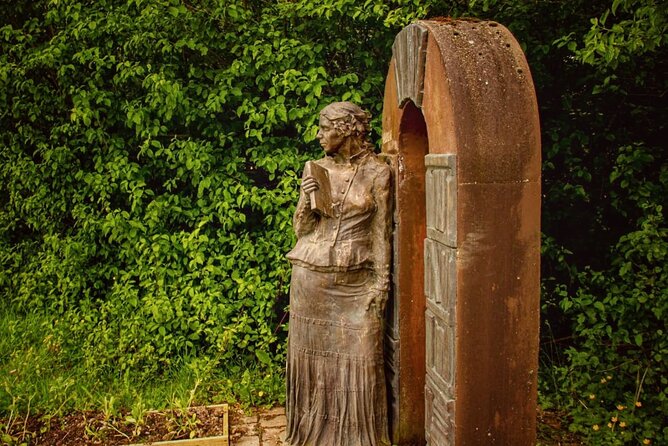
The audio experience includes a recreation of a 19th-century school-room, and that’s one of the standout parts of the visit. When you’re hearing about schooling in Ireland, visuals help. In this room, the story becomes easier to grasp because it’s not just lecture-style facts.
This part of the tour focuses on the origins of Ireland’s Hedge Schools. Those were educational spaces created outside the mainstream system—often small, often local, and built to solve a problem when formal schooling wasn’t accessible. The audio explains this context in plain terms, so the “why” behind Hedge Schools lands quickly.
Then the tour brings you into the next phase: the Edgeworth family’s efforts to make education a government priority. If you care about how ideas become policy, this is the section that tends to feel most meaningful. It’s not only about what schools looked like; it’s about how education gained structure and legitimacy over time.
Primary School System of 1831: A Timeline You Can Actually Use
One of the easiest ways to remember this visit is that it moves toward a specific turning point: the establishment of the Primary School System in 1831. The audio treats 1831 as more than a date—it connects the reform to the Edgeworths and the education shift that followed.
This is valuable for you because it turns “education history” into a clear story. Instead of bouncing between eras, you get a line you can follow: Hedge Schools, pressure for government priority, and then the more organized system in 1831.
If you’re visiting while you’re already reading about Irish education, this timeline gives you a framework. If you’re not reading anything, you still leave with a sense of cause-and-effect, which is rare in small audio tours.
Museum Artifacts: The Tangible Stuff That Makes Stories Stick
After the audio narrative sets the scene, the museum spaces add weight with artifacts. The centre contains valuable items, including pieces dating back to the 18th century. Seeing objects tied to Maria and her family helps convert what you heard into something concrete.
I find this part especially useful when I’m short on time. A well-designed exhibit gives you instant meaning. You can look, read, listen, and connect back to the audio points without having to “work” for understanding.
The rooms are also set up in a way that makes browsing feel natural. You’ll find portraits, books, and items that help you get a stronger sense of Maria Edgeworth as a real person rather than a distant figure.
Staff Welcome and Your Pace: How the Visit Feels in Real Time
This is a self-guided experience, but you’re not completely on your own. Based on what’s been shared, staff support can make a difference—especially when you arrive and want to start right away.
Some visitors mention being welcomed by people like Matt and Janine, and that quick, friendly orientation can help you make the most of the audio. If you’re the type who likes to ask one or two questions up front, you should be able to get a helpful starting point.
And because the format is self-guided, you set your pace. You can slow down for the school-room section, or skim a little if you’re mainly there for the literary connections. The whole visit is designed to fit into about 1 to 1.5 hours, so it doesn’t quietly steal your whole day.
One more practical note: one visitor mentioned it would have been handy to have payment options sorted out for quieter times. That’s not guaranteed for every visit, but it’s a good reminder to carry a card as a backup if you’re in the habit of relying on cash.
Price and Value: Why $9 Makes Sense for This Kind of Tour
The price is $9.00 per person, and it’s hard to beat as value—especially because admission is included. You’re paying for more than a room entry fee. You’re getting a story you can follow on your own time, with audio content that connects Maria Edgeworth to education reform and Irish schooling.
At this price point, you should treat it as a high-impact stop, not a long academic session. If you spend the full 1 to 1.5 hours and actually listen, you’ll leave with more context than you’d get from a quick skim.
Also, the centre is one place, so you’re not dealing with transit time between sites. When you’re budget-minded and time-minded, that matters more than people think.
Getting There and Practical Tips That Matter
The centre is near public transportation, which makes it easier to fit into a route around Ireland without needing a car plan. If you’re traveling on foot between other sights, you’ll also like that the space is walkable inside, with rooms designed for an easy flow.
The tour is offered in English, so you won’t need to rely on translations. Confirmation is received at the time of booking, which is convenient if you like to have everything ready before you arrive.
Service animals are allowed, and most people can participate. If you’re traveling with mobility needs, you might find the experience manageable because it stays in one venue, but the tour format doesn’t specify step-free details—so if you have specific needs, it’s smart to check with the centre before you go.
Who This Tour Suits Best (and Who Might Want a Different Option)
This tour is best for you if you like:
- Literature with real-world context
- Education history that explains how schooling changed over time
- A short, focused visit that doesn’t require a tight schedule
It’s also a great match if you’re tracing personal connections to Edgeworthstown or the Edgeworth family. One visitor mentioned family connections and left excited to read Maria’s books afterward. That’s the kind of emotional payoff this place can create: it gives you a reason to go read more.
You might want to choose something else if you prefer fully guided experiences with lots of live Q&A. This is designed for listening at your own pace, and that can be perfect—or not enough—depending on your travel style.
Should You Book the Maria Edgeworth Centre Audio Tour?
Yes, if you want a smart, low-cost stop that teaches you how one family’s ideas tied together literature and education. For $9 and roughly 1 to 1.5 hours, you get audio storytelling, a period school-room setting, and artifacts that help the narrative land.
Book it if you’re:
- interested in Irish education history (Hedge Schools and 1831 reform are big themes)
- curious about Maria Edgeworth beyond the books
- looking for a calm, self-paced museum moment that still feels substantial
Skip it only if you strongly prefer a live guide for context and conversation. Otherwise, this is the kind of place that rewards paying attention—quietly, clearly, and on your own terms.
FAQ
How long does the Maria Edgeworth Centre self-guided audio tour take?
It’s listed as about 1 hour to 1 hour 30 minutes.
What is the price for the audio tour?
The price is $9.00 per person.
What language is the audio tour offered in?
The audio tour is offered in English.
Do I get a mobile ticket?
Yes, the experience uses a mobile ticket.
Is admission to the visitor centre included?
Yes, the admission ticket is included as part of the experience.
Can service animals enter the centre?
Service animals are allowed.
Is the visitor centre near public transportation?
Yes, it’s near public transportation.
Is there free cancellation?
Yes. You can cancel for a full refund up to 24 hours in advance of the experience’s start time.